With help from a state grant, the new Cape Ann YMCA will be able to provide more space for in-house educational opportunities for young children.
The new YMCA, which is slated to open in the fall of 2020 at the site of the former Fuller School, will include, among other features, an expanded early education center with more staff and programming than is currently offered in the Y’s building on Middle Street. This will be funded, in part, by a $1 million capital grant the YMCA of the North Shore — the parent entity of the Cape Ann Y — received from the Baker-Polito administration.
The grant award also brings the Cape Ann Y’s overall capital campaign to a total of $20.4 million, closing in on the $22 million fundraising goal for the new complex.
“We are so grateful to the Children’s Investment Fund, the Department of Early Education and Care, and the entire Baker-Polito Administration team for their overall commitment to high-quality, affordable early learning across Massachusetts,” said Chris Lovasco, President and CEO of YMCA of the North Shore. “Our Cape Ann Y is honored to have been selected and truly appreciates the confidence the administration has expressed in our Y’s ability to deliver on its mission here in Cape Ann.”
The plan going forward is for the new Cape Ann YMCA to have a state-of-the-art licensed childcare space.
“It is going to be 6,000 square feet,” Cape Ann Y’s Executive Director Tim Flaherty said. “That does not include shared spaces.”
The entire new facility will have 65,000 square feet of recreational and educational space, compared to 44,000 square feet now at the Middle Street location.
The new early education space and increased staff will allow the Y to accept infants into its programs and increase space for toddlers to play and learn. This, in turn, is expected to enable the Y to double its enrollment in early education programs.
In 2019, the Cape Ann YMCA provided early education (including preschool) and after-school care for more than 200 children while offering more than $150,000 in financial assistance.
“With this increased enrollment, we are going to help all people from those who can’t afford to those who can afford child care,” Flaherty said. “It is going to be reflective of the community.”
The Cape Ann YMCA was one of six agencies in the state to receive this money in Early Education and Out of School Time capital improvement awards to establish Early Learning Centers and to repair and renovate facilities serving children from low-income households.
The other agencies receiving grants of $1 million each include the YMCA of Cape Cod, Greater Lawrence Community Action Council, Greater Lowell Family YMCA, Horizons for Homeless Children in Boston, and YWCA of Central Massachusetts.
As the YMCA’s dream of a new Cape Ann location begins to draw closer to reality, they are looking to the next few months as instrumental ones in reaching their fundraising goal of $22 million.
“The Y continues to push to the finish line to reach its goal by raising the final $2 million in the coming months,” said Pam Sullivan, of YMCA of the North Shore.
Anyone interested in volunteering to help the campaign may contact the Y’s Chrissy Cahill at cahillc@northshoreymca.org
Construction is Underway at Sycamore on Main in Brockton as MassHousing Closes $4.7 Million in Financing for the New, Mixed-Income Housing Community
SourceMassHousing
10 Boston developments to watch in 2020
So far, Boston’s building boom shows no signs of abating in 2020.
In the last six years, the Boston Planning and Development Agency has permitted about 65 million square feet of new development and the city has seen more than 60 million square feet built in that time, according to the city agency.
Even as some of the city’s most transformative projects of the last decade, like Hub on Causeway, continue to inch higher into the sky in 2020, we asked Jonathan Greeley, director of development review for the BPDA, to name some of the notable developments the public should keep an eye out for in 2020.
“One of the things the city is trying to do is respond to tremendous residential demand,” Greeley said. “In addition to responding to that residential demand by hopefully permitting and building as many units as possible, we’re trying to find a way to maximize the amount of those units being affordable. We put our money where our mouth is.”
The director of development review said that in 2019, guided by goals established with the city’s 2030 plan, 20 percent of all the units the BPDA approved were affordable. Officials, he emphasized, are constantly thinking about how to plan and facilitate “proper growth” in Boston.
“We want to make sure we’re creating a thriving city for all Bostonians,” he said of the efforts.
Below, 10 projects in Boston that will be ongoing or kicking-off in the coming year.
Renderings of Winthrop Square Tower. —Handel Architects
Work on the new residential and office tower at 115 Winthrop Square will push on in 2020, Greeley said.
“What’s exciting about this year is you’re going to start to see it come out of the ground,” Greeley said. “They’ve been doing a lot of work below the surface.”
The almost 1.6 million-square-foot project, on the site of the previously city-owned, shuttered Winthrop Square Garage, will feature residential, office, retail, and dining space. The tower, which will stand 691 feet tall, will contain a “Great Hall” at its base to serve as a public space.
Greeley emphasized that the project is a “one-two” punch for the city. Not only will it create new, mixed-use space, but it will contribute to other efforts city-wide. He said notably it will bring “significant investment” to the area around the site, including infrastructure improvements to Winthrop Square and the nearby park. But money from sale of the site to Millennium Partners will generate more than $150 million in funding for the City of Boston, which is slated for efforts including improvements to the Boston Common and Franklin Park and affordable housing.
“Most importantly it’s going to help to fund an all-affordable building in Chinatown,” Greeley said.
“[Winthrop Square] is a great example of a public/private partnership on public land to deliver a wide variety of results, which will add improvements on the site, but also in and around the neighborhood they sit in,” he added.
Work to redevelop the former headquarters of the Boston Globe got underway in 2019 and will continue in 2020 as the developers search for a wide variety of tenants to fill the building, Greeley said. The new name for the property at 135 Morrissey Blvd., “The Beat,” stands for “The Boston Exchange for Accelerated Technology” and pays homage to the “beat” reporters who used to call the site home.
“What’s exciting there is that they took a look at the site and said, we’re not going to demolish the whole thing, we’re going to re-envision the whole thing,” Greeley said. “So if you drive by it today, either from Morrissey Boulevard or the highway, you’ll see they are gutting and rebuilding the building.”
Development firm Nordblom envisions reconfiguring the 695,000-square-foot building into both tech and traditional office space, while maintaining ground floor use for neighborhood amenities that could serve nearby Savin Hill.
“One of the things that project has done is make sure there are pedestrian connections through Savin Hill,” Greeley said. “So they want to make sure that it’s not just ground floor uses and ground floor retail amenities that serve the building — they want those uses to be enhancements to the neighborhood as well.”
Greeley said the project is one of several exciting development efforts around the Columbia Point peninsula, and the city believes the approach taken for the “The Beat” is a precursor to other projects that could follow in and around the JFK/UMass area.
A rendering of the Fenway Center project. —The Architectural Team
Both Phase I and Phase II of the enormous development will be underway in 2020, Greeley said. When completed, the $500 million construction project will comprise four buildings and a parking garage that will extend along, and above, the Mass. Pike.
Phase 1, which features the construction of two buildings on Brookline Avenue and the creation of about 312 new residential units, broke ground in 2018 and is expected to be ready for occupancy in 2020.
“Those two new buildings will bring some life to that area, which again, it’s been a series of surface parking lots for a long time,” Greeley said of the project.
In 2020, Greeley said the BPDA is also expected to hear proposed changes to Phase II of the project, which would feature the construction of a 27-story tower above the Mass. Pike. The change would bring more space for office and life science tech to the site, replacing about 150 housing units originally planned for the site.
“We’re currently reviewing that project — those alterations,” he said. “And that project could be considered by our board in the first half of 2020.”
When the second phase over the Mass. Pike moves forward, it will be one of two so-called “air rights” projects, the first in decades, predicted to get underway in 2020.
“That’s something that was the subject of long-term planning efforts in partnership between the city and state, and we’re really thrilled to see that piece of the project go forward, built over the turnpike,” Greeley said.
Renderings of the Government Center Garage redevelopment project. —BPDA
By the end of 2020, Greeley said he expects to see the first phase of the downtown project, which will ultimately create six new high-rise and mid-rise buildings, completed.
The project includes 800 new residential units in two towers and more than 1 million square feet of office space, with the new corporate headquarters for State Street anchoring a retail tower at One Congress.
As the project moves forward, Bostonians can expect to see the existing Government Center Garage on Congress Street come down, Greeley said.
“[It’s] a dramatic change to the downtown neighborhood,” Greeley said of the project. “A dramatic change in the daylighting of Congress Street and I think just a really pleasant removal of a barrier between Government Center and North Station.”
Rendering of the proposed Back Bay Station redevelopment. —Courtesy of Boston Properties / Pelli Clarke Pelli Architects
The 1.26 million-square-foot mixed-use project that will rise above and adjacent to Back Bay Station is one the city hopes will reach into the skyline in 2020.
Some elements of the project — which features a new office building with ground floor retail, two new residential buildings, an expansion of the existing station, and redevelopment of the 165 Dartmouth Street Garage — are already already underway, Greeley said.
Improvements within Back Bay Station, such as redoing the bathrooms, are already underway as part of the project. The MBTA is responsible for platform level investments, but developer Boston Properties is responsible for the station renovations itself.
“That work is starting now,” Greeley said. “We hope and anticipate that Boston Properties will start construction in 2020 on one of those three towers.”
A rendering of the proposed development at Suffolk Downs. —Provided by BPDA
Greeley said the hope is that redevelopment of the East Boston site can get underway in 2020, pending an ongoing community review and approval by the BPDA board.
“The goal is to return what is kind of largely a surface parking lot with [an] infrequently used racing track and take it and use it to create a dynamic mixed-use community that is really anchored by two MBTA stations on the Blue Line, Suffolk Downs and Beachmont,” he said.
The project from HYM Investment Group proposes during Phase I of the project the creation of 520,000 square-feet of corporate and amenity space, three residential buildings, and town homes for the construction of more than 800 housing units. About two-thirds of the 150-acre plot sits in Boston, with a third falling in Revere.
About 40 acres of the development are proposed to remain unbuilt, serving as a mix of parks and open space, Greeley said.
“It’s going to be a really, really dynamic space and will truly be a mixed-use project that we’ll see manifest itself over the next 20 years,” he said. “One of the reasons why it’s taken us so long in the review process is that it’s been something we really want to get right, prioritizing a real mix of use, of affordability, of open space, and also making sure the design is just really dynamic as well.”
A rendering of “Building A” at the proposed Allston Yards development. —Stantec via BPDA
The project, proposed at the nexus of Allston, Brighton, and the area surrounding Boston Landing, was approved by the BPDA in December, and Greeley said he anticipates construction of the new neighborhood to get underway in 2020. The 868-unit mixed-use development would transform the existing Stop & Shop plaza at 60 Everett St. into a “transit-oriented” neighborhood featuring open space, a flagship grocery store, office and retail space, and residential units.
Greeley said the project will also create a new roadway network for better connectivity through the neighborhood and has subsidies for local transit in and around Allston/Brighton, including to help fund more frequent MBTA service for rail and bus.
“[It’s] a great mixed-use, dynamic project,” he said. “The project is getting 17 percent affordability on site and will fund another 40-plus units of affordable [housing] offsite throughout the neighborhood. So we’re really excited for the potential of that project.”
A rendering of the Dot Block project. —Provided by the BPDA
This project, located on almost an entire city block along Dorchester Avenue, first won approvals from the BPDA in 2016 and has gone through several iterations since then. A revised proposal for the project was approved in 2019, and Greeley said the hope is that it could break ground in 2020.
The project at 1205 Dorchester Ave. would include the construction of four new buildings that would contain 488 residential rental units, about 23,000 square feet of commercial space for neighborhood-oriented retail and restaurant space, as well as 1.34 acres of open space.
“That site will take what was essentially a derelict site, not a lot going on, and bring much-needed housing to the neighborhood, as well as breaking up a very large development site with new roadways and public realm,” Greeley said. “And we’re excited because it’s investment in an area that hasn’t seen as much investment traditionally, and so it would also set the tone for the types of development we want to see there long-term.”
A rendering of the proposed Mattapan Station project. —Provided by the BPDA
Construction on this $57 million mixed-use project is anticipated to start in the spring of 2020. It will feature the construction of 135 units of mixed-income apartments for rent and 10,000 square feet of commercial and retail space at 500 River Street.
Located beside the Mattapan MBTA station, it is being heralded as a transit-oriented development project that will provide affordable and market-rate housing to the neighborhood.
“We are excited to see investment in Mattapan and in the Mattapan Station area,” Greeley said. “This is a good project.”
A rendering of the proposed Pine Street Inn development for Washington Street in Jamaica Plain. —RODE Architects via Boston Planning and Development Agency
Pine Street Inn formally filed plans with the BPDA last March to construct the 225-unit building at 3368 Washington St., with the aim of serving chronically homeless disabled adults. The proposal won board approval later in the year, and Greeley said he hopes the project will secure its needed financing in 2020 in order to break ground and be under construction by the end of the year.
“One of the things that we’ve been able to do over the course of this year is that 20 percent of all new units throughout the city have some sort of deed restriction making them more affordable to Bostonians,” Greeley said of the project’s importance. “This project has a higher percentage and is an example of a nonprofit working really hard to fulfill their mission. So we’re really excited about the mission-driven outcome of this project in a neighborhood that has been really, really receptive to that type of use.”
Of the 225 affordable residential units in the six-story building, 140 would be reserved for supportive housing for individuals being served by the Pine Street Inn. The remaining 85 units would serve households earning between 60% and 80% of area median income.
SourceRealEstate
Women-led YWCA construction project breaks ground in Worcester
Poised to “meet the challenge of the new downtown,” as YWCA Central Massachusetts President Roberta Brien announced, the all women-led construction team for the YWCA’s $24 million renovation broke ground Thursday morning.
The ceremony, attended by some 50 people, was held inside the YWCA’s gymnasium, because of frigid temperatures. Thirteen project and organization executives and contributors dug shovels into a large sandbox as cameras clicked.
The construction project at 1 Salem Square features building system upgrades, a new two-floor early education and care center, expanded transitional housing units, increased space for domestic violence services, reconfigured wellness and health areas and overall site enhancement, including a shared play area with Worcester Public Library.
YWCA’s $7.5 million capital campaign has already received $5.25 million in pledges, said YWCA President-elect Christienne Bik.
The state has committed $3.6 million in bond funds.
Included in that, the YWCA received a $1 million Early Education and Out of School Time capital improvement grant in December through the Department of Early Education and Care, one of six grant recipients to receive the largest investment the state has made in child care facilities, said Early Education and Care Commissioner, Samantha Aigner-Treworgy.
What makes the project unusual is that its field management and supporting staff teams are all women.
“We knew that their (YWCA’s) mission was empowering women,” said Jody Staruk, project executive for Consigli Construction, the project’s construction contractor.
When Staruk was approached to arrange a team, she said, “I had a significant pool of women to pull from.”
Women conduct the estimates, preconstruction management, virtual design and construction modeling, and superintendent and engineer positions in the field, Staruk said.
While women have worked on numerous separate teams, to pull them together on one project is a first for Consigli.
The owner’s project manager, Pinck & Co., an Anser Advisory company, and architects Fennick McCredie Architecture Ltd. are also part of the women-led team.
“When we sit in a meeting, it’s a dozen women in the room, solving world problems and getting work done,” Staruk said.
She called the process, “collaborative and creative.”
Women aren’t just involved in leading the project. Some women working on site will have come through the Worcester Jobs Fund, a training program for low-income residents.
“Because the percent of women working in construction is so low, a lot of women don’t think of construction,” despite the high pay, said Kelsey Lamoureux, director or the Worcester Jobs Fund. The program is housed at MassHire’s Central Region workforce board.
She said that nationally, 3% of workers on construction sites are women. In Massachusetts, it’s closer to 8% to 9%, with union efforts helping to push the numbers.
Women make up about half the training program in Worcester.
Lamoureux said she was looking for more women interested in construction for the next training program, which begins at the end of February.
Construction started last week and is expected to finish by the end of the year.
SourceTelegram
Worcester YWCA begins $24M renovation
The YWCA Central Massachusetts began construction Thursday on a $24-million renovation of its Worcester facility.
The construction project has already hit a milestone: what the nonprofit says is the city’s first community benefits agreement, which ensures an all-women led construction management team. It’ll also promise living-wage jobs with benefits, and an emphasis on diversity by employing union contractors, local women and people of color.
The project will remake the YWCA’s Salem Square location with a relocated playground, a new shared play area with the Worcester Public Library, and four new rooms for residents to stay in the transitional housing program. Other improvements include an increase space for domestic violence services and the addition of a multi-use fitness area.
Other work is more utilitarian, including upgrading heating and air conditioning, repairing roofs and installing new windows and doors. The work is set to take about one year.
The YWCA Central Massachusetts was one of six community nonprofits to win a $1 million grant each in December from the Gov. Charlie Baker Administration and the Massachusetts Community Economic Development Assistance Corporation. The funds support facility improvements at early education and care programs that serve low-income children.
SourceWorcester Business Journal
Greater Lowell YMCA receives $1 million for renovations
Smiling kids smear green paint on paper plates. It’s Christmas Eve, and children in the Greater Lowell YMCA’s school-age care group are crafting cone-shaped pine trees.
The students crowd around tables in a room used for lunch, arts and crafts, STEM activities and small indoor games.
“Right now, we have such a limited space,” said Assistant Childcare Director Brittany Laferriere, wearing a Santa Claus skirt and green light-up earrings.
“There are so many things I’ve wanted to do and not been able to do,” she added.
But that is about to change.
With the help of a $1 million grant from the state, the YMCA will soon have a much larger space for its youth programs, with a new computer lab, a playground and more.
The Baker-Polito Administration and the Community Economic Development Assistance Corporation on Dec. 19 announced $6 million in Early Education and Out of School Time capital-improvement grants to six early-education and care programs serving low-income children.
“Our administration is pleased to support facility improvements at early-education and care programs throughout the commonwealth to provide families with the resources necessary for success in and out of the classroom,” Gov. Charlie Baker said in a news release.
The grant will help the Greater Lowell YMCA fund a $3.275 million project to include 9,500 square feet of renovations, 927 square feet of new construction and the addition of a 2,100-square-foot playground.
“The environment that they will have access to will be top-notch,” Greater Lowell YMCA CEO Kevin Morrissey said, referring to local children who can make use ot the playground.
Outdated preschool classrooms will be revamped with carpeting and new bathrooms, and a community and teen annex is planned. A rear entrance will also be added to completely separate child-care space from other YMCA facilities.
“It will be a huge increase in security,” Morrissey said.
The renovations will allow the YMCA to more than double the capacity of its youth programs. There are currently 50 preschool and 75 school-age students enrolled in the programs.
“It’s a safe environment for the children to come learn,” Morrissey said, adding that kids are able to socialize with others their age.
“There’s a lot of diversity, which makes it more fun to talk to people,” fourth grader Hadassa Perez said as she watched friends spread green paint on their masterpieces.
Construction is expected to begin at the end of January and finish by October 2020. The project will make the space “a lot more conducive for learning and especially safety,” Morrissey said.
A typical day in the YMCA’s after-school program consists of snacks, homework help, and physical or themed activities, such as constructing the paper pine trees, Laferriere explained. She has worked at the Greater Lowell YMCA for 12 years.
In the renovated space, students will be able to participate in STEM-related activities, use computers for homework, and engage in more age-specific play.
“We can just offer more programs for the kids themselves that they wouldn’t otherwise have,” Laferriere said.
Of the space, she said, “I’m excited to see it be something … that I never could have dreamed.”
SourceLowell Sun
Central Mass. YMCA receives $1M state grant to improve childcare facilities
The YMCA of Central Massachusetts was among six early education providers around the state this month to receive a $1 million grant to improve their facilities.
In total, Gov. Charlie Baker and the state’s Community Economic Development Assistance Corporation announced $6 million in funding would be awarded to the organizations, which serve low-income children in their areas.
“Well-designed buildings, classrooms and play spaces help provide high-quality learning environments in which children grow and thrive,” the state’s Early Education and Care Commissioner, Samantha Aigner-Treworgy, said in a statement. “The $6 million in grant awards this year — the highest amount since the EEOST Capital Fund inception — will support better program settings for over 700 children across the state.”
The YMCA of Central Massachusetts, which operates child development centers at its Westboro, Southbridge, Fitchburg, and two Worcester branches, received the Early Education and Out of School Time capital improvement grant by demonstrating financial need and securing other funding to subsidize the planned building improvements and renovations.
SourceTelegram.com
YWCA Gets Piece of $6 Million Grant from State to Improve Early Ed and Care Programs for Low-Income Kids
The Baker-Polito Administration and the Community Economic Development Assistance Corporation (CEDAC) announced $6 million in grant awards for facility improvements at early education and care programs that serve low-income children.Six agencies, including the YWCA in Worcester, were picked to get an Early Education and Out of School Time (EEOST) capital improvement grant, which will help increase the quality of their early education programs through critical facility repairs and renovations.
The YWCA of Central Massachusetts received $1 million for its greater Worcester facility.
“Our administration is pleased to support facility improvements at early education and care programs throughout the Commonwealth to provide families with the resources necessary for success in and out of the classroom,” said Governor Charlie Baker in a statement. “Renovating and repairing child care facilities helps achieve the administration’s goal of providing quality early education and care in all Massachusetts communities.”
The Early Education and Out of School Time capital improvement grants are financed through the state’s capital budget and provide matching funds that leverage private investment.
SourceThis Week in Worcester
YMCA Cape Cod Receives $1M Grant for Hyannis Early Education
The YMCA Cape Cod has been awarded a $1 million grant from the state to support a new early education center in downtown Hyannis.
The grant was one of six announced Thursday at the Hyannis Village Marketplace on Stevens Street – the location of the new education center which will open next fall.
The 2019 Early Education and Out of School Time Capital Fund Facilities Improvement grant awards were funded through the Department of Early Education and Care, and the Children’s Investment Fund, an affiliate of the Community Economic Development Assistance Corporation.
YMCA Cape Cod will renovate a commercially-zoned office and retail space to develop the early education center that will serve, primarily, low-income families.
The state-of-the-art center will be a tenth of a mile walk from the Hyannis Youth and Community Center, and just one block away from Main Street for immediate access to the Hyannis Public Library, the John F. Kennedy Hyannis Museum and the Cape Cod Maritime Museum.
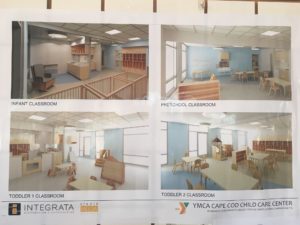
The design includes five classrooms that will be able to serve up to 65 infants, toddlers and preschoolers; an indoor motor play space with doors that open into a natural playscape; urban courtyard; and floor to ceiling windows for natural light.
“One million dollars invested into capital infrastructure for children is exactly what the Cape Cod community needs,” said Stacie Peugh, the president and CEO of YMCA Cape Cod. “We need more of it.”
Designs of a new YMCA Cape Cod early education center planned for the Hyannis Village Marketplace on Stevens Street.
Peugh said she couldn’t be happier that the organization is able to bring the facility to Hyannis to serve children and families.
“There are a hundred families who live in the apartments above these spaces who need services like an early childhood program,” Peugh said.
Peugh said the facility will be transformational and change the culture and feel of the community.
“There is nothing more exciting than seeing children and families play together and learn together,” she said. “It’s what makes it feel like a vibrant community.”
Peugh believes bringing the early education center to the community will be a draw for similar organizations to bring community service opportunities to the area.
Plans for the facility call for the outdoor courtyard area at the property to be converted into an all-natural playground.
“That will actually be utilized not only by the children in the daycare but the residents who live here in the apartments above these spaces,” Peugh said.
Second Barnstable State Representative Will Crocker (R-Centerville) said the new facility will provide a sense of security for parents.
“We have had some shake ups where child care has been going the last six months or so,” Crocker said. “Kudos to YMCA Cape Cod for being able to step in and pick the ball up and continue moving forward.”
Crocker said parents need to know there is going to be a safe and secure environment, and a place where children will be able to grow and thrive, when they drop of their kids.
Crocker said early childhood education is a component of the affordable housing issue on Cape Cod.
“We also need to know that once we get that housing for those families, those families need to know that there is a place for their children to go to be able to be safe, to learn and to thrive,” he said.
Cape and Islands State Senator Julian Cyr (D-Truro) echoed the importance of child care when it comes to increasing access to affordable homes for younger families.
“If you are someone who is trying to make a life here on Cape Cod you have to be working, and if you have a spouse they are probably working too,” Cyr said. “So child care is just a key piece of how we help working families be successful.”
Cyr said providing more options for families will help them to stay afloat.
“For families that are really struggling to make ends meet, this center is going to make a big difference and it is a big deal to have state support for it,” Cyr said.
Cyr said he would like to see every town on Cape Cod support some form of universal pre-kindergarten programs. He cited a voucher-based program in Wellfleet and the work of Mashpee to integrate programs with the schools as possible models for other communities.
“We are struggling to keep our families,” Cyr said. “If you look at where we are going demographically, we are losing younger people. We are losing young families.”
Cyr challenges other towns on the Cape to take up universal pre-K programs at town meetings.
“I think we can do this Cape-wide working with each of our towns before we are able to do it at the state level,” he said.
The announcement of $6 million in grant funding from the state for the six programs was made by Samantha Aigner-Treworgy, the state’s Early Education and Care Commissioner.
The other awardees include Cape Ann YMCA/YMCA of North Shore, which serves the Gloucester area; Greater Lawrence Community Action Council; Greater Lowell Family YMCA; Horizons for Homeless Children, in Boston; and the YWCA of Central Massachusetts, which serves the greater Worcester area.
“All children deserve to learn in enriching environments and their teachers deserve well-equipped facilities,” said Aigner-Treworgy. “The EEOST Capital Fund is creating those environments across the Commonwealth and leveraging additional resources in support of high-quality early childhood education and out-of-school time.”
SourceCapeCod.com
Baker-Polito Administration Awards $6 Million for Early Education Programs
The Baker-Polito Administration and the Community Economic Development Assistance Corporation (CEDAC) today announced $6 million in grant awards for facility improvements at early education and care programs that serve low-income children. Six agencies were selected to receive an Early Education and Out of School Time (EEOST) capital improvement grant, which will help increase the quality of their early education programs through critical facility repairs and renovations.
Early Education and Care Commissioner Samantha Aigner-Treworgy made the announcement at YMCA Cape Cod in Hyannis, the site of one of the facilities funded by the 2019 grant awards.
“Our administration is pleased to support facility improvements at early education and care programs throughout the Commonwealth to provide families with the resources necessary for success in and out of the classroom,” said Governor Charlie Baker. “Renovating and repairing child care facilities helps achieve the administration’s goal of providing quality early education and care in all Massachusetts communities.”
“Since taking office, we have provided over $25 million in funding to 31 non-profit agencies operating licensed child care programs,” said Lt. Governor Karyn Polito. “These critical investments provide safer environments for children to learn in, while providing educators with modernized facilities.”
“These grants were created to help non-profit providers serving children in low-income communities improve their facilities because we know that building deficiencies impact the quality of teaching and learning in early childhood,” said Education Secretary James Peyser.
The Early Education and Out of School Time capital improvement grants are financed through the state’s capital budget and provide matching funds that leverage private investment. The Baker-Polito Administration’s FY19 Capital Budget Plan included funding for the Early Education and Out of School Time capital improvement grant program.
“Well-designed buildings, classrooms and play spaces help provide high-quality learning environments in which children grow and thrive,” said Early Education and Care Commissioner Samantha Aigner-Treworgy. “The $6 million in grant awards this year — the highest amount since the EEOST Capital Fund inception — will support better program settings for over 700 children across the state.”
“All children deserve to learn in enriching environments and their teachers deserve well-equipped facilities,” said Theresa Jordan, Director of Children’s Facilities Finance, CEDAC Children’s Investment Fund. “The EEOST Capital Fund is creating those environments across the Commonwealth and leveraging additional resources in support of high-quality early childhood education and out-of-school time.”
The following organizations received grants:
Lead Agency
Service Area
Award
Cape Ann YMCA/YMCA of North Shore, Inc.
Gloucester
$1,000,000
Greater Lawrence Community Action Council
Lawrence
$1,000,000
Greater Lowell Family YMCA, Inc.
Lowell
$1,000,000
Horizons for Homeless Children, Inc.
Boston
$1,000,000
YMCA of Cape Cod, Inc.
Cape and Islands
$1,000,000
YWCA of Central Massachusetts
Greater Worcester
$1,000,000
“We are so honored to be selected for this transformational funding since Hyannis demonstrates an incredible need for high quality and affordable child care options,” said YMCA Cape Cod President and CEO, Stacie Peugh. “This new early education center located in the heart of downtown Hyannis will offer a state-of-the-art environment with optimal learning opportunities for children led by loving early childhood professionals. The YMCA Cape Cod is thankful for the investment in our children’s future.”
All of the programs selected to receive a grant award serve publicly-subsidized families, have demonstrated financial need and have secured additional funding to pay for a portion of their project costs. The Department of Early Education and Care partnered with CEDAC’s affiliate, the Children’s Investment Fund, to administer the grants. All of the grantees are non-profit corporations or organizations in which a non-profit corporation has a controlling interest.
###
SourceDepartment of Early Education and Care, Executive Office of Education