Cambridge Housing Authority to Provide $153M in Affordable Housing Improvements

The Cambridge Housing Authority (CHA) has provided $153 million in affordable housing improvements through its Public Housing Preservation Plan.

Under the plan, CHA will improve 837 affordable housing units at Washington Elms, Newtowne Court, Manning Apartments, Putnam Gardens and Woodrow Wilson Court.

For most of the units, the improvements will include new kitchens and bathrooms, as well as life safety upgrades and energy efficiency improvements. The projects were designed and certified under the Enterprise Green Communities program, and are partly funded by a $1.6 million contribution from Action for Boston Community Development. When completed, the projects will save upwards of $1 million in energy costs annually, enabling CHA to meet its goal of generating 20 percent of its electricity onsite by 2020.

By CHA’s estimate, the ongoing construction at the developments is creating approximately 897 direct jobs and 1,040 indirect jobs through indirect and induced activities. Additionally, the projects are generating an additional output of $150 million through these indirect activities.

Funding for the projects was made possible through CHA’s use of the Rental Assistance Demonstration, an assistance program run by the United States Department of Housing and Urban Development. CHA also participates in HUD’s Moving to Work program, which provides operating support.

The financing of these projects marks a major milestone for CHA, which is now funding the most capital improvements underway in its 80 years of existence.

CHA and community members celebrated the first phase of the development with an event held yesterday at Washington Elms, one of the five sites under construction. Speakers for the event included Cambridge Mayor E. Denise Simmons and City Manager Richard Rossi, as well as financial partners from Wells Fargo Community Lending and Investment and Citi Community Capital.

SourceBanker & Tradesman

MBHP Tasks Marquilies Perruzzi For New HQ Design

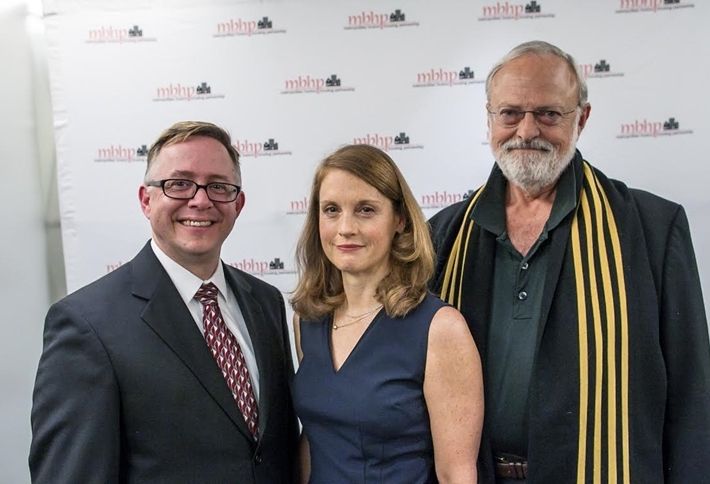
The planned development of the mixed-use One Roxbury Crossing took another step forward this week when the Metropolitan Boston Housing Partnership tagged Margulies Perruzzi Architects to design its new 27k SF HQ at the development. The offices will give the nonprofit room for growth and will allow it to become “one of the many community-focused tenants in One Roxbury Crossing, which is shaping a new urban space in the neighborhood,” says MBHP executive director Chris Norris. He’s show with MBHP board co-chairs Cynthia Lacasse and Steven Rioff at the eighth annual MBHP Founders Celebration. The HQ space will provide work areas and conference rooms for MBHP’s more than 150 employees, who assist residents with navigating the affordable housing process. An important feature of the new space will be the client-facing areas where MBHP staff will meet with their resident clients.
Developed by Mission Hill Neighborhood Housing Services, One Roxbury Crossing will replace a long-vacant, two acre site in Mission Hill. The overall development is being designed by Goody Clancy Architects, and will feature retail, affordable housing and office space near the Ruggles Crossing Orange Line MBTA station. BRA has yet to approve the project.

SourceBISNow

New Affordable Sober Housing For Homeless Veterans Slated For WeymouthJun 7, 2016

MassHousing recently awarded $75,000 to help create six new units of affordable sober housing for homeless veterans in Weymouth.

The grant will come from the Center for Community Recovery Innovations Inc., a nonprofit subsidiary corporation of MassHousing that supports nonprofits that create or preserve affordable sober housing in Massachusetts for recovering substance abusers.

“Substance abuse is one of the biggest obstacles to many of our veterans being able to live independent and productive lives,’’ MassHousing Executive Director Timothy C. Sullivan said in a statement. “This sober housing in Weymouth and in many other places around the state helps these veterans confront and overcome their addiction in a safe and sober setting that increases their chances of success.’’

NeighborWorks of Southern Massachusetts will receive the grant in the latest round of funding and plans to demolish an existing structure and build a new building containing six affordable units for homeless veterans.

Other funding came from the state Department of Housing and Community Development, the town of Weymouth and Blue Hills Bank.

SourceBanker&Tradesman

Communities scramble to keep affordable housing

Communities scramble to keep affordable housing
10 percent of units set to convert to market rate
By Douglas Moser dmoser@eagletribune.com
Jun 5, 2016

Nearly 10 percent of Greater Lawrence’s affordable housing agreements are set to expire by 2019, according to a report by the agency that tracks affordable housing around the state.
About 525 affordable units, out of roughly 5,500 in Andover, Haverhill, Lawrence, Methuen and North Andover, have agreements with either the state or federal government that expire, some of which potentially could become more expensive market rate housing, according to the annual assessment released by CEDAC, a quasi-public agency that tracks and works to preserve affordable housing.
All of those units are in Andover, Haverhill and Lawrence.
Local community development directors said the area is not in imminent danger of losing all of those affordable units because some are owned and operated by so-called mission-oriented organizations, typically nonprofits whose goal is to provide affordable housing for seniors or low-income people.
But for the others that could become market rate, communities have a few tools to use in working with property owners to keep all or some of the units affordable.
“By and large, the owners of the affordable housing in Lawrence are pretty much dedicated to serving their current population,” said James Barnes, director of community development in Lawrence. “That’s the No. 1 safeguard we have to make sure these properties continue to provide good quality housing at affordable prices.”
One example in the city is Rita Hall apartments, a senior apartment building on Hampshire Street. Its agreement with the federal Department of Housing and Urban Development for accepting federal rental vouchers is due to expire this year, but Barnes is confident the building’s owners will continue their relationship with the HUD program.
“If we got wind of the possibility of a current owner wanting to change the status of its occupancy, either quickly or gradually, we would hear about it through one of our partner agencies or tenant organizations,” he said. “We would quickly get involved with those organizations that could provide capital refinancing and work as closely as we could with those agencies.”
The Arlington Park building has an agreement with HUD to accept federal rental vouchers for its 130 units that expires in 2019, and another 55 units at Riverside Commons could become market rate as well, according to CEDAC’s report.
In Haverhill, Andrew Herlihy, director of the community development division, said the city can use a pool of federal funds, called the HOME Investment Partnership Program, for certain renovations or upgrades.
“We can offer them federal HOME funds and we can repoint the brick, or fix the plumbing, the leaky roof, whatever,” he said. “And we do that in exchange for extending the affordable usage. We can usually address the quality of life in these buildings at the same time and extend the affordability of the building.”
According to HUD, the HOME funds are a block grant specifically to fund a building, buying or rehabilitating affordable housing for rent or sale, or for providing direct rental assistance to low-income people.
The money is distributed through local consortia. Essex County’s consortium includes every community in the county except Lawrence and Lynn. According to HUD data, the Essex County consortium received nearly $1.3 million this year. Salem, Massachusetts, received the most, at $233,508, followed by Haverhill at $224,527. Andover, Methuen and North Andover received about $150,000 combined.
In Haverhill, 215 units could convert to market rate in 2019, the largest number in the area. The city lost 131 affordable units last year when One Water Street converted to market rate. In all, 164 units there became market rate, but were offset by 33 new affordable units.
Herlihy said the city made a strategic decision to let those units become market rate because that neighborhood is changing substantially. But those units will be mostly offset with the Tenney Place development on West Lowell Avenue, which will be composed of about 120 affordable units.
Andover could see 123 units across several developments become market rate, and the town faces a special challenge because market rate units can fetch much more than in Lawrence or Haverhill.
“We try to work with property owners to save those units. But a lot of times, the owners are saying look, we have a chance to convert, in this instance we’re talking about 125 affordable units, to market rate,” said Paul Matarazzo, the Andover planning director. “They don’t even want to have that conversation with the community. It’s pretty much a numbers thing in their mind.”
CEDAC, which stands for Community Economic Development Assistance Corp., monitors affordable housing units statewide and maintains a database of affordability expiration dates. When units approach those dates, CEDAC works to connect cities and towns and nonprofits with funding sources that can be used to keep those units designated as affordable.
Bill Brauner, director of housing preservation and policy at CEDAC, said 2015 was a good year for preserving affordable units for a number of reasons, including availability of funding, a special tax exemption program and low interest rates.
“We have a very big issue in the next few years of a particularly large group of projects that can convert to market in 2017, 2018 and 2019,” he said.
CEDAC also works with other affordable housing entities, like MassHousing, which administers a state trust fund dedicated to building or preserving affordable housing.
Developers build affordable units using a number of incentives, from a state law called Chapter 40B that gives developers a break in local zoning restrictions to HUD subsidies to a range of other state and federal programs that include tax breaks.

http://www.eagletribune.com/news/communities-scramble-to-keep-affordable-housing/article_3964810a-3803-5bfb-ae73-0c98842d6b13.html
©Copyright 2016 Douglas Moser. All Rights Reserved.

SourceEagle Tribune

$625,000 loan provided for Holyoke affordable housing project ‘Library Commons’

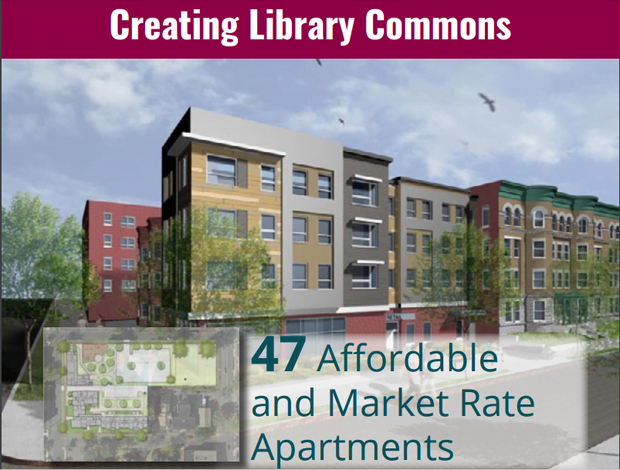
HOLYOKE — The developer planning to build a 47-unit affordable housing complex across from the Holyoke Public Library has received a $625,000 loan from a state-established agency toward the $13 million project.
The Community Economic Development Assistance Corp. (CEDAC) said it had committed the financing for HAPHousing’s Library Commons project in a press release Wednesday.
HAPHousing’s plan is to renovate three vacant buildings and build a new one on Chestnut, Essex and Elm streets for the Library Commons project, diagonally across from the Holyoke Public Library at 250 Chestnut St.
The CEDAC funding is a loan that HAPHousing will use to complete the purchase of properties over the next few months for the $13 million project, HAPHousing Project Manager Peter Serafino said in an email.
HAPHousing will give an update about the project Tuesday from 6 to 7:30 p.m. at the Holyoke Public Library.
As for other financing for the project, HAPHousing has received a $400,000 pre-development loan from CEDAC to pay for architectural plans, environmental reports, surveys and appraisals, as well as federal historic rehabilitation tax credits that can be used for two of the three historic building, Serafino said.
Also, HAPHousing has applied to the state for tax credits and loans from a pool of money for low-income housing at the Department of Housing and Community Development, he said.
Of the project’s planned 47 apartments, 39 will be rented to household’s that earn at or below 60 percent of the area median income, which is about $52,000 for a four-person household. The other eight apartments will be available at market-rate rents, he said.
Two of the 47 apartments will be designed for people with mobility impairments, he said.
Besides renovating three existing buildings, HAPHousing plans to build Roque House, “a supportive services center,” that will be available to Library Commons residents for career counseling and other services, the CEDAC press release said.
The state of Massachusetts established CEDAC in 1978 to help organizations with community development. CEDAC is now a “public-private, community development finance institution, that provides technical assistance, pre-development lending and consulting services…,” according to its website.

http://www.masslive.com/news/index.ssf/2016/06/625000_loan_provided_for_holyo.html
© Copyright 2016 Mike Plaisance. All Rights Reserved.

SourceMassLive

LISC Receives Citizens Bank Financial Literacy AwARD

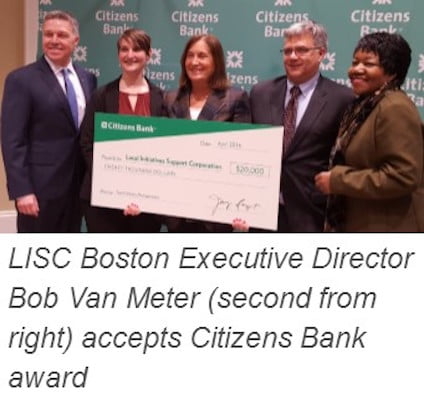
We are proud to have been selected as a partner for Citizens Bank’s “Citizens Helping Citizens Manage Money” initiative. With this $20,000 award, we plan to hold a master pitch contest, giving alumni of our entrepreneurship program the opportunity to refine their business pitches and compete for money to grow their companies. A representative from the bank will serve on the judge’s panel. Citizens Bank’s commitment to investing in the community enriches us all, and we thank them for all that they do for the residents of Massachusetts.

SourceLISC Boston Newsletter

A Lean Model For Housing Affordability

High land and labor costs, thorny regulations and opposition to density choke the housing supply in Massachusetts and drive up the cost of living in one of the nation’s priciest real estate markets.
What if there was a way to shave years and millions of dollars off every multifamily project?

The 49-unit Walker Park affordable housing development in Boston’s Egleston Square is a pilot program testing the potential for Lean construction techniques to save time and money through collaboration between developers, designers and builders. Roxbury developer Urban Edge has been pursuing the revitalization of three vacant and blighted parcels with plans for two apartment buildings that could be models for affordable housing cost containment.

In a departure from a traditional project, the construction manager, Waltham-based Commodore Builders, was brought on early in the design phase. Commodore and Cambridge-based architects Prellwitz Chilinski Assoc. met at the outset with an alphabet soup of city and state agencies that have a say over the project. That consolidated the design process, since each of the agencies has separate guidelines.

“Instead of tail-to-nose like elephants at the circus, we got all the elephants in a room,” President David Chilinski said.

The nonprofit Massachusetts Housing Partnership approached Urban Edge in 2014 about using Walker Park as a case study, with the goal of spreading limited housing subsidies further by controlling development costs.

Originally, Urban Edge planned to build a steel or concrete podium on the ground floor, said Jeremy Wilkening, the company’s director of real estate. As the result of discussions with Commodore Builders and the engineering team, parking was relocated under the building, enabling the entire structure to be built with wood framing. And original plans for three buildings were consolidated into two.

Those and other changes cut $1 million from the estimated $12 million construction costs, Wilkening said. The developers are seeking low-income state tax credits which would enable them to break ground in early 2017.

Controlling Costs Upfront
Multifamily projects take years to design and build while affordable projects tend to have the most sluggish timelines, given developers’ need to assemble multilayered financing packages. The average multifamily unit costs $400,000 to build in Boston, according to industry research, with labor and construction materials accounting for three-quarters of the total.

Applying the principles of Toyota’s influential manufacturing approach, Lean construction techniques put a premium on collaboration among developers, designers and builders. Designs drive costs, rather than vice-versa, with the goal of minimizing surprises during construction that blow up budgets. Some projects include contract language indemnifying parties to avoid costly litigation that results from project delays.

Bringing engineers and construction managers onboard early allows architects to shift gears – reducing the size of units or scaling back urban design flourishes, for instance – if material costs or site conditions raise red flags.

“From an end-user standpoint, it helps to get those numbers out on the table and say, ‘This is what it costs,’” Chilinski said.

With construction costs escalating at a rate of 5 percent to 8 percent annually in the booming Greater Boston market, the savings are potentially significant, he said.

Market-rate developers have adopted many of the Lean principles in recent years, but affordable housing developers have been slower to get on board. Because most projects use public funding, state regulations steer most projects toward the traditional design-bid-build model, Chilinski said.
As a pilot Lean project, Walker Park is working with the Boston Redevelopment Authority, Boston Department of Neighborhood Development, Massachusetts Housing Partnership and affordable housing financiers Enterprise Community Partners to test cost efficiencies. All units would be reserved for households making no more than 60 percent of the area median income, including 15 percent for those earning a maximum 30 percent of AMI.

The project received final BRA approval last July, but the developer is awaiting additional financing sources before breaking ground.

Redistributing The Risk
Near the heart of the Lean model is the concept of shared risk, said Joubin Hassanein, Lean practice leader for Boston-based Shawmut Construction.

The firm has participated in approximately 30 projects with Lean principles, mainly for educational and health care institutions. The complexity of such projects cries out for greater coordination from start to finish, Hassanein said.

“One of the main focuses is really to focus on reliability among the trades,” he said. “The traditional model did not address the ability of construction managers or subcontractors to come through on their promises. There’s a lot of buffering to accommodate the unknowns, and that contributes to a lot of waste in the industry.”

To reflect the efficiencies of the Lean model, some projects use the integrated project delivery (IPD) mechanism. A contractual arrangement, it encourages owners, designers and builders to consider the overall project so that all can share in cost savings.

In a traditional project, subcontractors reap the bulk of the benefits from completing the project ahead of schedule. In the IPD model, the potential savings are shared. But the owner assumes more risk, without the option of legal action.

“Because you agree to pay people’s time and materials, there’s no end cap to what you pay if things go bad,” Hassanein said.

http://www.bankerandtradesman.com/2016/05/lean-model-housing-affordability/?utm_medium=email&utm_source=twg&utm_campaign=btDaily052216
© Copyright 2016 Banker & Tradesman. All Rights Reserved.
SourceBanker&Tradesman

Fiscal Year Plan Allocates Funds To Housing, Transportation Grants

The Baker administration recently released the 2017 Fiscal Year Capital Plan, which includes a $2.19 billion bond cap on general obligation bonds.

The plan outlines resources that will be invested in affordable and workforce housing, transportation projects and various grant programs.

“This capital plan makes substantial investments in maintaining and modernizing our transportation network, preserving thousands of affordable housing units, training an already highly skilled workforce and supporting programs critical to economic development in cities and towns across Massachusetts,” Gov. Charlie Baker said in a statement.

“In addition to important capital funding for local issues like Chapter 90 transportation funding, vocational skills grants and cultural facilities grants, the Community Compact Program will build upon a successful first year to continue awarding communities who partner with the state to improve local services, IT infrastructure and various local projects, “ Lt. Gov. Karyn Polito said in a statement.
The full capital plan can be found here.

SourceBanker & Tradesman

Partnership’s Affordable Housing Numbers Hit Six-Year High

A public-private partnership preserved nearly 4,400 affordable rental housing units in Massachusetts during 2015, the largest number of units preserved in a single year since the Community Economic Development Assistance Corporation began collecting data in 2010.

Data released this week by CEDAC showed state financing helped preserve nearly 5,300 housing units in 38 developments, including more than 840 market rate units. Long-term contract renewals under the federal Section 8 program preserved an additional nearly 2,100 affordable apartments.

CEDAC officials said preservation efforts have been boosted under a six-year-old law known as Chapter 40T, which features public notification provisions for tenants and state and local officials, a right of offer and right of first refusal for the state or its designee to purchase publicly-assisted housing, and tenant protections for projects with affordability restrictions that terminate.

But officials also asserted that Massachusetts is at risk of losing thousands of affordable units over the next few years due to expiring affordability restrictions. A CEDAC database tracks over 1,500 projects with 130,000 housing units that are privately-owned but feature publicly assisted affordable housing.

Community development corporations recently reported record-setting affordable housing efforts that they said are tied to a community investment tax credit implemented in 2014.
And Boston Mayor Martin Walsh in late April declared his support for a surcharge under the Community Preservation Act that he says would cost the average homeowner $28 per year but generate $16.5 million annually for the city, and leverage millions of dollars in state funding that could be spent on affordable housing, historic preservation and open space. Walsh also announced recently that the city is on target to meet its goal of creating 53,000 units of housing by 2030, after permitting 565 units in the first quarter for a total of 17,183 units that have been permitted or created since October 2014.
CEDAC preserved 3,854 affordable units in 2010, 2,246 in 2011, 3,260 in 2013, and 3,278 in 2014. Numbers were not available for 2012.

Gov. Charlie Baker at 11:45 a.m. Monday plans to announce housing production and preservation capital investments at the Housing Opportunity 2016 Conference hosted by Urban Land Institute. The conference will be held at the Boston Marriott Copley Place.

SourceState House News

Massachusetts Sets Affordable Housing Preservation Record

Massachusetts preserved 4,397 units of affordable rental housing during 2015 – the most ever in a single year – according to data released yesterday by the Community Economic Development Assistance Corp. (CEDAC).

CEDAC is a public-private community development finance agency that provides financial and technical assistance to nonprofits involved in affordable housing development and preservation, agencies that promote workforce development and child care facilities that serve families in low-income communities.

CEDAC’s data shows that 5,259 total units from 38 project developments across the state were preserved using various types of state financing in 2015. The projects span the state and consist of large- and small-scale developments in both urban, suburban and rural communities.

“Preservation is a critical part of the affordable housing equation and a priority in the state,” Bill Brauner, CEDAC’s director of housing preservation and policy, said in a statement. “There are a variety of federal and state incentives available to support affordable housing in Massachusetts. It is quite an achievement for the commonwealth when more than 5,000 units of housing are preserved and it shows that many of our innovative tools are working effectively.”

SourceBanker & Tradesman