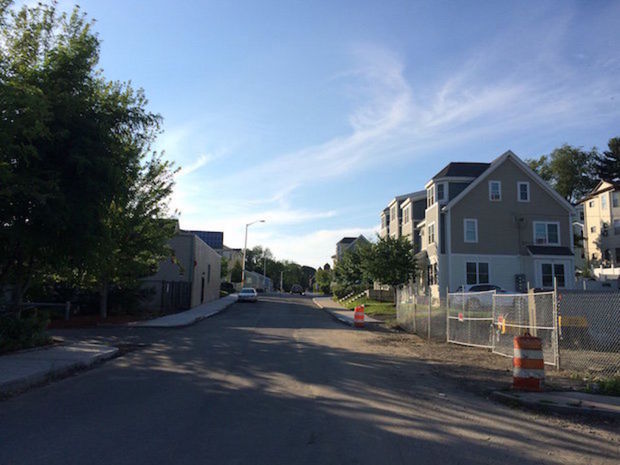
Asian Community Development Corporation Completes Rehabilitation

Asian Community Development Corporation (ACDC), a 27-year old nonprofit organization serving the Asian American community of greater Boston, has just completed the rehabilitation of Tremont Village, a 20-unit low-income apartment building at the border of Chinatown and Bay Village. An open house was held at the property, on August 18.
“This rehabilitation project preserves an important affordable housing asset and allows low-income families to remain in Chinatown and access the amenities, services and opportunities this community offers,” said Janelle Chan, executive director of Asian Community Development Corporation. Owned by the state Department of Housing and Community Development (DHCD), Tremont Village consists of 20 state public housing units originally constructed in 1987. ACDC was selected by DHCD as the redeveloper for Tremont Village through a 2010 RFP.
“DHCD is pleased with the work ACDC has done to rehabilitate and preserve affordable housing in Chinatown,” said Department of Housing and Community Development undersecretary Chrystal Kornegay. “Retaining low income access to neighborhoods and communities is an essential part of DHCD’s mission, and Tremont Village will ensure that families from across the income spectrum can participate in the neighborhood’s continued growth and development.”
ACDC undertook renovations to address life-safety and quality-of-life issues, as well as improve the energy efficiency of the property, in order to preserve these affordable housing units for low-income residents. The building includes four two-bedroom units and 16 three-bedroom units.
This project was financed by DHCD, MassDevelopment, Boston Private and Massachusetts Housing Investment Corporation. Predevelopment financing was provided by the Community Economic Development Assistance Corporation (CEDAC).
“The renovation of 20 affordable units will continue to provide high-quality options for those who might otherwise struggle to find good places to live in Boston’s tight housing market,” said MassDevelopment president and CEO Marty Jones. “MassDevelopment is thrilled to work with private and public partners to help to meet vital community needs and congratulates the Asian Community Development Corporation for its leadership in housing preservation.”
“We are pleased to support the important work ACDC is doing to address the need for affordable housing in the community,” said George Schwartz, president of Boston Private. “Investing in low- and moderate-income housing is a key part of our business strategy, and the kind of opportunity that we actively seek out, especially with experienced developers like ACDC. We value our partnerships with those that share our commitment to active participation in projects that have a real impact on the communities in which we work and live.”
“MHIC was pleased to provide critical financing generated from the use of low-income housing tax credits to preserve this affordable housing for families and to further the revitalization of this vibrant Boston neighborhood,” said Joe Flatley, president of Massachusetts Housing Investment Corporation.
“The Asian Community Development Corporation has a strong track record of producing quality affordable housing for the community,” said Roger Herzog, executive director of the Community Economic Development Assistant Corporation (CEDAC). “Tremont Village is their first preservation project and CEDAC is proud to have supported it in its early stages with a loan of $300,000. We are also pleased that the completed project will maintain the affordability of 20 units of quality housing for low income residents living in Boston’s Chinatown and Bay Village neighborhoods, who are facing increasing financial pressures in a neighborhood that is becoming ever-more expensive.”
The project team included Davis Square Architects, Pinck & Company and Page Building Construction.

About Asian Community Development Corporation
Asian Community Development Corporation (ACDC), a 27-year old community-based non-profit organization, serves the Asian American community of Greater Boston, with an emphasis on preserving and revitalizing Boston’s Chinatown. ACDC develops physical community assets, including affordable housing for rental and ownership; promotes economic development; fosters youth leadership development; builds capacity within the community and advocates on behalf of the community. ACDC has developed over $110 million in mixed-use real estate that is home to over 900 residents in Boston and Quincy, and provides housing counseling and homebuyer workshops throughout the year. For more information, visit www.asiancdc.org.

http://sampan.org/2015/08/asian-community-development-corporation-completes-rehabilitation-of-tremont-village-and-preserves-affordable-housing-in-chinatown/

SourceSampan

CDC Completes Rehabilitation Of Tremont Village Apartments

Asian Community Development Corp. (ACDC) recently completed the rehabilitation of Tremont Village, a 20-unit low-income apartment building at the border of Boston’s Chinatown and Bay Village.
An open house was held at the property on 339-351 Tremont St. on Tuesday.
“This rehabilitation project preserves an important affordable housing asset and allows low-income families to remain in Chinatown and access the amenities, services and opportunities this community offers,” Janelle Chan, executive director of ACDC, said in a statement.
ACDC worked to improve safety issues, as well as improve the energy efficiency of the property. The building includes four two-bedrooms and 16 three-bedrooms.
http://www.bankerandtradesman.com/news165139.html#sthash.H6JuZ7ZR.dpuf

SourceBanker & Tradesman

Mass. Advocates Warn Of Loss Of Thousands Of Affordable Housing Units

Cambridge, Mass. – The Briston Arms housing complex is tucked into a quiet corner of North Cambridge, not far from Fresh Pond. With trees and bushes aplenty, birds chirping and even a place residents can lock their bikes, it’s a neighborhood of about 150 garden-style apartments.
And most of them are reserved for low-income tenants.
“There’s a great amount of comfort in having something stable to rely on,” said Briston Arms resident Ted McCabe.
McCabe pays a little over $400 a month for his apartment. Without government subsidies, it would go for $1,950. Suffering from depression, McCabe lives on disability and federal Section 8 vouchers.
He sees himself as part of the neighborhood fabric.
“It’s nice to see that there’s a larger variety of people who are still just people,” he said. “It shows that the community cares about each other, whereas if it’s just a matter of the people living here being the ones who can afford it, then you lose that sense that the people care about each other.”
McCabe has called Briston Arms home for two decades. But this year, when the development’s owners put it up for sale, his home, and about 100 other subsidized apartments like it, were in jeopardy.
‘Now The Time’s Up’
“The fear was that this was simply a prelude for conversion to market, and that’s pretty scary,” said Bill Brauner, who works for the Community Economic Development Assistance Corporation (CEDAC), a quasi public agency that works to protect affordable housing around the state.
And Brauner says things could get even scarier in several years.
He says across Massachusetts, 20,000 privately owned affordable apartments could go market rate by the end of the decade.
According to CEDAC, as many as 5,000 apartments are most at risk for losing affordability. That’s because they were financed through 40-year government loans, made on the condition that they stay affordable.
“At the time, you can imagine, people thought 40 years is a huge period of time for affordability,” Brauner said. “And it was. But now the time’s up.”
Affordability at Briston Arms was set to expire in 2018. The owners put the development on the market, and three companies bid, according to one of the bidders, the nonprofit Preservation of Affordable Housing.
Julie Creamer, a vice president at the nonprofit, said Briston Arms was primed for conversion.
“Properties like Briston Arms and some of our properties in Boston — in very high rent, low vacancy markets — are really harder to capture because the upsides are so great once the affordability restrictions have expired,” Creamer said.
Creamer says Briston Arms’ location, amenities and construction type meant the apartments could be easily converted to market rate — some of them already are. Fortunately for low income residents, the sellers, whose father founded Briston Arms, didn’t want that to happen.
“I think in their minds this was something their father had set out to do, and it was important for them to try and find a nonprofit or someone who would keep the property affordable,” Creamer said.
But ideals aside, Creamer’s company needed to come up with a lot of cash — $42.5 million was their final offer. They got it from a variety of sources — one of them, Cambridge Affordable Housing Trust. And now, Preservation of Affordable Housing owns Briston Arms.
‘Red Tape Does Work. And It Has.’
It isn’t just the funding that makes acquisitions like this possible. There’s also a state law that gives affordable developers first dibs when a property hits the market. It’s known as Chapter 40 T. Basically, 40 T imposes extra burdens on those trying to convert affordable housing to market rate.
Howard Cohen was one of the top advocates for the law when it passed six years ago. Cohen says 40 T is red tape by design.
“And we did it intentionally,” Cohen emphasized. “We knew we were creating the red tape. Some people were skeptical that the red tape would work. Some people like me thought, based on our real estate experience, red tape does work. And it has.”
Cohen chairs the board of Beacon Communities, a for-profit company that owns some 5,000 affordable apartments across the state. He says 40T gives his company and others like it a shoulder up in the bidding process. Here’s how it works: When a property goes on the market, the state can designate a buyer that will maintain affordability, and that buyer gets extra time to put together the financing. For sellers, time is money, and by choosing an affordable developer, they can speed up the sale.
It worked for Cohen. Two years ago, 40T was triggered when a development in Framingham called Edmands House went on the market.
“Very nice development, could’ve easily been converted to market rate housing, in one of our stronger economic communities,” Cohen said. “And as the owners … were considering their alternatives, they ultimately saw the obstacles imposed by 40 T, and were willing to sell it to us.”
It was a win-win for his company, which got to add Edmands House to its portfolio, and the low income tenants who got to stay in their homes.
‘You Have To Buy The Affordability Over And Over Again’
Not everyone is a fan of the model of privately owned, publicly subsidized housing. Steve Meacham, an organizer with the community housing organization City Life/Vida Urbana, calls it a nationwide disaster. Meacham says it’s especially problematic in communities like Cambridge, where property rates have soared since the developments were first built.
“All of the owners who built in rundown areas with public subsidy, and then those areas take off, then they want to cash out and you have to spend fortunes to keep them in subsidized programs,” Meacham said. “So you have to buy the affordability over and over again.”
And Meacham said the government can be stuck paying the subsidy.
Though advocates say Chapter 40T has done its job since being passed — preserving some 11,000 units, according to CEDAC — Massachusetts’ affordable housing market is going to get tighter in the coming years.
“Unfortunately,” CEDAC’s Brauner said, “we have this bulge of mortgage maturities that are going to occur, and the resources that the state and local and federal organizations have are just not sufficient to preserve all of that.”
By resources, Brauner said he means money, whether that means tax credits, housing vouchers, government grants or low-interest loans. And there’s just not enough to save every affordable apartment in the state.
Given today’s booming real estate market, Brauner said, some people are bound to be displaced.
But not McCabe, who — thanks to efforts by affordable housing activists, and a bit of red tape — will get to stay in his apartment at Briston Arms.
“I would not have been able to live in Cambridge, I don’t think I could’ve lived within 20 miles of the city,” McCabe said. “All of the support that I have, it’d be gone, just because I’d have to move.”

http://www.wbur.org/2015/08/12/affordable-housing-expiration

SourceWBUR

MassDevelopment Puts $208K Toward Downtown Lawrence Mixed-Use Project

The nonprofit Lawrence CommunityWorks (LCW) has been awarded a $208,000 grant from the Brownfields Redevelopment Fund to go towards the Duck Mill/Union Crossing Phase II redevelopment in Lawrence.

The funds will be used for cleanup and adaptive reuse of the five-story Duck Mill (formerly a cotton and wool manufacturing facility) located on the North Canal in downtown Lawrence. When completed, the 2.2-acre site will consist of 10,000 square feet of commercial space and 73 units of affordable rental housing.

“MassDevelopment is pleased to partner with LCW in its efforts to redevelop the Duck Mill, thereby increasing affordable housing and sparking economic activity in a Gateway City,” MassDevelopment President and CEO Marty Jones said in a statement. “The money from the Brownfields Redevelopment Fund over the last five years has helped this project revitalize a part of the heart of Lawrence.”

In total, MassDevelopment has provided $338,510 for the second phase of the Union Crossing redevelopment. Additional funding has come from state and federal historic tax credits, state and federal low-income housing tax credits, HOME funds and several other housing program funds.

SourceBanker & Tradesman

Worcester affordable housing developments to get $115,000 boost

Two affordable housing developments in Main South and in downtown Worcester are set to receive a total of $115,000 in financing from the Community Economic Development Assistance Corporation (CEDAC).

The CEDAC recently approved $50,000 for an affordable housing residence on Kilby Street and $65,000 for the renovation of the Abby Kelley Foster House on High Street.

The money for the Kilby Street residence is going to the Main South CDC, which acquired a 100-year-old building on the street in August 2014 with plans to renovate the four-story home to create nine affordable rental units, including two accessible units reserved for homeless veterans.

“This project will complement the important revitalization taking place with the Kilby-Gardner-Hammond Revitalization project,” said Roger Herzog, CEDAC’s executive director, in a press release. “We are proud to continue to support the strong efforts of Main South CDC in their work in this neighborhood.”

The money going to Abby Kelley Foster House, more commonly known as Abby’s House, will renovate their building at 52 High St., which operates a 54-unit single room occupancy residence for women who are homeless, battered or low-income. The building also includes a thrift shop, program space, service offices, and Abby House’s Women’s Center. Abby’s House plans to replace building systems, add an elevator, and reconfigure the communal kitchen and bath facilities to improve building accessibility.

“Abby’s House has faithfully served at-risk women and children for nearly 40 years,” Herzog said. “The renovations planned for this location will enable the organization to continue to serve some of Worcester’s most vulnerable individuals for many decades to come.”

SourceMass Live

MassDevelopment Provides $9M For Affordable Pittsfield Apartments

Pittsfield April Lane LLC will use $9 million in MassDevelopment funds for the acquisition and renovation of an apartment complex in Pittsfield.

The organization plans renovate and preserve all 100 units as affordable to households earning no more than 60 percent of area median income with the $1.1 million taxable and $7.9 million tax-exempt bonds, purchased by Bank of America.

The 45-year old Dalton Apartments are located at 51 April Lane and consist of 11 buildings containing 28 one-bedroom units, 44 two-bedroom units and 28 three-bedroom units.

The developers plan to replace roofs, windows, furnaces, hot water tanks, kitchens, appliances, floors and lights, while creating five handicapped-accessible units.

In addition to the tax-exempt bond, MassDevelopment assisted the Department of Housing and Community Development with the approval of federal low-income housing tax credits, which provided approximately $3.2 million in equity.

SourceBanker & Tradesman

Massachusetts Housing Investment Corp. Provides $11.5M Financing for Allston Affordable Housing

Massachusetts Housing Investment Corp. (MHIC) and the Allston-Brighton Community Development Corp. (ABCDC) have finalized $11.5 million in financing for 235 units of affordable housing in Boston’s Allston neighborhood.

MHIC is providing an $11.5 million low-income housing tax credit investment to renovate the Commonwealth and Glenville Apartments; the investment is split between a multi-investor fund ($8.8 million) and Rockland Trust Bank ($2.6 million). Financing for the project also includes $25.7 million in construction and permanent loans from Boston Private, financed through tax exempt bonds issued by MassDevelopment.

The Commonwealth and Glenville Apartments are on 17 scattered properties, all on the same city block bounded by Commonwealth and Glenville avenues. Rehabilitation of the buildings will primarily include major masonry repairs, maintenance and structural repairs on all buildings; energy efficiency and safety upgrades; accessibility and common area enhancements; and new doors, kitchen and bathroom fixture replacement, and similar work as needed in individual units. Exterior improvements will include paving alleys and walkways. Work will begin in August and be completed in September 2016. The total development cost is $56 million.

The Commonwealth and Glenville Apartments buildings are more than 100 years old, and have been owned by two separate but related companies whose members include ABCDC and a corporation of elected tenant representatives, the Commonwealth Tenants Council. The properties originally were acquired and developed in 1998 using HUD financing that was prepaid by the owners in 2011 and 2013. As part of this refinancing, the current owners are selling the two projects to a single new LLC, which will undertake a rehabilitation program and ensure the rental apartments’ long-term affordability.

“In a community that has become very transitory, with even a studio apartment going for almost $2,000 in this neighborhood, keeping these units affordable for low- and moderate-income families is of paramount importance,” Carol Ridge-Martinez, executive director of ABCD, said in a statement. “Now that we have this financing in place, we can finally begin the renovations and we will be able to sustain affordability of these apartments for many more decades.”

SourceBanker & Tradesman

Cambridge Apartment Building To Undergo $45M Reno

The 154-unit Briston Arms Apartments in Cambridge will undergo improvements thanks to $45.1 million in MassHousing financing.

Preservation of Affordable Housing (POAH) of Boston has acquired Briston Arms and plans to extend the rental subsidies on 73 of the apartments. An additional 46 apartments will receive new rental assistance subsidies and 35 of the apartments will continue to be rented at market rates.

“Cambridge is one of the hottest real estate markets in the country right now,” MassHousing Executive Director Thomas R. Gleason said in a statement. “Thankfully POAH, which has an excellent track record of preserving quality affordable rental housing, has purchased the property and will keep it affordable for the residents.”

Among the improvements planned for Briston Arms are new windows, storm doors, roofing and siding as well as masonry repairs. The property will also be brought into compliance with current accessibility requirements.

The contractor will be NEI General Contracting and the architect is Davis Square Architects. The property manager will be POAH Communities. Work is expected to begin on the property in August.

SourceBanker & Tradesman

Foundation of recovery for veterans with new housing

Six years ago Will Hatley was homeless, struggling with substance abuse and suffering from post-traumatic stress disorder from his years in the Navy and a childhood marred by a tornado that killed his mother and baby sister.

Hatley overcame those obstacles with the help of the Edith Nourse Rogers Memorial Veterans Hospital, where he now works as a veteran peer specialist.

“When I came to the VA Bedford, I had a lot of baggage,” Hatley said. “I had bad credit, I didn’t have a job, I was suicidal. That’s why as a vocational rehab counselor I strive to take away these obstacles, these barriers, these hurdles, these roadblocks.”

For many veterans, one of those roadblocks is a lack of supportive, affordable housing.

On Monday, Hatley helped celebrate the groundbreaking at the Bedford VA hospital of a new housing complex featuring 70 affordable units for veterans.
The new residences will give priority to veterans age 55 and older, making it the first of its kind in the country.

It is expected to open in spring 2016, on a 4-acre parcel on the campus of the Bedford VA hospital.

Hospital Director Christine Croteau said the new facility would help fill a need in the community.

“This today is a great example of how partners in the community, private and federal and state partners, can come together to truly make sure our veterans want for nothing,” Croteau said.

Affordable veterans housing in Massachusetts has become more of a priority in recent years.

According to Roger Herzog, of the Community Economic Development Assistance Corporation, since 2012 Massachusetts has opened more than 1,500 units of permanent supportive housing serving some of the state’s most vulnerable populations, suffering from medical and mental disabilities and addictions. Of those 1,500 units, more than 425 were targeted toward veterans.

Earlier this month, the Varnum School in Lowell’s Centralville neighborhood was transformed from classroom space into 21 affordable units for veterans.
When Bedford Green opens, senior veterans will have the benefit of not just housing, but the full support of facilities at the hospital, just steps away.
But affordable housing isn’t the only area where the Bedford VA is seen as a leader.

U.S. Rep. Seth Moulton, himself a veteran of the U.S. Marines who served four tours in Iraq, said that Bedford was paving the way on issues like treating pain without an over-reliance on addictive opiates, prescribing just one-third the national average of opiate-based medications.

Housing and health care are examples of how the country should be taking care of the newest generation of veterans, the Salem Democrat said. Investing in the best care for veterans, he said, is “more than just a moral obligation, it’s a smart investment in America’s future.”

By supporting veterans, the VA would be helping to encourage future leaders, like those who were previously hailed as members of the Greatest Generation.

“It had as much to do with what the Greatest Generation did here at home, as what they did overseas,” Moulton said. “I believe the same can be said about the next generation of veterans, the generation coming out of Iraq and Afghanistan and for generations yet to come. But we’ve got to take care of them when they come back.”

Michael Mayo-Smith, network director for the VA New England Healthcare System, said that just as the VA had been a leader on universal health care, it could also pave the way for making sure all people are given access to affordable housing.

“We don’t think anybody who served their country should go without permanent housing, just like they don’t go without health care,” Mayo-Smith said.

SourceLowell Sun

Bedford VA to offer new housing opportunity for homeless vets

A cornerstone ceremony will be held at the Edith Nourse Rogers Memorial Veterans Hospital June 29 for Bedford Green, a housing development for homeless veterans that will be the first in the country offering independent living options for homeless vets age 55 and older.

The ceremony will be near the Patriot Golf Course located at Edith N. Rogers Memorial Veterans Hospital, 200 Springs Road in Bedford. It begins at 1 p.m. Monday, June 29.

“When they (Vietnam War veterans) returned home in the ’60s and ’70s, they were not greeted with the same level of support that exists today,” said Ken Link, chief of social work service for the Bedford VA. “It made them reticent to reach out for help due to earlier experiences that were not very positive.”

Link added it was this dynamic led to some vets of this era becoming chronically homeless.

One of the goals of the 70-unit building, which will be on four acres near the golf course on the Bedford VA’s campus, is to bring this group “back into the fold so they can see that there is a true effort on the part of state and local governments to support these vets in getting the resources and services necessary to integrate into the community and be successful in pursuing their goals whatever they may be,” said Link.

Bedford Green social workers will assist the senior vets in accessing the medical, psychological and vocational services available at the Bedford VA to address factors that may have contributed to their situation. Veterans who qualify to occupy the furnished, mostly one-bedroom apartments available by the spring of 2016 will pay rent based on a sliding scale up to one-third of the market value of the unit. No one will be turned away due to lack of funds.

Veterans can stay as long as they like provided they meet the requirements set by the U.S. Department of Housing and Urban Development and VA Supportive Housing Program, which issues the housing subsidies.

Finding safe and secure homes for vets to live in close proximity creates an environment with unique benefits, said Laurel Holland, the grants and per diem liaison at the Bedford VA.

“Vets derive a huge amount of healing by being around their cohort; that’s their family,” said Holland. “When they have community living and still have independence, it’s the best of all worlds.”

To provide that sense of community, governmental agencies and private donors such as The Home Depot Foundation, which granted the project $500,000, joined forces to pay for the $21 million development. The partnerships are a direct of the 2011 Building Utilization Review and Repurposing (BURR) Initiative to end homelessness for vets of all ages.

The 2014 estimate for homeless vets nationwide was just under 50,000. During that same time period in Massachusetts, the number of homeless veterans was estimated at nearly 1,300.

The BURR initiative allows for “third-party providers to finance, design, develop, maintain, operate housing on unused land or buildings on VA property,” according to the Department of Veterans Affairs. The VA retains ownership of the land, while community partners develop and operate the housing options.

In response to the initiative, the Bedford VA partnered with Peabody Properties, Windover Construction, the Affordable Housing Services Collaborative, Horsley Witten Group, The Architectural Team and New Ecology to develop and manage Bedford Green.

“Our goal is to allow people to age in place with grace,” said Betsy Collins, a senior project manager for Peabody Properties.

SourceBedford Minuteman - Wicked Local