Honoring Mel King

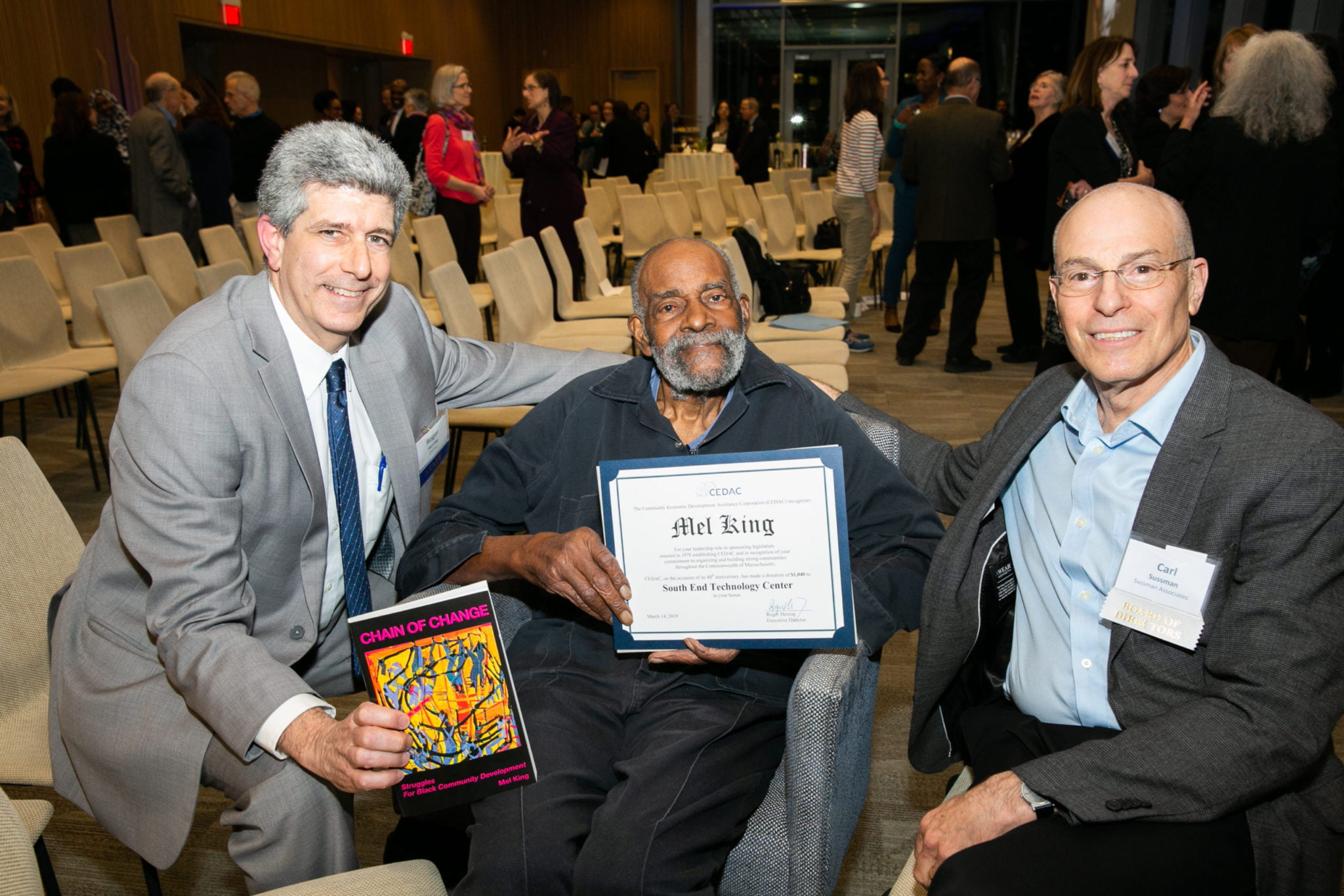
On March 14th 2019, the Community Economic Development Assistance Corporation (CEDAC) honored Mel King at its 40th anniversary celebration at the MIT Samberg Conference Center. King — a community organizer, former State Representative, and Adjunct Professor at the Department of Urban Studies and Planning — crafted the state legislation that created CEDAC in 1978. CEDAC is a community development financial institution providing financing and technical assistance to community-based and other non-profit community development organizations in Massachusetts. In addition to Mel King, CEDAC was joined by DUSP Professors Emeriti, Langley Keyes and Tunney Lee, both of whom promoted and led state and local community development activities, including the visioning and creation of CEDAC.

The event’s main program was modeled on DUSP’s ‘lightning talks,’ three-minute presentations that communicate research and work in layperson language to promote sharing and collaboration across groups. The presentations focused on affordable housing preservation; supportive housing; and early education facility development. Speaker teams, composed of current and former CEDAC staff members as well as community partners, addressed the 40 years of engagement and evolution with these fields, future challenges, and the synergistic relationship for non-profits and the communities they represented. Many CEDAC staff members and leadership are DUSP alumni/ae, including Sara Barcan (MCP ’94), Janelle Chan (MCP ’07), and Roger Herzog (MCP ’87).

“Mel King provided the inspiration and vision for the community development movement, with his experiences 40 years ago fighting for community control of development. Mel’s role as an elected official in helping to create a state infrastructure to support community development, including CEDAC, was instrumental,” said Herzog, Executive Director of CEDAC. “The Massachusetts system serves as a national model of community development, and we are honored to have the opportunity to celebrate his contributions as we mark our 40th anniversary.”

The venue for the 40th anniversary event at MIT speaks to the Institute’s role as the space where the idea for a public/private agency that provides technical expertise to non-profit community development organizations was first discussed during the weekly sessions that King hosted for 25 years while teaching at DUSP and leading the MIT Community Fellows Program. These weekly sessions were called the Wednesday Morning Breakfast Group where King cooked breakfast and led discussions between community activists, planners, and students. A regular participant of the sessions, MIT doctoral student, Carl Sussman, became the founding Executive Director of CEDAC and later played a pivotal role launching and leading its affiliated organization, the Children’s Investment Fund, one of the few community development finance institutions across the nation focused exclusively on meeting the physical capital needs of early care and education programs.

The MIT Community Innovators Lab (CoLab), founded in 2007, is the direct MIT descendant of the Community Fellows Program. CoLab facilitates the interchange of knowledge/resources between MIT students and faculty with community organizations, to build practicable models of economic democracy and self-determination. CoLab’s Mel King Community Fellows Program (MKCF), provides participants with an opportunity to examine innovative approaches to development using markets as an arena for pursuing social justice.

“The CoLab’s Mel King Community Fellows Program embodies Mel King’s approach to planning and community development through his championing of cities and the communities that comprise those cities,” said Dayna Cunningham, Executive Director of CoLab and MIT Sloan Alumna (MBA ’04). “The MKCF honors Mel’s legacy by gathering current and future leaders of community-based work and providing them with the space to collaborate, learn, and refine their efforts for a range of social justice pursuits.”

In the 40 years since CEDAC was created, the organization has committed over $402 million in early stage project financing, and has helped to fund the creation or preservation of nearly 50,000 affordable housing units across the Commonwealth. Additionally, CEDAC manages a number of supportive housing bond programs on behalf of the state’s Department of Housing and Community Development (DHCD), with commitments of more than $490 million over the past thirty years. These bond programs include the Housing Innovations Fund (HIF), the Facilities Consolidation Fund (FCF), and the Community Based Housing (CBH) program.

To learn more about CEDAC’s mission and current projects, click here.
»

SourceMIT Urban Planning News

For 40 Years, CEDAC Has Catalyzed Positive Change

For 40 Years, CEDAC Has Catalyzed Positive Change

Early-Stage Assistance Has Helped Build Housing, Transform Communities

By Roger Herzog

Special to Banker & Tradesman

In 1978, then- state representative Mel King introduced legislation that created the Community Economic Development Assistance Corporation (CEDAC), the nation’s first state agency designed to provide technical assistance to the burgeoning non-profit community development movement.  The idea of such an agency grew out of the Wednesday Morning Breakfast Group meetings convened by Mel at MIT with community activists and planners.  In Boston, the Group’s primary focus was the desire to establish community control over the redevelopment of acres of land in the heart of neighborhoods in the southwest area of the city that the state had taken by eminent domain for an inner belt highway.  The highway was stopped through community activism and by 1978, it had become clear that there was a need for an agency like CEDAC.

In the 40 years since we were established by an act of the legislature, Massachusetts and the community development sector have changed tremendously. And so has CEDAC.  We started as an economic development organization that provided technical assistance to community-based non-profits focused on small business development and job creation. But as the Commonwealth’s economy changed, we’ve evolved into a community development financial institution that provides early stage financing and technical assistance to non-profits seeking to produce and preserve affordable housing and non-profit early education facilities, through our affiliate, Children’s Investment Fund.

While it’s not easy to sum up 40 years of community development work, with its complications and challenges, the best way to share our accomplishments is to look at a sample of some of the non-profit development projects we’ve assisted:

Preserving affordable housing – the Chapman Arms story: since the early 1980s, CEDAC has fought to preserve the long-term affordability of subsidized multifamily housing, which is threatened by the time-limited use restrictions used as part of federal and state financing programs in the 1960s and 1970s.  In 2009, the state passed an affordable housing preservation law, Chapter 40T, which provided the Commonwealth with new tools to monitor and address this expiring use challenge. One of the key tools is purchase rights that allow the Commonwealth’s Department of Housing and Community Development (DHCD) or its designee to acquire and preserve expiring affordable housing projects if an owner proposes to sell a building.  In 2011, Chapman Arms, in Cambridge’s Harvard Square, became the first major project whose affordability was preserved through the use of Chapter 40T’s purchase rights. CEDAC delivered technical assistance to DHCD and its non-profit designee, Homeowner’s Rehab Inc., as well as a rapid commitment and closing on acquisition financing to preserve this mixed income 50-unit property.

Revitalizing neighborhoods – Northampton’s Live 155: Last year, Way Finders, a community development corporation (CDC) focused on Western Massachusetts, opened Live 155 in Northampton.  The mixed-use, mixed-income, new construction development of 70 apartments has helped to transform an important neighborhood in that city, a gateway into the downtown district.  CEDAC provided $2.6 million in early stage acquisition and predevelopment funding for that project, and similarly provided financing for Lumber Yard Apartments, a project by the Valley CDC across the street. These two projects have spurred significant public investment from the city, the state, and private partners.  This is only one recent example of the effective role of CEDAC’s early stage assistance that supports community non-profits’ transformative efforts.  Boston’s Jackson Square (where the original neighborhood battle against highway construction was waged) and Worcester’s Kilby-Gardner-Hammond are also examples where we’ve worked with community partners to reinvigorate those neighborhoods.

Supporting equitable transit-oriented development – the Residences at Fairmount Station: Late last year, Southwest Boston CDC and their development partner Traggorth Companies opened the Residences at Fairmount Station in Hyde Park, a 27-unit affordable housing development.  The Residences represent equitable transit-oriented development – affordable housing built near the MBTA’s new Fairmount Corridor commuter rail line.  Locations near transit offer opportunities for increased development density, and CEDAC and its financing partners provided $1.2 million in acquisition and predevelopment financing to ensure that low and moderate income residents can access these desirable locations.

CEDAC is celebrating our 40th anniversary at an event this March and we will honor Mel King for both his vision and his belief in the power of people to strengthen their communities.  In the four decades since he introduced that legislation, Massachusetts has evolved into a national model of community development, in large part because of the institutional framework he helped to create.  It’s gratifying for us to look at the innovative projects above and recognize we are carrying on an important legacy.

Roger Herzog is the executive director of the Community Economic Development Assistance Corporation.

BT_Reprint_Herzog_031119

»

SourceBanker & Tradesman

CEDAC Fall 2016 Newsletter

Dear Friends,

In this newsletter, we highlight recent successes and transitions for CEDAC and our affiliates, Children’s Investment Fund and Commonwealth Workforce Coalition.  As we note in the article on supportive housing, Massachusetts has a lot of good news to share when it comes to producing supportive housing units.  Through a state interagency effort, we created more than 1,750 in just three years and because of new state and federal resources, we will be able to produce even more.

SourceCEDAC

Baker Administration Awards $2M For Job Training

The Baker Administration has awarded more than $2 million in grants from the Workforce Competitiveness Trust Fund (WCTF) to support 14 regional partnerships between businesses, educational institutions, community-based organizations and workforce development groups in an effort to help prepare state residents with additional skills and job training.

“The key to the success of Workforce Competitiveness Trust Fund is active involvement between local businesses, community-based organizations, education and workforce development professionals,” Gov. Charlie Baker said in a statement. “These partnerships create opportunities for the citizens of the commonwealth and work to strengthen regional economies.”

Grant recipients include:
• Asian American Civic Association – $157,000 for jobs in finance and insurance
• BEST Corp. Hospitality Training Center – $135,002 for jobs in hotels
• Boston University – $99,986 for jobs in life sciences
• Brockton Area Workforce Investment Board – $179,992 for jobs in transportation and warehousing
• Central Massachusetts Workforce Investment Board – $160,473 for jobs in advanced manufacturing
• Community Learning Center, city of Cambridge – $149,133 for jobs in health care
• Holyoke Community College – $190,000 for jobs in culinary arts
• Lawrence Community Works – $190,000 for jobs in educational services
• Madison Park Technical Vocational High School – $64,344 for jobs in automotive technology
• Merrimack Valley Workforce Investment Board – $190,000 for jobs in transportation
• MetroNorth Regional Employment Board – $160,000 for jobs in hospitality
• Partnerships for a Skilled Workforce – $186,902 for jobs in retail
• Tech Foundry – $123,808 for jobs in information technology
• YouthBuild Boston – $60,000 for jobs in construction

SourceBanker & Tradesman

Hampden Sheriff’s Department, Commonwealth Workforce Coalition conduct training for employment couns

Of the 53 employees at his Avocado Street company, Hampton Farms plant manager Matthew B. Venezuela, said 25 have come through “the program.”

The program is a euphemism for the Hampden County Correctional Center in Ludlow, specifically it’s a pre-release program at the jail that prepares inmates for employment after release.

Venezuela said that in the 15 months since Hampton Farms, a food processing facility specializing in peanuts, peanut butter and cotton candy products, has been working with Sheriff’s Department to hire people who were “court involved” – another euphemism – the company has had no problems.

None, he said. Not a single of any hires who have come by way of the jail has been fired, he said. Two have even been promoted to supervisor posts.

“It’s a pretty easy decision for us,” he said. “We know what we are getting.”

Venezuela was one of the featured speakers Friday at a training session held at the Mason Square Library for a training session and certificate program for ex-offender employment specialists.

The training session, offered jointly by the sheriff’s department and the Commonwealth Workforce Coalition, had 43 attendees from all across the state and as far away as New Hampshire.

Attendees were not former jail inmates. Rather, they were work-force development staff and career counselors, the people who serve as go-betweens for former inmates and their would-be employees.

The sessions provided training for workforce development personnel to develop the skills needed to assist former inmates finding employment. They even learned how to prepare a client how to properly answer when the human resources manager asks about that two year gap in the client’s work history.

The Hampden County Correctional Center has always focused on a rehabilitation component in its role of housing inmates to prepare them for life on the outside after their sentence through vocational training and basic education. But the facility has also focused on aiding people after they have been released such as counseling, medical issues or even finding a place to stay.

And a key part of that is helping the former inmates find work, said Richard Devine, the Sheriff’s Department director of employment and community outreach.

“Ninety-seven percent of people incarcerated are coming home,” he said. “How do we prepare them to return to the communities and not return to jail,” he said.

Offenders who get out of jail and land a decent, steady job are statistically less likely to become re-offenders. “That’s exactly right,” he said.

“It’s about public safety. That is the bottom line,” Devine said. “If we can keep (the former inmates) focused on what they need to do, they don’t reoffend.”

Judith Lorei of Commonwealth Workforce Coalition, said it is critical for job-placement people who work with former offenders to establish relationships with would-be employers, to know what types are available and what skills are needed.

“That’s the importance of building a relationship with the employers. They know you’re not going to send anyone to them that hasn’t been screened or assessed, and who isn’t a right match for that job,” she said.

Devine said supplying the right people to employers is important “so the employer will come back and say ‘Gee, I want to hire more of your people.'”

Employment specialists working with ex-inmates make sure candidates are properly matched with employers, that they are properly suited for the post so the employer will not have any regrets about a hire.

“Unlike people coming in off the street, there’s a whole support system in place to help with retention issues,” she said. These can include substance abuse programs.

Venezuela said he has former inmates attending Alcoholics Anonymous and Narcotics Anonymous, and even one going to classes for being a better father. The support groups provide the stability needed to keep ex-inmates on track, he said, “and our job is to provide them with the structure they need for those eight hours at work.”

Devine said the interest in the session indicates people realize the need in helping former inmates find work.

“People are realizing we can’t build enough jails,” he said.

SourceThe Republican

Building a STEM-skilled workforce

One of our nation’s education challenges today is that too many students are training for jobs in which labor surpluses exist and demand is low, while high-demand jobs go unfilled, especially those in science, technology, engineering and math (STEM) fields. At the same time there is often a misperception that all STEM careers require an advanced degree, when that is not always the case. For example, Raytheon, a Massachusetts-based company, every year hires new employees with a high school or associate’s degree, many of whom are in positions with long-term career pathways.
That’s a good thing because it demonstrates that even companies that work with highly sophisticated technologies require a multi-skilled workforce to support their business. To achieve this, companies are working with the state’s workforce development professionals to find ways to develop a system that engages those who may not otherwise have the opportunity to attain the education or skills they need to compete in an increasingly global economy.
The private sector must be a critical ally in creating a workforce development system that develops true career pathways for individuals living in underserved communities. As public sector and philanthropic investment in the workforce development system declines, it is incumbent on businesses and corporations to further strengthen the programs they have developed to help job seekers find their way into promising careers. In doing so, companies will also avail themselves of some of the skills they need – such as hiring people who speak multiple languages – to maintain their competitiveness worldwide.
In order to become that ally, partnerships between the non-profit organizations that provide job training and career counseling and the private sector must be reinforced. At the recent Commonwealth Workforce Coalition’s 11th Annual Sharing Skills-Building Connections conference, representatives from the private sector were on-hand to work with job training providers and career coaches to help those organizations “sell” their services to employers around the commonwealth, so that these agencies might be a better conduit to employment for the job seekers with whom they work. The conference included over 30 workshops to help workforce professionals from around the state, and gave job training providers and others a chance to network and learn from each other. It is the kind of collaborative thinking we see at the conference that is invaluable to community-based agencies in their efforts to develop the programs and contacts necessary to help their clients, who are individuals with little to no professional skills. And it allows employers a chance to have access to potential employees who, with the right training, could become valuable long-term additions to their team.
Raytheon long ago recognized that being an active part of the workforce development system in Massachusetts will pay long-term dividends. As a technology company, Raytheon knows there must be an emphasis put on STEM careers for our region – indeed the country – to remain competitive. As mentioned, not all STEM jobs require a college degree for men and women first entering the workforce. Raytheon hires individuals with high school or associates degrees to work as laboratory technicians or in our manufacturing facilities. Once they are hired, though, they are put on a path of growth and seek to address any skills gaps they may have by allowing them access to the kind of training and education that will accelerate their career pathway.
Additionally, along with several other Massachusetts-based businesses, the company has developed a relationship with Bunker Hill Community College. Through the Learn and Earn program, students there have the opportunity to have a hands-on, paid work experience at some of the state’s largest employers. As valuable as earning a wage is through this program, students also have access to the kind of mentoring and networking opportunities that will help them advance their careers. Raytheon has also established a relationship with high school students in Lawrence, tutoring them in their math and science courses as well as preparation for their MCAS tests, which has resulted in better test scores for the students, a greater willingness to pursue a STEM career, and career opportunities through internships.
These are only examples of the kind of initiatives that industries can take to become an active participant in workforce development. We are in danger of falling behind – the U.S. already ranks only 23rd among nations when it comes to STEM education. The opportunities to create the next generation of prosperous citizens are also very real, too: the average annual income for people in STEM careers is $77,000 vs $43,000 for those in non-STEM careers. Working together, the public and private sectors – including non-profit organizations – can develop those kinds of innovative initiatives that will benefit families, businesses, and our local economy.
Dr. Ellen Ferraro is the Director of Systems Architecture, Design and Integration Directorate at Raytheon Integrated Defense Systems; Roger Herzog is the executive director of the Community Economic Development Assistance Corporation, which manages the Commonwealth Workforce Coalition

SourceThe MetroWest Daily News

Building a STEM-skilled workforce

One of our nation’s education challenges today is that too many students are training for jobs in which labor surpluses exist and demand is low, while high-demand jobs go unfilled, especially those in science, technology, engineering and math (STEM) fields. At the same time there is often a misperception that all STEM careers require an advanced degree, when that is not always the case. For example, Raytheon, a Massachusetts-based company, every year hires new employees with a high school or associate’s degree, many of whom are in positions with long-term career pathways.
That’s a good thing because it demonstrates that even companies that work with highly sophisticated technologies require a multi-skilled workforce to support their business. To achieve this, companies are working with the state’s workforce development professionals to find ways to develop a system that engages those who may not otherwise have the opportunity to attain the education or skills they need to compete in an increasingly global economy.
The private sector must be a critical ally in creating a workforce development system that develops true career pathways for individuals living in underserved communities. As public sector and philanthropic investment in the workforce development system declines, it is incumbent on businesses and corporations to further strengthen the programs they have developed to help job seekers find their way into promising careers. In doing so, companies will also avail themselves of some of the skills they need – such as hiring people who speak multiple languages – to maintain their competitiveness worldwide.
In order to become that ally, partnerships between the non-profit organizations that provide job training and career counseling and the private sector must be reinforced. At the recent Commonwealth Workforce Coalition’s 11th Annual Sharing Skills-Building Connections conference, representatives from the private sector were on-hand to work with job training providers and career coaches to help those organizations “sell” their services to employers around the commonwealth, so that these agencies might be a better conduit to employment for the job seekers with whom they work. The conference included over 30 workshops to help workforce professionals from around the state, and gave job training providers and others a chance to network and learn from each other. It is the kind of collaborative thinking we see at the conference that is invaluable to community-based agencies in their efforts to develop the programs and contacts necessary to help their clients, who are individuals with little to no professional skills. And it allows employers a chance to have access to potential employees who, with the right training, could become valuable long-term additions to their team.
Raytheon long ago recognized that being an active part of the workforce development system in Massachusetts will pay long-term dividends. As a technology company, Raytheon knows there must be an emphasis put on STEM careers for our region – indeed the country – to remain competitive. As mentioned, not all STEM jobs require a college degree for men and women first entering the workforce. Raytheon hires individuals with high school or associates degrees to work as laboratory technicians or in our manufacturing facilities. Once they are hired, though, they are put on a path of growth and seek to address any skills gaps they may have by allowing them access to the kind of training and education that will accelerate their career pathway.
Additionally, along with several other Massachusetts-based businesses, the company has developed a relationship with Bunker Hill Community College. Through the Learn and Earn program, students there have the opportunity to have a hands-on, paid work experience at some of the state’s largest employers. As valuable as earning a wage is through this program, students also have access to the kind of mentoring and networking opportunities that will help them advance their careers. Raytheon has also established a relationship with high school students in Lawrence, tutoring them in their math and science courses as well as preparation for their MCAS tests, which has resulted in better test scores for the students, a greater willingness to pursue a STEM career, and career opportunities through internships.
These are only examples of the kind of initiatives that industries can take to become an active participant in workforce development. We are in danger of falling behind – the U.S. already ranks only 23rd among nations when it comes to STEM education. The opportunities to create the next generation of prosperous citizens are also very real, too: the average annual income for people in STEM careers is $77,000 vs $43,000 for those in non-STEM careers. Working together, the public and private sectors – including non-profit organizations – can develop those kinds of innovative initiatives that will benefit families, businesses, and our local economy.
Dr. Ellen Ferraro is the Director of Systems Architecture, Design and Integration Directorate at Raytheon Integrated Defense Systems; Roger Herzog is the executive director of the Community Economic Development Assistance Corporation, which manages the Commonwealth Workforce Coalition.

SourceThe Milford Daily News

Meet & Greet In Massachusetts

TJX representatives from all three brands participated in a Meet & Greet event with community-based workforce development practitioners in New Bedford, MA. The Commonwealth Workforce Coalition (CWC), a
Massachusetts-based organization, coordinated the meeting and has a mission to strengthen the capacity of community-based education, training, and employment systems to produce better employment opportunities. TJX was represented by T.J.Maxx 195 and 672, Marshalls 380 and 460, and HomeGoods 124. The meeting focused on TJX’s hiring needs and challenges, best practices, and the benefits of NTWP participation. The meeting concluded with a networking exercise to teach Community-Based Organizations (CBOs) and SMs on how to best connect. TJX participants found the event instrumental for building connections with CBOs in their area

SourceTJX Workforce Initiatives News

Patrick Cabinet focus on workforce

Patrick Cabinet focus on workforce
By Sandy Meindersma CORRESPONDENT

STURBRIDGE — With a common goal of strengthening communities through a qualified and engaged workforce, three of Gov. Deval Patrick’s Cabinet secretaries discussed what they were doing to get it done at a conference Thursday.

Gregory Bialecki of Housing and Economic Development, Joanne Goldstein of Labor and Workforce Development, and Matthew Malone of Education were the keynote speakers at the Commonwealth Workforce Coalition annual conference at the Sturbridge Host Hotel and Conference Center.

“Massachusetts is recovering stronger and faster than the national average,” Mr. Bialecki said. “There are more people working now than there were in the spring of 2008, the last high point, and we are only one of seven states to be in that position.

Mr. Bialecki said manufacturing, which has a long and storied history in Massachusetts, continues to grow here.

“There are over 7,000 manufacturers in Massachusetts, and if you’re a skilled machinist, I can get you a job in less than 30 seconds,” he said.

Mr. Malone said the key to economic growth is partnerships among institutions.

“There is a partnership between Mount Wachusett Community College and NYPRO in Clinton, where the students are being taught advanced manufacturing, and it is seamless,” he said. “The future is hands-on, practical applications of science, technology, engineering, arts and math, and these partnerships are happening now.”

Mr. Malone said the focus of the state’s 15 community colleges is being revised, to align curriculum with 21st-century jobs and prepare students with employable skills.

Ms. Goldstein said a new careers pathways committee is being established to close the gap between employer needs and employee skills.

“We will have an important menu of tools that can be accessed by our education and workforce partners to help understand what jobs are in demand and where, the occupational skills and knowledge needed for jobs and the type of talent pool we have in Massachusetts to fill those jobs,” Ms. Goldstein said.

She said grant programs are available to train employees, including a $2,000 grant for companies who hire veterans that need additional training.

URL: http://www.telegram.com/article/20130510/NEWS/105109693/1002/business
© 2013 Worcester Telegram & Gazette Corp

SourceWorcester Telegram & Gazette

Training helps inmates get jobs

October 12, 2012
Training helps inmates get jobs
Job retention key to staying on right path
By: Jackie Brousseau
SPRINGFIELD, Mass. (WWLP) – The Commonwealth Workforce Coalition held training sessions Friday for people helping ex-inmates develop job interview skills.
Maurice Fitzgerald works with first generation, low-income people who are searching for a career path.
Some of them are ex-inmates.
“Since we deal with a few people who have spent time in prison, it’s basically to see what their needs are, what their desires are, what their problems are and what obstacles they run into as they seek to improve themselves, ” said Fitzgerald, who is an Advisor at the College of Worcester Consortium.
Hundreds of inmates could be released from prison because of tainted drug samples at one of the state’s drug labs.
CWC is sponsoring the training, from the National Institute of Corrections, to help inmates return to normal life.
Richard Devine works with the Hampden County Sheriff’s Department and says they place about 500 inmates into jobs each year.
Training people on techniques for getting a job gives the inmates a greater chance for success.
“We do a lot of mock interviews, because if they can’t answer that conviction question, and I know I keep speaking to that, but it’s such an important question, because if they can’t impress the employer about the fact that they’ve learned from their mistake, that’s what is key,” said Devine.
The training sessions will be held again on October 19th and 26th.
For more information go to www.cedac.org.

All content © Copyright 2000 – 2012 – LIN Television Corporation. All Rights Reserved.
URL: http://www.wwlp.com/dpp/news/local/hampden/training-helps-inmates-get-jobs

SourceWWLP-TV, Channel 22