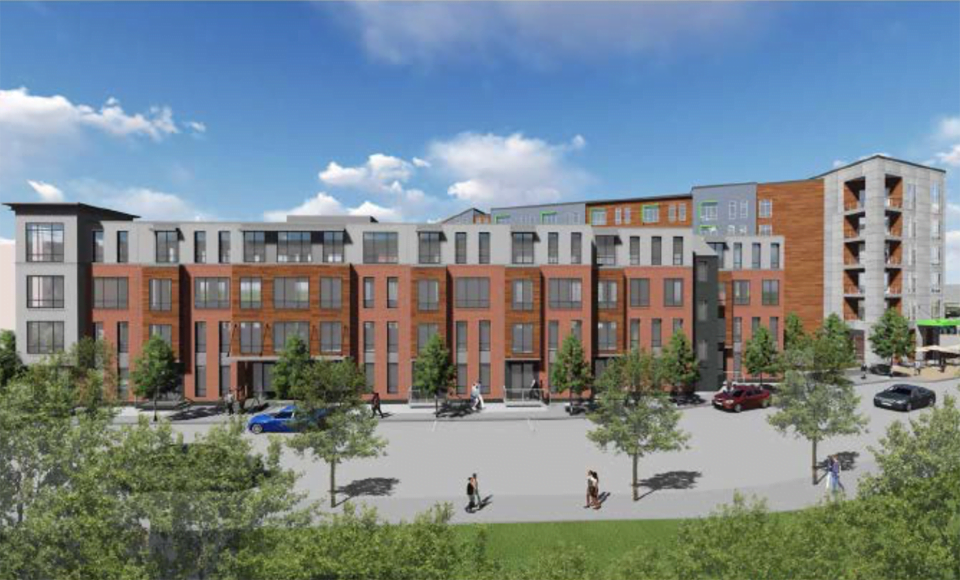
HAPHousing awarded funds for Northampton Lodging Development

NORTHAMPTON — HAPHousing has recently been awarded affordable housing resources by the Massachusetts Department of Housing and Community Development, to be used for HAP’s Live 155 development at the Northampton Lodging site downtown, according to a news release.
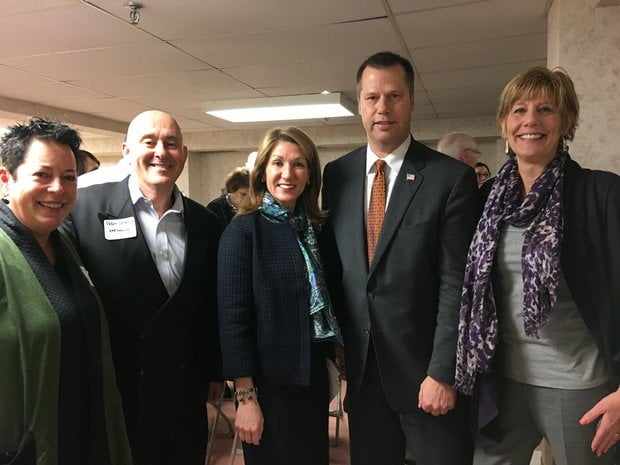
The awards were recently announced at an event at Tribune Apartments in Framingham, a historic 53-unit complex for the elderly that also received funds for building rehabilitation and is part of a $21 million grant statewide for affordable housing. Live 155 will consist of 70 studio and one-bedroom apartments and 2,800 square feet of retail space on Pleasant Street.
The cost for construction of the building is estimated at $14 million. The Community Economic Development Assistance Corporation provided HAPHousing a $1.6 million acquisition loan and an $800,000 pre-development loan.
The City of Northampton had awarded $300,000 in Community Preservation Act (CPA) funding and $150,000 in Community Development Block Grant (CDBG) funding to the project. Easthampton Savings Bank has been selected as the construction and permanent lender for the project. HAPHousing plans to commence building demolition and construction in September and complete the project in late 2017.

Sourcemasslive

Walsh Announces More Than $28M To Support Affordable Housing In Boston

Boston Mayor Martin Walsh announced $28 million in funding awards to support the creation of affordable housing throughout Boston yesterday. The funding, which will preserve or produce 837 housing units, comes from $21 million of federal and local resources awarded through the Department of Neighborhood Development (DND) and $7 million of Linkage funds, awarded through Boston’s Neighborhood Housing Trust.

“We are committed to creating a Boston where everyone who wants to live here, can afford to,” Walsh said in a statement. “I thank our local, state and federal partners for these housing investments that create good jobs and fuel our economy.”

The new funding will leverage more than $323 million of public and private investment in the neighborhoods, and will help to create an estimated 500 construction jobs. These developments will also create 125 units for homeless or extremely low-income families.

With the awarding of these funds, the Walsh Administration has now made more than $66 million in affordable housing available since Walsh took office.

SourceBanker&Tradesman

IBA To Renovate South End Residences

Boston-based nonprofit affordable housing agency Inquilinos Boricuas en Acción (IBA) has obtained $1.3 million in financing to renovate the 11-unit Residencia Betances in Boston’s South End.
The housing development containing 11 single-room units on Shawmut Avenue serves low-income individuals with mental health issues. IBA will upgrade the property’s brownstone exterior, individual units and common areas.
Financing was provided by the Department of Housing and Community Development’s Housing Preservation Stabilization and Facilities Consolidation fund and the Community Economic Development Assistance Corp. Renovations began in January and are expected to be completed in the fall.
IBA developed the Residencia Betances in 1993 to serve Spanish-speaking residents who are former homeless clients of the Department of Mental Health. The agency collaborates with the DMH on support services, including full-time bilingual staff.
“We want all of our community members to live in an atmosphere that provides the best care and supportive services so they can live quality lives, and this renovation will achieve that,” IBA CEO Vanessa Calderon-Rosado said in a statement.
IBA was founded in 1968 by a group of Puerto Rican activists to preserve affordable housing in the South End.
The Boston Housing Authority in December selected IBA to renovate 146 affordable housing units located in 24 townhouses on West Newton and Rutland streets.

SourceBanker & Tradesman

MassHousing Funds Improvements On Roxbury, Chelsea Affordable Housing Properties

MassHousing has arranged financing to improve two Boston-area apartment complexes and maintain their affordability.
The 90-unit Cleaves Court and Dimock Bragdon Apartments in Roxbury will receive $16.9 million in financing.
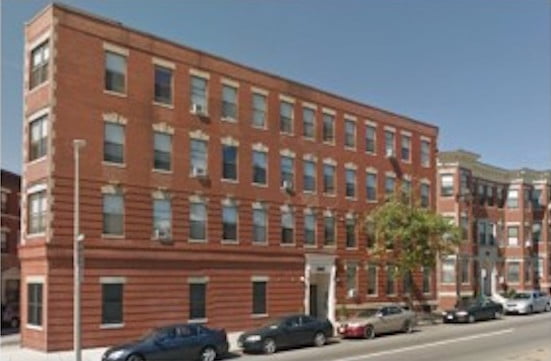
Cleaves Court was originally built in the late 1890s on Cleaves Street and consists of adjacent, 3-story buildings containing eight one-bedroom apartments, 20 two-bedroom apartments and eight three-bedroom apartments. Urban Edge has owned the property since 1985.
Dimock Bragdon was built in 1900 and consists of seven contiguous buildings on Columbus Avenue containing four one-bedroom apartments, 25 two-bedroom apartments and 25 three-bedroom apartments. Urban Edge has owned this property since 1982.

Cleaves Court
Among the property improvements planned are the installation of groundwater infiltration systems to address flooding at both locations, upgrades to building systems, upgrades to fire systems, masonry repairs, roof and window replacement, the venting of kitchen range hoods and bathroom fans and some kitchen and bathroom renovations.
All of the apartments are covered by federal Section 8 Housing Assistance Payment contracts.
Additionally, the 71-unit Chelsea Square apartments in Chelsea will receive $5.1 million in MassHousing financing.
Chelsea Square Assoc., which owns Chelsea Square, is refinancing the property and will extend the federal Section 8 Housing

Chelsea Square Apartments
Assistance Payment contact on the 71 apartments for 20 years.
Constructed in the early 1900s, Chelsea Square is located on Broadway in Chelsea and is comprised of two 4-story buildings and nine 3-story buildings containing 56 one-bedroom apartments and 15 two-bedroom apartments. The management agent is Trinity Management.
The $5.1 million MassHousing loan was provided through the U.S. Department of Housing and Urban Development’s Multifamily Accelerated Processing/Ginnie Mae Mortgage Backed Securities program.

SourceBanker & Tradesman

Olde English Village Receives Financing For Renovation Via MassDevelopment

Olde English Village Preservation L.P. has received a tax-exempt bond to acquire and renovate Olde English Village.

The $12.9 million in financing will go toward improvements to the 200-unit affordable multifamily Gardner housing facility on 19 acres. The complex has 17 walk-up buildings, two townhouse buildings and one building with community space. Planned renovations include new roofs, energy-efficient windows, siding, entry doors to townhouse units, intercom systems, security camera monitoring system, mechanical equipment replacement and upgraded bathrooms, hallways, kitchens. The units are designated for households earning no more than 60 percent of the area median income. Related Beal, the project’s sponsor, is extending the affordability for 30 years.
MassDevelopment also assisted DHCD with the approval of federal low income housing tax credits that will provide approximately $7.1 million in equity for the project.

“Preserving affordable housing is crucial for working individuals and families across the Commonwealth,” MassDevelopment President and CEO Marty Jones said in a statement. “Thanks to our partnership with Related Beal, a creative and trusted affordable housing developer, we will maintain affordability and renovate units at Olde English Village.”

http://www.bankerandtradesman.com/2016/03/olde-english-village-receives-financing-for-renovation-via-massdevelopment/?utm_medium=email&utm_source=twg&utm_campaign=btDaily030216
© Copyright 2016 Banker & Tradesman. All Rights Reserved.

SourceBanker&Tradesman

TND Upgrades Affordable Housing Situation In Chelsea, Revere Through MassDevelopment Funds

MassDevelopment has issued a $5.825 million bond to fund an affordable housing project in Chelsea and Revere.

The Neighborhood Developers (TND), the project’s sponsor, is using bond proceeds to acquire and renovate 21 units of affordable multifamily rental housing in Chelsea and 17 units of affordable multifamily rental housing in Revere. The developer has constructed 10 rental units for formerly homeless veterans, seven units for formerly homeless families and also is now building four affordable multifamily rental units for at-risk young parents in Chelsea.

Renovations include replacing mechanical systems and windows, electrical work and repairing exterior masonry and roofs. These homes are expected to remain affordable for a minimum of 50 years.

SourceBanker & Tradesman

44-Story Apartment Tower to Replace Garden Garage

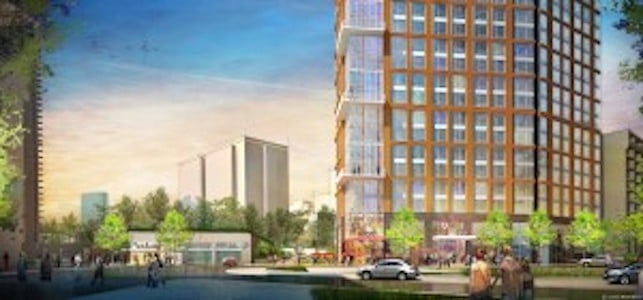
Boston officials approved a controversial proposal by Equity Residential to build 470 apartments on the site of the 650-space Garden Garage in the West End.
The 44-story tower at 35 Lomasney Way will become the city’s second-tallest apartment building, trailing the 45-story Government Center garage residential tower set to break ground this spring.
In 2011, Equity Residential filed plans to build two residential towers topping out at 310 and 240 feet containing 500 housing units with an 850-space underground garage. After neighbors including residents of the Amy Lowell Apartments objected to the height and density of the development, Equity Residential submitted revised plans in October 2014 for a single 465-foot-tall tower containing 486 units. It reduced the parking allotment from 850 to 830 spaces and finally to 775 spaces.
After tabling a vote at its previous meeting, the Boston Redevelopment Authority board of directors voted in favor of the project, now reduced by another 16 units, on Thursday.
As conditions of approval, Equity Residential will pay $8 million to satisfy affordable housing creation goals under the city’s inclusionary development policy. It also will contribute $1 million for transportation improvements in the neighborhood.
The development has reopened old wounds in the West End, where some residents still lament the slum clearance schemes of the late 1950s that razed thousands of tenements to make way for master-planned housing projects and highways. At a ceremony last fall launching a new West End Museum exhibit on urban renewal, BRA Director Brian Golden apologized to residents for the agency’s past conduct.
The Garden Garage project is part of an 8-million-square-foot wave of development transforming the neighborhoods around North Station and the Bulfinch Triangle.
Boston-based Trinity Financial is nearing completion of One Canal, a 12-story, 320-unit apartment complex on a parcel leased from the Massachusetts Department of Transportation at Canal and New Chardon streets.
AvalonBay Communities is expected to complete its 38-story, 503-unit Avalon North Station tower next to the TD Garden by year’s end.
Boston-based Related Beal broke ground this month on a 220-room Courtyard by Marriott hotel and 239-unit workforce housing project on land leased from MassDOT at Causeway and Beverly streets.
And after gaining final city approvals last month, HYM Investment Group and National Real Estate Advisors are set to begin construction this spring of a 45-story, 486-unit apartment tower in the first phase of the $1.5 billion Government Center Garage redevelopment.

SourceBanker & Tradesman

In Easthampton village, everyone helps the children

The 5-year-old boy in the green shirt with “Cool Little Bro” written across the chest had just thumped 81-year-old Mary Steele in the nose with a balloon. Steele, who was baby-sitting the excited child for his foster mother, stopped fast and flashed a look of mock surprise.
“Now, you have to give me a kiss right on the nose,” Steele said. The boy, clearly happy, did not consider this a chore.
Laughter and smiles have not come easily to the child, who was removed from his biological parents a year ago because of domestic violence and substance abuse.
But now, engaged and embraced, he is part of a pioneering social project called the Treehouse community, a 60-home village built from scratch nearly a decade ago in a broad former meadow near Mount Tom.
It’s an uncommon place, where once-traumatized children are raised in a quiet neighborhood where the special needs of foster and adoptive families are supported and understood.
It’s also a place where dozens of elderly residents have moved specifically to help these families in simple but critical ways — by walking children to school, by baby-sitting to give stressed parents a break — and to savor the simple pleasures of joining a community where their help and life experience are appreciated.
“This gives me an opportunity to serve,” said Steele, who had been a social worker in Oklahoma before she moved to Treehouse in 2007. “To me, life has meaning and purpose. This is the continuation of a vocation.”
Outside her brightly colored cottage, a small sign greets passersby with this simple message: “We love our children.”
The sign captures something about the Treehouse community: its aspiration to a hard-to-come-by small town ideal. Nearly everyone knows one another at Treehouse, and all the residents — parents, biological children, and the elderly — are encouraged to contribute to the mission, which is to give foster and adopted children a lasting sense of family and the tools to make good on life when they move out on their own.
Since Treehouse opened in 2006, a total of 61 children have arrived directly from foster care or with adoptive families. None of them have dropped out of school; there have been no teenage pregnancies, and all 16 children who applied for college have been accepted.
“This is a little utopia,” said Sandra Rubio, who lives at Treehouse with three adopted girls. “It’s whatever you want it to be.”
The idea for Treehouse was born at Judy Cockerton’s kitchen table in 1998, when the former teacher and toy-shop owner decided to do something for children without a permanent home. Her husband, Arthur Pollock, had just handed her a newspaper article about a 5-month-old boy in foster care who had been kidnapped from his crib in Worcester.
Cockerton summoned her two children back to the table at their Sharon home. “What do we want to do?” she asked the family. “We have the resources and the space and the ability to support children.”
The next day she called the state to offer her help. “Would you please take two?” Cockerton was asked. “We’ll be there in an hour,” she replied.
‘This is a little utopia. It’s whatever you want it to be.’
Sandra Rubio, who lives at Treehouse with three adopted daughters

From that beginning, Cockerton embarked on a complex journey in which she learned as she went — creating a nonprofit organization, seeking a site, finding an affordable-housing partner, and searching for child-welfare services that the Treehouse community would need.
“It takes a while for people to wrap their heads around this idea,” said Cockerton, who serves as chief executive officer of the Treehouse Foundation.
It’s an idea that Treehouse officials would like to replicate. Nearly 30,000 young adults in the United States “age out” of the foster-care system each year, and their lives afterward are often difficult.
Cockerton’s inspiration came from Hope Meadows, an adoptive Illinois community where seniors also live. What has emerged here 15 miles north of Springfield, Cockerton believes, is the only development of its kind in the Northeast that mixes adoptive and foster families with the elderly.
The $15.9 million project was designed by Beacon Communities, a Boston-based developer of affordable housing, with input from the City of Easthampton, the state, and conservation agencies. Berkshire Children and Families, a social-service organization, has two staff members on site who provide mental health and parenting support. Educational partnerships have been formed with schools and cultural groups.
Beacon owns and manages the property, which was built in a former hay field after investors, donors, grants, and state and federal tax credits helped make the dream a reality. Families who apply for housing are rigorously vetted by Treehouse managers.
The path to these connections was jump-started in 2002 when Cockerton asked for a meeting with Lewis “Harry” Spence, the commissioner of the state Department of Social Services, who steered Cockerton to Beacon Communities.

JOANNE RATHE/GLOBE STAFF
Mary Steele, 81, regularly babysits for a boy who lives at the Treehouse community with his foster family.
“I just thought the opportunity for a community of people who share a commitment to the parenting of adoptive children could be enormously valuable,” said Spence, who is the state’s trial court administrator. “I think that can make the difference between a successful and a failed adoption.”
One measure of success is that Treehouse attracts residents of differing incomes as well as age. Aided by tax credits, half of the 12 homes for adoptive families are reserved for households that make less than $56,700. The 48 cottages for residents 55 and older go to singles or couples with incomes less than $42,000.
The growing pains have been few, Cockerton said, but a foster parent who worked off-site as a teacher was charged in 2007 in a child-pornography case. The foster child, who was not involved in the case, was removed from his custody. No child at Treehouse was harmed, Cockerton said.
Adults come to Treehouse full of idealism and hope; children come from another place.
All the adopted or foster children here have serious emotional or physical needs. Many were abused by their biological parents or in previous foster homes. And reunification with their mothers and fathers, the primary goal of the foster-care system, has been deemed unworkable or impossible.
Treehouse is their safe haven, with 106 residents spread among duplexes for adoptive families and farm-style cottages for seniors. The homes, all rentals, are clustered amid 17 acres of green, open space. The residences are angled toward others to encourage interaction.
There are two playgrounds, 32 dogs, and small buses that link residents with the Pioneer Valley and beyond.
Doors are often unlocked, and children visit the homes of elderly neighbors just to chat or to borrow a sweater. The community center — a gathering place that holds a kitchen, library, post office, and all-purpose room — is a beehive of activity that ranges from tutoring to parenting advice to holiday parties.
“I knew I was searching for community. This is community for me. This is family,” said Pam Hanson, 70, who crisscrosses the village in a motorized wheelchair. Hanson moved here from Central Massachusetts after a teaching career because she missed the interaction with children and wanted to feel productive.
“There is an innate kindness and respectfulness that you just don’t see anywhere,” Hanson said. “I feel in love with the place — not just the physical place, but the idea of being older but not yet dead,” she added, chuckling.
Rosa Young, 71, drove here from her family cabin in Michigan nine years ago after she heard about Treehouse on National Public Radio.
“I just didn’t like the idea of not having children around,” said Young, who had been a director of homeless services for the Massachusetts Department of Mental Health before she retired and moved back to the Midwest.
Young helped a Treehouse family with two biological children and three adopted siblings, driving them to school on some days and baby-sitting on Fridays to give their parents, Alison Plummer and Wendy Gannett, a night on the town by themselves.
Before connecting with Plummer and Gannett, the adopted siblings had meandered through foster care after being taken from their biological home. The children had been severely underfed and appear to have been physically abused. One of the siblings weighed 35 pounds at age 7 — after 12 foster homes in two years — when Plummer and Gannett began caring for him.
Young, for her part, followed a recipe for dealing with the effects of their trauma: “Being predictable, and kind, and saying yes as often as I can.”

JOANNE RATHE/GLOBE STAFF
First Justice Daniel Swords held a celebratory Alexandra after awarding permanent custody to Treehouse community residents Angel and Sandra Rubio in Hampden Juvenile Court in Springfield in September.
Plummer and Gannett reciprocated her thoughtfulness in many ways, including accompanying Young to chemotherapy appointments for breast cancer two years ago.
Another neighbor, 80-year-old Gloria LaFlamme, moved to Treehouse from North Adams, not quite sure what to expect and not quite sure how she could help. The retired nurse had no previous experience with foster children.
Enter Ashlynn and Aliana,now 11 and 9, who needed transportation to weekly therapy sessions while their adoptive mother, Sandra Rubio, worked a dozen miles away in Westfield. The family faced a scheduling gap because Sandra’s husband, Angel, works at night in food service at Amherst College.
LaFlamme’s contribution — making the 35-minute drive each way to therapy — brought mutual benefits. The girls did not make a fuss when LaFlamme asked to listen to classical music. And updates from Ashlynn and Aliana about their daily ups and downs provided a lift and focus for LaFlamme.
The state placed the girls with Sandra Rubio when she was living in a tough Holyoke neighborhood scarred by crime and drugs. First came Ashlynn, an emergency placement whom Sandra agreed to take for a weekend.
“Monday morning never came,” Sandra recalled with a smile; Ashlynn never left. Gradually, the sullen girl who did not smile or make eye contact began to open up. Aliana arrived two years later in 2006, a four-day-old infant born with drugs in her system.
The girls rarely left their apartment, and they had few friends in the neighborhood. Then, three years ago, Sandra applied for one of the homes at Treehouse, and a fresh start became a reality.
Angel Rubio had moved in with Sandra by this time, and the pair decided to accept another foster child — Aliana’s three-week-old sister, Alexandra. Angel had not known what to expect, and he had some trepidations, but foster care became a life-changing experience for him.
“All my life, I’ve been very irresponsible taking care of myself, but now I take care of myself because of the girls,” said Angel, a quiet 36-year-old who struggles with diabetes, high cholesterol, high blood pressure, and Crohn’s disease. “It makes me want to stay around a little bit longer.”
Sometimes, he is startled at who he has become, a recently married man with a ready-made family who sings children’s rhymes as he works.
Sandra, 41, has seen the change in her partner. “He told me, ‘I thought this only happened in the movies,’ ” she said.
In September, the Rubios were awarded custody of Alexandra in a festive ceremony at Hampden Juvenile Court in Springfield. Relatives, friends, and Treehouse residents wiped away tears as First Justice Daniel Swords worked his way through the legal minutiae.
Finally, with a broad smile, Swords declared the adoption “final and irrevocable.” Alexandra bounded up to the judge’s chair, grabbed his gavel, and pounded the desk 13 loud and confident times.
The Treehouse concept so far has made a small dent in a vast problem, but Cockerton has plans that go well beyond the Pioneer Valley.
Discussions have begun for a Treehouse neighborhood in Santa Clara County, Calif., where Cockerton is exploring partnerships with housing and child-welfare organizations. Treehouse also is considering a community in the western Boston suburbs, and a group from Atlanta visited recently to seek ideas for a development in Georgia.
It is an ambitious vision fueled by a chronic need.
“We want to drive change in the nation,” Cockerton said. “I can see a Treehouse community in every state around the country.”

SourceThe Boston Globe

Clive McFarlane: Affordable housing gains in Worcester hurt by neighboring towns

Earlier this week, the Worcester Regional Research Bureau published a brief indicating that only 46 of 351 Massachusetts communities have achieved a state guideline (Chapter 40B) requiring at least 10 percent of their housing to be qualified as affordable.
Indeed, while Worcester has 13.4 percent of its housing units qualifying as affordable, the Research Bureau points out that none of the surrounding towns comes close to the 10 percent threshold, with Shrewsbury, 6.2 percent, being the highest of the surrounding towns, and Boylston, 1.4 percent, the lowest.
Worcester’s compliance relative to its neighbors “forces questions about the responsibility of surrounding towns to accommodate low-income residents,” the Bureau noted, arguing that the Chapter 40B law is not working and asking questions such as whether it should be made mandatory, or amended to provide developers with incentives to build affordable housing.
The bureau’s brief is the latest acknowledgement of what some have labeled a Massachusetts affordable housing crisis, fueled by inadequate supply and high rental costs. According to the Citizen’s Housing and Planning Association, for example, Massachusetts ranks eighth in the country in income inequality and seventh as the least affordable state for renters.
Michael Kane, director of the Massachusetts Alliance of HUD Tenants, said only about one in four lower-income individuals who qualify for subsidized housing is getting it. Meanwhile, almost 30 percent of those who currently have subsidized housing are living in sub-standard accommodations, he said.
The squeeze is likely to get worse, he said, noting that according to the Community Economic Development Assistance Corporation, the low-income restrictions for many affordable units built in the 1960s through the 1980s are due to expire, creating the potential of significant losses in affordable housing units should owners decide to opt out of their subsidy contracts.
This is already happening in Worcester.
In 2010, Mountain Village, now the Fairways Apartments, converted 140 of its 200 affordable units into market-price rentals. The other 60 units are at risk of losing their low-income restrictions in 2019.
Also at risk in 2019 are 156 units at Stratton Hills and 70 at Matheson Apartments.
With the Fruit Sever Apartments complex now up for sale, another 132 affordable housing units at the complex could be in jeopardy, as the landlord has the option of selling the apartment complex to a buyer who will not preserve the affordable units.
For now, the potential sale of the Sever apartments has triggered the provision of a law giving the state the right of first refusal in buying the apartment complex, and the state has acted, finding a buyer in Community Builders, a nonprofit real estate developer that owns or manages apartments.
The developer has made an offer for Fruit Sever Apartments, which, if accepted, will preserve 132 affordable units.
Among those waiting anxiously on the outcome of the sale is Joel Dress, a resident of the apartments for nearly 20 years. His insecurity, however, began a long time ago.
Less than two months following his liver transplant surgery in November, Mr. Dress, then 57 years old, found himself facing eviction, partly, he said, based on charges that he wasn’t paying his rent on time, the first of the month.
But Mr. Dress, who had been actively involved in the apartment complex’s tenant association, fighting against rent increases and advocating for improvements in living accommodations, said he had for years been paying his rent on the second Wednesday of each month, which was the date he always received his Social Security check.
Mr. Dress was able to stave off eviction with the help of the Massachusetts HUD Tenants Association, which helps individuals in subsidized housing such as Mr. Dress resolve issues with their landlords. In this case, Mr. Dress was partnered with a local lawyer who helped him make the case that his landlord had not made adequate rent payment accommodations before moving to evict him.
His battle is not over, as he currently has a case in Worcester District Court against his landlord, but he and others like him are finding other allies in their struggle to find and keep affordable housing.
State Sen. Harriette Chandler has filed a bill that that would provide a number of tools to help municipalities create and maintain affordable housing units.
City Councilor Sarai Rivera is among those locally pushing for stronger protection of the rights of tenants living in subsidized housing, while speaking to the urgency of preserving affordable units that are at risk.
“Not only do we need more affordable housing units in the city, but we have to preserve the units that are currently available, and particularly units occupied by our elderly residents” she said.
It is too bad, however, that the gains Worcester made in providing affordable housing is being undermined by the less than adequate efforts of its neighbors to do their part.

SourceWorcester Telegram

Home Funders Launches Competition To Create Affordable Housing Solutions

Home Funders is sponsoring an Innovation Fund Competition to develop new strategies and solutions to increase the supply of affordable housing for extremely low-income (ELI) families.
The program is encouraging a wide range of stakeholders to take part in the initiative, including housing producers, municipalities, nonprofits, quasi-public agencies and others.
Home Funders plans to award prizes of $10,000 to $25,000 each to up to three organizations or teams that propose a well-crafted, innovative, feasible and sustainable solution to build, preserve or create access to housing units for ELI families. The goal of the competition is for the winning strategies to be implemented at a larger scale in regions across Massachusetts to increase long-term ELI affordable housing. According to Home Funders, the proposals should be pragmatic and replicable. Finalists will be selected from an advisory committee.

SourceBanker & Tradesman