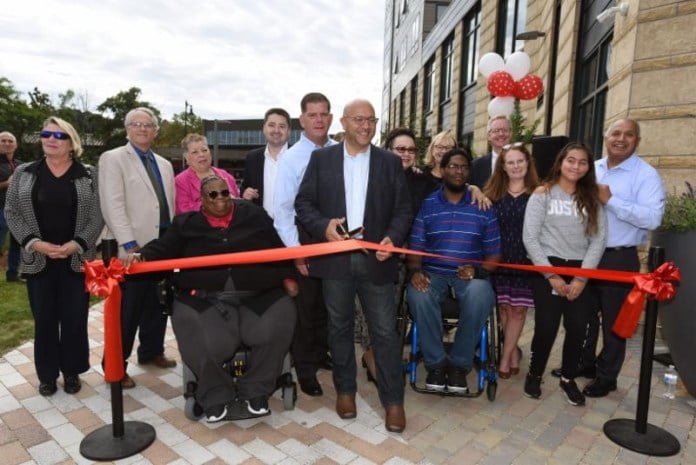
Fire-Damaged Westfield Property to Receive $28M Renovation
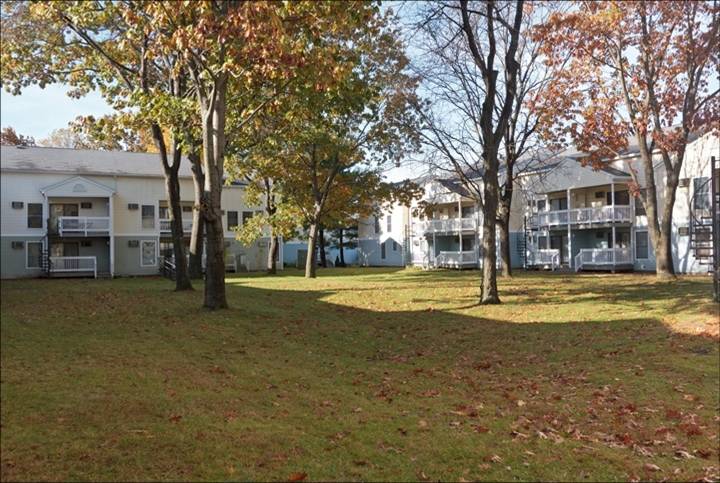
A 248-unit Westfield multifamily complex that was damaged in a 2018 fire will receive financing from MassHousing, enabling a nonprofit developer to begin a $28-million renovation project.
Braintree-based Affordable Housing and Services Collaborative Inc. will rehabilitate all 12 buildings at the Powdermill Village complex, including one building that was partially destroyed by the fire. The renovations, designed by The Architectural Team of Chelsea and performed by NEI General Contracting, include new roofing, siding, balconies, decks and accessibility upgrades.
MassHousing provided a $14.5 million tax-exempt construction and permanent loan and an $11.9 million tax credit equity bridge loan. The project is also receiving a total of $18.9 million in federal and state low-income housing tax credit equity financing. The LIHTC syndicator is Boston Financial Investment Management. The Massachusetts Department of Housing and Community Development, which allocated the federal and state LIHTCs, is also contributing $3.6 million in direct affordable housing subsidy.
The Affordable Housing Trust Fund, which MassHousing manages on behalf of DHCD, contributed $1.3 million to the project, while the city of Westfield is providing $275,000 in Community Preservation Act and HOME financing.
The transaction also involved approximately $1.7 million in insurance proceeds related to the 2018 fire, a $3.4 million seller loan, and $67,281 in owner financing.
The complex includes 50 units supported by the Massachusetts Rental Voucher Program and reserved for households earning a maximum 50 percent of area median income. The remainder of the complex is restricted to households earning 60 to 80 percent of AMI, along with six market-rate units.
Editor’s note: This article has been updated to correct that MassHousing was a source of the project financing.
SourceBanker & Tradesman
CBH DESIGN REQUIREMENTS: An update
After 15 successful years of the Community Based Housing program, CEDAC, DHCD and MRC have worked with Davis Square Architects to update and clarify the CBH design guidelines. Join us at one of these upcoming trainings to learn about these changes as well as other guidance on CBH design and construction.
Who should attend? Project managers and project architects who want to include CBH in their projects; and lender advisors who review projects that include CBH.
Trainer: Paul Warkentin, Associate at Davis Square Architects.
CBH DESIGN REQUIREMENTS: An update
After 15 successful years of the Community Based Housing program, CEDAC, DHCD and MRC have worked with Davis Square Architects to update and clarify the CBH design guidelines. Join us at one of these upcoming trainings to learn about these changes as well as other guidance on CBH design and construction.
Who should attend? Project managers and project architects who want to include CBH in their projects; and lender advisors who review projects that include CBH.
Trainer: Paul Warkentin, Associate at Davis Square Architects.
This event will be repeated November 12, at 2 pm
WinnCompanies joins with state and city officials to announce plans for $38.3 million mixed-income development in Lowell
WinnCompanies, an award-winning multifamily development and management company, today joined with Massachusetts Lt. Gov. Karyn Polito, state and Lowell city officials to unveil plans for a $38.3 million residential construction project in the Hamilton Canal Innovation District, a collection of 17 parcels master-planned to transform the primary gateway of downtown Lowell.
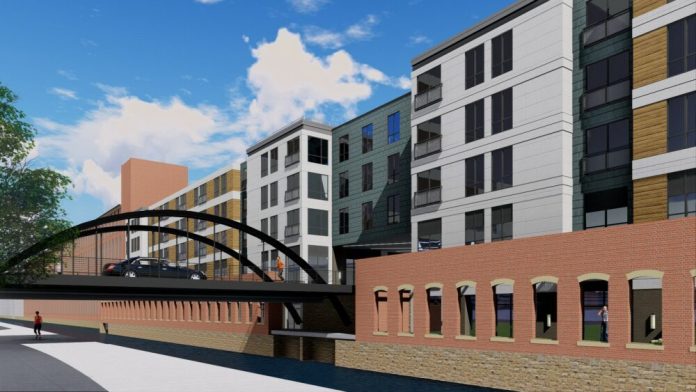
Building on vacant, side-by-side parcels separated by Canal Street, WinnDevelopment will create two five-story buildings with 125 apartments and 5,000 square feet of commercial space. It will be a true mixed income project—54 workforce apartments will rent at 100 percent of Area Median Income (AMI); 39 units will be affordable up to 60 percent of AMI; and, 32 apartments will rent at market rates.
“We’re pleased to be moving ahead with a development featuring a sizable component of workforce housing, which seems appropriate for the city seen as the cradle of the Industrial Revolution in America,” said WinnDevelopment President Larry Curtis. “This project will add a new twist to our long track record of delivering innovative mixed-income, mixed-use communities that contribute to the vitality and the economy of Lowell.”
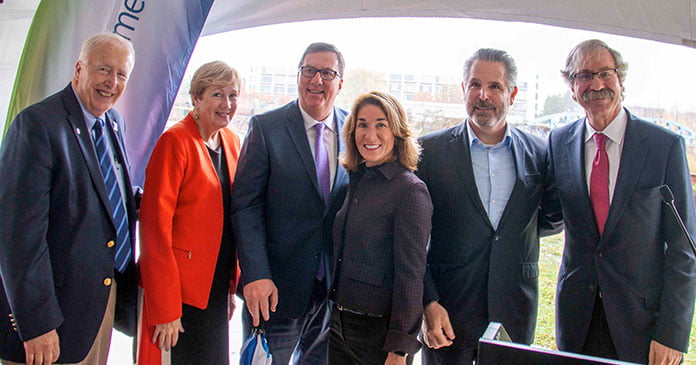
(left to right): Lowell Mayor William Samaras, Lowell City Manager Eileen Donoghue, Massachusetts State Rep. David M. Nangle, Massachusetts Lt. Gov. Karyn Polito, WinnCompanies Executive Vice President Michael O’Brien and WinnDevelopment President Larry Curtis.
The Lowell City Council cleared the way for the project on Tuesday night, unanimously voting to approve Urban Center Housing Tax Increment Financing (UCH-TIF) under a new state program designed to promote multifamily housing in urban centers. Construction is expected to begin in late December 2019 and be completed in December 2021.
“These are fun places to live. There’s a lot going on. There’s a vibe in the downtowns of these old industrial cities because of this collaboration and the willingness of all of you to take the chance, to take the risk, and move forward,” said Lt. Gov. Karyn Polito. “This is a best-of-everything project because you a mixed use project combining commercial and housing together, but it’s also mixed income. To have workforce housing, affordable housing and market rate housing all together is a really great accomplishment. It’s something to the core that WinnCompanies fully embraces.”
Construction will be financed with equity generated by Bank of America’s purchase of federal and state Low-Income Housing Tax Credits; a construction loan from Bank of America; a first mortgage and Workforce Housing funds from MassHousing; financing from the Massachusetts Department of Housing & Community Development under the state’s Affordable Housing Trust Fund, Housing Stabilization Fund and HOME program; financing from the Community Economic Development Assistance Corporation in the form of the Facilities Consolidation Fund and the Community-Based Housing program; Opportunity Zone investment and developer equity from WinnCompanies; and, funds from the Massachusetts Clean Energy Center and MassSave, both dedicated to advancing energy efficiency and clean technology.
The City of Lowell is supporting the project with HOME program funds, the UCH-TIF plan, and infrastructure investments in and around the 51,000-square-foot site.
“The City has made significant investments to put in place the infrastructure needed to support private development in the Hamilton Canal Innovation District. We are pleased that WinnCompanies has put forward a project that will capitalize on these investments and that will help meet the demand for more safe and energy-efficient housing in Lowell in a way that will also stimulate commercial growth in this key area,” said City Manager Eileen Donoghue. “This announcement marks the continuation of a positive partnership between WinnCompanies and the City that has been successful in developing high quality projects that advance our economic development goals.”
WinnDevelopment Project Director Matthew Curtin will lead the development team, which features Keith Construction; ICON Architecture; landscape architect Copley Wolff Design Group; interior designer Wolf in Sheep Design; civil engineer Vanasse Hangen Brustlin, Inc. (VHB); and, structural engineer Odeh Engineers. Deirdre Robinson, a partner at Sullivan & Worcester, serves as legal counsel for the project.
“I am thrilled to see additional private investment in the Hamilton Canal Innovation District. Bringing mixed-use developments to this area is important to ensure that our downtown continues to grow and thrive into the future,” said Lowell Mayor William Samaras.
The development will offer 15 studio apartments, 63 one-bedroom apartments and 47 two-bedroom apartments. The two residential buildings will be linked to each other by an enclosed sky bridge spanning Canal Street, a nod to Lowell’s history when similar connectors joined industrial mill buildings. The sky bridge will also compliment the new signature bridge the city recently built over the lower Pawtucket Canal.
Ambitious Energy Performance Goals
The complex will be designed, built and operated to achieve stringent energy performance goals, including certification through both Energy Star Homes and Enterprise Green Communities.
The environmentally responsible design and construction will feature high-efficiency air source heat pumps for heating and cooling, high performance building envelope details, including robust exterior wall and roof insulation, ENERGY STAR windows, LED lighting, ENERGY STAR appliances, and balanced ventilation with energy recovery for healthy indoor air quality and maximum efficiency.
Final Enterprise Green Communities certification will be achieved post-construction, following rigorous inspections, performance testing and verification provided by Boston based non-profit New Ecology Inc.
Critical incentive funding made available through the Massachusetts Clean Energy Center and MassSave Residential New Construction Program will support added construction costs associated with the project’s HVAC systems and building envelope design, which were designed and selected to reduce the project’s carbon emissions and long-term energy efficiency goals.
Located a half mile from the Lowell Connector with direct access to Route 495 and Route 3, the apartment community will be adjacent to a new 900-space parking garage that is under construction to serve downtown businesses and the new Lowell Justice Center regional court facility scheduled for completion in fall 2020. Residents also will be within walking distance of downtown retail business, a commuter rail line and bus routes served by the Gallagher Intermodal Terminal, as well as downtown retail businesses.
Lowell hosts the single largest concentration of properties owned by WinnCompanies in the United States. In addition, more than 100 company executives and accounting team members work at its regional headquarters in Boott Mills.
A member of the Lowell business community for nearly 25 years, WinnCompanies currently owns and manages seven award-winning residential properties featuring 572 apartments and condominiums, as well as 88,000 square feet of commercial space. The company’s property management arm, WinnResidential, manages an additional 250 apartments in the city.
About WinnCompanies
WinnCompanies is an award-winning national developer and manager of high-impact affordable, middle income and market rate housing communities. Supported by 3,500 team members, the company acquires, develops and manages affordable, senior, mixed-income, market rate, military and mixed use properties. Founded in 1971 and operating in 22 states and the District of Columbia, WinnCompanies is one of the nation’s leading multifamily housing managers with 100,000 units under management. It is the country’s largest manager of affordable housing and the second largest manager of privatized U.S. military housing.
SourceYield PRO Magazine
WinnCo Unveils $38.3 Million Workforce Housing Project in Lowell
WinnCompanies, a multifamily development and management company, joined with Massachusetts Lt. Gov. Karyn Polito, state and Lowell city officials to unveil plans for a $38.3 million residential construction project in the Hamilton Canal Innovation District, a collection of 17 parcels master-planned to transform the primary gateway of downtown Lowell.
Building on vacant, side-by-side parcels separated by Canal Street, WinnDevelopment will create two five-story buildings with 125 apartments and 5,000 square feet of commercial space. It will be a true mixed income project – 54 workforce apartments will rent at 100% of Area Median Income (AMI); 39 units will be affordable up to 60% of AMI; and, 32 apartments will rent at market rates.
“We’re pleased to be moving ahead with a development featuring a sizable component of workforce housing, which seems appropriate for the city seen as the cradle of the Industrial Revolution in America,” said WinnDevelopment President Larry Curtis. “This project will add a new twist to our long track record of delivering innovative mixed-income, mixed-use communities that contribute to the vitality and the economy of Lowell.”
The Lowell City Council cleared the way for the project on Tuesday night, unanimously voting to approve Urban Center Housing Tax Increment Financing (UCH-TIF) under a new state program designed to promote multi-family housing in urban centers. Construction is expected to begin in late December 2019 and be completed in December 2021.
“These are fun places to live. There’s a lot going on. There’s a vibe in the downtowns of these old industrial cities because of this collaboration and the willingness of all of you to take the chance, to take the risk, and move forward,” said Lt. Gov. Karyn Polito. “This is a best-of-everything project because you a mixed use project combining commercial and housing together, but it’s also mixed income. To have workforce housing, affordable housing and market rate housing all together is a really great accomplishment. It’s something to the core that WinnCompanies fully embraces.”
Construction will be financed with equity generated by Bank of America’s purchase of federal and state Low-Income Housing Tax Credits; a construction loan from Bank of America; a first mortgage and Workforce Housing funds from MassHousing; financing from the Massachusetts Department of Housing & Community Development under the state’s Affordable Housing Trust Fund, Housing Stabilization Fund and HOME program; financing from the Community Economic Development Assistance Corporation in the form of the Facilities Consolidation Fund and the Community-Based Housing program; Opportunity Zone investment and developer equity from WinnCompanies; and, funds from the Massachusetts Clean Energy Center and MassSave, both dedicated to advancing energy efficiency and clean technology.
The City of Lowell is supporting the project with HOME program funds, the UCH-TIF plan, and infrastructure investments in and around the 51,000-square-foot site.
“The City has made significant investments to put in place the infrastructure needed to support private development in the Hamilton Canal Innovation District. We are pleased that WinnCompanies has put forward a project that will capitalize on these investments and that will help meet the demand for more safe and energy-efficient housing in Lowell in a way that will also stimulate commercial growth in this key area,” said City Manager Eileen Donoghue. “This announcement marks the continuation of a positive partnership between WinnCompanies and the City that has been successful in developing high quality projects that advance our economic development goals.”
WinnDevelopment Project Director Matthew Curtin will lead the development team, which features Keith Construction; ICON Architecture; landscape architect Copley Wolff Design Group; interior designer Wolf in Sheep Design; civil engineer Vanasse Hangen Brustlin, Inc. (VHB); and, structural engineer Odeh Engineers. Deirdre Robinson, a partner at Sullivan & Worcester, serves as legal counsel for the project.
“I am thrilled to see additional private investment in the Hamilton Canal Innovation District. Bringing mixed-use developments to this area is important to ensure that our downtown continues to grow and thrive into the future,” said Lowell Mayor William Samaras.
The development will offer 15 studio apartments, 63 one-bedroom apartments and 47 two-bedroom apartments. The two residential buildings will be linked to each other by an enclosed sky bridge spanning Canal Street, a nod to Lowell’s history when similar connectors joined industrial mill buildings. The sky bridge will also compliment the new signature bridge the city recently built over the lower Pawtucket Canal.
SourceBoston Real Estate Times
Five items on area businesses for June 11, 2019
The Community Economic Development Assistance Corporation (CEDAC) recently joined Virginia Blanchard Memorial Housing Association (VBMH) and Jon Juhl of JNJUHL and Associates to celebrate the grand opening and ribbon cutting for Blanchard School Apartments at the Uxbridge Progressive Club. Built in 1873 as an elementary school and vacant since 2002, the property is named for the local educator Virginia Blanchard, who served as a teacher and principal at the school for 45 years. VBMH and JNJUHL have redeveloped the historic building and added an adjacent annex to create 25 units of affordable rental housing. Blanchard School Apartments contains a mix of one-, two- and three-bedroom apartments. All units will be reserved for households with incomes below 60 percent of area median, and the property will be managed by The Community Builders. With an initial loan in 2013, CEDAC provided more than $300,000 in pre-development financing, as well as valuable technical assistance, to support this project. Major sources of funding include Massachusetts Housing Investment ($6.2 million in federal low-income and historic tax credit financing); The Life Initiative ($6 million construction loan); the state Department of Housing and Community Development (DHCD) ($1.8 million); MHP ($250,000 permanent loan), and state low-income and historic tax credits ($1.7 million purchased by Unibank). Additionally, the project received $367,000 through the Community Based Housing program to include two units that provide enhanced accessibility features for households with a member at risk of institutionalization or homelessness as a result of their disability. The development also has a preference for military veterans. CEDAC works with the Massachusetts Department of Housing and Community Development to manage several supportive housing programs, including CBH.
SourceWicked Local Middleton
One Gurney Street Holds Grand Opening
Boston Mayor Martin J. Wash on Saturday joined Mission Hill Neighborhood Housing Services (MHNHS), elected officials and residents to celebrate the grand opening of One Gurney Street.
This once vacant property is now a transit-oriented, mixed-use development that offers 40 units of affordable family housing, a new office headquarters for Metro Housing Boston, and four community-oriented retail storefronts including a new Eastern Bank branch. This is the first phase of the redevelopment of Parcel 25, the Mission Hill community’s plan to revitalize Roxbury Crossing.
“Today we celebrate a significant milestone reached as we break ground on this project at Parcel 25 that will bring affordable housing and public benefits to Mission Hill community members,” said Mayor Walsh. “I’m proud of the work that all partners have done to create dozens of affordable homes for workforce families, formerly homeless individuals, and persons with disabilities. This mixed-use development will continue keep this neighborhood a strong and vibrant place for generations to come.”
Phase 1A of the Parcel 25 redevelopment represents the culmination of more than a decade of planning and hard work by MHNHS and the Mission Hill community to restore the land formerly owned by the MBTA. The Maria Sanchez House, located just across Gurney Street from Parcel 25, was the first building to be developed as part of the community’s vision to revitalize the area. The Maria Sanchez House, completed in 2015, offers 40 units of affordable housing for seniors.
“We like to say it takes a village to develop affordable, neighborhood-stabilizing housing. Never has this been more evident than our efforts to redevelop Parcel 25,” said Mission Hill NHS Executive Director Patricia Flaherty. “Not only were hundreds of our neighbors involved in the dreaming, the planning, and the advocacy, but almost as many funders were committed to making the community’s plan a reality, led by the City’s Department of Neighborhood Development and the MA Department of Housing and Community Development. Today we are grateful for all those involved in the Parcel 25 Phase 1A/One Gurney Street project and officially welcome Metro Housing Boston staff and clients, Eastern Bank, and 40 new families to the neighborhood!”
One Gurney Street features nine one-bedroom units, 22 two-bedroom units, and nine three-bedroom units. All of the new rental units are affordable to workforce individuals and families at or below 60 percent of Area Median Income (AMI), 11 of the units are further subsidized to make them affordable to families with incomes at or below 30 percent of AMI. The 11 units include five units that are now home to formerly homeless households, and six fully wheelchair accessible units serving the needs of households with persons with disabilities. Three of the handicapped units are equipped with additional enhancements for persons with significant mobility and other disabilities under the Community Based Housing (CBH) program. Four of the units are specially equipped for persons with hearing impairment and visual disabilities.
“I want to thank everyone here today.This building has opened up the world for me again,” said Allande Pierre, one of the building’s new residents. “After becoming wheelchair-bound, I had to live in an institutional rehab center for more than a year without being able to move around without asking for permission. With my new apartment and the special accessibility adaptations, I have my freedom again. I can come and go as I please, move around the neighborhood, and I can even invite family and friends over to my home. It’s like night and day!”
The first floor of the new building has four retail storefronts located along Tremont Street and immediately across from the Roxbury Crossing T Station, and now extend and support the Mission Hill Main Streets district. In a strong show of their long-term commitment to the project and to the neighborhood, Eastern Bank and Metro Housing Boston now occupy retail and commercial space in thenew development. Eastern Bank, one of the project’s construction/bridge lenders, recently opened the area’s first bank branch in decades in one of the retail spaces. Metro Housing Boston purchased the office condo and relocated their headquarters and more than 155 employees to better service its clients at this location. Metro Housing Boston is the state’s largest servicer of housing subsidies and a provider of housing support services.
“The staff and Board of Metro Housing are thrilled to participate in the development of Parcel 25 to help reconnect Mission Hill with Roxbury,” said Chris Norris, Metro Housing Boston Executive Director. “Not only have we provided our participants with a modern and accessible location for them to receive our services and get connected to affordable homes, but we have also helped knit together a community.”
The project is LEED Silver Certified and has many green features for long-term operations, sustainability, and provides several new improvements such as new sidewalks, handicap accessible ramps, benches, lighting, bike racks, and a new pedestrian plaza and walkway that allows residents and visitors to move through the site and to their points of destination. The building was designed by Goody Clancy architects, constructed by NEI General Contracting, and is managed by Maloney Properties.
The new development has been made possible in part by a City of Boston contribution of more than $4 million, including funds from the Community Development Block Grant and the Neighborhood Housing Trust tied to a linkage contribution from Children’s Hospital. This contribution enabled the development team to take advantage of more than $3 million from the Commonwealth’s Department of Housing and Community Development.The State also provided an allocation of almost $1 million in federal Low-Income Housing Tax Credits (LIHTC) that helped raise over $9.4 million in equity from Regions and First Sterling, the equity investor in the project.
A consortium of Boston Private and Eastern Bank provided over $10 million in construction/bridge financing for the development. The Massachusetts Housing Partnership (MHP) provided $2.9 million in long term financing and is the permanent lender for the project. Boston Community Loan Fund/Life Initiative and Community Economic Development Assistance Corporation provided important pre-development financing for the project, with BCLF/Life Initiative also providing critical acquisition financing for the land purchase.
SourceBoston Real Estate Times
Affordable Housing Next Frontier in Health Care
Affordable Housing Next Frontier in Health Care
New Programs, Partnerships and Funding Prioritize Health Improvements
By Roger Herzog and Sara Barcan
Special to Banker & Tradesman
Affordable housing is the next big frontier in health care, and community development practitioners are catalyzing the growing discussion on social determinants of health, defined by the Centers for Disease Control and Prevention (CDC) as “conditions in the places where people live, learn, work and play that affect a wide range of health risks and outcomes.”
In Massachusetts, we are at a critical juncture: health care policymakers seek to rein in high costs while their housing counterparts are increasing efforts to reduce chronic homelessness and address affordable housing shortages. These challenges are intertwined, especially when reviewing the growing body of research that demonstrates the negative health outcomes and high health costs for homeless and rent-burdened families.
On the housing side, the Department of Housing and Community Development (DHCD) and CEDAC have funded over 3,000 supportive housing units since 2013. We’ve achieved this through a twofold effort that includes improved coordination between housing and health/human services agencies, and increases to the state’s capital budget for housing, especially supportive housing for people experiencing homelessness, elders, persons with disabilities, veterans and unaccompanied youth.
The state makes innovative use of health care and human services resources, including Medicaid, to pay for clinical supports and services that stabilize tenancies and allow residents to succeed in community-based housing. This year was a very important year, as the Legislature and the Baker administration enacted a $1.8 billion housing bond bill, which authorized the capital funds that the state uses to construct supportive housing.
For decades, CEDAC has managed supportive housing capital programs on DHCD’s behalf. Several of these programs, including the Facilities Consolidation Fund and the Community Based Housing program, help to ensure that people with chronic disabilities may live in the community rather than the institutions that housed them previously. Residents of this housing access care and supportive services in their own homes. Medicaid waivers pay for many of these services; we know that they help to keep people out of institutions and can save health care dollars. So it’s nothing new for Massachusetts to capitalize on the intersection of housing and services: for decades, we’ve provided capital and operating subsidies for buildings while Medicaid has covered the supports.
Social Determinants Become Larger Consideration
In recent years, the health care sector has begun to connect its growing understanding about the impacts of these social determinants into their planning and investment decisions. The federal Patient Protection and Affordable Care Act established new opportunities to foster increased collaboration between housing and health care providers. Attorney General Maura Healey and the Department of Public Health have issued updated guidance for community benefits from hospitals and determination of need rules, both of which serve as the oversight framework for hospital performance and accountability. The health sector is responding, with innovative approaches in the community health needs assessment process and plans to utilize financial and real estate assets to align with their mission.
For instance, Boston Medical Center (BMC) recently announced it would invest $6.5 million and work with community partners to support new affordable housing to reduce medical costs. As BMC’s Dr. Megan Sandel has said, “housing is a critical vaccine that can pave the way to long-term health and wellbeing.”
BMC’s initiative was significant not only because of the $6.5 million but also because, as stated in its press release, it “represents the first time that a Massachusetts hospital has put all its required community health investment into one social determinant of health – in this case, housing – to satisfy the requirements of the Massachusetts Department of Public Health for a determination of need.”
BMC’s efforts are not restricted to the housing stabilization initiative it is creating with two nonprofits, Pine Street Inn and Boston Health Care for the Homeless Program. The hospital’s Elders Living at Home Program is working with the nonprofit Roxbury-based Madison Park Development Corporation and Winn Management to create a pilot project, a community based Complex Care Management program, at Madison Park Village. A community health advocate and a community wellness nurse work on-site to provide services with the goal of improving health outcomes, independence and housing stability for residents.
These activities bode well for future collaboration between the health care and affordable housing sectors.
A vibrant community development sector in Massachusetts with a proven track record in real estate development is working to strengthen the relationship with health care institutions. And as our experience with supportive housing shows, CEDAC stands ready to help with policy development, early stage financing and technical assistance.
Roger Herzog is the executive director of the Community Economic Development Assistance Corporation. Sara Barcan is CEDAC’s director of housing development.