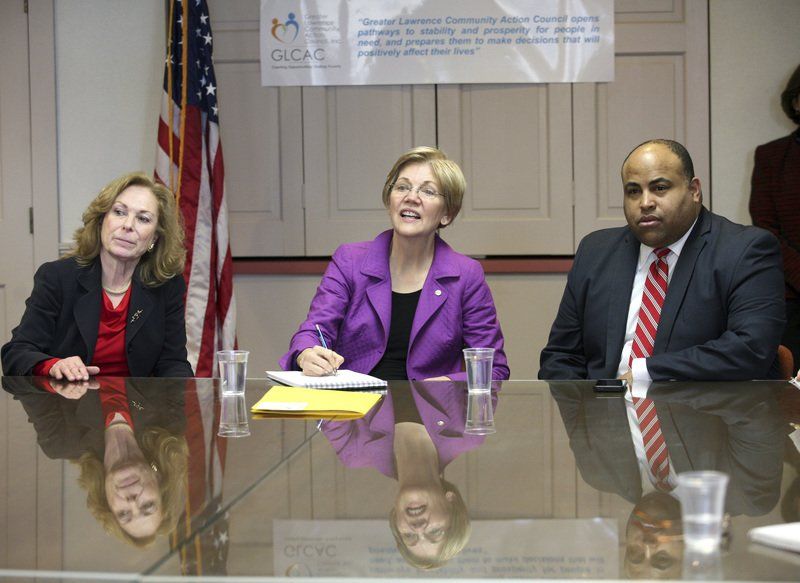
U.S. Sen. Elizabeth Warren met with city leaders Monday to discuss a range of issues, from affordable housing to transportation improvements, praising efforts made in these areas and pledging to advocate for the city at the federal level to help that work continue.
“The federal government wants to be a good partner to the people in Lawrence, and it’s my job to try to make that happen, whenever and wherever I can,” Warren, D-Mass., said.
To start her visit, Warren met with Mayor Daniel Rivera, several city employees and elected officials to hear the city’s plans to apply for Transportation Investment Generating Economic Recovery federal grant funds, known as TIGER money.
She then moved to the Greater Lawrence Community Action Council Inc., where she read to children in the Head Start program and heard about the GLCAC’s efforts to assist residents with everything from visa issues to heating their homes.
Rivera said it was important for the state’s senior senator to come to Lawrence both to celebrate the work that was being done in the city and to understand what still needed to be done to help improve the quality of life and expand opportunities in the city.
“To have such an influential person in the U.S. Senate be our senator, and then to have her come to Lawrence, is the leg up Lawrence really needs,” he said.
Warren called Lawrence a city with “great, great opportunities.”
“I like being in Lawrence because Lawrence is a gateway city in the true meaning of that word,” Warren said. “It is a gateway for people who are building a future, that’s what Lawrence is all about.”
Transportation improvements
Lawrence is seeking TIGER funds for an estimated $10 million in transportation improvements to a 1.6-mile stretch of road through the city’s downtown — from the Five Corners intersection north up Parker Street, across the Merrimack River to Amesbury Street, then to the intersection with Lawrence Street — designed to increase safety and make downtown Lawrence more easily navigable.
“We want to make multimodal transportation access better for everyone, whether that’s pedestrians, bicyclists, motor vehicles,” said Theresa Park, the city’s planning director.
The city is looking to make infrastructure improvements at the Five Corners intersection, from upgrading traffic signal equipment to making sure the roadway complies with the Complete Streets policy for all modes of transportation.
Then, the city is looking to turn Amesbury Street from a one-way roadway into a two-way roadway to help provide more direct access to locations in the city’s downtown. Motorists heading north on Amesbury Street are diverted either left or right after crossing the North Canal, limiting direct access to areas such as the Buckley Parking Garage or Northern Essex Community College, she said.
Plans also call for a roundabout at the intersection of Amesbury and Lawrence streets.
The one-way system “really makes navigation or way-finding within downtown difficult. It forces people to drive out of their way,” Park said.
The improved access and upgraded infrastructure could also help spur job growth, city officials said.
Rivera said the senator offered her perspective on the city’s application – the TIGER program is competitive, and Lawrence was not selected for a grant last year. She helped officials refine the city’s message for that application.
After discussing the grant, Warren, Rivera and elected officials, including state Sen. Barbara L’Italien, D-Andover, and state Reps. Frank Moran and Marcos Devers, D-Lawrence, headed to the GLCAC building for discussions about the organization’s services, its successes, and what resources it needed to help continue serving residents.
“People come here to get their foothold in American society, they come here in the neediest part of their lives, and I think organizations like the GLCAC make that transition easier,” Rivera said.
The GLCAC’s Head Start program was among the successes highlighted to the senator, but there were calls for increased salaries and more support for teachers.
Warren said while “we are not in the position we were in three years ago” when sequestration in Washington resulted in program cuts, including closures of Head Start centers, there was still a fight to be had.
“It is a reminder that what we need to do is we need to be putting more resources, not fewer resources, into Head Start,” she said. “I agree this is the best investment. The nickels we put into children is dollars that will pay off when they’re teenagers.”
Lawrence District F City Councilor Marc Laplante asked the senator whether the city should focus on maintaining and growing its middle class.
“Lawrence shouldn’t just hold onto people it educates, it should attract people,” Warren said. “That’s the kind of community that really is about building a future. A future isn’t just let us give you a start so you can go somewhere else to live a secure life, you can do that right here in Lawrence.”
Linda Soucy, program director for fuel assistance at the GLCAC, spoke of staffing and service issues for her program, which has nearly 12,000 clients. Staffing has been cut nearly in half since she started in 2008, the amount of money clients receive for heating assistance has diminished, and planning issues arise from not having their entire budget released to them at once, she said.
“We have to have the money come in,” Soucy said. “We’re just trying to do our best to make sure people live in safe, warm houses.”
Warren noted it was sometimes a challenge to get those federal funds for heating assistance.
“We don’t do it every time, we don’t win every battle, but I’ll tell you, we will get out there and fight, and fight for what’s right for families in Lawrence,” Warren said.
While each issue was discussed separately, Warren said they are all connected when it comes to advancing quality of life for families in Lawrence and beyond.
“It’s the reminder that all of the pieces work together. If a family doesn’t have housing, then they can’t be secure, they can’t get their children educated, they can’t build any kind of future,” she said.
“But if they get in that housing and can’t keep it heated, then they can’t be safe. If they get in that housing and they keep it heated but they have small children that can’t make it into a Head Start program, then their children will have more difficulty not just immediately, but over the very long run of their years in school and their working years,” she continued.
Given that, Warren said it was hard to prioritize just one issue to focus on in Lawrence.
“It truly is the case that we need to push forward on multiple fronts at once so the pieces can work together,” Warren said, adding, “We know what our families need. The federal government just needs to put the resources in so that we can deliver for our families.”