Enable JavaScript to ensure website accessibility

Boston Children’s Hospital Invests $200,000 in New Loan Product to Help Affordable Housing Developers Assess Feasibility of Co-Locating Child Care

Children’s Investment Fund and CEDAC to deploy predevelopment capital through new Child Care Needs and Design Assessment loan program

Read more here

Let’s Take It Outside: Developing Natural Play Spaces

Join Children’s Investment Fund for a one-day training that provides an overview of safe, healthy, and developmentally-appropriate natural play spaces for children.

Training content includes:

  • Discussion of free play and active learning, health benefits, and nationally-recognized standards
  • Ways to use natural play spaces for active, creative play and learning
  • Overview of key design elements
  • Practical information on the design process and costs

The training is intended for non-profit early education and/or out-of-school time organizations that are in the preliminary planning phase of renovating or creating a new outdoor play space. Priority will be given to organizations that serve low-income children.

*Please note that registration fees are non-refundable.

Investing in child care infrastructure can be transformative
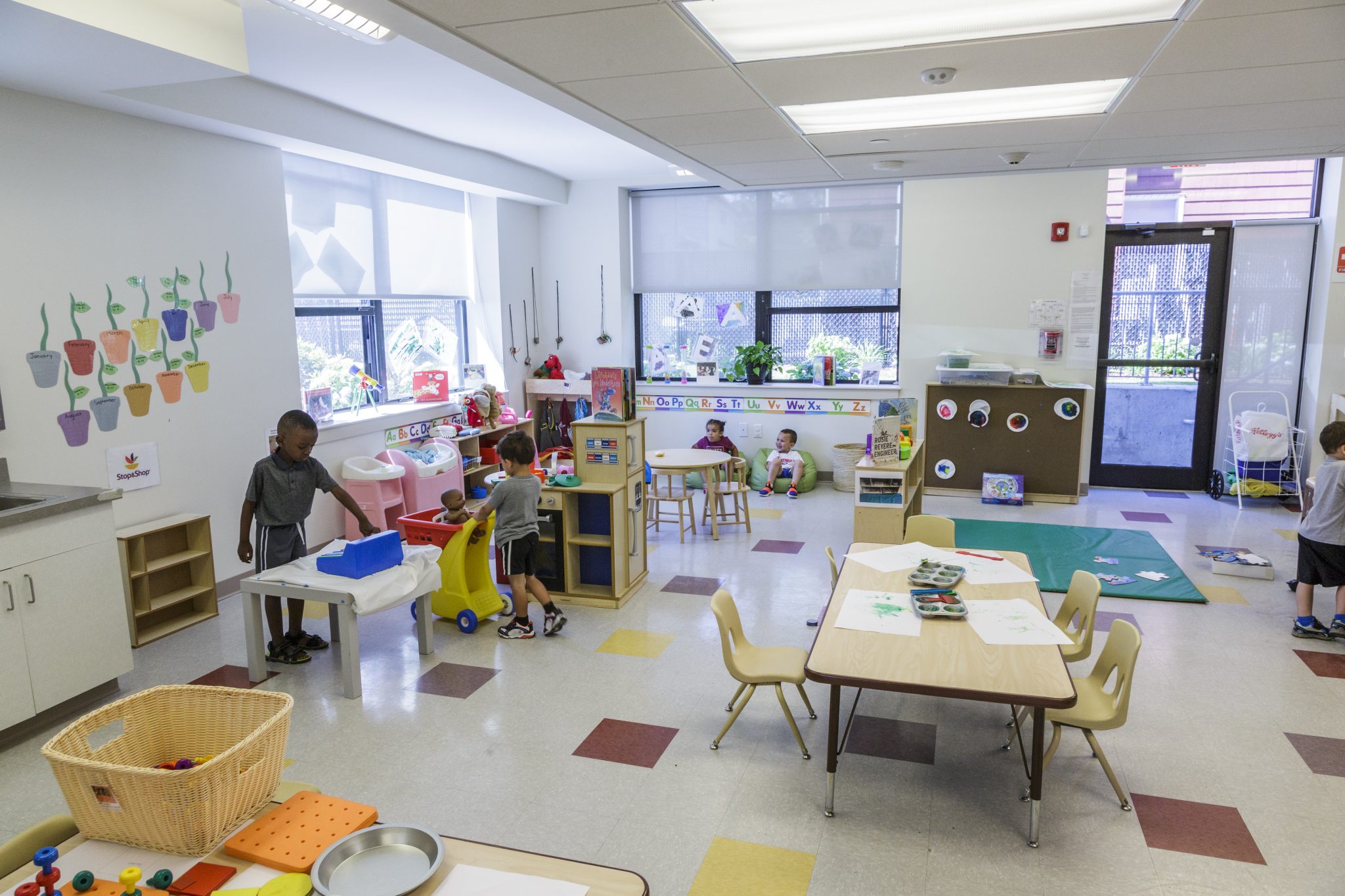
CHILD CARE is vital to our economy. This has never been more apparent than over the past 18 months as the COVID-19 pandemic shut down schools and child care centers across the Commonwealth – and the country. Parents and families rely on child care to work each day, and businesses rely on those employees to stay open and operational. The hope and expectation is that their children receive education and care in a safe and healthy environment that enables them to learn, socialize, and develop. The quality of these spaces is a crucial component of program quality.

Child care is essential, yet the nation’s system has faced scarce funding for decades. The physical infrastructure has suffered, as evidenced by a 2011 report by Children’s Investment Fund, which discovered that many child care centers in Massachusetts lacked necessities like efficient ventilation systems, sinks in classrooms for handwashing, adequate outdoor play spaces, and sufficient natural light.

Unfortunately, 10 years later, many child care centers throughout the Commonwealth still require much-needed investment to provide the high-quality care children and their educators deserve. While Children’s Investment Fund has provided support, training, and investments to centers, more work is to be done. The infrastructure challenges facing child care centers were made even more apparent in the wake of the COVID-19 pandemic, exposing the need to upgrade facilities to include proper ventilation and enough play and learning spaces that enable social distancing.

Children’s Investment Fund recently released a report, Building Quality: Transforming Early Learning Environments in Massachusetts, reflecting on the organization’s 30 years of work and highlighting the Early Education and Out of School Time Capital Fund created in 2013 together with the Department of Early Education and Care. The report rebrands the program as the Building Quality Capital Fund. Since its establishment, the Building Quality Capital Fund has invested a total of $39.2 million in child care facilities across Massachusetts, including $7.5 million in additional grants announced this summer to address emergency COVID-related needs.

Over half of the facilities are located in Gateway Cities. Ensuring that safe, viable child care facilities exist in these cities will only further efforts to revitalize these cities, support workers, and support their local economies.

One of the grantees, For Kids Only Afterschool, received a $400,000 award to help construct an afterschool building in Revere to serve up to 140 children. The funds allowed the organization to move from a leased storefront with no outdoor play space to a brand-new building with a commercial kitchen, large gym, and better ventilation. The impact on the program was transformative. The ample space, operable windows, and outdoor space became essential once the COVID-19 pandemic hit years later.

Not all environments produce equal results for all children. Through research and our 30 years of experience, Children’s Investment Fund has learned that child well-being is enhanced when facilities incorporate spacious classrooms, a bathroom in each room, natural light, indoor and outdoor play areas, and proper ventilation. The Building Quality Capital Fund has demonstrated that these improvements are possible and that a mix of public and private funding can achieve these results. The funding has helped improve learning environments for over 9,000 children, more than 80 percent of whom live in low-income households.

For the first time in decades, our society seems to understand the value of child care in our communities. Most parents need to work, and their children need stimulating environments that support their healthy social-emotional, physical, cognitive, and language development during the long hours spent away from home.  We must continue to raise the bar for our children and support the organizations who care and educate them as they seek to revitalize their spaces to provide high-quality learning environments. We have an opportunity to meet the moment and give these centers the investments and tools they need.

Theresa Jordan is director of the Children’s Investment Fund.

»

SourceCommonWealth Magazine

Belchertown Day School Opens Its Doors

After a three-year wait, the Belchertown Day School has opened its doors
to children and their families, with some restrictions due to COVID-19. Belchertown Day School Executive Director Pat Bruni and School Age Director Heidi Gutekenst said they are “excited to be in (their) forever home.”

»

SourceBelchertown, Granby & Amherst Sentinel

A $5 million investment in kids at Greater Lowell YMCA

A $5 million “investment in the future of our kids” should be ready by September as the Greater Lowell YMCA embarked Friday on a renovation and expansion project to its Thorndike Street building.

Executive Director Kevin Morrissey welcomed Lowell officials and others “to celebrate our investment in the facility and our children.”

When completed the project will mean 12,000-square-feet of renovated and added space providing  “a state of the art learning center for kids,” Morrisey said.

A $1 million grant from the state Department of Early Education and Care got the project off the ground.

The state agency visited Lowell a year ago to evaluate the YMCA’s facility and programs before making the award.

“It really felt great here,” said Theresa Jordan of the Children’s Investment Fund, which oversees the grant for the state.

State Sen. Edward Kennedy, state Rep. Tom Golden and Mayor John Leahy shared memories of the YMCA growing up in Lowell. Golden and Leahy both learned how to swim at the Y pool. Kennedy also learned to swim at the Y,  but the old Y on Merrimack Street, which was located between Old City Hall and what is now Enterprise Bank.

The new YMCA opened 45 years ago, so Kennedy took some ribbing from Golden and Leahy.

Golden called the Y “a real asset for the community” and added that it is a safe place for the children of Lowell. Leahy agreed and remembered coming to the building when it first opened.

City Manager Eileen Donoghue reminded the audience that the YMCA is more than 150 years old. “It’s been a labor of love from then until today,” she said, adding, “The YMCA is more important now than ever.”

While construction is underway, the early childhood programs and day care have been moved temporarily offsite. Windows in that area of the building are boarded up and the interior has been gutted. The gym and other areas at the front of the building are still open, but signs of construction are still evident.

Project Manager Robert Samaral of Kaplan Construction was on hand outside to answer questions. He has done a lot of work for YMCAs in the state, including several in Lawrence. But this is his first project in Lowell.


SourceLowell Sun

Belchertown Day School buys land at former State School site for early childhood education center

Belchertown Day School has purchased two acres the former site of the Belchertown State School, where it plans to build a 8,600-square-foot early-childhood education center and afterschool facility.

MassDevelopment announced the sale in a news release Wednesday.

“We no longer will be renting; we will have a school to call our own that will be a forever home,” the school’s executive director Pat Bruni said in an interview Wednesday. “This new school means so much to us.”

Belchertown Day School paid $133,333 for the land, according to documents filed Dec. 11 at the Hampshire County Registry of Deeds. The seller was the Belchertown Economic Development industrial Corp.

Also on file is a document requiring Belchertown Day School to build the childcare facility and to start construction within six months of buying the land.

MassDevelopment also said a new road at the 55-acre site, called Carriage Drive, opened in December.

At over a third of a mile, Carriage Drive opens the Carriage Grove neighborhood for residential, commercial, and industrial uses and realigns Jackson Street to move traffic away from an established neighborhood. The Day School site is on Carriage Drive.

MassDevelopment calls Carriage Grove a “new neighborhood” at the State School site, part of a master plan for up to 581,000 square feet of mixed-use development.

“MassDevelopment is proud to oversee the development of Carriage Grove from a former state school into a first-rate mixed-use neighborhood,” MassDevelopment President and CEO Lauren Liss said in a statement. “The addition of Belchertown Day School, Inc. and the recent completion of Carriage Drive mark two exciting milestones in our redevelopment efforts, and create momentum toward the build-out of this community.”

Carriage Drive opened Dec. 1, 2019. Funding included a $3 million grant from the Commonwealth’s MassWorks Infrastructure Program, according to the release.

Founded in 1977, Belchertown Day School is a nonprofit providing early childhood education for more than 100 children between ages 15 months and 12 years old. It has toddler and preschool classes, before and after-school programming and vacation and summer programming, according to a news release.

Belchertown Day School currently operates out of leased space at 432 State St. in Belchertown.

Deeds documents show at least $2.9 million in funding for the project. The new building will be financed by Children’s Investment Fund’s Early Education and Out of School Time Capital Fund, according to deeds documents. Additional financing is from Blue Hub Capital and the U.S. Department of Agriculture’s Community Facilities Program.

At least a quarter of the 110 slots in the new school will be set aside for children from low-income families.

Following the Belchertown State School’s closure in 1992, the Belchertown Economic Development and Industrial Corporation purchased the Carriage Grove site from the state, according to Wednesday’s news release. The main campus of the property contained almost 400,000 square feet of abandoned buildings and utility tunnels with significant environmental issues that required abatement and demolition.

MassDevelopment is the state’s finance and development agency.

The Belchertown Planning Board approved a site plan for the Day School in February 2019.

Jim Russell contributed reporting.

SourceMassLive

Making room for growth, GLCAC makes final push to fund new, bigger daycare center

Sharing the parking lot with a Dunkin’, the building looks a lot like a strip mall.

That’s because at one time, it was.

From the outside, the Child Care Center at 581 Andover St. is quite non-descript. A bunch of cars, some buses, the aforementioned Dunkin’ are all visible from the street.

Then there is the building, emblazoned with the sign indicating it is a school facility owned by the Greater Lawrence Community Action Council, or GLCAC.

Once a supermarket, the inside of the pre-school for low-income children and their families has been transformed over the years into a warm, inviting learning environment.

Teachers have created beautiful murals in the hallways. Classrooms are adorned with decorations. Mini chairs and low tables are filled with smiling children, eating raspberry yogurt “and granola,” as one young girl with curly red hair explains.

But the building, and the grounds around it, have outlived their usefulness. Quietly, almost stealthily, the board of directors of GLCAC over the past three years has raised $7.9 million to build a new school on the same piece of property. The group just received a $1 million donation from the state, bringing the total raised to $8.96 million.

Another $440,000 is needed to meet the goal of $9.4 million, and school officials are bullish about the project and the fund-raising.

“We looked for another building,” said GLCAC Executive Director Evelyn Friedman. “We wanted to stay in Lawrence and build a facility for 250 kids. Everything we found was too big or too small, so we decided to rebuild on-site.”

The existing building is about 20,000 square feet on one level. The new building will be 30,000 square feet on two levels and the number of students will increase from the current 200 to the goal of 250.

“We only have $441,000 left to raise,” said Jennifer Carter, director of program planning and evaluation, who is also responsible for grant-writing. She said $660,000 has been raised from individuals and family members, another $70,000 from staff and board members.

Sara Morin works with Carter and helps organize the annual gala in April. She said she is hopeful that event will put the organization over the top and that the white tip of the oversized fund-raising thermometer will turn red by spring.

In obvious need of expansion

During a tour of the facility last week, it became clear very quickly how much the school needs more space.

Items were stored in the hallways. Classes were doubled up in many cases.

A gym, also known as the “gross-motor room,” is tiny and can only handle 10 children at a time.

The new facility will have two much larger gross-motor rooms, enabling more children to play at any given time.

Classrooms will no longer be doubled up: In the current facility, one classroom has 20 kids on one side with two teachers. A makeshift wall of cabinets and desks marks a boundary of sorts, inside of which are 10 kids with one teacher.

In the new facility, there will be 20 kids per classroom, with two teachers in each. No shared space.

Jessi Surette, whose title is “inclusion coach” and whose job is to help children with behavioral difficulties, is looking forward to the new facility.

“It will be so much bigger, with more room for classrooms, and it will serve more children,” she said.

Adelaida Guzman, a teacher of 10 years, said she was hopeful about the new school, noting that with more room comes “more decorations which will make the kids more interested” in learning.

Other problems abound in the old school.

For example, the 13 employees in the transportation division are jammed into a small room in the center of the building. A room for teachers to do lesson plans is even smaller, but it is the only place in the building with WiFi.

The new school will offer larger rooms for these and other programs, as well as more and larger administrative offices, where employees are now doubled-up.

The new facility will have one, large kitchen, where food will be prepared for the six schools under the GLCAC banner throughout the city. The agency will hire at least 20 new teachers and staff.

Grateful for grants, donations

Outside, the differences will also be dramatic.

The way the construction is planned, the new building will be adjacent to the existing building, on top of the playground for the older kids and on top of what is now the parking lot for buses. It will go from the back to the front of the property at Andover Street.

When the new building is done, everyone will be moved over and the old building will be razed, making way for a brand-new playground, more parking, and a driveway that will carry buses and cars out the side of the property, onto Diamond Street.

Currently, buses trundle into the front entrance, pick up students, and then back up and out the exit/entry. Making matters worse is that customers going to Dunkin’ have a tendency to use the entrance to the school before going left to the drive-through.

Under the new scheme, the Dunkin’ driveway will be isolated from the rest of the property with landscaping and curbing.

Friedman said she was very thankful for all the support the agency has received for the new school, especially the $1 million grant from the Baker-Polito administration through the Community Economic Development Assistance Corporation.

The grant was announced last month as part of a $6 million gift to child care programs across the state.

“Our administration is pleased to support facility improvements at early education and care programs throughout the Commonwealth to provide families with the resources necessary for success in and out of the classroom,” Baker said during a ceremony Dec. 19 at the YMCA Cape Cod in Hyannis, one of the facilities benefiting from the state program.

“Renovating and repairing child care facilities helps achieve the administration’s goal of providing quality early education and care in all Massachusetts communities.”

SourceThe Eagle-Tribune

Cape Ann Y gets $1M for early ed center

With help from a state grant, the new Cape Ann YMCA will be able to provide more space for in-house educational opportunities for young children.

The new YMCA, which is slated to open in the fall of 2020 at the site of the former Fuller School, will include, among other features, an expanded early education center with more staff and programming than is currently offered in the Y’s building on Middle Street. This will be funded, in part, by a $1 million capital grant the YMCA of the North Shore — the parent entity of the Cape Ann Y — received from the Baker-Polito administration.

The grant award also brings the Cape Ann Y’s overall capital campaign to a total of $20.4 million, closing in on the $22 million fundraising goal for the new complex.

“We are so grateful to the Children’s Investment Fund, the Department of Early Education and Care, and the entire Baker-Polito Administration team for their overall commitment to high-quality, affordable early learning across Massachusetts,” said Chris Lovasco, President and CEO of YMCA of the North Shore. “Our Cape Ann Y is honored to have been selected and truly appreciates the confidence the administration has expressed in our Y’s ability to deliver on its mission here in Cape Ann.”

The plan going forward is for the new Cape Ann YMCA to have a state-of-the-art licensed childcare space.

“It is going to be 6,000 square feet,” Cape Ann Y’s Executive Director Tim Flaherty said. “That does not include shared spaces.”

The entire new facility will have 65,000 square feet of recreational and educational space, compared to 44,000 square feet now at the Middle Street location.

The new early education space and increased staff will allow the Y to accept infants into its programs and increase space for toddlers to play and learn. This, in turn, is expected to enable the Y to double its enrollment in early education programs.

In 2019, the Cape Ann YMCA provided early education (including preschool) and after-school care for more than 200 children while offering more than $150,000 in financial assistance.

“With this increased enrollment, we are going to help all people from those who can’t afford to those who can afford child care,” Flaherty said. “It is going to be reflective of the community.”

The Cape Ann YMCA was one of six agencies in the state to receive this money in Early Education and Out of School Time capital improvement awards to establish Early Learning Centers and to repair and renovate facilities serving children from low-income households.

The other agencies receiving grants of $1 million each include the YMCA of Cape Cod, Greater Lawrence Community Action Council, Greater Lowell Family YMCA, Horizons for Homeless Children in Boston, and YWCA of Central Massachusetts.

As the YMCA’s dream of a new Cape Ann location begins to draw closer to reality, they are looking to the next few months as instrumental ones in reaching their fundraising goal of $22 million.

“The Y continues to push to the finish line to reach its goal by raising the final $2 million in the coming months,” said Pam Sullivan, of YMCA of the North Shore.

Anyone interested in volunteering to help the campaign may contact the Y’s Chrissy Cahill at cahillc@northshoreymca.org

Staff writer Taylor Ann Bradford can be reached at 978-675-2705 or tbradford@northofboston.com.

SourceGloucester Daily Times

Women-led YWCA construction project breaks ground in Worcester

Poised to “meet the challenge of the new downtown,” as YWCA Central Massachusetts President Roberta Brien announced, the all women-led construction team for the YWCA’s $24 million renovation broke ground Thursday morning.

The ceremony, attended by some 50 people, was held inside the YWCA’s gymnasium, because of frigid temperatures. Thirteen project and organization executives and contributors dug shovels into a large sandbox as cameras clicked.

The construction project at 1 Salem Square features building system upgrades, a new two-floor early education and care center, expanded transitional housing units, increased space for domestic violence services, reconfigured wellness and health areas and overall site enhancement, including a shared play area with Worcester Public Library.

YWCA’s $7.5 million capital campaign has already received $5.25 million in pledges, said YWCA President-elect Christienne Bik.

The state has committed $3.6 million in bond funds.

Included in that, the YWCA received a $1 million Early Education and Out of School Time capital improvement grant in December through the Department of Early Education and Care, one of six grant recipients to receive the largest investment the state has made in child care facilities, said Early Education and Care Commissioner, Samantha Aigner-Treworgy.

What makes the project unusual is that its field management and supporting staff teams are all women.

“We knew that their (YWCA’s) mission was empowering women,” said Jody Staruk, project executive for Consigli Construction, the project’s construction contractor.

When Staruk was approached to arrange a team, she said, “I had a significant pool of women to pull from.”

Women conduct the estimates, preconstruction management, virtual design and construction modeling, and superintendent and engineer positions in the field, Staruk said.

While women have worked on numerous separate teams, to pull them together on one project is a first for Consigli.

The owner’s project manager, Pinck & Co., an Anser Advisory company, and architects Fennick McCredie Architecture Ltd. are also part of the women-led team.

“When we sit in a meeting, it’s a dozen women in the room, solving world problems and getting work done,” Staruk said.

She called the process, “collaborative and creative.”

Women aren’t just involved in leading the project. Some women working on site will have come through the Worcester Jobs Fund, a training program for low-income residents.

“Because the percent of women working in construction is so low, a lot of women don’t think of construction,” despite the high pay, said Kelsey Lamoureux, director or the Worcester Jobs Fund. The program is housed at MassHire’s Central Region workforce board.

She said that nationally, 3% of workers on construction sites are women. In Massachusetts, it’s closer to 8% to 9%, with union efforts helping to push the numbers.

Women make up about half the training program in Worcester.

Lamoureux said she was looking for more women interested in construction for the next training program, which begins at the end of February.

Construction started last week and is expected to finish by the end of the year.

SourceTelegram

Worcester YWCA begins $24M renovation

The YWCA Central Massachusetts began construction Thursday on a $24-million renovation of its Worcester facility.

The construction project has already hit a milestone: what the nonprofit says is the city’s first community benefits agreement, which ensures an all-women led construction management team. It’ll also promise living-wage jobs with benefits, and an emphasis on diversity by employing union contractors, local women and people of color.

The project will remake the YWCA’s Salem Square location with a relocated playground, a new shared play area with the Worcester Public Library, and four new rooms for residents to stay in the transitional housing program. Other improvements include an increase space for domestic violence services and the addition of a multi-use fitness area.

Other work is more utilitarian, including upgrading heating and air conditioning, repairing roofs and installing new windows and doors. The work is set to take about one year.

The YWCA Central Massachusetts was one of six community nonprofits to win a $1 million grant each in December from the Gov. Charlie Baker Administration and the Massachusetts Community Economic Development Assistance Corporation. The funds support facility improvements at early education and care programs that serve low-income children.

SourceWorcester Business Journal