Walker Park Apartments and Delphine’s Courtyard Opened

Mayor Martin J. Walsh today joined the community development agency Urban Edge, elected officials, community leaders and neighbors to celebrate the opening of the Walker Park Apartments and Delphine’s Courtyard, consisting of 49 units of affordable family housing and a pocket park in Egleston Square. The City of Boston’s Department of Neighborhood Development and the Community Preservation Fund provided more than $2.8 million in total for the new homes and courtyard.

“Today we celebrate the creation of 49 new affordable homes, a crucial step forward in our goal of preserving our neighborhoods,” said Mayor Walsh. “Along with our partners, the City of Boston is making big investments in Egleston Square, increasing opportunity for families and helping us keep housing affordable and accessible. I want to thank Urban Edge and everyone involved in this project for their work in making these new affordable homes possible.”

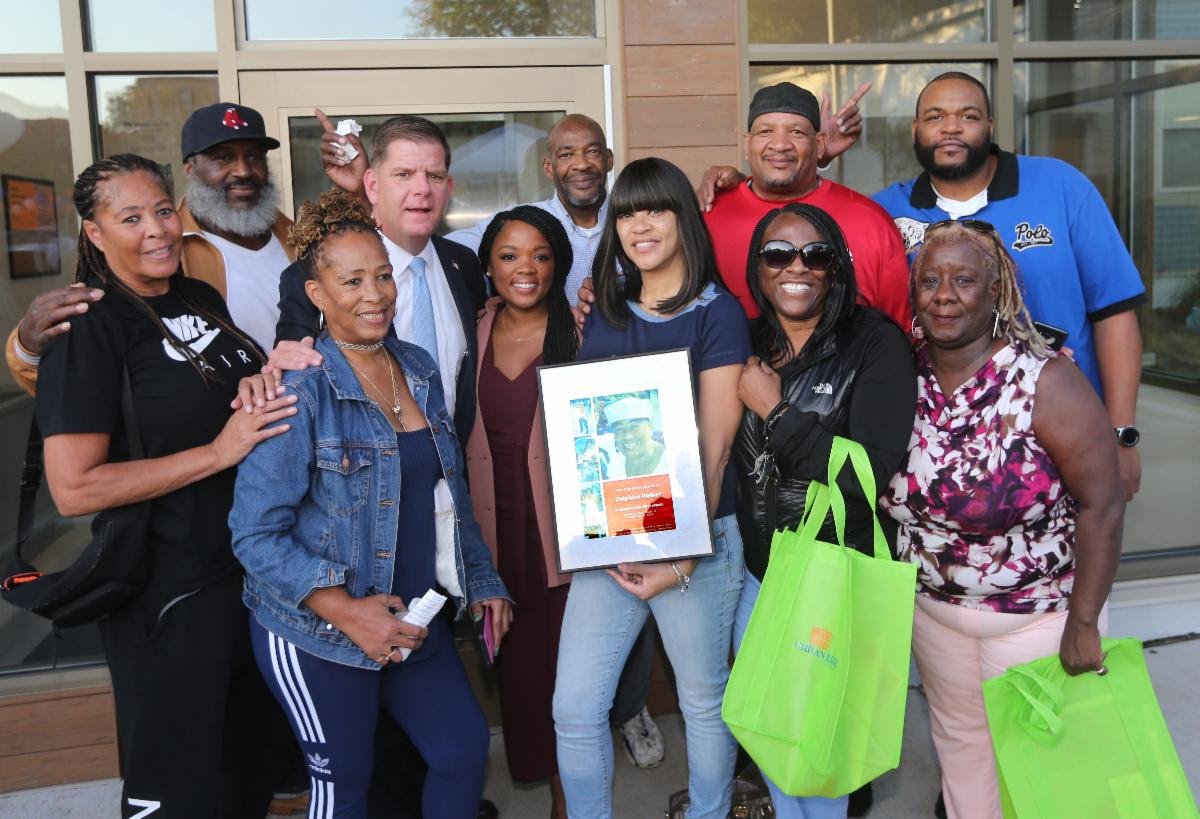
Mayor Walsh with members of the Walker family.

Mayor Walsh with members of the Walker family.

The Walker Park Apartments redeveloped three formerly vacant or underutilized parcels adjacent to the Egleston Square Branch of the Boston Public Library and in the Egleston Square Main Street District. The development is named for longtime community activist Delphine Walker, whose home stood on one of the development sites. All of the 49 new apartments have been rented to households who earn at or below 60 percent of the Area Median Income (AMI), including eight apartments reserved for families earning 30 percent of AMI or below.

“Urban Edge is proud that we have led investment in Egleston Square and is doing so in a way that honors the neighborhood’s past while providing more opportunities for quality housing for members of the community,” said Natacha Dunker, president of Urban Edge’s Board of Directors. “We are so grateful to Mayor Walsh, the Department of Neighborhood Development, and all of our funders for their support of this important project.”

“Today, we celebrate another victory for our city and community: new construction of 49 income-restricted units and 34 off-street parking spots,” said State Representative Liz Malia (D-11th Suffolk). “This is exactly the type of housing we need to build in Boston and specifically in the Egleston Square Neighborhood. The face of our community depends on it, and I’m  grateful to Urban Edge and the City for having the long-term vision to realize this project and others like it.”

The Walker Park Apartments now boast 13 one-bedroom, 28 two-bedroom, and eight three-bedroom family apartments, an elevator for accessibility, on-site laundry facilities, on-site parking, and Delphine’s Courtyard funded by the Community Preservation Fund. In accordance with state guidelines, funds generated from the Community Preservation Act fund for affordable housing, historic preservation, and parks and open space projects.

“My mother bought her home in Roxbury at a time when many people were not making investments in this community, and she worked with others to strengthen Egleston Square as a neighborhood,” said Pamela Walker, daughter of Delphine Walker. “We are so grateful that Urban Edge has honored her by naming both the apartment complex and the courtyard after her.”

“Since I moved to Walker Park, my life feels different. I can see how my children always have a smile on their faces,” said Cassandra Amazan, a resident of Walker Park Apartments. “It was a great feeling seeing them choosing their own room and making plans of how they would decorate them. It is not only about having or walking in to my own apartment now, it’s about feeling accomplished in many ways and that this is opening new doors for me and my family.”

In accordance with the City of Boston’s Green Affordable Housing Program, Walker Park Apartments will utilize a high-efficiency heating system as well as Energy Star rated appliances. The development employs environmentally friendly design features that meets the U.S. Green Building Council LEED Homes Silver certifiable standard. The development also met the U.S. Environmental Protection Agency’s Energy Star standards. The development team is made up of Urban Edge, Prellwitz Chilinski Associates, and NEI General Contracting, Inc.

The Walker Park Apartments have been made possible by funding from the City of Boston, and State and Federal Low Income Housing Tax Credits from the Commonwealth’s Department of Housing and Community Development (DHCD). Financing team members also included Bank of America Merrill Lynch, Brookline Bank, the Community Economic Development Assistance Corporation, MassDevelopment, MassHousing, Massachusetts Housing Investment Corporation, Massachusetts Housing Partnership, US Bank Corporation, and the US Department of Housing and Urban Development.

Walker Park Apartments strongly aligns with the City’s housing goals outlined in Housing a Changing City: Boston 2030. Mayor Walsh recently increased the City’s overall housing targets from 53,000 to 69,000 new units by 2030 to meet Boston’s population growth. These updated housing goals build on Mayor Walsh’s commitment to increasing access to home ownership, preventing displacement and promoting fair and equitable housing access.

Since the release of the original Housing a Changing City: Boston 2030 plan in 2014, income-restricted housing stock, designed to increase affordable housing, has grown along with overall new production: nearly 20 percent of housing units are income restricted, and 25 percent of rental units are income restricted. In total, after creating an additional 15,820 units of income-restricted housing, Boston will have nearly 70,000 units of income-restricted housing by 2030.

Mayor Walsh’s 2019 housing security legislative package focuses on expanding upon the work that Boston has done to address the region’s affordable housing crisis and displacement risks for tenants by proposing new and strengthening current tools to leverage Boston’s prosperity and create sustainable wealth opportunities that make Boston a more inclusive and equitable city. The housing security bills proposed seek to help existing tenants, particularly the elderly, remain in their homes, and creates additional funding for affordable housing.

For more information on the City’s work to create more housing, please visit: Housing A Changing City: Boston 2030.

###Delp

SourceMayor's Office

Baker-Polito Administration Advances Production and Preservation of 1,500 Housing Units Across Commonwealth

Today, Governor Charlie Baker announced the 2019 Affordable Rental Housing Awards. Today’s awards will support the preservation and production of 1,581 rental units, including 1,349 affordable units. This includes 273 units that will be reserved for extremely low-income households.

Today’s awards will advance three transit-oriented projects, five projects for seniors, and two projects that will significantly rehabilitate public housing. Affordable rental housing awards have led to the production, renovation and preservation of more than 7,800 housing units, representing nearly half of all the housing units supported by the Baker-Polito Administration since 2015 though funding mechanisms like the MassWorks Infrastructure Awards Program, the Housing Development Incentive Program and more.

“We are pleased to announce these Affordable Rental Housing Awards to advance the production and preservation of more than 1,500 rental housing units throughout the state,” said Governor Charlie Baker. “Our administration has already invested more than $1 billion in affordable housing and we look forward to working with our colleagues in the Legislature to pass our Housing Choice bill to facilitate the production of more new housing units in communities across Massachusetts.”

“Each housing unit advanced today will benefit entire communities, by bringing more people to downtowns, transforming long-vacant properties, and providing new customers for local businesses,” said Lt. Governor Karyn Polito. “Housing is both a valuable tool and critical precursor for economic development, and these projects will provide stability to many households in need. Congratulations to all of today’s awardees.”

The Department of Housing and Community Development is awarding nearly $80 million in direct subsidies from seven state bond accounts and federal HOME funds, and allocating $38 million in state and federal Low Income Housing Tax Credits (LIHTC) to 28 projects. The tax credit allocations will generate more than $260 million in equity to support these projects. Massachusetts is one of just 17 states to offer a state tax-credit program to complement the federal LIHTC program to support the development and rehabilitation of affordable housing.

“The housing crisis in Massachusetts has far reaching effects on our Commonwealth, and is a major obstacle to long-term growth,” said Housing and Economic Development Secretary Mike Kennealy. “Our workforce and low-income households need more housing options that connect them to employment opportunities, transportation and amenities. Our administration is proud to support today’s projects, which will further diversify our housing portfolio and help more families access stable housing.”

“Housing that meets the needs of residents is the foundation for thriving communities, supporting strong neighborhoods and vibrant downtowns,” Housing and Community Development Undersecretary Janelle Chan. “Today’s awards enable the creation of housing for low-income families, seniors, and individuals, including those transitioning out of homelessness. These high-impact projects will bring new residents to Fitchburg, Gloucester, and Methuen’s downtown districts, redevelop vacant school properties in Southbridge, Swampscott and Taunton, and leverage town-owned land in Williamstown. This is just a sample of the amazing developments we are supporting, all of which will benefit thousands of residents upon their completion.”

Governor Baker joined Housing and Economic Development Secretary Mike Kennealy, Housing and Community Development Undersecretary Janelle Chan and local leaders to announce the awards in Swampscott, near the site of the future Senior Residence at the Machon, which received funding today. The project will redevelop a vacant elementary school into 38 affordable rental units for seniors, with eight units reserved for extremely low-income seniors. The developer, B’Nai B’rith, will also provide long-term services at the site to support residents. DHCD is supporting the project with a federal LIHTC allocation and direct subsidy funding.

“A few years back the Town of Swampscott took an important step in making the former Machon Elementary School available for affordable housing. Together with a strong partner in B’nai B’rith Housing and the required financial support from the Baker Administration, 38 units of very affordable senior housing are becoming a reality in Swampscott,” said Peter Spellios, Chair of the Swampscott Select Board. “The need for affordable housing in every community is real. By supporting the Senior Residences at Machon in his hometown of Swampscott, Governor Baker is setting an important example for all communities. We are grateful for his leadership and support.”

“We are so grateful for the State’s support and for our partnership with the Town of Swampscott to bring much-needed affordable housing to seniors and older adults in Swampscott,” said Susan Gittelman, Executive Director B’nai B’rith Housing. “Seniors and older adults are a fast growing demographic, and we believe this community development will help fill the need for affordable housing in Massachusetts.”

“With the current high demand for housing, unlocking the potential of developments like this is of paramount importance,” said Senator Brendan Crighton. “This project perfectly combines the need for senior housing with an unutilized building ripe for redevelopment and reuse.”

“This project is an excellent use of the Old Machon School building, supporting seniors who increasingly cannot afford Massachusetts’ skyrocketing housing costs,” said Representative Lori Ehrlich. “I am grateful to the administration for including this project in its award round, and I look forward to continuing to work with my colleagues and the administration to reduce housing costs on the North Shore and increase the supply of housing options.”

Today’s awards further the Baker-Polito Administration’s efforts to increase significant housing production across the Commonwealth, including affordable and market-rate housing. Since 2015, the administration has injected more than $1 billion in affordable housing, resulting the production and preservation of more than 17,000 housing units, including 15,000 affordable units. In 2018, Governor Baker signed the largest housing bond bill in Massachusetts history, committing more than $1.8 billion to the future of affordable housing production and preservation. The Baker-Polito Administration has also advanced the development of more than 11,000 mixed-income housing units through the successful MassWorks Infrastructure Program, reformed the Housing Development Incentive Program, and worked with communities to implement smart-growth development and planning efforts.

In February 2019, Governor Baker refiled the Housing Choice legislation to deliver necessary, targeted zoning reform to benefit communities pursuing new housing production and support the administration’s goal of producing 135,000 new housing units by 2025. In May, Governor Baker, Lt. Governor Polito, and Housing and Economic Development Secretary Mike Kennealy testified in support of the legislation in front of the Joint Committee on Housing.

###

Cabot Street (Beverly) is an existing single-room occupancy (SRO) project located in the city’s central business district. The sponsor is the non-profit YMCA of the North Shore. The project will rehabilitate 45 existing SRO units and construct 24 new SRO units. DHCD will support the project with federal and state low-income housing tax credits (LIHTC) as well as subsidy funds. The City of Beverly will also support the project with local funding. When construction is completed, Cabot Street will offer 69 total SRO units. All units will be restricted for individuals earning less than 60% of area median income (AMI), with 20 units further restricted for individuals earning less than 30% of AMI.

Bartlett Station Building A (Boston) is part of a multi-phase redevelopment of a former MBTA lot in Roxbury. The sponsor is the non-profit Nuestra Comunidad Development Corporation. DHCD will support the project with LIHTC and subsidy funds, and the City of Boston also will support the project with local funding. When completed, this phase of Bartlett Station will offer 42 new rental units. Thirty units will be affordable to households earning less than 60% of AMI. Twelve units will be further restricted for extremely low-income households earning less than 30% of AMI. When fully redeveloped, Bartlett Station will transform an underutilized urban site into a mixed-use, mixed-income, mixed-tenure community, with over 300 new homes – affordable, workforce and market rate – and space for community activities and commercial and retail businesses.

Dudley Terrace Apartments (Boston) is an existing scattered-site occupied project located in the Dorchester neighborhood. The sponsor is the non-profit Dorchester Bay Economic Development Corporation. The project will fully renovate 56 rental units. DHCD will support the project with LIHTC and subsidy funds, and the City of Boston will support the project with additional local funding. When completed, Dudley Terrace Apartments will offer 56 units of affordable rental housing to households earning less than 60% of AMI. Twenty units will be further restricted for extremely low-income households earning less than 30% of AMI, including formerly homeless households.

Holtzer Park (Boston) is a new construction transit-oriented housing project for families located in the Jamaica Plain neighborhood. The sponsor is the non-profit Urban Edge. DHCD will support the project with federal and state LIHTC and subsidy funds. The City of Boston will support the project with additional local funding. When completed, Holtzer Park will offer 62 new rental units. Fifty-four units will be reserved for households earning less than 60% of AMI, including thirteen units further restricted for households earning less than 30% of AMI, including formerly homeless households.

Old Colony Phase Three B4 (Boston) is part of the ongoing redevelopment of an 840+ unit public housing project in the South Boston neighborhood. The sponsor, Beacon Communities, is working with the Boston Housing Authority (BHA). DHCD will support this phase of Old Colony with federal and state LIHTC and subsidy funds with additional support from the City of Boston with local funding. The project is transit-oriented and located in proximity to extensive park and recreation areas and Boston Harbor beaches. When completed, this phase of Old Colony will offer 88 total units. All units will be affordable to households earning less than 60% of AMI. Nine units will be further restricted for extremely low-income households earning less than 30% of AMI, including formerly homeless families.

Old Colony Phase Three B9 (Boston) is also part of the ongoing redevelopment of an 840+ unit public housing project located in South Boston. The sponsor is Beacon Communities, working with the Boston Housing Authority (BHA). DHCD will support this phase of Old Colony with federal low-income housing tax credits and subsidy funds. The city of Boston also will support this phase with funds. The project is transit-oriented and located in close proximity to extensive park and recreation areas and Boston Harbor beaches. When completed, this phase of Old Colony will offer 27 total units affordable to households earning less than 60% of AMI. Three units will be further restricted for extremely low-income households earning less than 30% of AMI, including formerly homeless families.

Olmsted Green Rental Phase IV (Boston) is a new construction project and one of the final phases of the redevelopment of the former Boston State Hospital site located in the Mattapan neighborhood. Sponsored by the New Boston Fund, this phase of the project will offer 47 total units. Forty units will be restricted to households earning less than 60% of AMI with eight units further restricted to households earning less than 30% of AMI, including formerly homeless households. DHCD will support the project with LIHTC and subsidy funds, and the City of Boston also will provide additional funding.

Parcel 25 Phase 2 (Boston) is a new construction transit-oriented housing project for families located in the Mission Hill neighborhood. The project will be located one block from an MBTA subway stop and several major bus routes. The sponsor is the non-profit Mission Hill Neighborhood Housing Services. DHCD will support the project with federal and state LIHTC and subsidy funds. The City of Boston will also support the project with local funding. When completed, Parcel 25 Phase 2 will offer 46 total units. Forty-three units will be affordable to households earning less than 60% of AMI, including eight units further restricted for extremely low-income families earning less than 30% of AMI, including formerly homeless families.

Whittier Choice Neighborhood Phase 2 (Boston) is part of the ongoing major redevelopment of a significant public housing project in need of significant rehabilitation. The sponsor is the non-profit Preservation of Affordable Housing. This new construction phase of the project will be located on a site near Melnea Cass Boulevard and Tremont Street. DHCD will support this phase of Whittier with federal and state LIHTC and subsidy funds. The City of Boston also will support the project with local funding. When completed, this phase of Whittier will offer 52 new rental units. Thirty-one units will be restricted for households earning less than 60% of AMI. Six units will be further restricted for households earning less than 30% of AMI, including formerly homeless families.

St. Therese Condo I (Everett) is part of a two-phase new construction project. The non-profit sponsor is The Neighborhood Developers (TND). The two-phase project consists of the redevelopment of a site as low-income housing with services for seniors. DHCD will support the project with low-income housing tax credits and subsidy funds. The city of Everett also will support the project with funds. When completed, St. Therese Condo I will feature 44 units, all of which will be affordable to seniors earning less than 60% of AMI. Eight units will be further restricted for extremely low-income seniors earning less than 30% of AMI, including formerly homeless seniors.

St. Therese Condo II also is part of a two-phase new construction project in Everett. The non-profit sponsor is The Neighborhood Developers (TND). The two-phase project consists of the redevelopment of a site as low-income housing with services for seniors. DHCD will support the project with low-income housing tax credits and subsidy funds. The city of Everett also will provide support for the project with funds. When completed, St. Therese Condo II will feature 33 units, all of which will be affordable to seniors earning less than 60% of AMI. Six units will be further restricted for extremely low-income seniors earning less than 30% of AMI.

Megansett Crossing (Falmouth) is a new construction housing project for families. The sponsor is Michael Galasso (Megansett Crossing LLC). DHCD will support the project with subsidy funds. The town of Falmouth also will support the project with Community Preservation Act funds. When completed, Megansett Crossing will offer 10 total units, three of which will be affordable for families earning less than 80% of AMI.

Moran Square Redevelopment (Fitchburg) is a housing project involving the adaptive re-use of two historic buildings and the construction of a new five-story building. The project will create new mixed-income units and commercial/retail space in downtown Fitchburg. The project sponsor is Jon Rudzinski (Rees-Larkin Development LLC). DHCD will support the project with federal and state LIHTC and subsidy funds, and the City of Fitchburg will support the project with local HOME funds. When completed, the project will offer 44 new rental units. Twenty units will be affordable to households earning less than 60% of AMI, with five units further restricted for extremely low-income households earning less than 30% of AMI.

Harbor Village (Gloucester) is a mixed-use project consisting of affordable rental units and ground-floor commercial/retail space in the city’s downtown district. The sponsor is the non-profit North Shore Community Development Coalition. The Department will support the project with federal LIHTC and subsidy funds, and the City of Gloucester also will support the project with local funds, including Community Preservation Act funds. When completed, the project will offer 30 new units. All 30 units will be affordable to households earning less than 60% of AMI, with eight units further restricted for extremely low-income households earning less than 30% of AMI.

Depot Village (Hanson) is a new construction housing project for families. The sponsor is Dakota Properties. DHCD will support the project with federal and state LIHTC and subsidy funds. When completed, Depot Village, located near an MBTA commuter rail stop, will create 48 new rental units. All 48 units will be affordable to households earning less than 60% of AMI, including five units further restricted for extremely low-income households earning less than 30% of AMI.

PAC 10 Lofts Phase II (Lawrence) is the continuation of the adaptive re-use of a historic mill project.  The sponsor is Reed Community Partners, LLC. DHCD will support the project with federal and state LIHTC and subsidy funds. The City of Lawrence will support the project with local funding. The completed project will offer 96 new rental units. Sixty-three units will be affordable to households earning less than 60% of AMI, with ten units further restricted for extremely low-income households earning less than 30% of AMI.

Sirk and Chestnut Square Redevelopment (Lowell) is a preservation project with two existing occupied projects in need of rehabilitation. The non-profit sponsor is The Caleb Foundation. DHCD will support the rehabilitation of the properties with LIHTC and project-based rental assistance. When the rehabilitation work is completed, Sirk and Chestnut Square will offer 87 total units. Seventy-one units will be restricted for individuals or families earning less than 60% of AMI, with eight units further restricted for extremely low-income households earning less than 30% of AMI.

Lunenburg Senior Living (Lunenberg) is a new construction housing project located on the site of a former amusement park. The sponsor is Great Bridge Properties. The sponsor already has completed two successful phases of affordable rental housing on the Lunenburg site. DHCD will support the project with LIHTC and subsidy funds. When completed, Lunenburg Senior Living will offer 70 new rental units for seniors. Fifty-six units will be restricted for seniors earning less than 60% of AMI, with eight units further restricted for extremely low-income seniors earning less than 30% of AMI. Support services will be available at Lunenburg Senior Living.

Broadway Building (Methuen) is a new construction housing project for families to be built in downtown Methuen. The sponsor is DS Development LLC. DHCD will support the project with federal and state LIHTC and subsidy funds, and the City of Methuen will support the project with local HOME funds. When completed, Broadway Building will offer 40 new rental units, all of which will be affordable to households earning less than 60% of AMI. Four units will further be restricted for extremely low-income households earning less than 30% of AMI.

The Tannery (Peabody) is an existing occupied housing project. Winn Development will purchase and rehabilitate the project as DHCD’s designee under provisions of the state’s preservation law, Chapter 40T. DHCD will support the project with federal and state LIHTC and subsidy funds. MassHousing will also support the project, which was originally financed through Chapter 13A, with subsidy funds. In addition, the City of Peabody will also provide local funding. When rehabilitation is complete, the Tannery will offer 284 total units, with 200 units reserved for households earning less than 60% of AMI. Thirty-five units will be further restricted for households earning less than 30% of AMI.

Terrapin Ridge (Sandwich) is a new construction housing project for families. The Women’s Institute is the non-profit sponsor. DHCD will support the project with LIHTC and subsidy funds. The Town of Sandwich will support the project with $1.4 million in Community Preservation Act funds. When completed, Terrapin Ridge will offer 30 new rental units. All units will be restricted for households earning less than 60% of AMI, with 14 units further restricted for extremely low-income households earning less than 30% of AMI.

Lawson Green (Scituate) is a new construction housing project for seniors located next to the newly renovated and expanded public library. The sponsor is The Grantham Group, LLC. DHCD will support the project with federal LIHTC and subsidy funds, and the Town of Scituate will support the project with $2.5 million in Community Preservation Act funds. When completed, Lawson Green will offer 30 new rental units, all of which will be affordable to senior households earning less than 60% of AMI. Eight units will be further restricted for extremely low-income senior households earning less than 30% of AMI. Support services for seniors will be available at Lawson Green.

Wells School Apartments (Southbridge) is the adaptive reuse of a former Southbridge school into affordable housing for residents age 55 and over. The sponsor is Arch Communities LLC. DHCD will support the project with federal and state LIHTC and subsidy funds. When completed, the project will offer 56 new rental units, all of which will be affordable to households earning less than 60% of AMI. Six units will be further restricted for extremely low-income households earning less than 30% of AMI.

Senior Residences at The Machon (Swampscott) is a redevelopment project of a vacant elementary school located across from a park and near the senior center and high school. The sponsor is the non-profit B’nai B’rith Housing New England, Inc. DHCD will support the project with federal LIHTC and subsidy funds. When completed, the project will offer 38 new rental units, all of which will be affordable to senior households earning less than 60% of AMI. Eight units will be further restricted for extremely low-income senior households earning less than 30% of AMI.  B’nai B’rith will offer support services at the Machon for residents.

Walker School Apartments (Taunton) is a historic rehabilitation project for seniors. The sponsor is the non-profit Affordable Housing and Collaborative Services, Inc. DHCD will support the project with federal and state LIHTC and subsidy funds. The City of Taunton will also provide local funding to support the project. When completed, Walker School Apartments will offer 40 units, all of which will be affordable to seniors earning less than 60% of AMI. Sixteen units will be further restricted for extremely low-income seniors earning less than 30% of AMI. The new residents of the project also will be able to access support services tailored to seniors’ needs.

Cole Avenue (Williamstown) is a new construction housing project on a town-owned, former industrial site located near the Hoosic River. The sponsor is the non-profit Berkshire Housing Development Corp. DHCD will support the project with federal LIHTC and subsidy funds, and the Town of Williamstown will provide additional funds through the Community Preservation Act. When completed, Cole Avenue will offer 41 new rental units. Thirty-eight will be affordable to households earning less than 60% of AMI, with eight units will be further restricted for extremely low-income households earning less than 30% of AMI.

126 Chandler (Worcester) is a new construction and adaptive re-use housing project. The project will revitalize a long-vacant mill building and construct new units in the Piedmont neighborhood of Worcester. The sponsor is the non-profit Worcester Common Ground. DHCD will support the project with federal and state LIHTC and subsidy funds, and the City of Worcester will support the project with local HOME funds. When completed, the project will offer 31 total units, all of which will be affordable to households earning less than 60% of AMI. Nine units will be further restricted for extremely low-income households earning less than 30% of AMI.

Residences at Yarmouth Gardens (Yarmouth) is a new construction project for families. The sponsor is Commonwealth Community Developers, LLC. DHCD will support the project with federal and state LIHTC and subsidy funds, and the Town of Yarmouth will provide $1.2 million in Community Preservation Act funds. When completed, the Residences at Yarmouth Gardens will offer 40 new rental units. All units will be affordable to households earning less than 60% of AMI, with eight units further restricted for households earning less than 30% of AMI.

###
SourceOffice of Governor Charlie Baker and Lt. Governor Karyn Polito

New Affordable Housing Development Opened in Downtown Boston, MA

The building, called the Union, includes forty six new units of housing for people who are currently experiencing homelessness

BOSTON, MA (STL.News) – Building on his commitment to build more affordable housing and end chronic homeslessness in the City of Boston, Mayor Martin J. Walsh Wednesday, May 29, 2019, joined Cardinal Seán Patrick O’Malley, Governor Charlie Baker, President of the Planning Office for Urban Affairs of the Archdiocese Lisa Alberghini, President and CEO of St. Francis House Karen LaFrazia, and residents to celebrate the ribbon cutting for The Union, a historic redevelopment in downtown Boston that creates 46 units of affordable supportive housing.

“The Union represents our belief that every single person in our City deserves compassion, support, and a safe place to call home,” said Mayor Martin J. Walsh.  “This project couldn’t have been possible without the compassionate leadership of The St. Francis House and The Planning Office for Urban Affairs of the Archdiocese, as well as the City and State.”

“The Archdiocese of Boston, through the Planning Office for Urban Affairs, is pleased to have collaborated with St. Francis House as together we received support and assistance from Governor Baker and Mayor Walsh in developing this greatly needed affordable housing,” said Cardinal Seán O’Malley.  “The Union’s new residents, those of limited income and those formerly homeless, now have a home from where they can fully participate in civic and community life.  It is a blessing for the Archdiocese to be able to work with the Commonwealth and the City of Boston to provide sustainable, dependable and affordable housing for people in need.  As we celebrate the successful completion of this project we look forward to further opportunities for continuing the mission of lifting people from the instability and anxiety of not knowing where they will spend the coming day or night to the dignity, respect and confidence of having a home.”

“Our administration remains committed to addressing the Commonwealth’s housing crisis by supporting development at all levels, including boosting affordable housing stock,” said Governor Charlie Baker.  “The Union is a key step toward that goal, and the project’s focus on supporting people struggling with homelessness is crucially important.  We look forward to working with all stakeholders to encourage future development modeled on the successful partnership that made The Union possible.”

This development creates permanent affordable homes for people experiencing homelessness or with low incomes. The Union has 26 units set aside units for people who are currently homeless or have experienced homelessness in the past, and 20 units set aside for residents with incomes at or below 50-60 percent of area median income (households making up to $51,780 a year).  In addition to this new housing, St. Francis House, located across the street, has relocated their administrative offices into the development, will provide the wrap around support services needed to ensure the residents are stable and able to thrive in their new homes.

The new homes at The Union were created by renovating the historic Boston Young Men’s Christian Union, completed in 1875 and designated a Boston Landmark in 1977.  This adaptive reuse of the 48 Boylston Street property was completed to the standards for historic preservation and utilized both Federal Historic Tax Credits and Massachusetts Historic Tax Credits provided by the Massachusetts Historical Commission. Financing was made possible by funding from the City of Boston Neighborhood Housing Trust; the City of Boston Department of Neighborhood Development; the Massachusetts Department of Housing and Community Development; MassHousing; Bank of America Merrill Lynch; the Community Economic Development Assistance Corporation; and the Federal Home Loan Bank of Boston. Additionally, Eastern Bank is participating in the Bank of America financing.

The Union was developed through a unique partnership between the Planning Office for Urban Affairs (POUA) and St. Francis House, two non-profits rooted in a commitment to social justice and serving others.  With the completion of The Union, POUA has developed nearly 3,000 units of affordable and mixed-income housing, over 1,200 of which are in Boston.

“We are so grateful for our partnership with the Planning Office for Urban Affairs and the extraordinary commitment of the City and Commonwealth for the development of this housing.  Together we are creating an inclusive community where men and women once homeless will live a new life contributing to and enjoying the vitality and prosperity of the neighborhood.” said Karen LaFrazia, President and CEO of St. Francis House.

“Providing housing options for a diverse group of people is key to a vibrant community and illustrates what can happen when we work together for the common good,” said Lisa Alberghini, President of the Planning Office for Urban Affairs.  “We’re grateful to the Commonwealth, the City, our funders and supporters who made this possible, and especially to our partner St. Francis House.”

St. Francis House, which partners with homeless individuals to help them move from the streets and shelters to permanent homes, operates more than 102 units of permanent and supportive housing in downtown Boston.  The Union will help St. Francis House meet the growing need for safe, secure and affordable long-term housing solutions.

Creating new permanent supportive housing like these new units at The Union, are an important component of Boston’s Way Home, the Mayor’s action plan to end veteran and chronic homelessness in Boston.  Permanent supportive housing provides individuals with subsidized rents and individualized support services so that they receive the assistance needed to stay housed.  The housing is designed to build independent living skills and connect people with services such as community-based medical and mental health care, job training and employment services.

“As with many people who end up at the front door of SFH, it has been a long and winding road, filled with pain and shame but ultimately triumph.  I can’t emphasize enough the importance of stable housing for people like me.  The safety and dignity of a home and the support of people that care about you makes all things possible,” said Andrew Moskevich, a resident at The Union.

Over the past five years, the City has transformed its system so that every homeless veteran in Boston has access to shelter and a path to permanent housing. As a result, Boston has the lowest rate of unsheltered homelessness of any major U.S. city, as well as one of the lowest rates of unsheltered veteran homelessness nationally.  Mayor Walsh recently announced that since the inception of the Boston’s Way Home plan to end chronic and veteran homelessness, the City of Boston has housed more than 1,000 homeless veterans.

Since 2016, there has been a 36 percent reduction in veteran homelessness. During that time there has been a 20 percent reduction in the chronically homelessness population and more than 770 chronically homeless individuals have been housed.

SourceSTL.News

Affordable Housing Is a Worthy Investment

Affordable Housing Is a Worthy Investment

By Roger Herzog

Special to Banker & Tradesman

It’s clear to see the benefits for Massachusetts when the state invests in community development – thousands of affordable housing units are created, child care facilities are upgraded and seniors gain an opportunity to age in place. We saw the most recent example of the commonwealth’s support in May, when Gov. Charlie Baker signed the $1.8 billion Housing Bond Bill into law.  The bill will allow for new capital spending on affordable housing production and preservation in Massachusetts.

The bill signing was held at The Harry and Jeanette Weinberg House, a supportive senior housing complex in Brighton that Jewish Community Housing for the Elderly (JCHE) is constructing. Weinberg House, which will provide 61 new affordable units, exemplifies a creative approach to allow elders to age in community. The project secured funding from the state’s Housing Innovations Fund (HIF) and Facilities Consolidation Fund (FCF), two supportive housing programs reauthorized by the Bond Bill, along with housing tax credits and other public and private financing.

The truth is, there is virtually no affordable housing development in Massachusetts that hasn’t utilized at least some Bond Bill-funded resource.

CEDAC administers capital programs that the Department of Housing and Community Development (DHCD) uses to create supportive housing, which allows those requiring services to live independently in community based settings. Those capital programs are HIF, FCF and the Community Based Housing (CBH) program. Additionally, we manage the Home Modification Loan Program (HMLP) in collaboration with the Massachusetts Rehabilitation Commission and DHCD, and the Early Education and Out of School Time (EEOST) Capital Fund with our affiliate, Children’s Investment Fund, and the Massachusetts Department of Early Education and Care (EEC).

HIF was the original housing bond program, and since 1987, DHCD and CEDAC have committed $257 million to produce 13,643 units for the homeless, victims of domestic violence, individuals living with HIV/AIDS, elders, disabled veterans and single working adults. In the last 25 years, we have financed 2,461 units with $143.8 million of FCF funding, which provides housing for clients of the Departments of Mental Health (DMH) and Developmental Services (DDS). With CBH, which is designed to provide integrated housing opportunities for disabled residents who are not clients of DMH or DDS, we have allocated $50.7 million to produce 354 fully accessible units.

State Housing Programs Reauthorized

The Bond Bill also reauthorized funding for HMLP and EEOST. HMLP provides low- or no-interest loans to make access modifications, such as ramps, lifts and bathroom modifications. HMLP has provided 2,742 total loans in the amount of $62.7 million since the program’s beginning. EEOST offers grants to nonprofits building early education or out of school time facilities. Since 2013, $19.2 million in EEOST funding has supported 25 child care facility projects throughout Massachusetts.

We are particularly gratified to see the support that the Bond Bill received both from the legislature and the Baker administration because these programs are effective. The legislation included $100 million in funding for HIF; $65 million for FCF; $55 million for CBH; $60 million for HMLP and $45 million for EEOST.

In addition to these bond investments, the legislation extended the state housing tax credit program. This action will help Massachusetts continue to preserve and produce affordable housing units, even as the recent federal tax reform law has diminished the value of the federal tax credit program. The final legislation extended the state housing tax credit program through 2025 at an annual level of $20 million and authorized an additional $5 million per year in tax credits specifically targeted to affordable housing preservation. Given the state’s well-documented challenges with existing projects facing expiring affordability, these additional state credits will help to maximize preservation. Finally, the Bond Bill also extended the Community Investment Tax Credit (CITC) program for community development corporations and the Workforce Housing program, both of which are important components to developing more affordable housing for households with a range of incomes.

What is most remarkable is how many people worked hard on behalf of the Housing Bond Bill.  That includes legislative champions like state Rep. Kevin Honan and state Sen. Joe Boncore, co-chairs of the Joint Committee on Housing; members of the executive branch, including Gov. Charlie Baker, Lt. Gov. Karyn Polito, Housing and Economic Development Secretary Jay Ash, Undersecretary of DHCD Janelle Chan and MassHousing executive director and former DHCD Undersecretary Chrystal Kornegay; and countless advocates.

Community development remains strong in Massachusetts because of their efforts – and in turn, our communities are strengthened by having affordable homes and quality child care.

Roger Herzog is the executive director of the Community Economic Development Assistance Corp.

https://cedac.org/wp-content/uploads/2018/08/BT_Reprint_Herzog_070218.pdfBT_Reprint_Herzog_070218

»

SourceBanker & Tradesman

New Tool in the Fight for Boston’s Affordability

Public-Private Partnership Creates Fund to Support Nonprofit Development

By Roger Herzog and Sara Barcan

Special to Banker & Tradesman

As observers of the Boston real estate market know, our historic city is heavily “built out,” with relatively few opportunities to develop vacant parcels. While the charm of our densely built city means there is great demand to live here, the relative scarcity and high cost of available development sites present a challenge to policymakers and the community development sector who seek to increase the stock of Boston’s affordable housing. Nonprofit developers tell us that when they identify vacant or underutilized parcels with potential for affordable housing development, they frequently have difficulty competing for acquisition against private developers, and when they can acquire, may need to hold sites for several years before they can assemble project financing and move into construction.

Last year, our colleagues at the city of Boston’s Department of Neighborhood Development (DND) approached CEDAC and the Local Initiatives Support Corporation (LISC Boston) with an idea for an acquisition fund that could help level the playing field for nonprofits: the Vacant Site Acquisition Fund. This fund targets sites that are often sources of neighborhood blight. CEDAC has long helped nonprofit developers acquire sites that are both eyesores and in need of cleanup and our participation in the Vacant Site Acquisition Fund is an extension of that work.


Boston Mayor Marty Walsh, along with CEDAC and LISC Boston, announced the creation of the fund last fall. Its program design resulted directly from conversations that DND, CEDAC and LISC conducted with nonprofit housing developers and reflects their priorities: a predictable, competitive interest rate; a longer loan term than typical acquisition loans; a streamlined approval process; and assistance with site control and holding costs.

The Vacant Site Acquisition Fund established a pilot funding source of more than $8 million to help nonprofit developers purchase vacant or underutilized land appropriate for the development of multifamily housing. The city has committed $2.5 million, while CEDAC and LISC Boston have provided a combined $6 million. CEDAC manages the day-to-day operations of the fund, which has an efficient “one-stop” approval process enabling nonprofit developers to better compete in the private market.

The fund has three components:

· Site deposit assistance: DND has set aside $200,000 for short-term, zero interest bridge loans, available to nonprofit developers who need to make cash deposits to secure site control of potential acquisition sites.

· Acquisition fund: A combined $8 million contributed by the city, CEDAC, and LISC Boston funds low interest rate acquisition financing with longer terms to acquire sites and plan for future affordable housing development. CEDAC’s streamlined approval process allows developers to respond quickly when opportunities arise, and create additional opportunities for properties not currently on the market.

· Holding cost assistance: DND has also allocated $300,000 for zero interest loans to cover interest, insurance, real estate taxes and other holding costs while nonprofits conduct community process, secure regulatory approvals and assemble complex packages of public and private financing.

Combatting Displacement in Jackson Square

Since the fund was established, one project has closed using its resources, with a second loan approved. Urban Edge Inc., a community development corporation that serves Roxbury and Jamaica Plain, in January acquired two lots on Columbus Avenue, adjacent to a third parcel that the CDC purchased through a prior CEDAC acquisition loan. Located just outside of Jackson Square, those underutilized parcels include a commercial building in need of repair and a parking lot. These sites are within an area that the Boston Planning and Development Agency (BPDA) deemed PLAN: JP/ROX, about which the city of Boston has made recommendations regarding affordable housing, transportation and open space improvements. Urban Edge’s project will both combat displacement, which remains a problem in the surrounding neighborhood, and contribute to Jackson Square’s revitalization.

“The Vacant Site Acquisition Fund is an important new resource for nonprofit organizations in Boston who otherwise might find it challenging to compete in the real estate market,” said Frank Shea, CEO of Urban Edge. “Along with providing resources, working with the city, CEDAC and LISC Boston made this a much easier process.”

CEDAC, DND and LISC have heard about many exciting opportunities as we speak with our nonprofit partners, all of whom are working hard to compete in a difficult real estate market, to ensure that long-term residents and newcomers alike can afford to live here. The Vacant Site Acquisition Fund demonstrates the kind of innovative public-private partnership that shows why Boston is a national leader in community development – and ways we can be effective in creating a diverse and equitable community.

Roger Herzog is the executive director of the Community Economic Development Assistance Corporation (CEDAC). Sara Barcan is CEDAC’s director of housing development.

https://cedac.org/wp-content/uploads/2018/05/BT_May072018_Reprint_BostonsAffordability.pdf

»

SourceBanker & Tradesman

Baker-Polito Administration Successfully Preserves Affordable Housing

Challenges Ahead as Thousands of Units Approach Affordability Expiration

Preserving affordable housing is an important priority in Massachusetts, and has become a special focus of policymakers and advocates as the region’s hot real estate market has constrained the ability of nonprofit developers and others to produce new affordable units. But while some of the challenges we face in maintaining affordability are new, many of the most intractable issues are legacy challenges from decades ago. The commonwealth has spent years – decades, even – finding innovative solutions to address these old problems. Even with all of the hard work, threats remain.

Roger Herzog
Roger Herzog

March 1 marked an important date in affordable housing preservation – it was the day in which a large number of affordable housing projects built in the 1970s hit their mortgage expiration date. This “expiring use” problem stems from how many large-scale affordable developments were financed during that era – these apartments were built by private owners utilizing state and federally funded mortgage programs with 40-year terms. In return for the below market rate loans, owners are required to comply with affordable housing use restrictions. Many of those mortgages have reached or are reaching maturity in the next few years, at which point the use restrictions terminate and the owners may convert the affordable housing to market rate. And in a real estate market that is as super-charged as Greater Boston, it’s easy to imagine why an owner would be tempted to convert their development.

Affordability Preserved

First, the good news – over the past three years, the state’s Department of Housing and Community Development (DHCD) and its state agency partners have preserved the long-term affordability of over 15,000 housing units across the commonwealth. Due to significant capital investments in affordable housing by the Baker-Polito Administration more than 4,400 units maintained their affordability in 2017 alone.

Bill Brauner

It is also due to the state’s affordable housing preservation law, Chapter 40T, which was passed nine years ago to address the expiring use challenge. Chapter 40T established public notification provisions for tenants and state and local officials, purchase rights through a right of offer and right of first refusal for DHCD or its designee to acquire this housing if the owner decides to sell, and modest tenant protections for projects with affordability restrictions that terminate. The state has helped to preserve almost 30,000 units of affordable rental housing since the law was enacted. Through the investment of federal, state and local resources and Chapter 40T, the state’s affordable housing programs have ensured that families are able to stay in their homes and neighborhoods.

CEDAC offers its technical assistance and early stage financing to nonprofit developers seeking to preserve affordable multifamily housing facing expiring use restrictions. In 2017, two preserved projects exemplify our preservation success. In the high-cost market of Lexington, CEDAC supported efforts by MassHousing, the town of Lexington and its housing authority, and project residents to preserve 16 units of low- and moderate-income cooperative housing. Worcester’s Fruit Sever Apartments is another good example of the kind of affordable housing being preserved. In January 2016, CEDAC approved a $9 million acquisition loan to The Community Builders Inc. to help the nonprofit developer preserve the 132 affordable apartments there. The building was preserved through the Chapter 40T purchase process and state financing

Housing at Risk

In spite of these efforts, a significant portion of the state’s portfolio of federal and state-assisted affordable housing remains at risk. Thousands of additional affordable units continue to face the potential of  market-rate conversion. In one state mortgage program, 3,200 units are at high risk due to expiring mortgages. A decision by property owners to convert these into market-rate apartments could leave the residents, including many elders, facing much higher rents. And unlike most federally financed projects, tenants in these projects are not able to receive federal rent vouchers that allow them to remain in the housing post-conversion. State housing officials have responded to this challenge by creating a $100 million fund, combined with federal housing tax credits and bond financing, to offer new financial incentives to the private owners to preserve this housing.

The truth is that the March 1 milestone is a reminder that we will be facing crunch time over the next few years when it comes to preserving affordable housing. Thousands of vulnerable Massachusetts families and individuals are counting on us to effectively solve these old problems – and as we look at the actions of policymakers on both the state and federal levels, we must continue to find and implement innovative solutions, just as we’ve done in the past.

Roger Herzog is the executive director of the Community Economic Development Assistance Corporation (CEDAC). Bill Brauner is CEDAC’s director of housing preservation and policy.

Baker-Polito Administration Successfully Preserves Affordable Housing

SourceBanker & Tradesman

Chinatown Development Includes 51 Affordable Condos

A 51-unit development will provide homeownership units selling for under $200,000 in Boston’s Chinatown, a neighborhood under pressure from gentrification and conversion of apartments into short-term rentals.

Asian Community Development Corp. led the 88 Hudson St. project on parcel 24, which became available from the Massachusetts Department of Transportation following the completion of the Central Artery Tunnel project. The latest phase includes a mix of one- through three-bedroom condos restricted to households earning from 60 to 100 percent or less of the area median income, with sales pricing ranging from under $200,000 to $235,000.

The financing package included a contribution from the city of Boston totaling more than $6 million including $5.9 million from inclusionary development funds and $750,000 from the City of Boston’s Neighborhood Housing Trust, $2.1 million from the Massachusetts Department of Housing and Community Development and Housing Stabilization Funding and $1.9 million in Affordable Housing Trust Funds. Eastern Bank provided an $8.9 million construction loan  and CEDAC provided predevelopment financing for the project.

The first phase of parcel 24, the One Greenway project, was completed in 2015. That phase included 312 apartments, including 95 affordable units and 3,300 square feet of retail space.

Chinatown Development Includes 51 Affordable Condos

SourceBanker & Tradesman

Mayor Walsh Announces Vacant Site Acquisition Fund for Affordable Housing

Boston Mayor Martin J. Walsh, along with partners Community Economic Development Assistance Corporation (CEDAC) and the Local Initiatives Support Corporation (LISC), announced the creation of the Vacant Site Acquisition Fund, which will provide new financing options for nonprofit developers to acquire vacant and underutilized land and buildings for affordable housing development.

Using a $2.5 million investment from City funding to leverage $6 million in private funding provided by CEDAC and LISC, the Vacant Site Acquisition program is a critical part of the City’s anti-displacement strategy, and is designed to help nonprofit developers compete in Boston’s real estate market.

 MAYOR WALSH

“Addressing rising housing costs is necessary for preserving the diversity and character that makes Boston a place where all residents can thrive; so we need to continue to think innovatively about ways to give Boston residents more affordable housing options,” said Mayor Walsh. “The Vacant Site Acquisition Program is another important tool in our affordable housing strategy. As our neighborhoods develop and change, it is vital that our nonprofit partners are able to compete in today’s real estate market to acquire developable sites. Boston is lucky to have strong lending partners like CEDAC and LISC who are joining us in fighting displacement by making housing more affordable to neighborhood residents.”

The Vacant Site Acquisition Fund establishes a pilot fund of more than $8 million to provide nonprofit developers with financing to acquire vacant land and underutilized buildings appropriate for the development of mixed income, multi-family housing. The program is a direct result of feedback from Boston’s affordable housing advocates and nonprofit partners, as the nonprofit development community needs the resources and tools to gain control of sites, and to help to preserve affordability in rapidly-changing neighborhoods. The program’s focus on acquiring eligible sites enables nonprofit developers to better compete in the market.

“CEDAC is pleased to partner with the City of Boston and LISC Boston to provide more opportunities for affordable housing development in Boston,” said Roger Herzog, the executive director of the Community Economic Development Assistance Corporation. “Under Mayor Walsh’s leadership, the City is taking action to help nonprofit developers successfully compete for developable land and we look forward to implementing this innovative strategy.”

“When the real estate market heats up, community-based developers of affordable housing can be priced out,” said LISC Boston Executive Director Bob Van Meter. “This tool helps them purchase vacant sites to create affordable homes where they are needed most.”

The Vacant Site Acquisition Fund has three components:

  • Site Deposit Assistance: The City is providing short-term bridge loans up to $200,000 at no interest to assist nonprofit developers in putting deposits on potential acquisition sites.
  • Acquisition Fund: A combined $8 million fund, using money contributed by the City, CEDAC, and LISC, will provide quick approval for low interest rate acquisition financing with longer terms to acquire sites and plan for future development.
  • Holding Cost Assistance: The City is providing up to $300,000 at no interest to provide loans that will help defray the cost to developers of holding property for a three to five year period. This funding is necessary because affordable housing can take longer to produce than market-rate housing due to the complexity of funding structures.

The City of Boston, CEDAC, and LISC have adopted a streamlined approval process so nonprofit developers can better compete in the private market. The day-to-day operations of the fund, including screening and selection of applications, will be overseen and managed by CEDAC.

The Vacant Site Acquisition Program is part of the Walsh Administration’s strategy to combat displacement and builds on the foundation of the City’s Acquisition Opportunity Program. The Acquisition Opportunity Program earmarked $7.5 million of Inclusionary Development funds to help responsible investor-owners acquire occupied, multi-family rental properties. Property owners assisted through the program are required to maintain the tenancies of residents in good standing and are also required to maintain affordable rent levels for the units in the property for a minimum of 50 years.

In addition, the City’s efforts to combat displacement and address rapidly changing neighborhoods included the launch of Boston’s first Office of Housing Stability, which provides residents no-cost, one-on-one assistance with issues around tenancy, and Mayor Walsh’s filing of a five-bill anti-displacement legislative package to help existing tenants remain in their home by expanding tenants’ rights, rewarding good landlords, and creating additional funding for affordable housing.


Today’s announcement ties into Imagine Boston 2030, Boston’s Citywide plan, which aims to proactively encourage a broad range of housing growth for people of all income levels and stages of life. For more information on Imagine Boston 2030, please visit imagine.boston.gov.

Applications for the Vacant Site Acquisition Fund are currently available, and can be submitted via CEDAC’s web site.

Mayor Walsh Announces Vacant Site Acquisition Fund for Affordable Housing

SourceBoston Real Estate Times

City unveils $8.5m program to help affordable-housing developers

In the midst of Boston’s ongoing development boom, there are few more valuable commodities than a piece of buildable land.

Now City Hall and a couple of local nonprofits are teaming up to help affordable-housing developers compete for some of that property.

The Walsh administration has rolled out an $8.5 million program designed to help nonprofit housing developers acquire vacant and under-used properties that could be used as sites for affordable housing. The city will kick in $2.5 million, along with $6 million from the Community Development Assistance Corp. and the Local Initiatives Support Corp., to create a loan fund to help affordable-housing developers buy sites for projects.

It’s an effort to make them more competitive in a hot market where some investors will buy land and sit on it, waiting for values to rise even higher, said Sheila Dillon, chief of housing for Mayor Martin J. Walsh. And it’s aimed not at high-priced downtown locations, but at underused pockets of neighborhoods around Boston that, ideally, are close to public transportation.

“If you can buy an unused parking lot in, say, Egleston Square for $1 million and put a 40- or 50-unit building on it, that’s kind of the sweet spot,” Dillon said. “We need to take things out of the speculative market.”

Affordable-housing developers often struggle to compete for sites against private builders, who can pay cash and move faster than nonprofits who typically have to cobble together a variety of financing sources to make a project work. Enabling those nonprofits to buy and hold the land, then finance the building separately, could enable them to build more, the program’s creators say.

“When the real estate market heats up, community-based developers of affordable housing can be priced out,” said LISC Boston Executive Director Bob Van Meter. “This tool helps them purchase vacant sites to create affordable homes where they are needed most.”

It’s similar to a $7.5 million program the city launched last year to make it easier for nonprofits to buy apartment buildings and keep rents reasonable. Results of that program have been mixed. There have been successes in East Boston and Roslindale, but in many neighborhoods the money being offered doesn’t go far enough.

Implementing the program has taught city officials some lessons about to how compete with private developers, Dillon said.

“You need to be able to move quickly,” she said. “There are a lot of cash buyers out there.”

http://www.bostonglobe.com/business/2017/10/02/city-unveils-program-encourage-affordable-housing-developers/JF2GOYgWxMMi3G3BqFkeZP/story.html?event=event25

SourceBoston Globe