Annie Walsh first got involved with Aspire Developmental Services when her twins, Maeve and Myles, needed early intervention care.
Aspire provides early intervention services to children who have, or are at risk for, developmental delays.
Walsh’s daughter received services for about a year, but her son needed more care. Once the twins aged out of the program, Walsh began fundraising and eventually joined the Board of Directors as a way to give back.
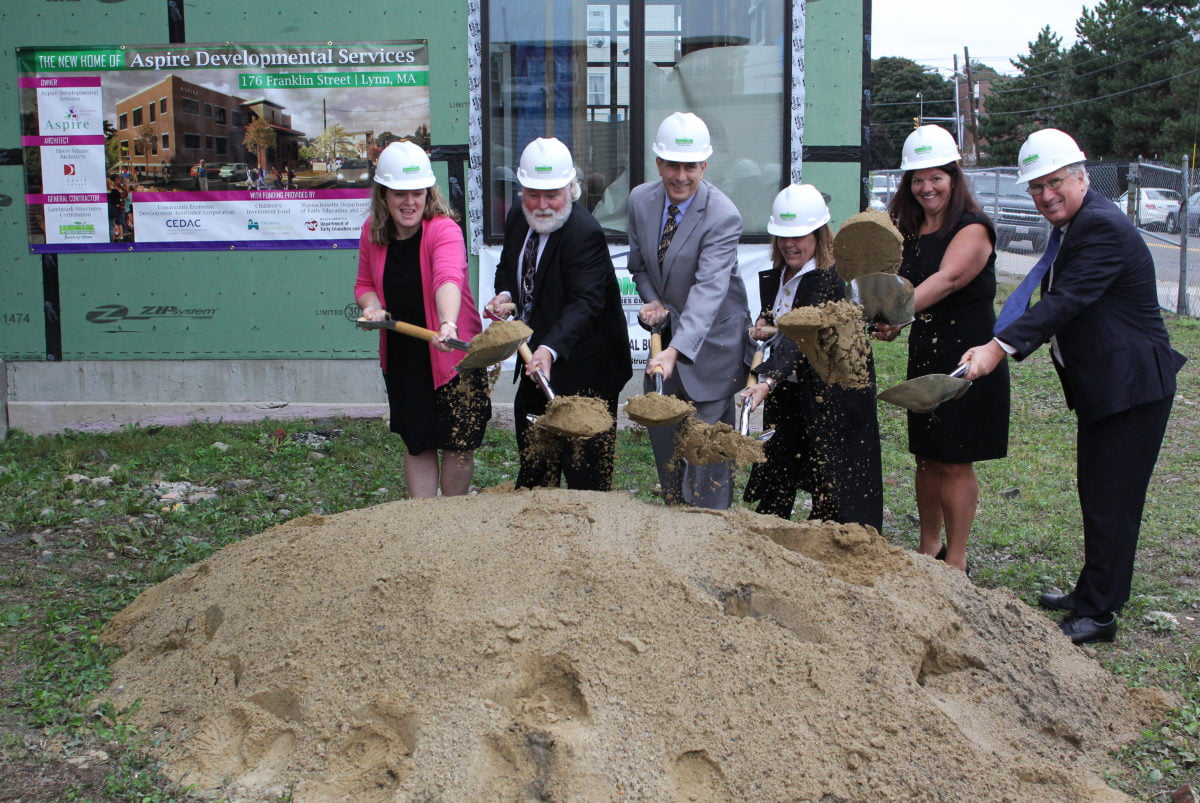
“It means the world to me what you’ve done for my family,” she said during a groundbreaking for Aspire’s new Franklin Street headquarters on Wednesday. “Aspire provides incredible services. They do so much for the kids who really need it.”
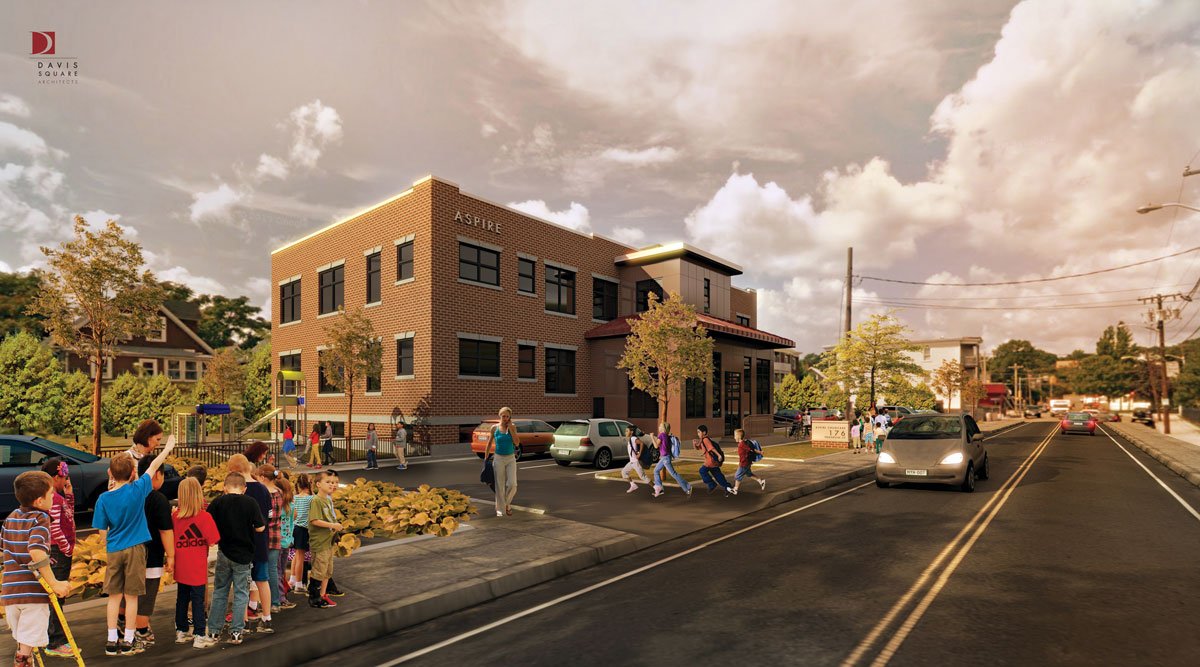
The organization is renovating the former O’Keefe School building on Franklin Street. Lori Russell, acting executive director of Aspire, is hoping for a summer 2017 grand opening.
Mayor Judith Flanagan Kennedy said she remembers the school being in operation when she was a child. After the school sat unused for 15 to 20 years, she couldn’t think of a better use for it than to help the children in the city of Lynn.
City Council President Dan Cahill added that at one point, a recommendation was made to the panel to tear down the building.
“As a parent whose daughter went through services of early intervention, seeing the help that she got, I’m blown away,” he said.
Sen. Thomas McGee said he was glad to see the building be brought back to life, educating and helping children again.
“It’s good for the neighborhood but more importantly, it’s great for the children,” he said.
Aspire provided services to more than 1,850 children last year. Two-thirds of the families served were minority and 78 percent were below 200 percent of the federal poverty level.
The new facility will provide 15,000 square feet, or three times as much space, allowing play group opportunities for children receiving early intervention services to double. Capacity for childcare and preschool students will also increase, said Russell.
“The old Johnson Street facility reached capacity a long time ago,” Walsh said.
She’s thrilled that Aspire will be able to offer services to families in Lynn that weren’t possible at the old building.
The cost of the project is estimated to be $4.3 million and about half was funded by a state grant, bank financing and the sale of their existing property.
In June, the Community Economic Development Assistance Corporation, in partnership with the Children’s Investment Fund, awarded Aspire a $1 million Early Education and Care and Out of School Time grant.
SourceItemlive.com
How Mass. ‘Gateway Cities’ Are Crafting New Identities
The hum of textile looms once filled the 19th-century mill buildings throughout downtown Lawrence. Immigrant workers from Ireland and Germany were among some of the first laborers.
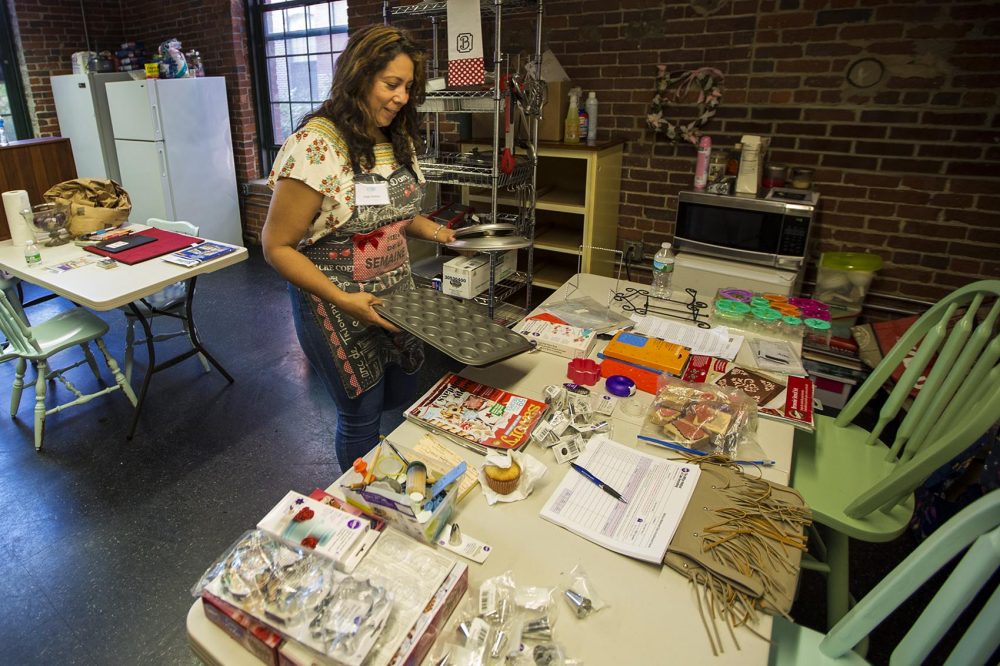
Today, many of the mill buildings in Lawrence are home to refurbished work spaces — buzzing with the sounds of artists, innovators and entrepreneurs like Angie Jimenez, who is arranging pots and pans in the site of her future cooking classroom.
“I’m going to be teaching pies, and cooking lessons — cookies, different cookies for the holidays so people can, you know, make their own and give them as a gift,” she says with a smile.
Jimenez is a graduate of Entrepreneurship for All, a business accelerator program. It’s the first of its kind in the country to offer courses and training in Spanish. It’s no surprise that such a program would launch in Lawrence, where more than 70 percent of the population is Hispanic or Latino.
EParaTodos — that’s EforAll in Spanish — gathers would-be business owners, mentors and staff who collaborate in the program’s shared co-working space.
Entrepreneurs, mentors and staff collaborate in Entrepreneurship for All’s co-working space in Lawrence. (Jesse Costa/WBUR)
CEO David Parker says after two years, graduates of the program have created 150 jobs in Lawrence and nearby Lowell — a key measurement of the program’s success.
“Because manufacturing across the U.S. and certainly here in these cities in Massachusetts has declined,” Parker says, “the immigrant communities still exist, there’s social services to help people, people who speak your language who have built neighborhoods now, except the jobs don’t exist.”
‘Lawrence Is A Place Where People Work’
New England mill towns were once global manufacturing hubs, pumping out cotton, wool and paper products — attracting immigrant workers from around the world.
But, one by one, the mills closed when faced with factors like modernization and global trade.
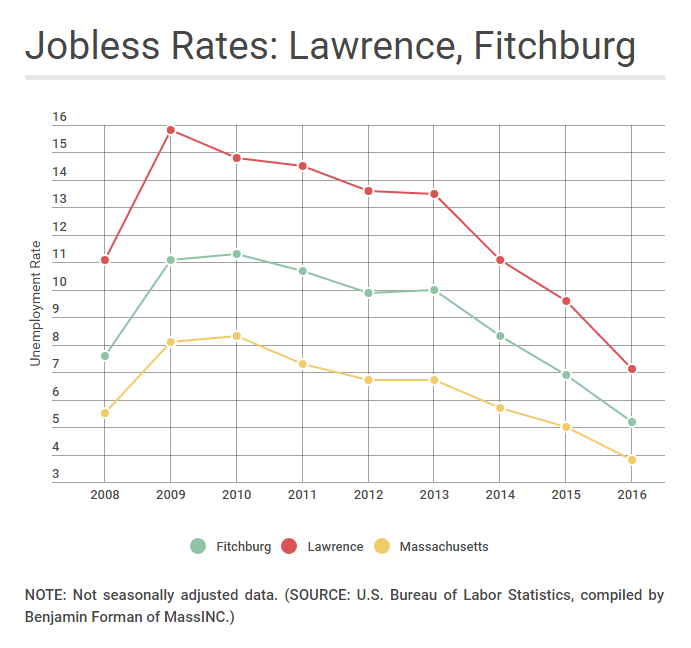
Unemployment in Lawrence is now among the highest in the state, a dubious distinction the city shares with places like Springfield and Holyoke — all former mill towns, now known as “Gateway Cities.”
On paper, it might not be the most flattering title.
State law defines a Gateway City as a mid-sized municipality, where the median household income and rate of bachelor’s degree holdersare both below state averages.
But Lawrence Mayor Daniel Rivera says there’s more to Gateway Cities than those metrics alone.
“Lawrence is a place where people work,” he says. “We’ve always been a place where people work.”
Rivera says he’s proud of the city’s immigrant heritage and the work ethic he believes accompanies those roots. He believes that owning that immigrant identity has helped shift the image of the city.
“We’ve already changed the way people talk about Lawrence,” he says. “They used to talk about Lawrence in these whispered tones and, like, not so great intonations and now they’re like, ‘Wow, something good maybe’s happening up there, maybe we should go check it out.’ “
Lawrence Mayor Daniel Rivera (Jesse Costa/WBUR)
Despite ongoing challenges, Rivera says he’s confident Lawrence is poised for progress, and hebelieves the city’s geography plays a role.
“When you think about what’s happening in Boston, and that’s around the boom in housing, they’re just doing great and we’re so excited about that because at some point they’re going to cap out and people are going to come toward our areas,” he says.
That’s the hope in many of the state’s 26 Gateway Cities, some just close enough to see the glow of the red hot market in Boston.
But a recent report findsBoston’s boom remains largely isolated from the rest of the state.
Benjamin Forman is research director at MassINC, a nonpartisan think tank. He’s also co-author of the Gateway Cities report, “Rebuilding Renewal.”
Forman says that while state investment in Gateway Cities is robust, it lacks coordination, which hinders significant impact, especially in places south and west of Boston.
“The biggest story in Massachusetts is the pull of Boston, how everything has been pulled into the orbit of the city,” he says, “and so to that extent the closer you are to that action, the better off you are as a small, mid-sized regional city in our state.”
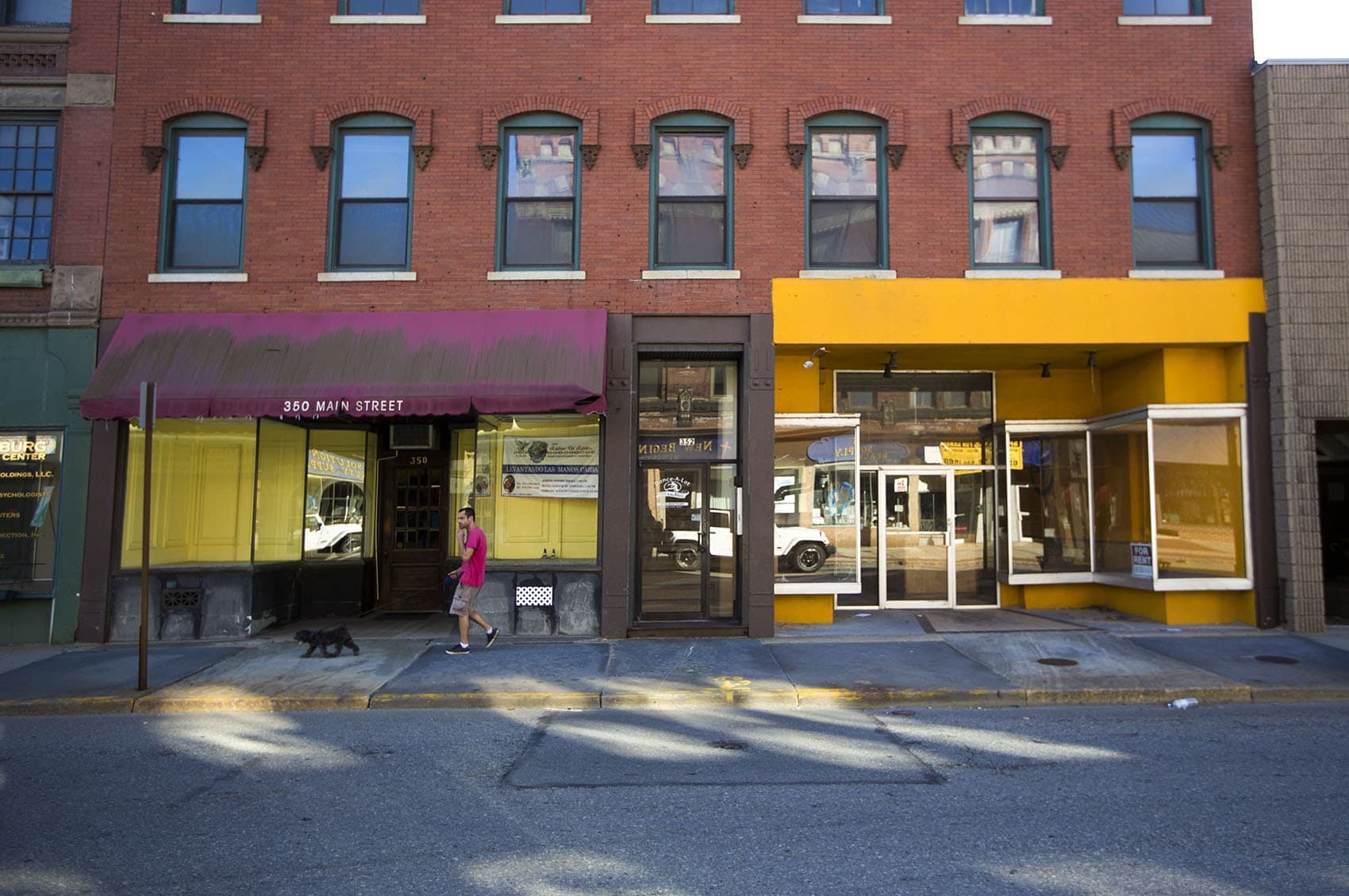
A man walks his dog in front of vacant commercial spaces along Main Street in Fitchburg. (Jesse Costa/WBUR)
Embracing Change In Fitchburg
Forty miles west of Lawrence, another Gateway City is also planning a revival.
And on this day, a group of six nonprofit leaders and city officials are gathered around a table to figure out how to pump a little more vitality into Fitchburg’s downtown.
Mayor Stephen DiNatale, who took office in January, says the city’s weak real estate market has yet to fully recover from the subprime mortgage crisis. Nearly one in five homes in Fitchburg are underwater on their mortgages, according to real estate tracking firm Zillow Inc.
An old housing stock and deteriorating commercial and civic buildings present another challenge — one that the mayor says the city is trying to address through demolition.
Fitchburg Mayor Stephen DiNatale (Jesse Costa/WBUR)
“When I took over, the demolition figure for Fitchburg was about $30,000,” DiNatale says. “This year we’re going to be spending close to a million.”
DiNatale says that increase partially reflects a better system in place to identify blighted properties, as well as a renewed commitment to improving the community.
“That will take care of, in terms of removing some of those areas that bring a neighborhood down,” he says. “I mean the challenge is, more of those buildings than we can deal with, so we’re going to chip away at it every year.”
Fitchburg, once known for its bustling paper mills, is also chipping away at a new identity.
Much of that work falls to NewVue Communities, a local community development corporation.
Walking out onto Main Street, Marc Dohan, NewVue’s executive director, says he sees more than vacant storefronts and sparse sidewalks. He also sees opportunities and success stories.
Pointing just over his shoulder, he shares one such story.
Luis Feliciano cuts the hair of a young boy at the newly opened Brother’s Barber Shop on Main Street in Fitchburg. Feliciano worked with NewVue Communities, a local community development corporation, to open his business. (Jesse Costa/WBUR)
“We have about seven businesses just right in this little section of Main Street that we work with,” he says. “So, Brother’s Barber Shop, Luis started it on his own. He came in for us, got technical assistance. It’s impossible to get your hair cut there now ’cause he has so many people with him.”
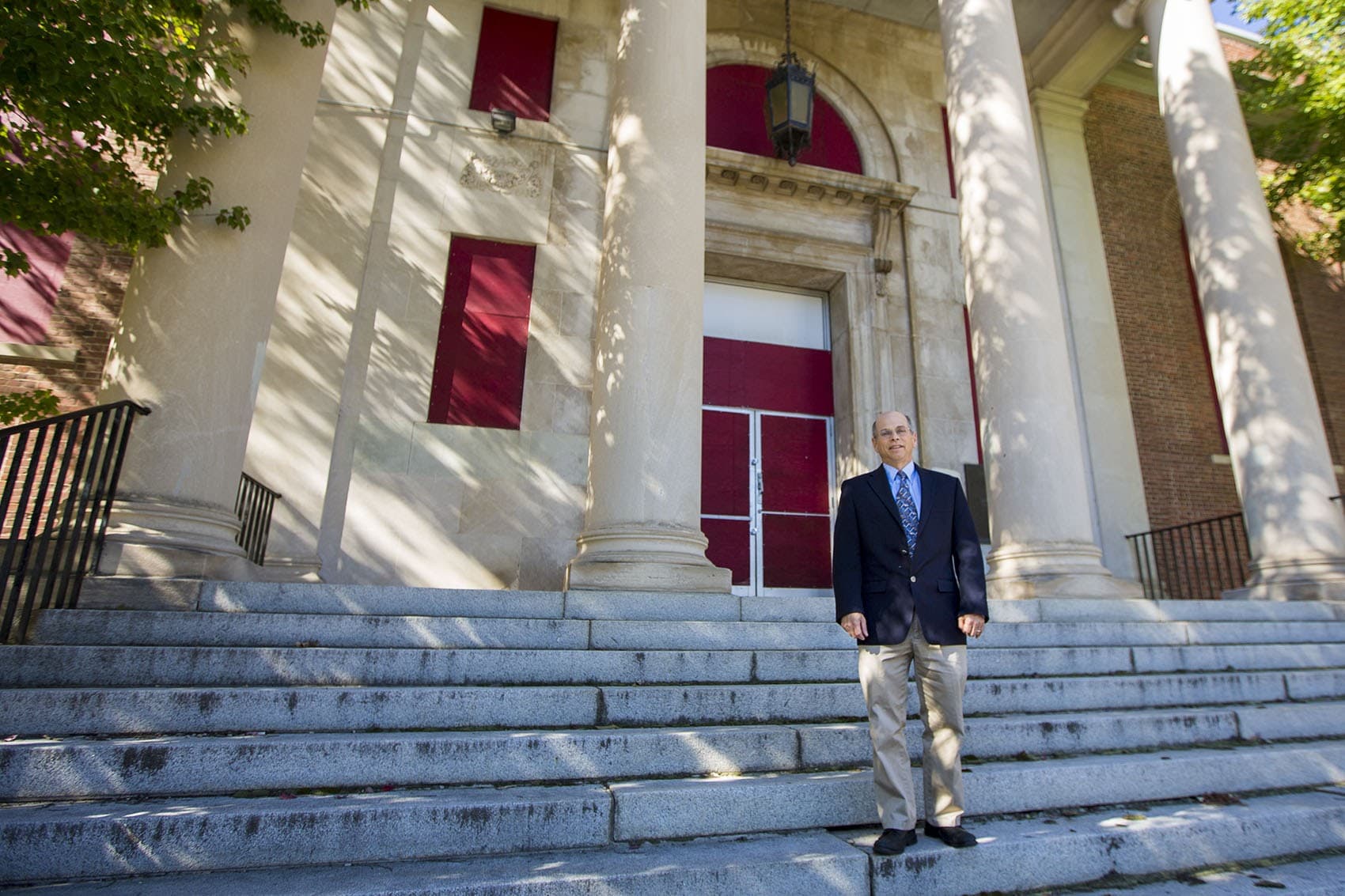
Heading north of Main Street, Dohan stops to point out the vacant B.F. Brown School, NewVue’s next big development project, which Dohan says will be renovated into artist apartments.
The old school is just across the street from the Fitchburg Art Museum, an institution that Dohan and others say is integral to Fitchburg’s sense of place.
Marc Dohan, executive director NewVue Communities, stands in front of the vacant B. F. Brown School which NewVue plans to renovate into artist apartments. (Jesse Costa/WBUR)
“One of the things that we think of for Fitchburg, it is one of the cultural hubs of the area. It has the art museum, it has the university, and we want to build on that asset,” Dohan says. “This neighborhood in particular, it’s one of the more diverse neighborhoods in north-central Massachusetts, and that’s another type of culture that we want to take advantage of because people who live here want to celebrate their own culture.”
Dohan says recognizing the importance of change is key to Fitchburg’s success.
“I think all great places, it’s not just the old, it’s not just the new, but it’s welcoming and being able to accept that change as opposed to being afraid of that change,” Dohan says.
Fitchburg and Lawrence are trying to embrace change, recognizing their mill town histories while crafting a vision of their future as Gateway Cities.
And that willingness to change may be one of the most important indicators of success.
WBUR is participating in a national week of conversation, along with other NPR member stations, on economic opportunity. Find more from “A Nation Engaged” here.
Two Community Development Nonprofits Receive $1.3M
Two Community Development Nonprofits Receive $1.3M
August 19, 2016 — The Community Economic Development Assistance Corporation, a public-private community development finance institution that provides financial resources and technical expertise to promote community development in Massachusetts, yesterday announced that it is providing $1,323,100 to two Boston-based nonprofits.
The loan financing will support development of affordable housing in the Boston’s Roxbury neighborhood and improvements to a parent support program in the city’s Dorchester neighborhood.
The Community Economic Development Assistance Corporation (CEDAC) provided $1,200,000 in acquisition financing to Urban Edge in Boston, which helps build affordable housing and diverse communities in Boston and surrounding neighborhoods. The funding will support the purchase and development of a new affordable housing project on Columbus Avenue in Roxbury.
Located just south of Jackson Square, Urban Edge’s Columbus Avenue site will include 38 units of multifamily affordable rental housing and 1,000 square feet of commercial space.
CEDAC has been involved in the redevelopment of Jackson Square since 2006 and provided over $1.5 million in early stage financing for the master planning of the neighborhood and other affordable housing development projects. The new affordable housing project will serve low- and extremely low-income families in the community and continue the trend of growth in the area in- and around Jackson Square.
“We have been extremely proud to support the efforts by the Jackson Square Partners to revitalize the neighborhood in a way that helps current residents,” said CEDAC’s Executive Director Roger Herzog. “The current site is blighted and the neighborhood will greatly benefit from quality housing on that site. It is a pleasure to continue our effective relationship with Urban Edge, which goes beyond the Jackson Square redevelopment and into other nearby neighborhoods in Roxbury and Jamaica Plain.”
CEDAC also provided $123,100 to Family Nurturing Center of Massachusetts (FNC) in Dorchester, which provides support services to families promote skill-building and access to educational, social, and health resources. The funding, made through CEDAC’s affiliate Children’s Investment Fund, will support expansion of FNC’s Bowdoin Street site in Dorchester.
The commitment is in addition to $375,000 previously provided to FNC by the fund for this project. To allow for the expansion of programmatic and administrative space, FNC, which has provided comprehensive family support services to low-income families throughout Boston, is renovating and enlarging its existing Bowdoin Street center to include two additional floors.
“The fund is proud to continue to support mission-focused providers like the Family Nurturing Center of Massachusetts,” said Theresa Jordan, director of Children’s Facilities Finance for the fund. “Supporting children and their families builds strong communities and encourages positive environments for children to learn and grow both in the center and in their homes.”
State grant to benefit Boston Street affordable housing 2 rooming houses will become units for formerly homeless
State grant to benefit Boston Street affordable housing
2 rooming houses will become units for formerly homeless
By Dustin Luca Staff Writer
Aug 19, 2016
SALEM — Harborlight Community Partners just landed a valuable chunk of change toward its $6.5 million overhaul of two Boston Street properties.
Gov. Charlie Baker’s administration said this week that Boston Street Crossing is one of 26 projects in the state that will receive state grants aimed at developing and preserving affordable rental housing. Andrew DeFranza, executive director of Harborlight, said he didn’t know yet just how much money the project will receive.
The project grew out of a homelessness task force that has been meeting on the North Shore for about a year and a half.
“This is sort of springing from that soil,” DeFranza said. “It’s going to take two existing rooming houses in Salem — 43 Boston St. and 179 Boston St. — and make dramatic physical improvements to those buildings.”
There are currently 37 rooms in the two buildings. Once the project is finished, the buildings will house 26 studio apartments tailored for formerly homeless individuals. All 26 units will be reserved for people making less than 30 percent of the area’s median income.
Lifebridge, the nonprofit that runs the shelter for the homeless in downtown Salem, is a partner in the project.
“They’re going to provide the case management services,” DeFranza said. “We do the development and run the property, but we bring in partners to provide services.”
The state grant is one of several funding sources for the $6.5 million project.
“The (Community Preservation Act) funded it and the city of Salem funded it,” DeFranza said. “It was funded with North Shore Home Consortium funds. It also has a redevelopment loan from CEDAC (the Community Economic Development Assistance Corp.).”
The City Council voted earlier this year to approve $59,000 in funding from CPA funds. The money comes from a small surcharge on property taxes that is dedicated to historic preservation, open space and affordable housing.
This project represents one of the best ways to fight against homelessness, said DeFranza.
“Creating (good quality) affordable housing is the key method for making it possible for those who are homeless to be housed again,” he said. “You have to create housing they can afford with their income levels and have the services that allow them independence.”
The homelessness task force, meanwhile, “created the space to help allow solutions addressing that problem,” he continued. “This is one of the mechanisms to address the problem in the region.”
The Beverly-Salem Mayors Regional Task Force on Homelessness began meeting in December of 2014, bringing together local officials, law enforcement and social service agencies to come up with solutions to the problems of homelessness.
CEDAC Provides $1.3M In Funding To Support Boston Housing And Child Care
CEDAC Provides $1.3M In Funding To Support Boston Housing And Child Care
Aug 19, 2016
The Community Economic Development Assistance Corporation (CEDAC) recently approved acquisition and predevelopment loans totaling over $1.3 million to Urban Edge Housing Corp. and Family Nurturing Center of Massachusetts. CEDAC’s financing will support the development of affordable housing in the Roxbury neighborhood and improvements to a parent support program in the Dorchester neighborhood of Boston.
CEDAC provided $1.2 million in acquisition financing to Urban Edge Housing Development for the purchase and development of a new affordable housing project on Columbus Avenue in Roxbury, which includes 38 units of multifamily affordable rental housing and 1,000 square feet of commercial space. This new affordable housing project, which will be located just blocks from the Jackson Square MBTA station, will serve low- and extremely low-income families in the community and continue the trend of growth in the area in and around Jackson Square.
“We have been extremely proud to support the efforts by the Jackson Square Partners to revitalize the neighborhood in a way that helps current residents,” Roger Herzog, CEDAC’s executive director, said in a statement. “The current site is blighted and the neighborhood will greatly benefit from quality housing on that site. It is a pleasure to continue our effective relationship with Urban Edge, which goes beyond the Jackson Square redevelopment and into other nearby neighborhoods in Roxbury and Jamaica Plain.”
Family Nurturing Center of Massachusetts (FNC) also received $123,100 from CEDAC, through its affiliate Children’s Investment Fund, for the expansion of a Dorchester location. This commitment is in addition to $375,000 previously provided to FNC by the fund for this project. For over two decades, FNC has provided comprehensive family support services to low-income families throughout Boston. To allow for the expansion of programmatic and administrative space, FNC is renovating and enlarging its existing Bowdoin Street center to include two additional floors.
Proposed Rockport housing development gets $564,000 boost
Proposed Rockport housing development gets $564,000 boost
By Ray Lamont Staff Writer
July 28, 2016
ROCKPORT — The nonprofit development group looking to build 23 units of affordable rental housing on Granite Street has received a boost of more than $500,000 from a state-created financing agency to advance the project.
The Community Economic Development Assistance Corporation, a public-private agency that provides financial, technical and other assistance to nonprofit developers, has extended $564,000 to the Beverly-based Harborlight Community Partners as an interest-free loan in its bid to build a new affordable housing complex at 5 Granite St.
The proposal, outlined in June by Harborlight CEO Andrew DeFranza, is pegged to include four one-bedroom units, 16 units of two bedrooms each, and a trio of three-bedroom apartments, all geared toward federal and state-recognized affordable housing eligibility standards.
DeFranza said Wednesday evening that the loan will enable Harborlight to accelerate acquiring the property and advancing its design work. He said the purchase is pegged at $470,000.
“This is a huge piece of support in terms of being able to hold it, and to do the planning work that’s needed,” DeFranza said. “But emotionally, it’s also a significant state boost that shows that folks at the state level are interested in the concept and the site.”
Rockport Planner Kirk Baker and DeFranza both said Wednesday that Harborlight has not yet submitted specific plans for the 1.3-acre site and the project, which Harborlight has titled Granite Street Crossing.
Both also said the project will be filed as a comprehensive permit under the state’s Chapter 40B affordable housing legislation, which limits local permitting for projects and can be utilized in communities whose current affordable units represent less than 10 percent of the town’s housing stock.
Rockport’s affordable housing percentage sits at 3.3 percent, according to the Massachusetts Department of Housing and Community Development.
DeFranza termed the application a “friendly Chapter 40B” filing, adding that he and other Harborlight officials have met with the site’s neighbors.
LYNN SCHOOL GETS A REASON TO ASPIRE
A rendering of Aspire Developmental Services’ plan to convert the former O’Keefe School on Franklin Street into an early intervention center.
BY PAUL HALLORAN
LYNN — Aspire Developmental Services’ efforts to raise funds for a new headquarters got a major boost when the agency was awarded a $1 million state grant. Aspire, which provides Early Intervention services to children up to age 3, was one of six agencies to receive the Early Education and Care and Out of School Time grant from the state Community Economic Development Assistance Corporation, in partnership with the Children’s Investment Fund. The state awarded competitive grants totaling $3.6 million to be used for major capital facilities projects. Aspire got the largest grant and was the only agency to receive the maximum of $1 million.
“We are extremely grateful to receive this funding,” said Lori Russell, acting executive director of Aspire. “This will play a major role in bringing our new building closer to reality. It was a very competitive process. We’re thrilled to be the only agency to receive $1 million.”
“We are very pleased that Aspire will be expanding their operation and capacity to provide critical services to children and families in Lynn and the surrounding area,” said Mayor Judith Flanagan Kennedy. Russell said while the grant is a big help, the capital campaign is ongoing, with the agency hoping to raise at least an additional $1 million for the $4.2 million project.
“This grant is very important, and we are extremely grateful, but we still have funds to raise in order to reach our goal,” said capital campaign committee member Debby Regan, co-owner ofMeninno Construction. “We plan to continue to make the case that this is a project worthy of the community’s support.” Aspire will renovate the former O’Keefe School building on Franklin Street. The new facility will provide 15,000 square feet of space — triple what it has now on Johnson Street. The additional space will allow Aspire to double the play group opportunities for children receiving Early Intervention Services. Aspire will also increase its capacity for child care from 20 to 49 toddlers and pre-school students.
The purpose of the grant is to improve the quality of early education settings.“The new building will allow us to serve more families in more modern and appropriate space,” Russell said. “We will also be able to provide parent-child groups and parent training workshops.”
“The Early Education and Care and Out of School Time grants are a critical resource for helping ensure that our early learning program environments support children’s learning,” said Lieutenant Governor Karyn Polito in announcing the grant recipients.
“By providing high quality facilities for children to grow and thrive in, we are both helping foster their success and building a more prosperous future for all of us.”
Aspire provided services to more than 1,850 children last year. Two-thirds of the families served were minority and 78 percent were below 200 percent of the federal poverty level.
Groundbreaking is scheduled for this fall.
Baker-Polito Administration Awards $3.6 Million in Grants for Facilities Development to Increase Quality in Early Education Programs
For Immediate Release – June 14, 2016
Baker-Polito Administration Awards $3.6 Million in Grants for Facilities Development to Increase Quality in Early Education Programs
WEBSTER – The Baker-Polito Administration and the Community Economic Development Assistance Corporation (CEDAC) today announced $3.6 million in grant awards for facility improvements at early education and care programs that serve low income children. Six agencies were selected to receive an Early Education and Care and Out of School Time grant, which will help increase the quality of their early education programs through critical facility repairs and renovations. Lieutenant Governor Karyn Polito made the announcement at the new Guild of St. Agnes early education program in Webster, the site of one of the facilities funded by the 2016 grant awards.
“The Early Education and Care and Out of School Time grants are a critical resource for helping ensure that our early learning program environments support children’s learning,”said Lieutenant Governor Karyn Polito. “By providing high quality facilities for children to grow and thrive in, we are both helping foster their success and building a more prosperous future for all of us.”
The $3.6 million in FY16 grant awards will improve the quality of existing settings for approximately 500 children in programs licensed by the Department of Early Education and Care, will increase the capacity of these programs to serve an additional 119 children in higher quality settings, and will support the creation of 179 jobs during the grant period.
The Early Education and Care and Out of School Time grants are financed through the state’s capital budget and provide matching funds that leverage private investment. The Baker-Polito Administration’s FY17 Capital Budget Plan included $4 million for the Early Education and Out of School Time grant program.
“It is well established through research that environments influence the architecture of a child’s developing brain, so having program spaces that facilitate positive experiences for children is critical,” said Early Education and Care Commissioner Tom Weber. “The planned facility developments will modernize spaces, improve the efficiency of systems, and provide better environments for the children that support their optimum growth and learning.”
All of the programs selected to receive a grant award serve publicly subsidized families, have demonstrated financial need, and have secured additional funding to pay for a portion of their project costs. The Department of Early Education and Care partnered with CEDAC’s affiliate, the Children’s Investment Fund, to administer the grant awards. All of the grantees are tax-exempt non-profit corporations or organizations in which a non-profit corporation has a controlling interest.
“The EEOST Capital Fund is a critical resource for helping non-profit child care providers improve the spaces where so many low income children attend child care,” said Theresa Jordan, Program Manager of Children’s Investment Fund. “It has helped fund renovations and construction of centers, creating wonderful learning environments across the Commonwealth. The child care community is grateful that policymakers had both the vision and commitment to quality that led to establishment of the Capital Fund. This Fund has made Massachusetts a national leader in developing facilities that support children’s education and wellbeing.”
Sixteen organizations submitted requests for funding that totaled over $12 million combined. The applicants selected for a grant award demonstrated sound feasibility of project, readiness for implementation, and likely potential for long-term sustainability and success. The grantees and their award amounts are listed below:
Lead Agency
Service Area
Award
Aspire Developmental Services
Lynn
$1,000,000
Brookview House, Inc
Boston
$450,000
Community Art Center
Cambridge
$750,000
Epiphany School
Boston
$500,000
Guild of St. Agnes
Webster
$700,000
Rainbow Child Development Center
Worcester
$200,000
The grants were financed through the Early Education and Care and Out of School Time Capital Fund, which was established in 2013 through An Act Financing the Production and Preservation of Housing for Low and Moderate Income Residents. The legislation that established the capital fund provided $45 million in general obligation bond funding over five years.
Communities scramble to keep affordable housing
10 percent of units set to convert to market rate
By Douglas Moser dmoser@eagletribune.com
Jun 5, 2016
Nearly 10 percent of Greater Lawrence’s affordable housing agreements are set to expire by 2019, according to a report by the agency that tracks affordable housing around the state.
About 525 affordable units, out of roughly 5,500 in Andover, Haverhill, Lawrence, Methuen and North Andover, have agreements with either the state or federal government that expire, some of which potentially could become more expensive market rate housing, according to the annual assessment released by CEDAC, a quasi-public agency that tracks and works to preserve affordable housing.
All of those units are in Andover, Haverhill and Lawrence.
Local community development directors said the area is not in imminent danger of losing all of those affordable units because some are owned and operated by so-called mission-oriented organizations, typically nonprofits whose goal is to provide affordable housing for seniors or low-income people.
But for the others that could become market rate, communities have a few tools to use in working with property owners to keep all or some of the units affordable.
“By and large, the owners of the affordable housing in Lawrence are pretty much dedicated to serving their current population,” said James Barnes, director of community development in Lawrence. “That’s the No. 1 safeguard we have to make sure these properties continue to provide good quality housing at affordable prices.”
One example in the city is Rita Hall apartments, a senior apartment building on Hampshire Street. Its agreement with the federal Department of Housing and Urban Development for accepting federal rental vouchers is due to expire this year, but Barnes is confident the building’s owners will continue their relationship with the HUD program.
“If we got wind of the possibility of a current owner wanting to change the status of its occupancy, either quickly or gradually, we would hear about it through one of our partner agencies or tenant organizations,” he said. “We would quickly get involved with those organizations that could provide capital refinancing and work as closely as we could with those agencies.”
The Arlington Park building has an agreement with HUD to accept federal rental vouchers for its 130 units that expires in 2019, and another 55 units at Riverside Commons could become market rate as well, according to CEDAC’s report.
In Haverhill, Andrew Herlihy, director of the community development division, said the city can use a pool of federal funds, called the HOME Investment Partnership Program, for certain renovations or upgrades.
“We can offer them federal HOME funds and we can repoint the brick, or fix the plumbing, the leaky roof, whatever,” he said. “And we do that in exchange for extending the affordable usage. We can usually address the quality of life in these buildings at the same time and extend the affordability of the building.”
According to HUD, the HOME funds are a block grant specifically to fund a building, buying or rehabilitating affordable housing for rent or sale, or for providing direct rental assistance to low-income people.
The money is distributed through local consortia. Essex County’s consortium includes every community in the county except Lawrence and Lynn. According to HUD data, the Essex County consortium received nearly $1.3 million this year. Salem, Massachusetts, received the most, at $233,508, followed by Haverhill at $224,527. Andover, Methuen and North Andover received about $150,000 combined.
In Haverhill, 215 units could convert to market rate in 2019, the largest number in the area. The city lost 131 affordable units last year when One Water Street converted to market rate. In all, 164 units there became market rate, but were offset by 33 new affordable units.
Herlihy said the city made a strategic decision to let those units become market rate because that neighborhood is changing substantially. But those units will be mostly offset with the Tenney Place development on West Lowell Avenue, which will be composed of about 120 affordable units.
Andover could see 123 units across several developments become market rate, and the town faces a special challenge because market rate units can fetch much more than in Lawrence or Haverhill.
“We try to work with property owners to save those units. But a lot of times, the owners are saying look, we have a chance to convert, in this instance we’re talking about 125 affordable units, to market rate,” said Paul Matarazzo, the Andover planning director. “They don’t even want to have that conversation with the community. It’s pretty much a numbers thing in their mind.”
CEDAC, which stands for Community Economic Development Assistance Corp., monitors affordable housing units statewide and maintains a database of affordability expiration dates. When units approach those dates, CEDAC works to connect cities and towns and nonprofits with funding sources that can be used to keep those units designated as affordable.
Bill Brauner, director of housing preservation and policy at CEDAC, said 2015 was a good year for preserving affordable units for a number of reasons, including availability of funding, a special tax exemption program and low interest rates.
“We have a very big issue in the next few years of a particularly large group of projects that can convert to market in 2017, 2018 and 2019,” he said.
CEDAC also works with other affordable housing entities, like MassHousing, which administers a state trust fund dedicated to building or preserving affordable housing.
Developers build affordable units using a number of incentives, from a state law called Chapter 40B that gives developers a break in local zoning restrictions to HUD subsidies to a range of other state and federal programs that include tax breaks.
MassDevelopment announces $1 million loan to Springfield Technical Community
MassDevelopment has announced additional funding for Springfield Technical Community College Assistance Corporation and the Phoenix Public Charter Academy High School project.
MassDevelopment, the state’s economic development financing arm, provided a $1 million loan to Springfield Technical Community College Assistance Corporation. STCCAC developed, leases, and manages the Springfield Technology Park, which is across the street from Springfield Technical Community College, according to a news release.
The project includes parts of what was once Building 104 at the Springfield Armory, the building used to manufacture M1 Garand rifles during World War II.
At the park, STCCAC recently completed construction of Phoenix Public Charter Academy High School, which will serve at-risk students in grades nine through 12 who have been displaced from area public schools. The corporation converted a vacant building into a 31,000-square-foot school building. STCCAC used loan proceeds to complete the school’s renovation and prepare a nearby space for future occupancy.
In 2014, MassDevelopment provided a $3.1 million tax-exempt bond on behalf of STCCAC to begin construction of the high school.
“STCCAC’s redevelopment of the Springfield Technology Park has attracted dozens of companies and hundreds of workers to the area,” said MassDevelopment President and CEO Marty Jones. “MassDevelopment was pleased to assist STCCAC as it completed construction of the Phoenix Public Charter Academy High School, which will serve as a critical educational resource and a welcome addition to the park.”
Springfield Technical Community College and the Technology Park are at the site of the former Springfield Armory, the primary center for manufacturing U.S. military firearms from 1777 until it closed in 1968. Part of the park is now the Springfield Armory National Historic Site, featuring the world’s largest collection of historic U.S. firearms. STCCAC leases nearly 400,000 square feet of space in the park to roughly 40 companies, which employ about 800 workers. The U.S. Department of Commerce selected STCCAC as the sole national winner of the 2001 Excellence in Urban or Suburban Economic Development Award. STCCAC also received the International Economic Development Council’s 2002 Excellence in Economic Development Award.
SourceMass Live
X
The Work That Happens Early: Reflections from CEDAC’s FY25 Annual Report