Baker-Polito Administration Awards Funding, Vouchers to Seven Affordable Housing Projects for Vulnerable Communities

Today, Governor Charlie Baker, Lt. Governor Karyn Polito, and Housing and Economic Development Secretary Mike Kennealy joined House Speaker Ronald Mariano, Quincy Mayor Tom Koch, Senator John Keenan, and advocates to celebrate the production and preservation of 67 units of supportive housing for vulnerable populations, as well as 100 shelter beds, through $13.7 million in capital funding and project-based vouchers. Today’s event was held at the future home of the Father Bill’s & MainSpring Housing Resource Center, which has received both supportive housing funding and a Housing Choice Community Capital Grant for design and engineering work.

Each year, DHCD distributes capital funds as well as project-based vouchers to pay for supportive services through a competitive process administered by the agency’s Supportive Housing for Vulnerable Populations program.  These supportive services serve veterans, older adults, persons with disabilities, individuals and families who have experienced homelessness, as well as unaccompanied youth.  Some state capital subsidies have also funded emergency shelter beds, including in this most recent round.

“In 2018, our administration signed the largest affordable housing legislation in Massachusetts history, and we have worked hard to invest in the production and preservation of thousands of affordable units in every region of the Commonwealth,” said Governor Charlie Baker. “Thanks to our partners in the Legislature and local leaders, we are ensuring that supportive housing remains a key component of our broader strategy to increase production.”

“Permanent supportive housing provides necessary services to our most vulnerable populations, and I am so proud that we have invested in the development of hundreds of units of this type of affordable housing across the Commonwealth available to the families and individuals that have the greatest need,” said Lt. Governor Karyn Polito. “Every project in today’s round will result in housing with tailored services that will create an environment that will allow people to thrive.”

The Department of Housing and Community Development (DHCD), working with the Community Economic Development Assistance Corporation (CEDAC), will make available approximately $2.6 million in National Housing Trust Fund (HTF) funding, dedicated to households at 30% area median income or less; $10.7 million in state bond funds through the Housing Innovations Fund (HIF) and the Housing Stabilization Fund (HSF); and 57 state project-based housing vouchers to qualified and experienced sponsors. CEDAC, which manages HIF, works closely with DHCD to administer these rounds and review applications for funding.

Supportive housing provides residents with social and health services, including job training, case management, healthcare coordination, addiction recovery resources, and more. All 67 units are affordable to low and extremely low-income people. There are an additional 20 units that are being supported through vouchers only but are eligible to seek additional state funding in the future. Since 2015, the Baker-Polito Administration has supported the preservation and production of hundreds of supportive housing units.

“Solving our housing crisis requires housing production of all types, including permanent supportive housing for veterans, older adults, people in recovery, and individuals with disabilities, as well as shelter beds for those experiencing homelessness,” said Housing and Economic Development Secretary Kennealy. “Thanks to this innovative partnership involving DHCD, the city of Quincy, elected officials, and Father Bill’s and MainSpring, the vision of meeting the needs of the most vulnerable among us with a state-of-the-art facility is closer to being a reality.”

“Our team has worked closely with incredible partners like CEDAC to invest in projects that will meaningfully help a diverse set of people who can thrive with support and housing they can afford,” said Housing and Community Development Undersecretary Jennifer Maddox. “Our department has been committed to keeping our investments in housing development on track. Our housing crisis began before our current health crisis, and I am proud we’ve been able to continue funding the development of new affordable housing in every region and pass important zoning reform to make it easier for communities to promote housing at the local level.”

In Quincy, DHCD is awarding $4 million subsidy funds to Father Bill’s & MainSpring (FBMS) for the construction the new Housing Resource Center that will be built across from the organization’s current shelter for homeless individuals. This new multi-use facility will incorporate approximately 100 shelter beds, onsite supportive services, a respite care area, food preparation and dining facilities, administrative offices, and a clinic. DHCD will support this project with $4 million in subsidy funds. The City of Quincy is supporting the project by granting FBMS a 99-year lease at $1 per year and a capital award of $1 million in local housing trust funds, and successfully applied for a Housing Choice Community Capital Grant to cover portions of design and engineering services.

“The COVID-19 pandemic has exacerbated many of the longstanding issues that our cities and towns have faced, such as homelessness,” said Speaker of the House Ronald J. Mariano. “The grants awarded today will support organizations that serve our most vulnerable residents and provide them with a path to safe, stable and dignified housing. The Massachusetts House is proud to support the work of the awardees and provide opportunities for them to expand their services. I am proud to have worked alongside the Quincy delegation to help secure this grant for Father Bill’s, and look forward to seeing the positive impact their future facility will have in our community.”

“The Supportive Housing award, coupled with local funding from the City of Quincy, allows Father Bill’s and MainSpring to move forward with its multi-use facility, which represents a new, more comprehensive approach towards preventing homelessness in southern Massachusetts,” said Senator John Keenan, Senate Chair of the Joint Committee on Housing.

“Father Bill’s & MainSpring are an invaluable resource and advocate for our community. Their innovative work in not only providing stable housing, but also in their efforts in intervention and prevention work are critical to our community members facing homelessness,” said Representative Tackey Chan. “This grant money will make their new facilities a reality and allow their work to be more broad-reaching.”

“The innovative Father Bill’s and Mainspring Housing Resource Center is going to be a life-changer for so many of our most vulnerable community members in the City of Quincy,” said Quincy Mayor Thomas P. Koch. “I’m proud to partner in this endeavor, and deeply grateful to the Baker and Polito Administration for once again seeing the value in a such a vital local project by granting it a National Trust Fund Supportive Housing Award.”

“We want to end homelessness, not manage it — and the Housing Resource Center will move us closer to that goal,” said FBMS President & CEO John Yazwinski. “The HRC is a solutions-based, proactive approach that meets individuals further upstream in their housing crisis. By investing in day services that re-house homeless individuals more quickly and prevent more people from entering shelter, we will lower public costs, reduce reliance on shelter beds and downtown spaces, and provide our neighbors in need with stability and a pathway to self-sufficiency. Thank you to Governor Charlie Baker and his administration, Speaker Ron Mariano and the Quincy state delegation, and Mayor Thomas Koch and the Quincy City Council for supporting this innovative approach. Together, our community is taking a leap forward in our fight to end homelessness.”

“Congratulations to the non-profit organizations receiving these supportive housing funding awards. Their work is so necessary to providing housing and services to truly vulnerable populations across the Commonwealth,” said Roger Herzog, the Executive Director of the Community Economic Development Assistance Corporation (CEDAC). “CEDAC values our effective collaboration with the Baker-Polito Administration and its Department of Housing and Community Development and its strong commitment to the production of supportive housing through the eighth annual funding round dedicated for this purpose.”

The Baker-Polito Administration has shown a deep commitment to increasing the production of housing across all income levels. Since 2015, the administration has invested more than $1.4 billion in affordable housing, resulting in the production and preservation of more than 20,000 housing units, including 18,000 affordable units. In 2018, Governor Baker signed the largest housing bond bill in Massachusetts history, committing more than $1.8 billion to the future of affordable housing production and preservation. This year, Governor Baker signed economic development legislation titled An Act Enabling Partnerships for Growth that includes substantial new funding for affordable and climate-resilient housing, as well as targeted zoning reforms to advance new housing production. The administration has also supported the development of more than 17,000 mixed-income housing units through the successful MassWorks Infrastructure Program, reformed the Housing Development Incentive Program, and worked with communities to implement smart-growth development and planning efforts.

Award Recipients:

37 Wales Street, Boston: The non-profit sponsor, Heading Home, will demolish a structurally compromised building and construct a new, 23-unit building. Located in Dorchester, the project will provide permanent supportive housing to formerly homeless, extremely low-income (ELI) individuals. The project also will be highly energy efficient. DHCD will support this project with subsidy funds and 23 enhanced rental vouchers.

6 Quint Ave, Boston: 6 Quint is an existing, privately owned lodging house in Allston. The non-profit sponsor, Allston-Brighton CDC, will purchase and redevelop this property into 14 supportive housing units targeted toward extremely low-income (ELI) individuals in the advanced stages of addiction recovery. DHCD subsidy funds will support the acquisition and renovation of this project. The Boston Housing Authority also is supporting 6 Quint with project-based rental vouchers.

Ashford Street, Boston: Ashford Street is an existing 12-unit project featuring single-room occupancy (SRO) units as well as studio and one-bedroom units. The sponsor is the non-profit Allston-Brighton CDC. Located in Allston, the project serves extremely low-income (ELI) individuals. DHCD funds will support the rehabilitation and preservation of this project, including improved accessibility, with subsidy funds and four rental vouchers. The Boston Housing Authority also is supporting Ashford Street with 8 rental vouchers.

Father Bill’s Housing Resource Center, Quincy: This project, sponsored by non-profit Father Bill’s and MainSpring (FBMS), consists of a new multi-use facility next to its existing shelter facility. It will incorporate approximately 100 shelter beds, onsite supportive services, a respite care area, food preparation and dining facilities, administrative offices, and a clinic. DHCD will support this project with subsidy funds. The City of Quincy is supporting the project by granting FBMS a 99-year lease at $1 per year and a capital award of $1 million in local housing trust funds.

A Place to Live – 30 Winfield Street, Worcester: The non-profit sponsor, South Middlesex Opportunity Council (SMOC), will construct a new three-story building for chronically homeless single adults. The building will consist of 18 studio apartments for at-risk homeless individuals as well as office space for full time case management and a community room. DHCD will support 30 Winfield Street with subsidies and 10 state MRVPs. The City of Worcester is providing $100,000 in local HOME funds as well as project-based subsidies.

Amherst Supportive Studio, Amherst: Sponsored by the non-profit Valley CDC, this project consists of the creation of 28 enhanced single-room occupancy (SRO) units. The building, which will achieve Passive House certification, will include one office for onsite property management and a separate office for a Resident Services Coordinator. The site currently holds a single-family home that will be demolished. The location is highly walkable, less than 1/2 mile to the Town Center and numerous service providers. DHCD will provide the project with 10 MRVP vouchers to assist in the effort to house ten homeless individuals.

New Point Acquisitions, Salem: North Shore Community Development Coalition (NSCDC) will carry out substantial capital improvements, implement supportive services, and convert 18 unrestricted units into affordable units for homeless individuals. Located in the Point neighborhood close to Salem’s center, this project consists of units divided across three, 3-story brick walk-up buildings. The City of Salem is supporting the project with City Home funds of $25,000, CPA funds of $100,000, CDBG funds of $25,000, and 8 rental vouchers.  DHCD will provide the project with 10 enhanced rental vouchers to assist NSCDC’s efforts to house homeless families.  NSCDC will apply to DHCD for subsidy funds in future competitive funding rounds.

###
SourceExecutive Office of Housing and Economic Development, Housing and Community Development, Office of Governor Charlie Baker and Lt. Governor Karyn Polito

Community Development Corporation of South Berkshire awarded funds for new affordable housing complex

The Commonwealth of Massachusetts’ Housing and Economic Development Secretary Mike Kennealy and Housing and Community Development Undersecretary Jennifer Maddox recently announced the Community Development Corporation of South Berkshires (CDCSB) and project co-sponsor Way Finders, Inc. have been awarded approximately $14 million. These funds will provide the majority of financing for Windrush Commons, a new $19 million, 49-unit affordable housing complex at 910 South Main Street in Great Barrington.

The only project to receive funding in Western Massachusetts in this round, the initiative will be supported with federal and state low-income housing tax credits and subsidy funds from the Department of Housing and Community Development (DHCD). The town of Great Barrington also will support the project with Community Preservation Act funds.

Qualified families, individuals, and seniors will be offered the opportunity to rent apartments at significantly lower than market rates. All units will be “Net Zero ready” energy efficient. Windrush Commons will include a community gathering space with a kitchen, green space, and laundry facilities. The apartments will sit on approximately 2.5 acres. The additional 5.47 acres of the site will be permanently conserved land.

“This award of funds comes at a critical time for Great Barrington. With very few housing units on the market, and a zero percent rental vacancy rate, home prices and rents are out of reach for most households,” said Assistant Town Planner Chris Rembold.

The development team for Windrush Commons includes project co-sponsor Way Finders, Inc. of Springfield; Elton and Hampton Architects; civil engineering by White Engineering; Berkshire Housing Development Corporation as the management agent; and Allegrone Construction. Greylock Federal Credit Union will serve as the Federal Home Loan member bank.

Construction is expected to begin this summer/fall. The project is located in Great Barrington’s Smart Growth Overlay District, which was designed for this kind of development: high-density affordable housing within walking distance of shopping, health services, public transportation, and downtown attractions.

This new project award comes as the CDCSB is putting the finishing touches on Bentley Apartments, its new 45-unit affordable housing complex on Bentley Road, within walking distance of downtown Great Barrington.

“The projects that the CDCSB develops, including Bentley Apartments and Windrush Commons, enable us to address the housing crisis in the Berkshires,” said James Harwood, CDCSB Board of Directors president. “The positive impact on residents who will call these new apartments home is immense,” he said. “It changes people’s lives.”

More information about Windrush Commons and CDCSB economic development efforts can be found online or by contacting Executive Director Allison Marchese at allison@cdcsb.org.

SourceThe Berkshire Edge

MassHousing Closes on $5.5 Million in Financing for 181 Chestnut Street in Chelsea

BOSTON– MassHousing has closed on a total of $5.5 million in affordable and workforce housing financing to the non-profit The Neighborhood Developers, Inc. (TND), to transform a formerly market-rate rental property at 181 Chestnut Street in Chelsea into a mixed-income housing community.

The MassHousing financing will allow TND to extend long-term affordability to households across a wide range of incomes, from very-low-income households to middle-income households.

“By converting existing market-rate apartments to affordable homes with long-lasting affordability protections, this transaction will help ensure that Chelsea residents facing rising rents will be able to continue living and working in this vibrant city,” said MassHousing Executive Director Chrystal Kornegay. “TND is a mission-oriented housing developer, and MassHousing is pleased to partner with them on this exciting project.”

“Preserving a historic building as permanent affordable housing in Chelsea’s downtown will help advance long-term community goals and will keep families in stable and healthy housing through and beyond the COVID-19 pandemic,” said The Neighborhood Developer’s Executive Director Rafael Mares. “We believe this project will also serve as a model for how community development corporations in Massachusetts can convert naturally occurring affordable housing into deed-restricted homes for low-income families.”

TND acquired the three-story brick and masonry building at 181 Chestnut Street in 2019. The MassHousing financing will allow TND to rent 30 of the previously unrestricted market-rate units to income-eligible households across a range of incomes, while two of the apartments will be rented at market rates.

Eight apartments will be subsidized with federal housing vouchers and restricted to households earning up to 30 percent of the Area Median Income (AMI), and nine apartments will be restricted to households earning up to 60 percent of AMI. There will be 13 workforce housing units, of which six will be restricted to households earning up to 80 percent of AMI and seven for households earning up to 120 percent of AMI. The AMI for Chelsea is $119,000 for a family of four. None of the existing tenants will be displaced.

MassHousing is providing TND with a $4.9 million permanent loan and $650,000 in financing from the Agency’s Workforce Housing Initiative.

The transaction also involved $1 million in financing from the Massachusetts Department of Housing and Community Development (DHCD), $1.1 million from the Affordable Housing Trust Fund, which MassHousing manages on behalf of DHCD, approximately $1.5 million in state HOME funds, $700,000 in local HOME funds provided by the North Suburban Consortium through the Malden Redevelopment Authority, $640,000 in financing from the Community Economic Development Assistance Corporation (CEDAC), and $238,052 from a TND loan fund. CEDAC also provided $8.5 million in acquisition financing in partnership with LISC Boston’s Equitable Transit-Oriented Development Accelerator Fund and supported by Partners HealthCare and other fund investors.

181 Chestnut Street advances the Baker-Polito Administration’s goal of creating at least 1,000 new workforce housing units affordable to middle-income households through MassHousing’s Workforce Housing Initiative. Since the inception of the initiative in 2016, MassHousing has committed or closed workforce housing financing totaling $116.5 million, to 54 projects, located in 22 cities and towns. To date, the Workforce Housing Initiative has advanced the development of 4,669 housing units across a range of incomes, including 1,308 middle-income workforce units.

181 Chestnut Street was originally built as a school and convent and was converted to housing in 2015. It is within walking distance to retail shops, restaurants and the city’s commuter rail station and serviced by multiple MBTA bus routes.

The property is managed by WinnCompanies.

MassHousing has financed seven rental housing communities in Chelsea totaling 640 units of housing with an overall original loan amount of $75.6 million. The Agency has also provided home mortgage loans to 754 homebuyers and homeowners in Chelsea with an original purchase principal balance of $90.5 million.

SourceBoston Real Estate Times

LISC Expands Funding for Affordable Housing Near Transit

FOR IMMEDIATE RELEASE
Contact:
Karen Kelleher, LISC Boston
617.410.4343 | kkelleher@lisc.org

Tia M. Vice, LISC Boston
617.410.4343 | tvice@lisc.org

LISC EXPANDS FUNDING FOR AFFORDABLE HOUSING NEAR TRANSIT
LISC is pleased to announce a new investment in the Equitable Transit-Oriented Development Accelerator Fund

BOSTON (February 11, 2020) – Local Initiatives Support Corporation (LISC) is pleased to announce an increase in the Equitable Transit-Oriented Development Accelerator Fund (ETODAF or the Fund).  The Fund is a revolving loan fund that has seeded the preservation or development of more than 1,500 apartments located near transit throughout Boston and Massachusetts since 2014, 72% of them affordable to low-income households.  The new investment will help the Fund support the development of more affordable housing with access to transit by providing critical early-stage financing.

Fund Background.  The Fund was created by LISCBoston, The Boston Foundation, and the Hyams Foundation in 2014 to provide developers of affordable housing with streamlined access to acquisition and predevelopment capital to acquire and advance key properties along transit corridors.  The foundations each invested $1.5 million for 10 years at a very low interest rate.  LISC paired that with a $1 million MassWorks grant from the Executive Office of Housing and Economic Development, through MassDevelopment for a total revolving fund of $4 million.  LISC has leveraged that capital with $7 million of its own funds and a similar amount from other community development financial institutions.  The resulting $18 million of investment has seeded the acquisition and development of more than 1,500 apartments within walking distance of transit, 1,100 of them affordable to low-income tenants, and will attract over $400 million of additional investment.

Why Transit-Oriented Development?   ETODAF-funded projects must be located within a quarter to a half-mile of a subway, train or major bus line, to ensure that residents have equitable access to affordable transit, which usually translates to access to jobs, education, health care, shopping, services, and other critical resources and amenities.  Where done successfully by a community-focused developer, transit-oriented development also attracts businesses and jobs, maximizes existing infrastructure, and capitalizes on new investments to make neighborhoods more vibrant.   The Fund can be used throughout the Commonwealth, and has invested in thirteen different neighborhoods, empowering developers revitalizing their communities in some cases, and those staving off displacement in others.

The Fund’s Impact.   The Fund has seeded the development of 22 affordable or mixed-income apartment properties near transit, all of them by nonprofit developers and most by local community development corporations.  These developments will result in more than 1,500 housing units, with 72% of those units restricted as affordable for at least 30 years.  Construction and operation of the affordable units requires additional construction and permanent financing and subsidy, but ETODAF provides critical early-stage financing that enables fast action to acquire parcels and replaces the cash equity developers otherwise need to buy properties in a hot market and to finance the early, high-risk predevelopment costs that other lenders will not finance.  The Fund has invested in both rental and homeownership units, in new construction and preservation, and in diverse communities including Gateway Cities, suburban communities, and Boston neighborhoods.

Catalyzing Community-Based Development by Sharing Risk.  While most lenders will only lend a buyer 70 or 80 percent of the property’s value, ETODAF lends more than the property value to empower affordable developers to secure these critical parcels.  This means the Fund takes on some of the risk that a developer typically bears. This makes the Fund particularly useful for community-based nonprofit developers who lack cash reserves needed to put their own equity into an acquisition.  All of ETODAF’s borrowers to-date have been nonprofit organizations.  For-profit affordable housing developers are eligible to borrow from the Fund for eligible projects, but they would pay a higher interest rate.

New Investment in the Fund.  Partners HealthCare recently became the newest investor in the Fund, joining the two foundations as a low-cost investor, with a $1.5 million investment that matches the foundations’ initial investments, making it an equal investment partner. Partners HealthCare answered LISC’s call for an investor at this level to increase the fund’s impact quickly. The Fund has been fully deployed for some time, making new loans only when prior loans are repaid.  Partners stepped in because it understands how fundamental affordable, stable housing is to health. Its investment enables LISC to achieve even greater leverage with this small but impactful fund.

A Growing Partnership Between Health Care and Community Development. With this investment, Partners HealthCare joins a growing list of healthcare institutions nationally that are partnering with community development organizations like LISC to support healthy, economically strong families and communities. Partners HealthCare, like many health institutions, understands that as much as 80% of health outcomes are determined by social factors such as whether one has safe, affordable housing, economic stability, access to healthy food and opportunities for recreation.  These so-called social determinants of health are at the heart of comprehensive community development, the focus of LISC’s work for 40 years.  Partners joins ProMedica, Sentara Healthcare, Kaiser Permanente, Dignity Health, Atrium Health and other health systems around the country working with LISC to coinvest in healthy communities.

Housing and Health Partnerships in Communities.   Most recently, the Fund invested, together with LISC and Community Economic Development Assistance Corporation (CEDAC), in an acquisition loan to The Neighborhood Developers, Inc. (TND), a nonprofit community development corporation that works in Chelsea, Revere and Everett.  TND used the financing to purchase 181 Chestnut Street, a 32-unit market-rate multifamily building in Chelsea near Bellingham Square, on the MBTA’s Silver Line.  Given the pace of development in the neighborhood, the building would otherwise have sold to a profit-motivated purchaser who would likely have raised the existing below-market rents, resulting in displacement or financial instability for the existing tenants.

Instead, TND will make modest repairs and commit to keeping most of the units affordable long-term to tenants of low- and moderate-income levels.  The Fund and LISC provided flexible, low-cost capital via a participation in a loan originated by CEDAC, a public-private community development finance institution.  The Fund’s investment would not have been possible without the recent infusion of capital from Partners.  Partners was particularly excited for the Fund to support stable, affordable housing in Chelsea where it is deeply invested at a property that is walking distance from the Mass General Hospital’s Chelsea HealthCare Center.

According to LISC Executive Director Karen Kelleher, there is great demand for additional flexible, low-cost financing for properties like this one, particularly where the city or town is willing to invest public dollars to support long-term affordability.  “The Commonwealth, particularly Greater Boston, is facing both a housing affordability crisis and a transit crisis.  We are eager to work with more civic leaders like Partners to step up and invest in solutions that prioritize community health and equity and link housing and transit.”

“Developing and protecting affordable housing within reach of transit is a game-changer for thousands of people in Greater Boston,” said Paul S. Grogan, President and CEO of the Boston Foundation. “These developments not only provide and sustain affordable housing that is so critical for individuals, workers and families, they also provide easier access to jobs and services that have a powerful impact on quality of life. We welcome Partners’ addition to the Fund.”

###

About LISC

Local Initiatives Support Corporation (LISC) provides grants, financing, and technical assistance to community development corporations (CDCs), nonprofit developers, grassroots organizations, as well as policy and advocacy organizations throughout Massachusetts. Working with local leaders, we invest in affordable housing, health, education, public safety and employment. As part of a national organization with deep local roots, LISC Boston is uniquely positioned to share resources, develop best practices, and craft innovations with the communities we serve. To learn more, visit http://www.lisc.org/boston .

About The Boston Foundation

The Boston Foundation, Greater Boston’s community foundation, seeks to bring the collective power of our region’s people and resources together to drive real change. Established in 1915, it is one of the largest community foundations in the nation—with net assets of $1.3 billion. In 2019, the Foundation received $151 million in contributions and the Foundation and its donors paid $153 million in grants to nonprofit organizations. The Foundation has many partners, including its donors, who have established more than 1,000 separate charitable funds for the general benefit of the community or for special purposes. With support from the Annual Campaign for Civic Leadership, the Foundation also facilitates public discourse and action, commissions research into the most critical issues of our time and advocates for public policy that advances opportunity for everyone.

About The Hyams Foundation

The Hyams Foundation is a private, independent foundation with a mission of increasing economic, racial and social justice and power within low-income communities in Boston and Chelsea, Massachusetts. Our vision for the future is a society in which systems and structures are transformed to create the conditions for increased collective well-being and produce equitable power, access, opportunities and outcomes, regardless of race.  For more about Hyams, visit www.hyamsfoundation.org .

About Partners HealthCare

Partners HealthCare is an integrated health care system, founded by Brigham and Women’s Hospital and Massachusetts General Hospital, that offers patients a continuum of coordinated and high-quality care. In addition to its two academic medical centers, the system includes community and specialty hospitals, a health insurance plan, a physician network, community health centers, home health and long-term care services, and other health care entities. Partners is a non-profit organization that is committed to patient care, research, teaching, and service to the community. In addition, Partners is one of the nation’s leading biomedical research organizations and is a principal teaching affiliate of Harvard Medical School.

About The Neighborhood Developers

The Neighborhood Developers (TND) promotes economic diversity, opportunity and quality of life in struggling communities. TND’s mission is to bring its core strengths—building homes, engaging neighbors, and fostering economic mobility—to community partnerships that create great neighborhoods where all people can thrive. Our work deepens the impact and scale our strengths through strategic growth, community leadership, strong partnerships, and refined programming. For additional information on TND, please visit https://theneighborhooddevelopers.org/ .

About CEDAC

CEDAC is a public-private community development finance institution that provides financial resources and technical expertise for community-based and other non-profit organizations engaged in effective community development in Massachusetts. CEDAC’s work supports two key building blocks of community development: affordable housing and early care and education.  CEDAC is also active in state and national housing preservation policy research and development and is widely recognized as a leader in the non-profit community development industry. For additional information on CEDAC and its current projects, please visit www.cedac.org .

SourceLISC Boston

Local Initiatives Support Corporation Expands Funding for Affordable Housing Near Transit

Local Initiatives Support Corporation (LISC) announced an increase in the Equitable Transit-Oriented Development Accelerator Fund (ETODAF or the Fund).

The Fund is a revolving loan fund that has seeded the preservation or development of more than 1,500 apartments located near transit throughout Boston and Massachusetts since 2014, 72% of them affordable to low-income households.  The new investment will help the Fund support the development of more affordable housing with access to transit by providing critical early-stage financing.

Fund Background

The Fund was created by LISCBoston, The Boston Foundation, and the Hyams Foundation in 2014 to provide developers of affordable housing with streamlined access to acquisition and predevelopment capital to acquire and advance key properties along transit corridors.  The foundations each invested $1.5 million for 10 years at a very low interest rate.  LISC paired that with a $1 million MassWorks grant from the Executive Office of Housing and Economic Development, through MassDevelopment for a total revolving fund of $4 million.

LISC has leveraged that capital with $7 million of its own funds and a similar amount from other community development financial institutions.  The resulting $18 million of investment has seeded the acquisition and development of more than 1,500 apartments within walking distance of transit, 1,100 of them affordable to low-income tenants, and will attract over $400 million of additional investment.

Why Transit-Oriented Development?

ETODAF-funded projects must be located within a quarter to a half-mile of a subway, train or major bus line, to ensure that residents have equitable access to affordable transit, which usually translates to access to jobs, education, health care, shopping, services, and other critical resources and amenities.  Where done successfully by a community-focused developer, transit-oriented development also attracts businesses and jobs, maximizes existing infrastructure, and capitalizes on new investments to make neighborhoods more vibrant.

The Fund can be used throughout the Commonwealth, and has invested in thirteen different neighborhoods, empowering developers revitalizing their communities in some cases, and those staving off displacement in others.

The Fund’s Impact

The Fund has seeded the development of 22 affordable or mixed-income apartment properties near transit, all of them by nonprofit developers and most by local community development corporations.  These developments will result in more than 1,500 housing units, with 72% of those units restricted as affordable for at least 30 years.  Construction and operation of the affordable units requires additional construction and permanent financing and subsidy, but ETODAF provides critical early-stage financing that enables fast action to acquire parcels and replaces the cash equity developers otherwise need to buy properties in a hot market and to finance the early, high-risk predevelopment costs that other lenders will not finance.

The Fund has invested in both rental and homeownership units, in new construction and preservation, and in diverse communities including Gateway Cities, suburban communities, and Boston neighborhoods.

Catalyzing Community-Based Development by Sharing Risk

While most lenders will only lend a buyer 70 or 80 percent of the property’s value, ETODAF lends more than the property value to empower affordable developers to secure these critical parcels.  This means the Fund takes on some of the risk that a developer typically bears. This makes the Fund particularly useful for community-based nonprofit developers who lack cash reserves needed to put their own equity into an acquisition.  All of ETODAF’s borrowers to-date have been nonprofit organizations.  For-profit affordable housing developers are eligible to borrow from the Fund for eligible projects, but they would pay a higher interest rate.

New Investment in the Fund

Partners HealthCare recently became the newest investor in the Fund, joining the two foundations as a low-cost investor, with a $1.5 million investment that matches the foundations’ initial investments, making it an equal investment partner. Partners HealthCare answered LISC’s call for an investor at this level to increase the fund’s impact quickly. The Fund has been fully deployed for some time, making new loans only when prior loans are repaid.  Partners stepped in because it understands how fundamental affordable, stable housing is to health. Its investment enables LISC to achieve even greater leverage with this small but impactful fund.

A Growing Partnership Between Health Care and Community Development

With this investment, Partners HealthCare joins a growing list of healthcare institutions nationally that are partnering with community development organizations like LISC to support healthy, economically strong families and communities. Partners HealthCare, like many health institutions, understands that as much as 80% of health outcomes are determined by social factors such as whether one has safe, affordable housing, economic stability, access to healthy food and opportunities for recreation.  These so-called social determinants of health are at the heart of comprehensive community development, the focus of LISC’s work for 40 years.  Partners joins ProMedica, Sentara Healthcare, Kaiser Permanente, Dignity Health, Atrium Health and other health systems around the country working with LISC to coinvest in healthy communities.

Housing and Health Partnerships in Communities

Most recently, the Fund invested, together with LISC and Community Economic Development Assistance Corporation (CEDAC), in an acquisition loan to The Neighborhood Developers, Inc. (TND), a nonprofit community development corporation that works in Chelsea, Revere and Everett.  TND used the financing to purchase 181 Chestnut Street, a 32-unit market-rate multifamily building in Chelsea near Bellingham Square, on the MBTA’s Silver Line.  Given the pace of development in the neighborhood, the building would otherwise have sold to a profit-motivated purchaser who would likely have raised the existing below-market rents, resulting in displacement or financial instability for the existing tenants.

Instead, TND will make modest repairs and commit to keeping most of the units affordable long-term to tenants of low- and moderate-income levels.  The Fund and LISC provided flexible, low-cost capital via a participation in a loan originated by CEDAC, a public-private community development finance institution.  The Fund’s investment would not have been possible without the recent infusion of capital from Partners.  Partners was particularly excited for the Fund to support stable, affordable housing in Chelsea where it is deeply invested at a property that is walking distance from the Mass General Hospital’s Chelsea HealthCare Center.

According to LISC Executive Director Karen Kelleher, there is great demand for additional flexible, low-cost financing for properties like this one, particularly where the city or town is willing to invest public dollars to support long-term affordability.  “The Commonwealth, particularly Greater Boston, is facing both a housing affordability crisis and a transit crisis.  We are eager to work with more civic leaders like Partners to step up and invest in solutions that prioritize community health and equity and link housing and transit.”

“Developing and protecting affordable housing within reach of transit is a game-changer for thousands of people in Greater Boston,” said Paul S. Grogan, President and CEO of the Boston Foundation. “These developments not only provide and sustain affordable housing that is so critical for individuals, workers and families, they also provide easier access to jobs and services that have a powerful impact on quality of life. We welcome Partners’ addition to the Fund.”

SourceBoston Real Estate Times

Baker-Polito Administration Awards Funding for Seven Affordable Housing Projects for Vulnerable Communities

Today, Lt. Governor Karyn Polito joined Worcester City Manager Edward M. Augustus, Senator Harriette L. Chandler, YWCA of Central Massachusetts Executive Director Linda Cavaioli, and local officials to celebrate the production and preservation of 147 units of supportive housing for vulnerable populations, including homeless families and individuals, veterans, survivors of domestic violence, and individuals with disabilities.

Supportive housing provides residents with social and health services, including childcare, job training, case management, healthcare coordination and more. All 147 units are affordable to low and extremely low-income people. Since 2015, the Baker-Polito Administration has supported the preservation and production of hundreds of supportive housing units.

“Our administration firmly believes that affordable housing is fundamental to our success as a Commonwealth and have been pleased to invest over $1 billion in the affordable housing ecosystem over the last four and a half years and propose Housing Choice legislation that would significantly increase housing production throughout the state,” said Governor Charlie Baker. “We are committed to working with our partners in the legislature to give our communities the tools they need to increase housing production to meet the needs of current and future Massachusetts residents, especially the most vulnerable.”

Today’s awards will fund seven projects, supporting the preservation or production of 147 units of housing with $6 million in grant funding, $2.5 million in federal funding and state project-based housing vouchers. Housing will also provide a myriad of social services tailored to the population, including mental health support, childcare, and accessibility.

“Families and individuals deserve access to the stability that permanent housing offers, and we are pleased that this funding will also give our most vulnerable residents, including veterans and survivors of domestic violence, the supportive services they need to thrive in the face of challenges,” said Lt. Governor Karyn Polito. “I’m proud of these efforts to increase the amount of affordable housing for people with the greatest need, and today’s awards are part of a commitment to ensuring Massachusetts is a place where all residents can succeed.”

“We understand the great need for more housing for extremely low-income populations. While there is no one strategy to close the gap, our funding for supportive, permanent housing, is part of the solution, and we are thrilled to support projects across Massachusetts,” said Housing and Economic Development Secretary Mike Kennealy. “We are committed to working with communities and private-sector partners to create pathways to stability for vulnerable populations, through housing, emergency assistance, job training, and social services.”

“Today’s awards will reach families, veterans, survivors of domestic abuse, seniors, and individuals with disabilities in need of reliable, quality housing they can afford,” said Acting Undersecretary of Housing and Community Development Jennifer Maddox. “Our people are our greatest asset, and we will continue to advocate for programming and resources to help residents reach their potential, ensure children have access to permanent housing, and support municipal efforts to create healthy communities.”

“Massachusetts is fortunate in that we have a strong network of non-profit organizations providing quality supportive housing to vulnerable populations throughout the Commonwealth and the kind of public/private infrastructure that helps develop these important projects,” said Roger Herzog, Executive Director of the Community Economic Development Assistance Corporation. “The developments funded today will provide much-needed housing and services to veterans, seniors, survivors of domestic violence, formerly homeless individuals, and more.  CEDAC is honored to work with the Baker-Polito administration, the Department of Housing and Community Development, and our non-profit partners to provide the state bond funds and early stage financing that turns supportive housing projects from an idea into a reality.”

“This incredibly generous award will afford the YWCA Central Massachusetts the opportunity to increase our capacity to serve more women in more effective and efficient space that ultimately helps them achieve independence and economic self-sufficiency,” said Linda Cavaioli, Executive Director of the YWCA of Central Massachusetts.

“I want to thank Governor Baker and Lieutenant Governor Polito for their continued support for Worcester organizations like the YWCA that does invaluable work,” said Worcester Mayor Joseph M. Petty. “Congratulations to Linda Cavaioli and the entire YWCA family on this announcement.  These funds will allow the YWCA to continue and expand the vital work it does every day here in the City of Worcester.”

“Providing supportive housing options to vulnerable populations in our community is a constant priority,” said Worcester City Manager Edward M. Augustus Jr. “We’re excited about the YWCA’s renovation project taking place in the heart of our City and we thank the Baker Polito Administration for their continued investment in producing more supportive housing units across the Commonwealth.”

“The awards that were announced today help communities who need stable housing the most. Stable housing allows people to ground themselves, to build a life, and to grow within their communities,” said Senator Harriette L. Chandler. “I want to thank my housing policy partners in the administration, in the legislature, in local government, and to thank all of the advocates and activists who fight for affordable housing every day.”

“The YWCA of Central Massachusetts continues to empower women and girls to achieve their best,” said Senator Michael O. Moore.  “The renovations made possible through this investment will increase access to many critical programs and services.  Congratulations to the entire team at the YWCA for their ongoing efforts to better the surrounding community, and to provide meaningful opportunities for our neighbors.”

“The YWCA of Central Massachusetts provides our community with valuable housing, education, and health programming,” said Representative Jim O’Day. “Worcester prides itself on investing in programs that support families and foster community, and so I am thrilled to hear of the building renovations, as they expand access to essential services for women and children.”

The Baker-Polito Administration has shown a deep commitment to increasing the production of housing across income levels. Since 2015, the administration has invested more than $1 billion in affordable housing, resulting in the production and preservation of more than 17,000 housing units, including 15,000 affordable units. In 2018, Governor Baker signed the largest housing bond bill in Massachusetts history, committing more than $1.8 billion to the future of affordable housing production and preservation. The Baker-Polito Administration has also advanced the development of more than 11,000 mixed-income housing units through the successful MassWorks Infrastructure Program, reformed the Housing Development Incentive Program, and worked with communities to implement smart-growth development and planning efforts.

###

Award Recipients:

123 Crawford St., Boston

This existing 24-unit Single Room Occupancy (SRO) project for formerly homeless individuals is located in the Trotter Garrison neighborhood of Roxbury. DHCD is awarding funds to the Commonwealth Land Trust to repair and upgrade the building’s envelope and major systems. Two live-in staff and case managers will provide intensive supportive services to a high need target population including individuals with major medical and/or mental health challenges.    

112-116 Emerson St., Haverhill

This existing 21-unit project provides permanent, supportive sober housing for homeless elders and individuals with disabilities at three properties and is owned and operated by Emmaus, Inc. DHCD is supporting the project with MRVP vouchers with supportive service funding. These enhanced vouchers will assist Emmaus in providing robust housing supports to both CSPECH and non-CSPECH eligible residents.     

Opening Doors, Lowell

Alternative House provides emergency shelter, transitional and permanent housing to survivors of DV. DHCD’s capital funds will finance the construction of a new eight-unit DV shelter that will accommodate eight women and up to 14 children. Their existing shelter, an aging single-family home, will be sold and the sales proceeds will help defray the cost of the new building.

420, 423, and 445 Broadway, Lowell

This existing 29-unit project consists of three multi-family properties on Broadway in Lowell. DHCD’s funding will allow Common Ground Development Corporation, an affiliate of Community Teamwork, Inc., to undertake exterior improvements to all three buildings, and convert two standard units into accessible units for residents with mobility impairments.  

2033 Ocean St., Marshfield

Marshfield Veterans House will provide supportive housing for eight homeless veterans. With DHCD’s financial support, Neighborworks Southern Massachusetts will convert a town-owned historic property into eight studios and a small archive room for the local historical society. Father Bill’s & MainSpring will provide comprehensive supportive services to the residents.   

26 Moulton St., Randolph

Father Bill’s & MainSpring developed a partnership with Envision Bank to construct 10 studio apartments for homeless veterans on a vacant parcel behind the bank. DHCD will provide state and federal funds to finance the construction. In addition to the land, the bank is providing grant funding. 

One Salem Square, Worcester

The YWCA of Central Massachusetts is renovating its main building in downtown Worcester including an existing SRO program for women, 12 child care classrooms, and its health and fitness program areas. DHCD funds will allow the YWCA to renovate 41 existing SROs and add six more rooms, for a total of 47 units. The organization has undertaken a capital campaign to renovate the non-residential portions of the building.

###

SourceOffice of Governor Charlie Baker and Lt. Governor Karyn Polito

Back in session: Carter School turning into apartments

It’s been more than 30 years since the sounds of learning have been heard inside the three-story brick building at 261 West St.

Soon, adults and children will be walking the halls again — and this time, they will call it home.

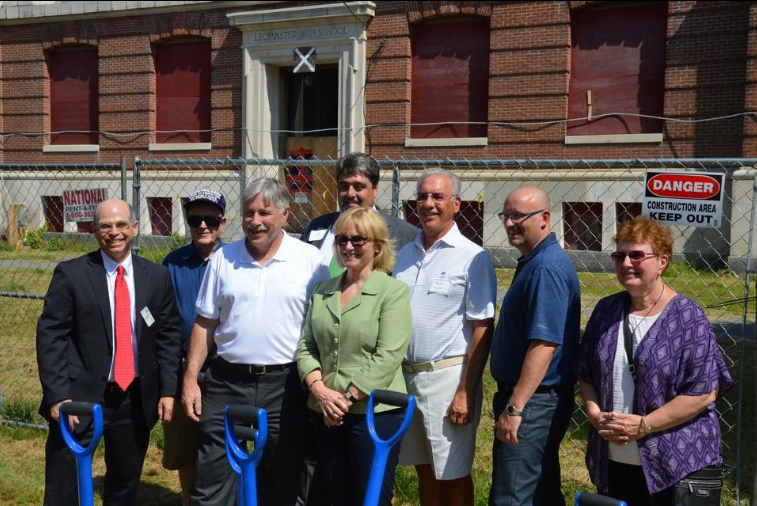
A ceremonial groundbreaking ceremony Wednesday, Aug. 29 marked the start of the conversion of the former Carter Junior High School into 39 units of affordable housing.

The building will have 14 one-bedroom apartments, 21 two-bedroom units and four three-bedroom units when work is complete, which is expected to take about a year and cost about $17 million.

There will also be storage for tenants, an exercise room, community space and parking. The building’s exterior and its boiler will be historically restored.

Each unit would be classified as affordable, according to documents from the Commonwealth of Massachusetts, including 16 units that would be affordable to households earning less than 30 percent of the region’s median income.

The hope, according to a press release from building owner NewVue Communities, is for the building to be certified by Enterprise Green Communities and placed on the National Register of Historic Places.

Built in 1904, the former Carter School was named after James Gordon Carter, a Leominster native, teacher and member of the first Massachusetts Board of Education. It served as the city’s high school until 1963; in fact, the building still bears the Leominster High School inscription above the front entrance. Then, from 1964-84, the Carter School was a junior high school.

The City of Leominster sold the Carter School to a private developer in 2000, but attempts to redevelop the building were not successful. NewVue Communities, based in Fitchburg, bought the building in 2016.

“It was such a significant part of Leominster’s rich history, and it broke my heart to see it in such terrible condition,” said NewVue Vice President Bill Brassard, Carter Junior High School Class of 1981. “I am proud to be part of a team that will revitalize this building and create a new use for it.”

NewVue Communities teamed up with city officials, Davis Square Architects, Hutter Construction and Wingate Companies to bring the Carter School project to the phase celebrated last week. Wingate, which will manage the building for NewVue, will start accepting apartment applications in the summer of 2019.

“We are excited to be here today,” Leominster Mayor Dean Mazzarella said. “This building was in such tough shape that we did not know how to redevelop the building. Given NewVue’s track record of taking on the most challenging projects with great success, I was thrilled when they asked us to partner with them to create affordable housing that is such an important part of Leominster’s history.”

The Carter School is NewVue’s second affordable housing project in Leominster. The first was Water Mill Apartments on Water Street.

Project partners and funders for the Carter School renovation include the City of Leominster, the Fitchburg-Leominster HOME Consortium, the state Department of Housing and Community Development, the Massachusetts Housing Investment Corporation, Avidia Bank, the Massachusetts Historical Commission, the Massachusetts Affordable Housing Trust Fund, the National Park Service, NeighborWorks America, the Community Economic Development Assistance Corporation, the Massachusetts Housing Partnership and the TD Charitable Foundation.

SourceLeominster Champion

Former Leominster school being converted to affordable housing

NewVue Communities is helping to breathe new life into the former Carter Junior High School, which has been vacant more than 30 years.

Wednesday, state and local officials and community leaders, some of whom attended Carter Junior High at 261 West St., across from the West End Diner, gathered under a tent for a groundbreaking ceremony outside the three-story brick school building to kick off its redevelopment into 39 affordable housing units.

Leominster Mayor Dean J. Mazzarella said that in 1985, former Mayor Richard J. Girouard Sr. asked Mr. Mazzarella and his business partner, who were in construction at the time, to tour the deteriorating building and consider redeveloping it. The school – built in 1904 and named after Leominster native and teacher James Gordon Carter, who was a member of the first Massachusetts Board of Education – served as the city’s high school until 1963, then a middle school from 1964 until 1984, when it was left vacant.

“I walked through the building with my partner and said, ‘If you give us the building and $100,000, we’ll do it over,’ ” Mr. Mazzarella said, adding that the cost of the project outweighed the benefits at the time.

After showing it himself to potential buyers “a million times,” the mayor said, he is excited about NewVue’s team effort and passion to see the project through. NewVue is a regional nonprofit that specializes in redeveloping properties into housing.

“Given NewVue’s track record of taking on the most challenging projects with great success, I was thrilled when they asked us to partner with them to create affordable housing (in a property) that is such an important part of Leominster’s history,” Mr. Mazzarella said.

In 2000, the city sold the school to a private developer, but after multiple unsuccessful attempts to redevelop it, NewVue Communities stepped in, officials said, and acquired the building in 2016.

NewVue Communities Vice President Bill J. Brassard, who attended Carter from 1979 to 1981, said he was happy to see the school restored.

When renovations are completed in 2019, the building will have 14 one-bedroom apartments, and 21 two-bedroom and four three-bedroom units. It will also have tenant storage, an exercise room, community space and parking. The exterior of the building and the existing boiler will be historically restored, officials said. The goal is for the building to be certified by Enterprise Green Communities and placed on the National Register of Historic Places.

Janelle Chan, undersecretary for housing and community development for the state’s Executive Office of Housing and Economic Development, said her office was glad the building will benefit future generations and become an asset for Leominster.

Ms. Chan said it is “pretty cool” that people who attended the school want to come back to live there and that children will be back in the hallways. Her office, she said, is proud to support the project.

The $17.4 million project is using historic and low-income housing tax credits, she said, along with state and local subsidies and private loans to rehabilitate the building that is in significant disrepair. Four units will be reserved for formerly homeless households, she said, who will have supportive services provided by the Massachusetts Opportunity Council. All units will be available to tenants at or below 60 percent of the average median income, and 16 units are reserved for tenants at or below 30 percent.

Marc Dohan, executive director of NewVue Communities, said the development team also includes city officials, Davis Square Architects, Hutter Construction and Wingate Companies, who have been working on bringing the project to fruition over the past five years.

Project partners and funders include the city of Leominster, Mr. Mazzarella, the Fitchburg-Leominster HOME Consortium, the Department of Housing and Community Development, Massachusetts Housing Investment Corporation, Avidia Bank, the Massachusetts Historical Commission, the Massachusetts Affordable Housing Trust Fund, the National Park Service, NeighborWorks America, the Community Economic Development Assistance Corporation, the Massachusetts Housing Partnership and the TD Charitable Foundation.

SourceTelegram