Affordable Housing Finance Magazine 2019 Readers’ Choice Award: Historic Rehab Category – The Union at 48 Boylston

We are excited to announce that The Union at 48 Boylston was chosen as the historic rehab winner in Affordable Housing Finance magazines 2019 Readers’ Choice Awards!

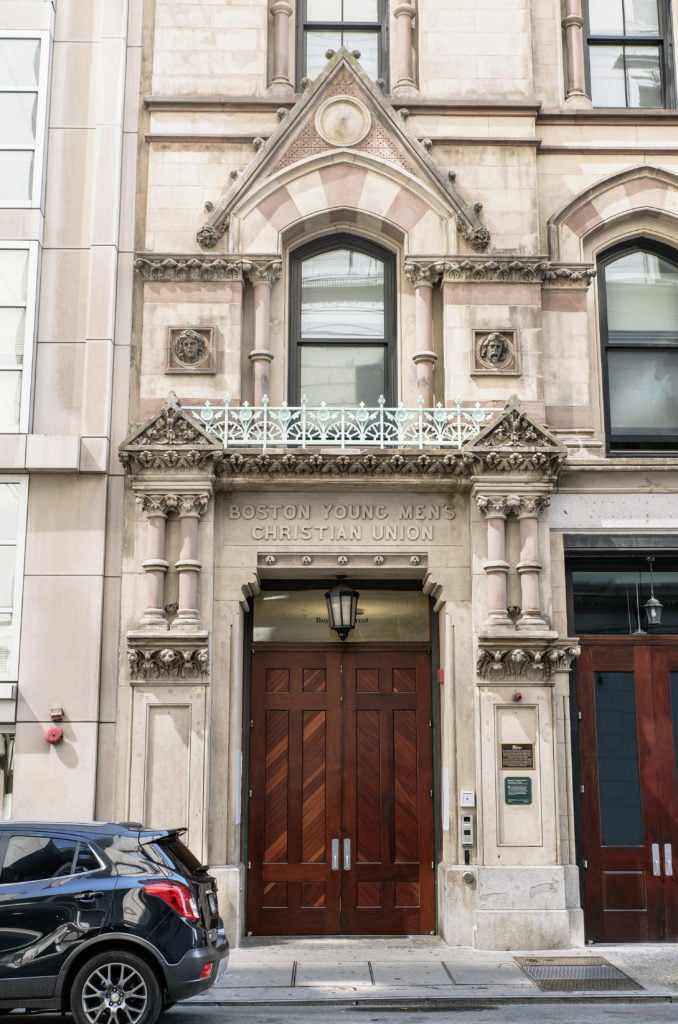
The Union at 48 Boylston was the result of a partnership between St. Francis House, the largest multi-service center for adults experiencing homelessness in the City of Boston, and the Planning Office for Urban Affairs (POUA).

Purchased in 2016, 48 Boylston has since been completely redeveloped by St. Francis House and POUA to provide much needed affordable housing in the community, creating 46 units of affordable housing. The completed development includes units to serve people who have experienced homelessness and others with very modest incomes. Twenty-six of the units are reserved for individuals earning less than 30% of the area median income.

Man stands in his kitchen in The Union at 48 looking happy and comfortable
Stephen has been a happy resident of The Union since May 2019. “Feeling at home… there’s just nothing like it. I have my own couch, I have my own bed. I get to put art on my walls. It doesn’t get any better than this.”

A designated Boston Landmark listed on the National Register of Historic Places, the building was constructed in 1875 and was originally operated by the Boston Young Men’s Christian Union (BYMCU) for more than 150 years to provide a variety of social, recreational and service programs. In keeping with the building’s history, the 48 Boylston development will also provide benefits beyond housing including new employment training opportunities through a partnership with The Urban Hound, a dog day care facility, and the ability to establish a brand-new recovery support center at St. Francis House.

Taken together, this building project has not only created critical affordable housing, but has opened the doors for St. Francis House to explore and implement new employment training and expand our social services for the vulnerable populations of Boston.

Read more about the AHF 2019 Readers Choice Awards: https://www.housingfinance.com/developments/ahf-announces-2019-readers-choice-award-winners_o

St. Francis House is excited to attend the AHF Live: 2019 Affordable Housing Developers Summit and award ceremony November 18 – 20 at the Hyatt Regency in Chicago.

…

Developers: Planning Office for Urban Affairs and St. Francis House

Architect: The Architectural Team

General Contractor: Gilbane Construction

Major Funders: Bank of America Merrill Lynch; commonwealth of Massachusetts (Department of Housing and Community Development, Community Economic Development Assistance Corp., and MassHousing); city of Boston (Department of Neighborhood Development and Neighborhood Housing Trust); Massachusetts Historical Commission; National Park Service; Federal Home Loan Bank of Boston; Eastern Bank

SourceSt. Francis House

Walker Park Apartments and Delphine’s Courtyard Opened

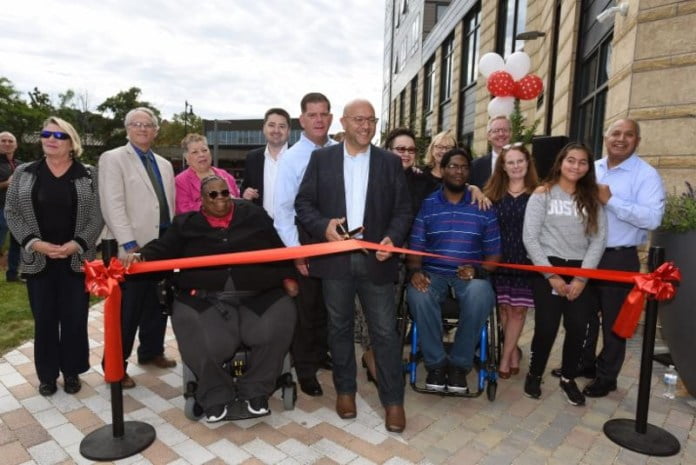
Mayor Martin J. Walsh today joined the community development agency Urban Edge, elected officials, community leaders and neighbors to celebrate the opening of the Walker Park Apartments and Delphine’s Courtyard, consisting of 49 units of affordable family housing and a pocket park in Egleston Square. The City of Boston’s Department of Neighborhood Development and the Community Preservation Fund provided more than $2.8 million in total for the new homes and courtyard.

“Today we celebrate the creation of 49 new affordable homes, a crucial step forward in our goal of preserving our neighborhoods,” said Mayor Walsh. “Along with our partners, the City of Boston is making big investments in Egleston Square, increasing opportunity for families and helping us keep housing affordable and accessible. I want to thank Urban Edge and everyone involved in this project for their work in making these new affordable homes possible.”

Mayor Walsh with members of the Walker family.

Mayor Walsh with members of the Walker family.

The Walker Park Apartments redeveloped three formerly vacant or underutilized parcels adjacent to the Egleston Square Branch of the Boston Public Library and in the Egleston Square Main Street District. The development is named for longtime community activist Delphine Walker, whose home stood on one of the development sites. All of the 49 new apartments have been rented to households who earn at or below 60 percent of the Area Median Income (AMI), including eight apartments reserved for families earning 30 percent of AMI or below.

“Urban Edge is proud that we have led investment in Egleston Square and is doing so in a way that honors the neighborhood’s past while providing more opportunities for quality housing for members of the community,” said Natacha Dunker, president of Urban Edge’s Board of Directors. “We are so grateful to Mayor Walsh, the Department of Neighborhood Development, and all of our funders for their support of this important project.”

“Today, we celebrate another victory for our city and community: new construction of 49 income-restricted units and 34 off-street parking spots,” said State Representative Liz Malia (D-11th Suffolk). “This is exactly the type of housing we need to build in Boston and specifically in the Egleston Square Neighborhood. The face of our community depends on it, and I’m  grateful to Urban Edge and the City for having the long-term vision to realize this project and others like it.”

The Walker Park Apartments now boast 13 one-bedroom, 28 two-bedroom, and eight three-bedroom family apartments, an elevator for accessibility, on-site laundry facilities, on-site parking, and Delphine’s Courtyard funded by the Community Preservation Fund. In accordance with state guidelines, funds generated from the Community Preservation Act fund for affordable housing, historic preservation, and parks and open space projects.

“My mother bought her home in Roxbury at a time when many people were not making investments in this community, and she worked with others to strengthen Egleston Square as a neighborhood,” said Pamela Walker, daughter of Delphine Walker. “We are so grateful that Urban Edge has honored her by naming both the apartment complex and the courtyard after her.”

“Since I moved to Walker Park, my life feels different. I can see how my children always have a smile on their faces,” said Cassandra Amazan, a resident of Walker Park Apartments. “It was a great feeling seeing them choosing their own room and making plans of how they would decorate them. It is not only about having or walking in to my own apartment now, it’s about feeling accomplished in many ways and that this is opening new doors for me and my family.”

In accordance with the City of Boston’s Green Affordable Housing Program, Walker Park Apartments will utilize a high-efficiency heating system as well as Energy Star rated appliances. The development employs environmentally friendly design features that meets the U.S. Green Building Council LEED Homes Silver certifiable standard. The development also met the U.S. Environmental Protection Agency’s Energy Star standards. The development team is made up of Urban Edge, Prellwitz Chilinski Associates, and NEI General Contracting, Inc.

The Walker Park Apartments have been made possible by funding from the City of Boston, and State and Federal Low Income Housing Tax Credits from the Commonwealth’s Department of Housing and Community Development (DHCD). Financing team members also included Bank of America Merrill Lynch, Brookline Bank, the Community Economic Development Assistance Corporation, MassDevelopment, MassHousing, Massachusetts Housing Investment Corporation, Massachusetts Housing Partnership, US Bank Corporation, and the US Department of Housing and Urban Development.

Walker Park Apartments strongly aligns with the City’s housing goals outlined in Housing a Changing City: Boston 2030. Mayor Walsh recently increased the City’s overall housing targets from 53,000 to 69,000 new units by 2030 to meet Boston’s population growth. These updated housing goals build on Mayor Walsh’s commitment to increasing access to home ownership, preventing displacement and promoting fair and equitable housing access.

Since the release of the original Housing a Changing City: Boston 2030 plan in 2014, income-restricted housing stock, designed to increase affordable housing, has grown along with overall new production: nearly 20 percent of housing units are income restricted, and 25 percent of rental units are income restricted. In total, after creating an additional 15,820 units of income-restricted housing, Boston will have nearly 70,000 units of income-restricted housing by 2030.

Mayor Walsh’s 2019 housing security legislative package focuses on expanding upon the work that Boston has done to address the region’s affordable housing crisis and displacement risks for tenants by proposing new and strengthening current tools to leverage Boston’s prosperity and create sustainable wealth opportunities that make Boston a more inclusive and equitable city. The housing security bills proposed seek to help existing tenants, particularly the elderly, remain in their homes, and creates additional funding for affordable housing.

For more information on the City’s work to create more housing, please visit: Housing A Changing City: Boston 2030.

###Delp

SourceMayor's Office

Baker-Polito Administration Files New Housing Legislation to Increase Housing Production in Massachusetts

Today, Governor Charlie Baker filed legislation to further the administration’s Housing Choice Initiative, a bold plan to support the production of 135,000 new housing units by 2025. This bill builds on efforts undertaken last legislative session to deliver necessary, targeted zoning reform to benefit communities pursuing new housing production.

The Baker-Polito Administration developed the Housing Choice Initiative to offer a combination of incentives, technical assistance and new capital grant funding to facilitate community-led housing production across the Commonwealth. This diverse set of tools for communities is intended to create the conditions for sustainable housing development that meets the needs of current and future residents.

“Today, we have more people working in Massachusetts than at any time in our Commonwealth’s history, and the need for substantially increased housing production –for residents across the income spectrum – is necessary to match Massachusetts’ booming economic growth,” said Governor Charlie Baker. “This legislation is critical, will unlock the potential of our cities and towns committed to responsible growth, development and enacting best practices in sustainable housing production and we are committed to working with stakeholders and our partners in the legislature to make it a reality.”

“The Commonwealth’s cities and towns are eager to meet the needs of their residents and we are thrilled that 69 communities have already received a Housing Choice Community designation, showing their commitment to housing production,” said Lt. Governor Karyn Polito. “This legislation is the next step in fulfilling our commitment to Massachusetts residents, creating the conditions for all of our families and individuals to live, work, and thrive across the state.”

When the Baker-Polito Administration first unveiled the Housing Choice Initiative in 2017, in addition to the changes proposed through legislation, the comprehensive initiative also created a new system of incentives and rewards for municipalities to deliver sustainable housing growth by designating communities that are producing new housing units and have adopted best practices with a new “Housing Choice Communities.” It also created a new technical assistance toolbox empowering cities and towns to plan for new housing production.

Since the Housing Choice Initiative program’s inception, the Baker-Polito Administration has awarded $5 million in capital funding to 31 communities, and with its partnership with MassHousing, 14 communities have received technical assistance to advance the production of more than 4,000 new housing units.

The bill filed by the Governor today mirrors the legislation filed by the Governor in the last legislative session and includes changes made by the legislature in House Bill 4290 An Act to Promote Housing Choices.

This proposal will enable cities and towns to adopt certain zoning best practices related to housing development by a simple majority vote, rather than the current two-thirds supermajority. This legislation will not mandate cities and towns to make any of these zoning changes; but will allow municipalities that want to rezone for denser, transit or downtown oriented, and new housing development to do so more easily.

Zoning changes that promote best practices for housing growth that would qualify for the simple majority threshold include:

  • Building mixed-use, multi-family, and starter homes, and adopting 40R “Smart Growth” zoning in town centers and near transit.
  • Allowing the development of accessory dwelling units, or “in-law” apartments.
  • Approving Smart Growth or Starter Homes districts that put housing near existing activity centers.
  • Granting increased density through a special permit process.
  • Allowing for the transfer of development rights and enacting natural resource protection zoning.
  • Reducing parking requirements and dimensional requirements, such as minimum lot sizes.

This legislation also includes a provision, added by the Joint Committee on Housing, that would reduce the voting threshold for a special permit issued by a local permit granting authority to a simple majority vote, for certain multi-family or mixed-use projects with at least 10% affordable units in locations near transit or, in centers of commercial activity within a municipality.

Massachusetts is currently one of only a few states to require a supermajority to change local zoning.

“We have an incredible economy here in Massachusetts, capitalizing on our talented workforce, thriving innovation ecosystem,” said Housing and Economic Development Secretary Mike Kennealy. “Attracting and retaining talent – including the Commonwealth’s newly graduated students, young families and workforce – continues to be a paramount concern. This legislation is an important step in ensuring Massachusetts cities and towns can create welcoming communities that leverage their existing assets, like thriving downtowns and vital transportation hubs.”

“Since launching our Housing Choice Initiative, we have provided technical assistance and access to new capital grant funding to numerous communities committed to housing production,” said Housing and Community Development Undersecretary Janelle Chan. “This legislation is a necessary component to our overall effort to encourage and support municipalities and, together, pro-actively move high-quality projects forward to address our current and growing need for new housing in Massachusetts.”

“There is perhaps no more critical issue impacting Massachusetts’ cities and towns today than the issue of housing. Like many communities in Greater Boston, Salem is witnessing a sharp decline in the affordability and availability of housing for people who live and work here. We are fortunate to have a city that has a rich mix of people from different backgrounds, income levels, cultures, and more. That diversity contributes to the character of our community in a meaningful way and is a part of our nearly 400 year old history. However, the current housing crisis is threatening that character as, too often, the many faces of Salem – seniors on fixed incomes, working families, young adults – all are finding our city increasingly unaffordable. We want Salem to continue to be a place that people of all means can call home. While we are pushing for policies and investments on the local level to address this growing challenge, we need a strong partnership with state leaders to advance legislation, including Housing Choice, that can make these reforms possible in the first place. I am proud to stand with Governor Baker and other advocates for sensible, compassionate housing policy, to ensure that Salem can be home for anyone,” said Salem Mayor Kim Driscoll.

“Easthampton’s designation as a Housing Choice community gave our city access to multiple tools that unlocked long standing impediments to growing our housing stock and encouraging mixed – use development.  This designation allowed our city to vertically stack grants and economic incitements.  Our ability to leverage public dollars to attract private investment makes tangible the vital connection between housing, jobs and sustainable smart growth,” said Easthampton Mayor Nicole LaChapelle.

“Creating more housing choices requires local communities across the Commonwealth to be creative and adaptable.  It also requires an approach that’s appropriate for each individual community. That’s what makes the Housing Choice Initiative such a great approach.  It gives every community new tools, from grant opportunities to technical assistance to best practices, that allows each to craft plans that make sense locally while at the same time helping address the overall housing challenge,” said Cohasset Town Manager Christopher Senior.

“This important legislation will provide communities with vital tools and authority to address our housing production needs,” said Massachusetts Municipal Association Executive Director Geoff Beckwith. “We applaud the Baker-Polito Administration for recognizing that true progress in making housing more affordable can only be achieved when the state and cities and towns work together as partners.  This bill embraces that partnership, and the MMA looks forward to working with all coalition partners to bring meaningful zoning reform that respects local decision-making across the finish line.”

“We can’t confront our housing and climate crises without local zoning changes, so we hope to see the Legislature fast-track this bill in 2019,” said André Leroux, Executive Director of the Massachusetts Smart Growth Alliance. “Thanks to the Governor’s support and the work of the Joint Committee on Housing, it also includes a key reform to encourage developers to build more of the affordable homes that our state desperately needs.”

“Housing Choice needs to pass, preferably over the next few months, before town meetings start in the spring,” said Marc Draisen, Executive Director of the Metropolitan Area Planning Council (MAPC). “The bill would really help cities and towns to amend zoning and issue permits that will boost housing production. The legislation was thoroughly vetted in the last session, so MAPC hopes it can pass quickly this time around.”

“Passage of the Housing Choices Bill is our top priority,” said Hunter Marosits, Vice-President of H and R Homes Remodeling, Inc. in Wilbraham and President of the Home Builders and Remodelers Association of Massachusetts. “Making it easier for communities to adopt zoning for housing will benefit young couples seeking to buy their first home, growing families looking to trade up, and downsizing baby boomers wishing to live near their children and grandchildren.”

“The Greater Boston Chamber of Commerce applauds Governor Baker for his continued focus on remedying the Commonwealth’s housing shortage, and we are pleased to see the Administration’s Housing Choice bill back on the legislative track,” said James E. Rooney, President and CEO of the GBCC. “The rising cost of living in Greater Boston is a critical issue impacting our regional and economic competitiveness. Governor Baker’s proposal would take meaningful steps forward by increasing workforce housing development and rewarding that development with potential transportation investments, two initiatives that are strongly supported by the business community. We are eager to see this bill advance, and quickly.”

“The state’s housing crunch is not just a Boston problem, but also a suburban problem. The legislation will help communities allow the type of housing in the right area that helps promote community stability and economic growth. It is as much an economic development bill as it is a housing bill,” said Peter Forman, President & CEO of the South Shore Chamber of Commerce.

“We know the vast majority of people age 50 and older want to stay in their homes and communities for as long as possible.  With the Housing Choice bill, Governor Baker is again taking steps to help Massachusetts residents age in place. This bill allows for the development of new housing models, promotes accessory dwellings, and encourages construction in areas and neighborhoods that have accessible resources,” said Mike Festa, State Director of AARP Massachusetts.

The Baker-Polito Administration has shown a deep commitment to increasing the production of housing across income levels. Since 2015, the administration has invested more than $1 billion in affordable housing, resulting in the production and preservation of more than 17,000 housing units, including 15,000 affordable units. In 2018, Governor Baker signed the largest housing bond bill in Massachusetts history, committing more than $1.8 billion to the future of affordable housing production and preservation. The Baker-Polito Administration has also advanced the development of more than 7,000 mixed-income housing units through the successful MassWorks Infrastructure Program, reformed the Housing Development Incentive Program, and worked with communities to implement smart-growth development and planning efforts.

###

SourceOffice of Governor Charlie Baker and Lt. Governor Karyn Polito

One Gurney Street Holds Grand Opening

Boston Mayor Martin J. Wash on Saturday joined Mission Hill Neighborhood Housing Services (MHNHS), elected officials and residents to celebrate the grand opening of One Gurney Street.

This once vacant property is now a transit-oriented, mixed-use development that offers 40 units of affordable family housing, a new office headquarters for Metro Housing Boston, and four community-oriented retail storefronts including a new Eastern Bank branch. This is the first phase of the redevelopment of Parcel 25, the Mission Hill community’s plan to revitalize Roxbury Crossing.

“Today we celebrate a significant milestone reached as we break ground on this project at Parcel 25 that will bring affordable housing and public benefits to Mission Hill community members,” said Mayor Walsh. “I’m proud of the work that all partners have done to create dozens of affordable homes for workforce families, formerly homeless individuals, and persons with disabilities. This mixed-use development will continue keep this neighborhood a strong and vibrant place for generations to come.”

Phase 1A of the Parcel 25 redevelopment represents the culmination of more than a decade of planning and hard work by MHNHS and the Mission Hill community to restore the land formerly owned by the MBTA. The Maria Sanchez House, located just across Gurney Street from Parcel 25, was the first building to be developed as part of the community’s vision to revitalize the area. The Maria Sanchez House, completed in 2015, offers 40 units of affordable housing for seniors.

“We like to say it takes a village to develop affordable, neighborhood-stabilizing housing. Never has this been more evident than our efforts to redevelop Parcel 25,” said Mission Hill NHS Executive Director Patricia Flaherty. “Not only were hundreds of our neighbors involved in the dreaming, the planning, and the advocacy, but almost as many funders were committed to making the community’s plan a reality, led by the City’s Department of Neighborhood Development and the MA Department of Housing and Community Development. Today we are grateful for all those involved in the Parcel 25 Phase 1A/One Gurney Street project and officially welcome Metro Housing Boston staff and clients, Eastern Bank, and 40 new families to the neighborhood!”

One Gurney Street features nine one-bedroom units, 22 two-bedroom units, and nine three-bedroom units. All of the new rental units are affordable to workforce individuals and families at or below 60 percent of Area Median Income (AMI), 11 of the units are further subsidized to make them affordable to families with incomes at or below 30 percent of AMI. The 11 units include five units that are now home to formerly homeless households, and six fully wheelchair accessible units serving the needs of households with persons with disabilities. Three of the handicapped units are equipped with additional enhancements for persons with significant mobility and other disabilities under the Community Based Housing (CBH) program. Four of the units are specially equipped for persons with hearing impairment and visual disabilities.

“I want to thank everyone here today.This building has opened up the world for me again,” said Allande Pierre, one of the building’s new residents. “After becoming wheelchair-bound, I had to live in an institutional rehab center for more than a year without being able to move around without asking for permission. With my new apartment and the special accessibility adaptations, I have my freedom again. I can come and go as I please, move around the neighborhood, and I can even invite family and friends over to my home. It’s like night and day!”

The first floor of the new building has four retail storefronts located along Tremont Street and immediately across from the Roxbury Crossing T Station, and now extend and support the Mission Hill Main Streets district. In a strong show of their long-term commitment to the project and to the neighborhood, Eastern Bank and Metro Housing Boston now occupy retail and commercial space in thenew development. Eastern Bank, one of the project’s construction/bridge lenders, recently opened the area’s first bank branch in decades in one of the retail spaces. Metro Housing Boston purchased the office condo and relocated their headquarters and more than 155 employees to better service its clients at this location. Metro Housing Boston is the state’s largest servicer of housing subsidies and a provider of housing support services.

“The staff and Board of Metro Housing are thrilled to participate in the development of Parcel 25 to help reconnect Mission Hill with Roxbury,” said Chris Norris, Metro Housing Boston Executive Director. “Not only have we provided our participants with a modern and accessible location for them to receive our services and get connected to affordable homes, but we have also helped knit together a community.”

The project is LEED Silver Certified and has many green features for long-term operations, sustainability, and provides several new improvements such as new sidewalks, handicap accessible ramps, benches, lighting, bike racks, and a new pedestrian plaza and walkway that allows residents and visitors to move through the site and to their points of destination. The building was designed by Goody Clancy architects, constructed by NEI General Contracting, and is managed by Maloney Properties.

The new development has been made possible in part by a City of Boston contribution of more than $4 million, including funds from the Community Development Block Grant and the Neighborhood Housing Trust tied to a linkage contribution from Children’s Hospital. This contribution enabled the development team to take advantage of more than $3 million from the Commonwealth’s Department of Housing and Community Development.The State also provided an allocation of almost $1 million in federal Low-Income Housing Tax Credits (LIHTC) that helped raise over $9.4 million in equity from Regions and First Sterling, the equity investor in the project.

A consortium of Boston Private and Eastern Bank provided over $10 million in construction/bridge financing for the development. The Massachusetts Housing Partnership (MHP) provided $2.9 million in long term financing and is the permanent lender for the project. Boston Community Loan Fund/Life Initiative and Community Economic Development Assistance Corporation provided important pre-development financing for the project, with BCLF/Life Initiative also providing critical acquisition financing for the land purchase.

SourceBoston Real Estate Times