Educare Springfield: Early education takes a giant step forward

On Monday, civic partners gathered in the city of Springfield and broke ground on what will be a $14 million Educare Center, a school that will open next year and provide “a full-day and full-year program for up to 141 children from birth to age five each year,” MassLive.com reports.

As we’ve blogged, Springfield’s educators and philanthropists have called this Educare project a “dream come true,” one that promises to provide the city’s children with increased access to a high-quality early education program.

Educare “began in Chicago in 2000,” public radio station WAMC reports. It’s a research-based model that has four core features: “data utilization, embedded professional development, high-quality teaching practices, and intensive family engagement,” according to Educare’s website.

“Among the innovations at Educare,” WAMC adds, “is the placement of teachers with the same children from the time they enroll as infants up to age 3. Parents are required to participate in school activities, home visitations, and regular parent-teacher conferences.”

Several years of rigorous evaluation shows that when children leave Educare for elementary school, the majority are academically, socially and emotionally prepared for kindergarten.”

There are “23 Educare schools in 15 states,” including California, Florida, Maine, Michigan, Washington, D.C., and Wisconsin. “Educare Springfield will be the first in Massachusetts.”

Springfield is putting the Educare Center in its Old Hill neighborhood, the home of many children who live in poverty. The neighborhood suffered considerable damage from the 2011 tornado that struck the Springfield area.

At the ground-breaking ceremony, Lieutenant Governor Karyn Polito pointed to the economic significance of the Educare Center, praising Springfield for “rebuilding this neighborhood” and noting that the school will serve children who are born in Springfield and grow up to become part of the city’s workforce, MassLive reports.

Springfield Mayor Domenic Sarno added, “Educare is a significant investment here in the city of Springfield and it’s another public and private partnership, with everybody working together for the same goal for our children.”

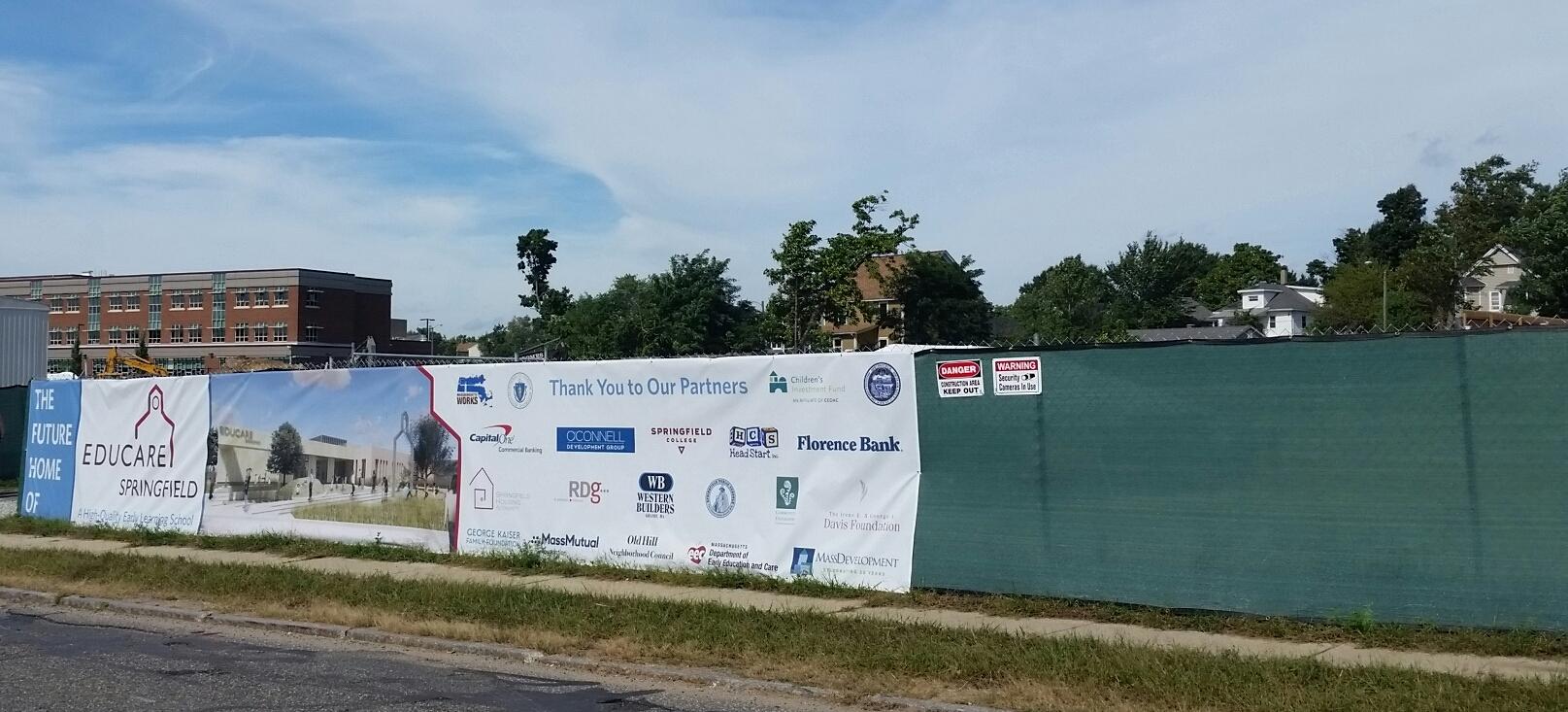
There are many members of this public/private partnership including: the Davis Foundation, which provided fundraising support and overall leadership for the project; Springfield College, which donated land; and the state of Massachusetts, which provided both a $1 million facilities grant to help finance construction as well as infrastructure funding from the MassWorks program at the Massachusetts Executive Office of Housing and Economic Development. Among the other partners are the Children’s Development Fund, the Mass Mutual Fund, Capital One Commercial Banking; and a number of anonymous donors. (The full list is on the City of Springfield’s website.)

Educare Springfield will be operated in partnership with Holyoke Chicopee Springfield Head Start. All Educare sites build upon strong partnerships with Head Start, and this one is no different. HCS Head Start Executive director Janis Santos spoke at Monday’s groundbreaking and shared her extensive conversations with other Head Start colleagues nationally who have partnered with Educare.

“They all told me, ‘It’s a lot of work, but it’s worth it,’” she said.

The center will also serve as a learning laboratory “for best practices” as well as “an essential resource for Springfield College, Springfield Technical Community College, Springfield Public Schools, and the early education community across the state for training and providing professional development for future teachers, social workers, evaluation and research.”

It’s an ambitious project with a great deal of promise that could transform children’s lives. As Tom Weber, the commissioner of the Department of Early Education and Care, explained to WAMC, “despite the success the state has seen with rising test scores and graduation rates in the last 25 years, it still has one of the largest achievement gaps in the country.”

“We have to take risks,” Weber added. “It is worth taking risks. If the solutions were obvious to us, we would have solved these problems already, so we have to be daring.”

Stay tuned. We hope to share more about Educare Springfield as the project develops. The center is scheduled to open in late 2019.

SourceEye on Early Education

Ground broken for low-income childcare program in Springfield

Ground was broken Monday for a new childcare program in Springfield that will serve low-income families.

According to a news release sent to 22News, the Educare Springfield will serve 141 children with a full-day, year-round program.

The release said the program will target the children’s education needs as well as other needs their families may have.

The 26,000 square-foot program will be built in the Old Hill Neighborhood near the Elias Brookings Elementary School.

Educare Springfield is scheduled to open by the fall of 2019.

The new facility will create 110 construction jobs, 46 existing Head Start jobs, and another 10 jobs within two years after opening.

The program has already received two separate $1 million grants, one from the Department of Early Education and Care and one from the Baker-Polito Administration.

The program will be the 25th Educare Learning Network in the country, and the first one in the state of Massachusetts.

SourceWWLP

Construction Underway On $14 Million Educare Preschool

An early childhood education center that will be part of an innovative national network of preschools is under construction in western Massachusetts.

A $14 million state-of-the-art preschool is being developed by the Educare Learning Network in Springfield’s Old Hill neighborhood – one of the poorest urban areas in the country.

It is an ideal location because the goal of Educare, according to executive director Cynthia Jackson, is to “level the playing field” by helping children living in poverty start kindergarten prepared to learn at the same pace as other children.

“Our schools serve as places of innovation and learning,” said Jackson. “This is a learning lab. We don’t have all the answers. We are learning together.”

Among the innovations at Educare is the placement of teachers with the same children from the time they enroll as infants up to age 3.  Parents are required to participate in school activities, home visitations, and regular parent-teacher conferences.

The pre-school program began in Chicago in 2000.  There are now 23 Educare schools in 15 states.  Educare Springfield will be the first in Massachusetts.

“We know the work you will do here in Springfield, Massachusetts will inspire other communities across the country to do what is best and right for our young children and families,” said Jackson.

She  spoke at a groundbreaking ceremony Monday that was attended by close to 100 local and state officials, advocates for early childhood education, community leaders, and benefactors.

Tom Weber, Commissioner of the Massachusetts Department of Early Education, said despite the success the state has seen with rising test scores and graduation rates in the last 25 years, it still has one of the largest achievement gaps in the country.

” We have to take risks,” he said. “It is worth taking risks. If the solutions were obvious to us, we would have solved these problems already, so we have to be daring.”

Educare Springfield will be operated by Head Start.  Janis Santos, executive director of the local Head Start program said its one of the most exciting projects in her 45-year career in early education.

“It is just an incredible exciting opportunity here in Springfield and in the state of Massachusetts for our children and families,” said Santos.

The new preschool is scheduled to open in the fall of 2019 with an enrollment of 141 children.

The effort to bring an Educare school to Springfield was spearheaded by the Davis Foundation which put up some of the initial funding and raised money from several sources including $9 million from an anonymous donor.     In addition to the money to build the school, $7 million has been raised for an endowment to support operations.

Springfield College donated the land for the school.

Massachusetts put $1 million towards the construction of the school, and Lt. Gov. Karyn Polito Monday announced a $1 million award from the MassWorks program to build public infrastructure to support the new school.

“This is the way we do business in this Commonwealth,” said Polito. “We work together. We find collaborations and common ground and find the ability to get to ‘Yes’.”

Polito was filling in for Gov. Charlie Baker, who was in Lawrence for a meeting on the recovery efforts after last week’s gas explosions and fires.

The area where the new school is under construction was heavily damaged by a tornado seven years ago.

SourceWAMC

Warren pledges to push for Lawrence grants

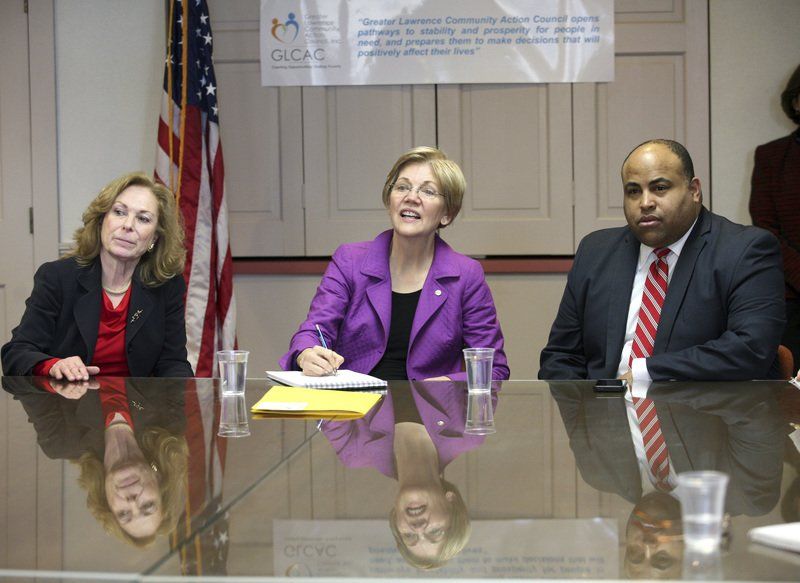
U.S. Sen. Elizabeth Warren met with city leaders Monday to discuss a range of issues, from affordable housing to transportation improvements, praising efforts made in these areas and pledging to advocate for the city at the federal level to help that work continue.
“The federal government wants to be a good partner to the people in Lawrence, and it’s my job to try to make that happen, whenever and wherever I can,” Warren, D-Mass., said.
To start her visit, Warren met with Mayor Daniel Rivera, several city employees and elected officials to hear the city’s plans to apply for Transportation Investment Generating Economic Recovery federal grant funds, known as TIGER money.
She then moved to the Greater Lawrence Community Action Council Inc., where she read to children in the Head Start program and heard about the GLCAC’s efforts to assist residents with everything from visa issues to heating their homes.
Rivera said it was important for the state’s senior senator to come to Lawrence both to celebrate the work that was being done in the city and to understand what still needed to be done to help improve the quality of life and expand opportunities in the city.
“To have such an influential person in the U.S. Senate be our senator, and then to have her come to Lawrence, is the leg up Lawrence really needs,” he said.
Warren called Lawrence a city with “great, great opportunities.”
“I like being in Lawrence because Lawrence is a gateway city in the true meaning of that word,” Warren said. “It is a gateway for people who are building a future, that’s what Lawrence is all about.”
Transportation improvements
Lawrence is seeking TIGER funds for an estimated $10 million in transportation improvements to a 1.6-mile stretch of road through the city’s downtown — from the Five Corners intersection north up Parker Street, across the Merrimack River to Amesbury Street, then to the intersection with Lawrence Street — designed to increase safety and make downtown Lawrence more easily navigable.
“We want to make multimodal transportation access better for everyone, whether that’s pedestrians, bicyclists, motor vehicles,” said Theresa Park, the city’s planning director.
The city is looking to make infrastructure improvements at the Five Corners intersection, from upgrading traffic signal equipment to making sure the roadway complies with the Complete Streets policy for all modes of transportation.
Then, the city is looking to turn Amesbury Street from a one-way roadway into a two-way roadway to help provide more direct access to locations in the city’s downtown. Motorists heading north on Amesbury Street are diverted either left or right after crossing the North Canal, limiting direct access to areas such as the Buckley Parking Garage or Northern Essex Community College, she said.
Plans also call for a roundabout at the intersection of Amesbury and Lawrence streets.
The one-way system “really makes navigation or way-finding within downtown difficult. It forces people to drive out of their way,” Park said.
The improved access and upgraded infrastructure could also help spur job growth, city officials said.
Rivera said the senator offered her perspective on the city’s application – the TIGER program is competitive, and Lawrence was not selected for a grant last year. She helped officials refine the city’s message for that application.
After discussing the grant, Warren, Rivera and elected officials, including state Sen. Barbara L’Italien, D-Andover, and state Reps. Frank Moran and Marcos Devers, D-Lawrence, headed to the GLCAC building for discussions about the organization’s services, its successes, and what resources it needed to help continue serving residents.
“People come here to get their foothold in American society, they come here in the neediest part of their lives, and I think organizations like the GLCAC make that transition easier,” Rivera said.
The GLCAC’s Head Start program was among the successes highlighted to the senator, but there were calls for increased salaries and more support for teachers.
Warren said while “we are not in the position we were in three years ago” when sequestration in Washington resulted in program cuts, including closures of Head Start centers, there was still a fight to be had.
“It is a reminder that what we need to do is we need to be putting more resources, not fewer resources, into Head Start,” she said. “I agree this is the best investment. The nickels we put into children is dollars that will pay off when they’re teenagers.”
Lawrence District F City Councilor Marc Laplante asked the senator whether the city should focus on maintaining and growing its middle class.
“Lawrence shouldn’t just hold onto people it educates, it should attract people,” Warren said. “That’s the kind of community that really is about building a future. A future isn’t just let us give you a start so you can go somewhere else to live a secure life, you can do that right here in Lawrence.”
Linda Soucy, program director for fuel assistance at the GLCAC, spoke of staffing and service issues for her program, which has nearly 12,000 clients. Staffing has been cut nearly in half since she started in 2008, the amount of money clients receive for heating assistance has diminished, and planning issues arise from not having their entire budget released to them at once, she said.
“We have to have the money come in,” Soucy said. “We’re just trying to do our best to make sure people live in safe, warm houses.”
Warren noted it was sometimes a challenge to get those federal funds for heating assistance.
“We don’t do it every time, we don’t win every battle, but I’ll tell you, we will get out there and fight, and fight for what’s right for families in Lawrence,” Warren said.
While each issue was discussed separately, Warren said they are all connected when it comes to advancing quality of life for families in Lawrence and beyond.
“It’s the reminder that all of the pieces work together. If a family doesn’t have housing, then they can’t be secure, they can’t get their children educated, they can’t build any kind of future,” she said.
“But if they get in that housing and can’t keep it heated, then they can’t be safe. If they get in that housing and they keep it heated but they have small children that can’t make it into a Head Start program, then their children will have more difficulty not just immediately, but over the very long run of their years in school and their working years,” she continued.
Given that, Warren said it was hard to prioritize just one issue to focus on in Lawrence.
“It truly is the case that we need to push forward on multiple fronts at once so the pieces can work together,” Warren said, adding, “We know what our families need. The federal government just needs to put the resources in so that we can deliver for our families.”

SourceEagle Tribune

CEDAC NOT Mentioned: Quincy dedicates Wahlberg Learning Center

April 12, 2012
Quincy dedicates Wahlberg Learning Center
By Lauren DiTullio
QUINCY — In a Wednesday morning ceremony that turned into a standing-room-only affair, the Rosemary & Archie Wahlberg Early Learning Center was dedicated to its namesake couple.
Quincy Community Action Programs purchased the building at 22 Pray St., formerly the St. Joseph’s School, from the Archdiocese of Boston in 2010. After a $7.5 million renovation – paid for with federal funding, grants from Head Start, State Street Corp. and the City of Quincy, and low-interest financing from Rockland Trust – the school opened in December.
Having the new facility enabled QCAP to stop leasing classroom space in Braintree and Germantown.
Children of low-income families in Quincy and other communities are fed at the center from a state-of-the-art kitchen and have the opportunity to learn in colorful room.
“We’ve been waiting for a moment to really be able to acknowledge Rosemary and Archie properly,” said Beth Ann Strollo, QCAP executive director.
Archie Wahlberg was a founding member of the QCAP board, and his wife went on to serve as executive director for 25 years.
“They did work that was hard. They were courageous in their work,” Strollo said.
The ceremony also included the naming of a large meeting space in the school. The space is now called the Delahunt Room, in recognition of former U.S. Rep. William D. Delahunt, who helped QCAP secure federal funding for the project.
“This building is a physical reflection of the character of this city,” Delahunt said.
Also among the attendees were Mayor Thomas Koch, city council President Michael MacFarland, state Reps. Bruce Ayers and Tackey Chan, and state Sen. John Keenan.
A plaque honoring the Wahlbergs will hang in the early learning center’s lobby.
The couple took the podium to a standing ovation, after which Rosemary Wahlberg spoke briefly about her life and service in Quincy since 1957.
“You can really make a difference here,” she said.
READ MORE about this issue.

SourcePatriot Ledger