
Advocates See Cote Development As A Sign Mattapan Is Changing

When Mattapan residents pass by the old Cote Ford dealership on Cummins Highway, some see a symbol of neglect — a boarded-up beige brick building, with graffiti on the walls and weeds cracking through the pavement.

Now, more than three decades after the dealership closed, this key piece of real estate is coming back to life.

“Cote Village, we believe, is a significant investment in the future of Mattapan,” said Lincoln Larmond, a development advocate and co-chair of the group Mattapan United. “Historically there’s been a lot of disinvestment in Mattapan.”

The Cote Ford site, Larmond said, “had been vacant for 30 years, so that alone will demonstrate the fact that it’s been a long time coming.”
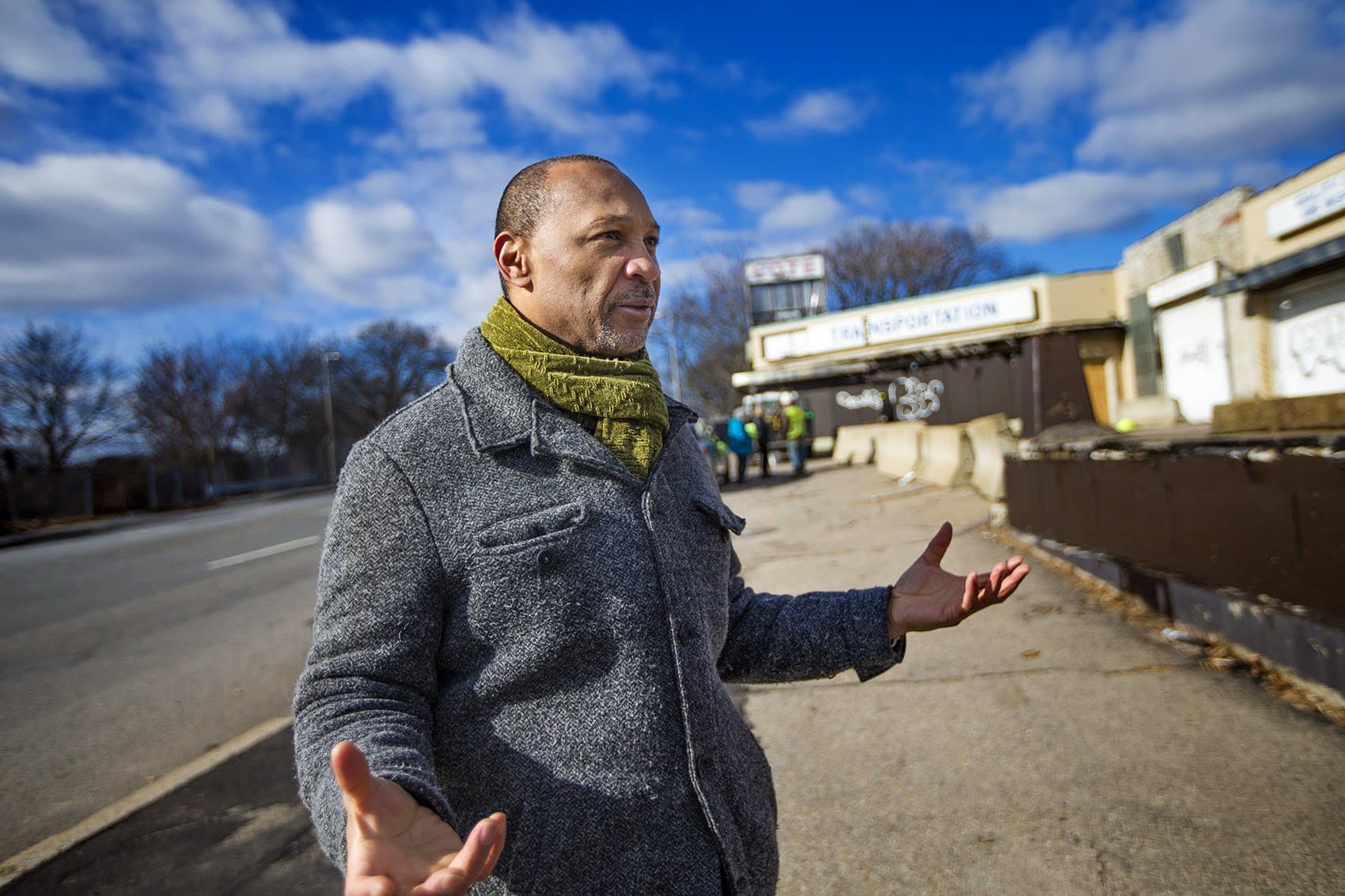
Lincoln Larmond is a development advocate and co-chair of the group Mattapan United. (Jesse Costa/WBUR)

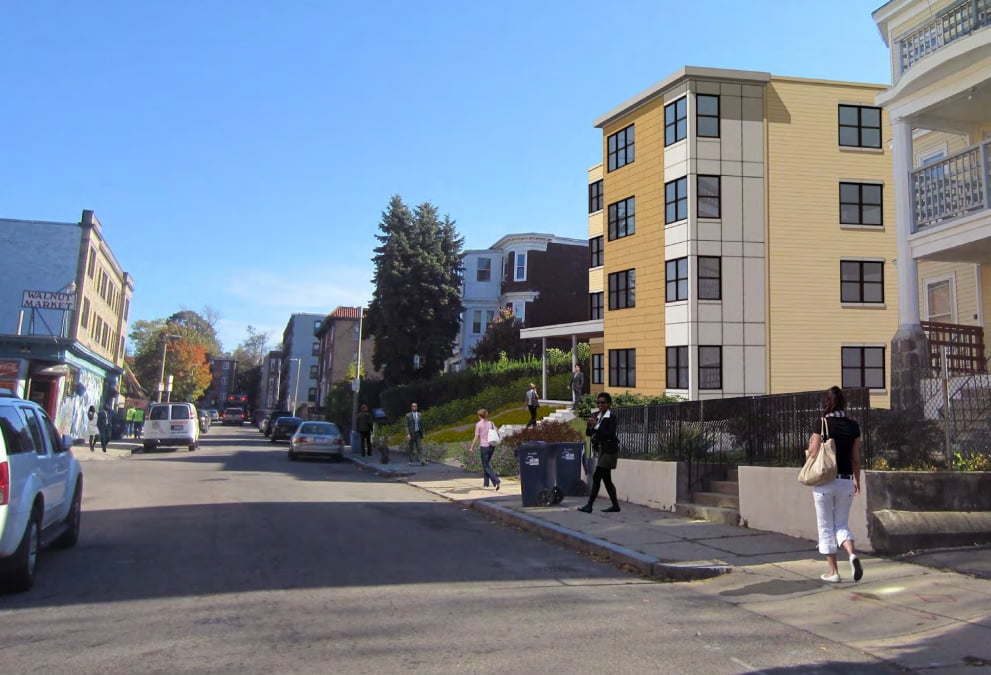
The $28 million Cote Village was the winning bid in the city’s quest to develop the abandoned site. The plan is to build 76 apartments, set aside for families earning a range of incomes, as well as a community area and some commercial space.

A stone’s throw from the development, a new stop on the commuter rail — Blue Hill Avenue Station — is under construction. With the momentum of these two projects, advocates hope more development is spurred in the years ahead.

The Fairmount Line station, which is scheduled to open next year, represents a $17 million investment by the state, and it helped to trigger the redevelopment of the Cote property nearby.

Cote Village was proposed by Caribbean Integration Community Development (CIDC). The group’s Donald Alexis says the project highlights the positives of Mattapan — something rarely captured on the evening news.

“This is a very great community, there’s a lot of diversity, there’s a lot of great activities happening there, but people never talk about it,” Alexis said. “So we seek to create that catalyst to attract people from outside to come shop and dine here.”

A rendering of Cote Village (Courtesy of the Boston Planning and Development Agency)

Alexis notes that Cote Village is Mattapan’s first housing development subsidized by federal tax credits since 2006.

By comparison, federal records show Dorchester has had nine such developments during that period. Dorchester’s population is much larger, but there’s also fewer advocacy groups clamoring for housing dollars.

The Boston Archdiocese’s Planning Office for Urban Affairs is the other developer behind Cote Village. The group’s president, Lisa Alberghini, said it’s clear there has been a lack of investment in Mattapan, but she thinks Cote Village is evidence this is starting to change.

Alberghini said groups like Mattapan United and CIDC are coalescing — and that means “more opportunity for investment.”

“There needs to be local leadership that’s giving the city and the commonwealth an opportunity to work with local partners to make this happen,” Alberghini said.

Some say the lack of investment has left Mattapan struggling to catch up with a booming Boston economy.

The typical family in Mattapan, where more than 80 percent of residents are of African descent, makes $10,000 less than the rest of Boston families, census figures show.
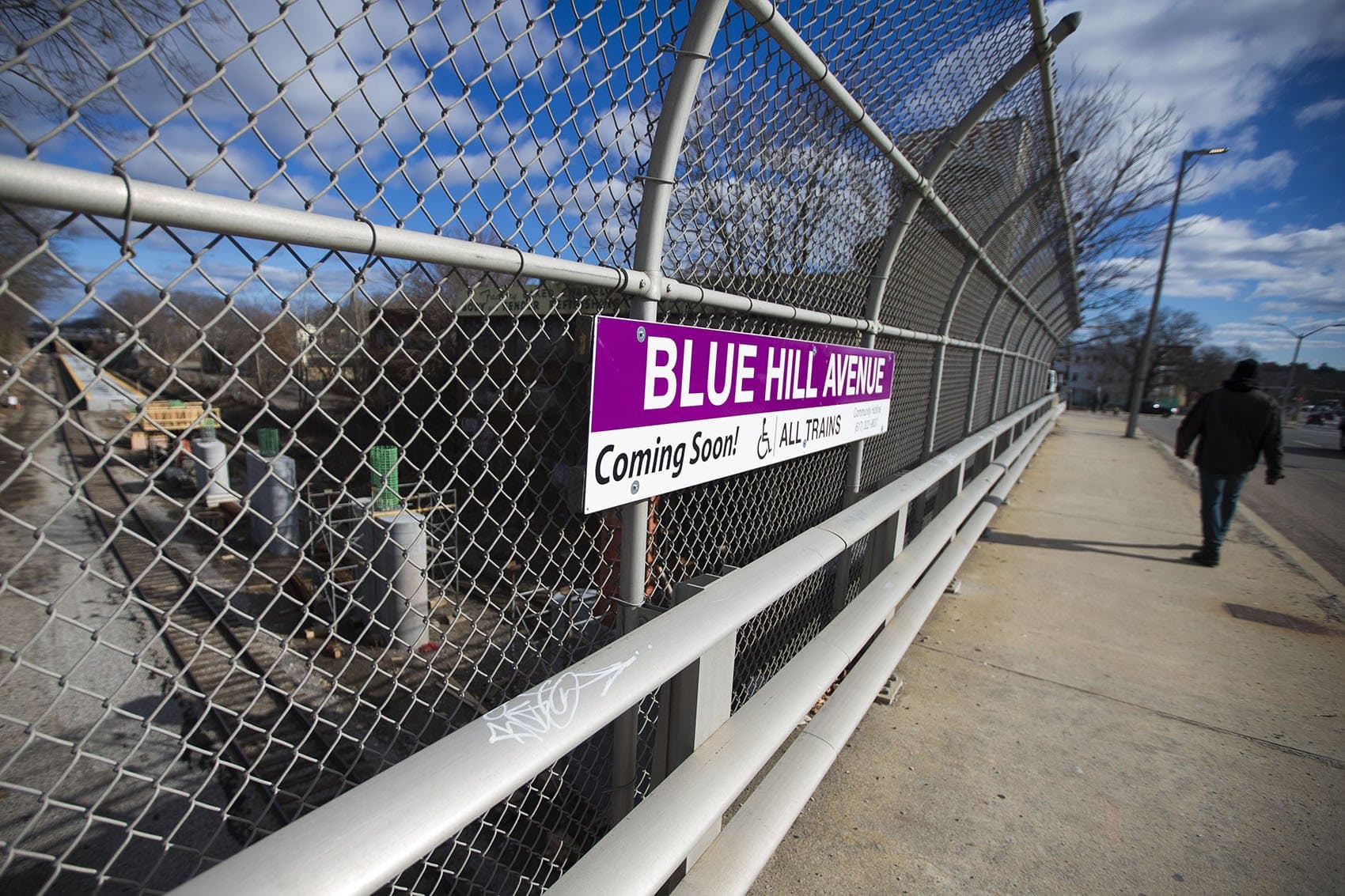
A stone's throw from the Cote development, a new stop on the commuter rail -- Blue Hill Avenue Station -- is under construction. (Jesse Costa/WBUR)
A stone’s throw from the Cote development, a new stop on the commuter rail — Blue Hill Avenue Station — is under construction. (Jesse Costa/WBUR)

Mattapan wants change, but residents like Barbara Fields, an abutter to the Cote site and longtime community advocate, want that change to benefit locals first. They see gentrification in neighborhoods like East Boston and Roxbury as a cautionary tale.

“Mattapan seems to be primed for development right now,” Fields said.

Fields hopes the property can strike a balance between development and the kind of gentrification that leaves residents out in the cold.

“We’re not opposed to development and moving forward,” Fields said, “but we do not want just any kind of development, and we don’t want to change the positive things about Mattapan [like] the fact that we have trees and there is land.”

That means Fields wants less density, and she opposed other proposals for the Cote site that sought more apartments than the 76 units in store for Cote Village. (Fields also opposed the commuter rail station that’s being built behind her house.)

Home values in Mattapan are a third less than the rest of Boston, but Fields said something strange is starting to happen: Calls are coming in from people looking to buy homes in the neighborhood, pressuring her to sell.

Fields doesn’t like what that says about the direction Mattapan is headed.

“The times right now seem to be moving in the benefit of those who want to gentrify for financial purposes,” she said. “And so I think we have to be vigilant and stay on top of it so that the neighborhood does not get hurt by this.”

Field said she’s disappointed that a collaboration fell through between the developers of Cote Village and the Boys & Girls Club of Boston, which was part of the original Cote Village pitch. The club was considering establishing a presence on the Cote site, but both said they were unable to reach an agreement.

Fields still supports the proposal, but without the BGCB presence on the site, she said she might not have testified before the zoning board in favor of the project.

The developers say they continue to search for a partner that can offer preteen services at the Cote site.

Construction on Cote Village is slated to begin this summer, and open 15 months later.

This segment aired on February 8, 2018.

http://www.wbur.org/bostonomix/2018/02/08/mattapan-cote-village
SourceWBUR

Sixteen Lexington affordable housing units locked in for good

Lexington Housing Authority (LHA) is “now the proud owner of five condos at
Pine Grove Village,” according to LHA Executive Director Caileen Foley. Foley
made the announcement at the Dec. 13 Lexington Housing Authority meeting.
The announcement was not sudden, but rather a summing-up of months of
work that went into preventing 16 housing units at Pine Grove Village from
losing their affordable status and reverting to fair market value. LHA’s five newly
acquired units—they officially turned over to the agency on Dec. 1–are rental
properties, while 11 other units made the transition from a co-op to
condominiums. The five rental units, now belong to the Lexington Housing
Authority. They are, and will continue to be, leased to Section 8 voucher holders
and Massachusetts Rental Voucher Program (MVRP) voucher holders.
The latter units are owned outright by those living there. LHA is one of the
trustees on the newly created condo board, according to Foley.
Elizabeth Rust of the Regional Housing Services Office spearheaded the effort,
operating as an agent for the town of Lexington. Pine Grove Village “was
probably one of the first 40Bs in the commonwealth,” Rust said, referring to the
state’s Chapter 40B affordable housing law that lets developers skirt local zoning
regulations in return for the inclusion of a substantial percentage of affordable
units. It was created under the auspices of Massachusetts’ 13A Preservation
Initiative, begun in the 1970s. The program was set up with a 30-year restriction
that expires in 2018, Rust said, meaning that a chunk of Massachusetts’
affordable housing, Pine Grove Village included, stands to revert to market value
next year.
Project used CPA funds
Sixteen Lexington aordable
housing units
locked in for good
The town of Lexington, LHA, MassHousing and co-op (now condo) residents
worked together to make sure that wouldn’t happen. They used just over $1
million in Community Preservation Act (CPA) funds approved with the passage
of a 2017 annual Town Meeting article to fund the necessary shifts. Worried by
the prospect of losing their affordable housing, co-op residents initially
approached the town in May 2016, according to Rust. Those residents and the
town initially disagreed on how to proceed, ultimately concluding that it would
be better to forge ahead together to find a mutually agreeable solution, rather
than head to litigation, she explained.
In the end, they did, after much “work toward a common, beneficial solution for
all parties,” Rust said. “In the end, everyone had the same goal.”
The conversion of the co-op into 11 condominiums was a key component. The
key change for the five rental units is that they’re now owned by LHA.
“We’re excited for the opportunity,” Foley said in an interview after the meeting.
“It was fun to work with the town, and get it done so quickly.”
Units now affordable forever
The town contributed money to the conversion, and in return received a
“perpetual deed restriction restricting the resale of the units,” Rust said.
This deed restriction is different from that instituted under 13A. Now, “there’s
no risk of losing them, or having to do this again,” Rust said of the housing.
“They’re properly secured from the affordable housing perspective.”
It took many steps to get to this point, in what was an unusually involved
process, due to several factors. For one thing, the co-op was “a nontraditional,
nonstandard set-up,” Rust said. Moreover, the work had to be done not only for
rental properties, but for owned properties as well, and “there was a capital needs
study done, and analysis,” she explained.
“Each one was a standard piece, but it was a project that brought all pieces
together,” in an unusual way, Rust added.
The journey from potential litigation to preserving 16 affordable housing units
in a community with still-rising property values “shows that the town is really
committed to preserving its affordable housing,” Rust said. “The town was
proactive and cooperative and supportive. No one got the better deal or outdid
each other.”

http://lexington.wickedlocal.com/news/20171215/sixteen-lexington-affordable-housing-units-locked-in-for-good

SourceWicked Local Lexington

Multifamily Developer Breaks Ground On ‘Lean’ Pilot Project

Egleston Square

Boston-based developer Urban Edge Housing Corp. broke ground Friday on the Walker Park apartments, a 49-unit, $17.5 million affordable rental housing complex in Roxbury’s Egleston Square.

Urban Edge is redeveloping three vacant parcels next to the Egleston Square Library into apartments restricted to households earning a maximum of 60 percent of the area median income (AMI), including eight units reserved for families earning no more than 30 percent of AMI.

The development is being built under the city’s Lean Pilot Project, which is designed to cut construction costs through coordination between the developer, architect and city officials from the early stages of the design process. Nearly 50 percent of the project’s subcontractors are minority-owned businesses and more than 22 percent are women-owned enterprises.

Financing for the project included $2.6 million from the city’s Department of Neighborhood Development and $3.46 million in state and federal Low Income Housing Tax Credits from the Massachusetts Department of Housing and Community Development.

Financing team members also include Bank of America Merrill Lynch, Brookline Bank, the Community Economic Development Assistance Corp., MassDevelopment, MassHousing, Massachusetts Housing Investment Corp., Massachusetts Housing Partnership, US Bank Corp., and the U.S. Department of Housing and Urban Development.

The development is named for the late community activist Delphine Walker, whose home previously occupied one of the parcels. Walker Park Apartments will include 13 one-bedroom, 28 two-bedroom and eight three-bedroom family apartments, an elevator for accessibility, on-site laundry facilities, on-site parking and a pocket park along Columbus Avenue.

Along with Urban Edge, the development team includes Prellwitz Chilinski Assoc. as architect and NEI General Contracting, Inc. as the general contractor.


Multifamily Developer Breaks Ground On ‘Lean’ Pilot Project

SourceBanker & Tradesman

Boston to Help Affordable Housing Developers Rethink Vacant Lots

In a market where buildable land goes quickly to private developers paying cash — or investors who sit on the property and wait for its value to rise — nonprofit builders are at a definite disadvantage. Boston Mayor Marty Walsh wants to level that building field, and his administration has announced an $8.5 million program designed to help nonprofits acquire parcels for affordable housing.

The city plans to contribute $2.5 million to the loan fund, with $6 million coming from the Community Economic Development Assistance Corporation and the Local Initiatives Support Corporation, the Boston Globe reports. The program is aimed at underutilized chunks of neighborhood around Boston close to public transportation.

“If you can buy an unused parking lot in, say, Egleston Square for $1 million and put a 40- or 50-unit building on it, that’s kind of the sweet spot,” Sheila Dillon, chief of housing for Mayor Walsh, told the Globe. “We need to take things out of the speculative market.”

The program is similar to another one that the city announced last year to help nonprofits buy apartment buildings. According to the Globe, results of that program have been mixed with some success in East Boston and Roslindale. But in other neighborhoods, the money offered hasn’t gone far enough.

Like other cities struggling with the many flip sides of a hot housing market — skyrocketing rents, displacement, homelessness — Boston has gotten creative in the last few years. In 2016, voters chose to adopt the Massachusetts state Community Preservation Act (CPA), which allows municipalities to add a small surcharge to their property taxes to fund affordable housing, open space acquisition and historic preservation. As Next City has reported, the city had previously opted out of the agreement, under which the state can match local dollars by up to 30 percent.

Walsh has also made housing a legislative priority, promising to address the city’s housing shortage by building 53,000 new homes by 2030, although questions remain about how he plans to go about doing that without causing displacement — a worry that’s especially prevalent in black communities like Dudley Square.

https://nextcity.org/daily/entry/news-boston-affordable-housing-developers-rethink-vacant-lots

SourceNext City

City, nonprofits turn focus on affordable housing

It’s no secret to agents, buyers and sellers in Boston that the city’s housing market is hot — sometimes a little too hot. With scarce inventory and increasing prices, many people find themselves sitting on the sidelines, unable to afford homes of their own.

To level the playing field, Mayor Martin J. Walsh recently announced the Vacant Site Acquisition Fund, which will help nonprofit developers acquire plots of underutilized land and buildings around the city.

Under the plan, affordable housing developers will be able to apply for loans to acquire such properties. The $8.5 million includes $2.5 million from the city and $6 million from the Community Economic Development Assistance Corporation and the Local Initiatives Support Corporation.

“Addressing rising housing costs is necessary for preserving the diversity and character that makes Boston a place where all residents can thrive; so we need to continue to think innovatively about ways to give Boston residents more affordable housing options,” Walsh said in a statement. “As our neighborhoods develop and change, it is vital that our nonprofit partners are able to compete in today’s real estate market to acquire developable sites.”
Besides acquisition of land with longer terms, the VSAF also has two other functions — it will offer short-term bridge loans to help developers put down deposits on land and loans of up to $300,000 at no interest to help developers hold properties for three to five years.
Property owners who take advantage of the program are required to maintain the tenancy of residents in good standing and to maintain affordable prices for at least 50 years.
https://bostonagentmagazine.com/2017/10/03/city-nonprofits-turn-focus-affordable-housing/

SourceBoston Agent Magazine

CEDAC provides predevelopment loans to housing in Lexington

The Community Economic Development Assistance Corporation approved $341,500 in predevelopment financing to Pine Grove Village Inc. and Women’s Institute Realty Inc. for the preservation and production of affordable housing, respectively.

In Lexington, Pine Grove Village Inc. received a $130,000 predevelopment loan commitment from CEDAC for the preservation of Pine Grove Village, an existing resident-owned cooperative development. Originally constructed in 1976 with an affordability restriction, the coop residence requires five of the 16 units to be affordable to low-income families, with the remaining units affordable to moderate-income families.

Pine Grove Village Inc. will convert the 11 moderate income units to condominium ownership and transfer the five low-income condo units to the Lexington Housing Authority. New affordability restrictions will be established for the 16 units for 40 additional years under an innovative preservation plan.

For information: https://cedac.org.

http://lexington.wickedlocal.com/news/20171003/strongcedac-provides-predevelopment-loans-to-housing-in-lexington-strong

SourceWicked Local Lexington

Mayor Walsh Announces Vacant Site Acquisition Fund for Affordable Housing

Boston Mayor Martin J. Walsh, along with partners Community Economic Development Assistance Corporation (CEDAC) and the Local Initiatives Support Corporation (LISC), announced the creation of the Vacant Site Acquisition Fund, which will provide new financing options for nonprofit developers to acquire vacant and underutilized land and buildings for affordable housing development.

Using a $2.5 million investment from City funding to leverage $6 million in private funding provided by CEDAC and LISC, the Vacant Site Acquisition program is a critical part of the City’s anti-displacement strategy, and is designed to help nonprofit developers compete in Boston’s real estate market.

 MAYOR WALSH

“Addressing rising housing costs is necessary for preserving the diversity and character that makes Boston a place where all residents can thrive; so we need to continue to think innovatively about ways to give Boston residents more affordable housing options,” said Mayor Walsh. “The Vacant Site Acquisition Program is another important tool in our affordable housing strategy. As our neighborhoods develop and change, it is vital that our nonprofit partners are able to compete in today’s real estate market to acquire developable sites. Boston is lucky to have strong lending partners like CEDAC and LISC who are joining us in fighting displacement by making housing more affordable to neighborhood residents.”

The Vacant Site Acquisition Fund establishes a pilot fund of more than $8 million to provide nonprofit developers with financing to acquire vacant land and underutilized buildings appropriate for the development of mixed income, multi-family housing. The program is a direct result of feedback from Boston’s affordable housing advocates and nonprofit partners, as the nonprofit development community needs the resources and tools to gain control of sites, and to help to preserve affordability in rapidly-changing neighborhoods. The program’s focus on acquiring eligible sites enables nonprofit developers to better compete in the market.

“CEDAC is pleased to partner with the City of Boston and LISC Boston to provide more opportunities for affordable housing development in Boston,” said Roger Herzog, the executive director of the Community Economic Development Assistance Corporation. “Under Mayor Walsh’s leadership, the City is taking action to help nonprofit developers successfully compete for developable land and we look forward to implementing this innovative strategy.”

“When the real estate market heats up, community-based developers of affordable housing can be priced out,” said LISC Boston Executive Director Bob Van Meter. “This tool helps them purchase vacant sites to create affordable homes where they are needed most.”

The Vacant Site Acquisition Fund has three components:

  • Site Deposit Assistance: The City is providing short-term bridge loans up to $200,000 at no interest to assist nonprofit developers in putting deposits on potential acquisition sites.
  • Acquisition Fund: A combined $8 million fund, using money contributed by the City, CEDAC, and LISC, will provide quick approval for low interest rate acquisition financing with longer terms to acquire sites and plan for future development.
  • Holding Cost Assistance: The City is providing up to $300,000 at no interest to provide loans that will help defray the cost to developers of holding property for a three to five year period. This funding is necessary because affordable housing can take longer to produce than market-rate housing due to the complexity of funding structures.

The City of Boston, CEDAC, and LISC have adopted a streamlined approval process so nonprofit developers can better compete in the private market. The day-to-day operations of the fund, including screening and selection of applications, will be overseen and managed by CEDAC.

The Vacant Site Acquisition Program is part of the Walsh Administration’s strategy to combat displacement and builds on the foundation of the City’s Acquisition Opportunity Program. The Acquisition Opportunity Program earmarked $7.5 million of Inclusionary Development funds to help responsible investor-owners acquire occupied, multi-family rental properties. Property owners assisted through the program are required to maintain the tenancies of residents in good standing and are also required to maintain affordable rent levels for the units in the property for a minimum of 50 years.

In addition, the City’s efforts to combat displacement and address rapidly changing neighborhoods included the launch of Boston’s first Office of Housing Stability, which provides residents no-cost, one-on-one assistance with issues around tenancy, and Mayor Walsh’s filing of a five-bill anti-displacement legislative package to help existing tenants remain in their home by expanding tenants’ rights, rewarding good landlords, and creating additional funding for affordable housing.


Today’s announcement ties into Imagine Boston 2030, Boston’s Citywide plan, which aims to proactively encourage a broad range of housing growth for people of all income levels and stages of life. For more information on Imagine Boston 2030, please visit imagine.boston.gov.

Applications for the Vacant Site Acquisition Fund are currently available, and can be submitted via CEDAC’s web site.

Mayor Walsh Announces Vacant Site Acquisition Fund for Affordable Housing

SourceBoston Real Estate Times

Housing Bond Bill Advances Reauthorizations of Community Investment Tax Credit and Early Education and Out-of-School-Time Capital Fund

United Way praised the Joint Committee on Housing for including two key provisions in the Housing Bond Bill that advanced today on Beacon Hill that would strengthen neighborhoods and early education programs.  The Housing Bond Bill, a comprehensive package aimed at helping more individuals and families secure safe, affordable housing, included reauthorizations of two successful programs: the Community Investment Tax Credit and the Early Education and Out of School Time Capital Fund.

“The legislation reported out favorably today by the Joint Committee on Housing recognizes the comprehensive approach needed to ensure neighborhoods and communities thrive,” said Michael K. Durkin, President and CEO at United Way of Massachusetts Bay and Merrimack Valley. “More affordable housing is critical, but communities also need high-quality affordable child care and healthy economies. Reauthorization of the Community Investment Tax Credit and the EEOST Capital Fund are positive steps toward advancing economic and neighborhood development in low-income communities.”

The Early Education and Out of School Time Capital Fund (EEOST) program is a unique source of funding for early education and care and afterschool programs throughout the Commonwealth. It supports major renovation and construction projects for facilities serving low-income children. Since the passage of the Housing Bond Bill in 2013, legislation that included a $45 million bond authorization to create the fund to improve the quality of center-based facilities, the EEOST Capital Fund has distributed over $15 million to help organizations modernize their space and improve the quality of the learning environments for children.

“The Commonwealth needs an improved and expanded supply of facilities to meet the demands of families across the state who are looking for convenient, high quality centers for their children,” said Durkin. “High quality, professional facilities, projects that better utilize existing facilities, and those that add additional space for planning and professional development, will allow the Commonwealth to best compete and retain top tier educators.”

The Housing Bond Bill reported out today also includes reauthorization of the Community Investment Tax Credit, which provides a 50% state tax credit for private donations to support the work of community development corporations across Massachusetts.  Since the program’s inception in 2014, United Way has raised over $4 million from donors to support CDCs across the state through the Community Investment Tax Credit (CITC). Nearly $24 million has been raised to support CDCs statewide.

“Every day, in neighborhoods and cities across the Commonwealth, Community Development Corporations (CDCs) are working hard to spur affordable housing and job creation, incubate small businesses and revitalize neighborhoods,” Durkin said. “CDC’s are an important source of innovation. The CITC Program is helping to greatly accelerate and deepen their work, as well as provide new and sustainable sources of funding.”

The Housing Bond bill will now advance to the House Committee on Bonding.

https://unitedwaymassbay.org/news/housing-bond-bill-advances-reauthorizations-of-community-investment-tax-credit-and-early-education-and-out-of-school-time-capital-fund/

SourceUnited Way of Massachusetts Bay and Merrimack Valley

Dedication ceremony for Agawam ‘Soldier On’ facility brings hope and homes to vets (photos)

Soldier On, the Pittsfield-based nonprofit dedicated to ending veteran homelessness by providing permanent, supportive, sustainable housing, held a dedication ceremony Monday afternoon at the Gordon H. Mansfield Veterans Community facility, 702 South Westfield St., in the Feeding Hills section of Agawam.

The former Western Massachusetts Regional Police Academy has been transformed into affordable housing for 51 veterans, including 49 partially furnished units in the renovated academy and two units in a new annex to the building.

U.S. Rep. Richard E. Neal, D-Springfield, Agawam City Council President James P. Cichetti, and state Secretary of Housing and Economic Development Jay Ash were among those who spoke at the dedication ceremony.

In the absence of Agawam Mayor Richard A. Cohen, who was traveling back from Boston at the time of the event, Cichetti welcomed the large crowd of dignitaries to Agawam for the ceremony, including veterans and local and state officials.

“On behalf of the City of Agawam, welcome home,” Cichetti, who’s running for mayor, said to the veterans. The candidate praised former state Rep. Rosemary Sandlin for getting the legislative process rolling.

Ash credited Congressman Neal for his ability to get things done for his constituents in Western Massachusetts. “Richie Neal is legendary for delivering things back home to his district,” Ash said.

Ash spoke on behalf of Gov. Charlie Baker, saying nobody who ever wore a U.S. military uniform “should ever struggle to find a place to live.”

State Sen. Donald F. Humason Jr., R-Westfield, state Rep. Nicholas A. Boldyga, R-Southwick, and state Secretary of Veterans’ Services Francisco A. Urena were among the many officials in attendance.

When it was Neal’s turn to speak, he said the dedication of the new facility marked a “great day for Agawam and a great day for Soldier On.” Neal, dean of the state’s congressional delegation in Washington, praised Agawam officials for making the necessary zoning changes to accommodate and support the project.

Linda Mansfield, a member of the Soldier On Board of Directors and wife of the late Gordon H. Mansfield, whom the building is named for, was also on hand.

Gordon Mansfield, a former deputy secretary of Veterans Affairs, was a Pittsfield native and highly decorated Army veteran who survived two tours of duty in Vietnam. As company commander of the 101st Airborne Division, Mansfield sustained a spinal cord injury during the 1968 Tet Offensive, for which he received the Distinguished Service Cross — the second-highest personal decoration for valor in combat.

In July 2010, the former police academy building was transferred to Soldier On through state legislation, allowing for the development of permanent affordable housing for veterans at the Agawam site.

The Agawam project was approved in 2015, with construction beginning in March 2016. The roughly $14 million project was financed through state and federal historic tax credits, in partnership with companies such as Citizens Bank and the Stratford Capital Group.

Soldier On staff will be on site to provide daily support to veterans. The organization also has facilities in Pittsfield, Northampton and Chicopee.

http://www.masslive.com/news/index.ssf/2017/09/dedication_ceremony_for_soldie.html

SourceMassLive.com

Four Corners toasts new apartments on Washington Street

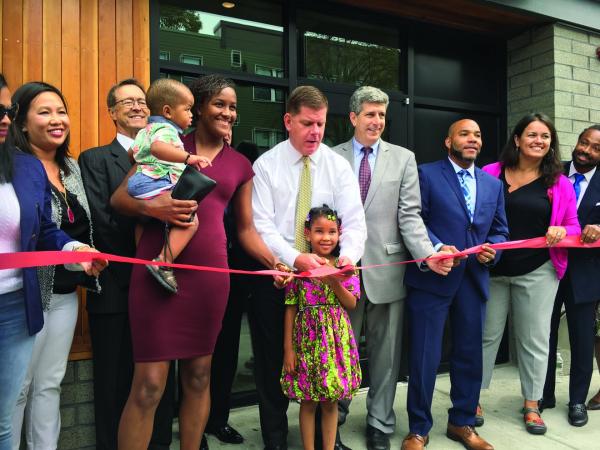
Officials and Four Corners residents celebrated the new Upper Washington buildings, which includes 35 income-restricted apartments and two commercial spaces on Washington Street, at a ribbon-cutting ceremony on Tuesday.

The Vietnamese American Initiative for Development (VietAID) helmed the $15.3 million project. Its management team was joined at the ceremony by Mayor Martin Walsh, Trinity Management, the Massachusetts Department of Housing and Community Development, and other local and state officials.

Since its inception, VietAID has created 88 affordable housing units in four Fields Corner projects, and “we’ve had a successful track record in transforming and improving neighborhoods,” said Kim Thai, president of the organization’s board of directors. “The time, effort and struggles from conception to construction,” he added, “are all well worth the joy and happiness that we witness when new tenants move in.”

Dione Teixeira, 26, drove by the Upper Washington apartments every day while they were under construction, going to and from a small basement she shared with her husband. “I used to say, ‘God, this is my home. It’s not ready yet, but this is my home,’” she said.

She choked back tears on Tuesday next to her new home on Washington Street, where they live with their one-year-old son. “Every day I used to say, ‘God, how am I going to raise my son in this little room?’ And I had my husband also,” she said. “And we used to live there but we never gave up.”

Teixeira and her mother came to Boston from Cape Verde 11 years ago. Her mother dreamed of a new house and Teixeira hoped to build a life for herself. After applications and waiting out the housing lottery, she got the call she had been waiting for – she made it, and so did her mother.

“I don’t know how to explain how happy I am,” she said, welling up. “I don’t know how to say how happy it is to see my mom smile, with her own home. Now she calls it home, and I call it home, too.”

Four Corners Main Streets and the new Four Corners Yoga & Wellness will be the commercial tenants in the complex. The artist Iris DuPont presented artwork inspired by the elements to hang inside the community space.

The project — income restricted for those making under 60 percent area median income — includes 5 one-bedroom, 21 two-bedroom, and 9 three-bedroom units.

“Mixed-use development is an important strategy for establishing and maintaining vitality in today’s neighborhoods,” Thai said, noting that VietAID has had “great success” with 1392 and 1460 Dorchester Ave. and that the organization hopes to replicate that experience with the Upper Washington apartments.

Nine of the units are set aside for formerly homeless families. “That’s something that’s really important for us as a city,” the mayor said. “We’ve housed over 1,100 chronically homeless people in the city of Boston over the last three years. We’ve been able to do it because of projects like this, because projects set aside some apartments and then wrap-around services.”

Upper Washington’s Four Corners location benefits from a nearby health center and a supermarket next door, Walsh noted, along with other resources.

“For three decades, a lot of the lots that we see on Washington Street have been sitting vacant,” he said. “Now we see a lot of mixed-use development happening and bringing these lots to life.”

Upper Washington was funded by the City of Boston and the Massachusetts Department of Housing and Community Development (DHCD), and by tax credit equity provided by RBC Capital Markets. The project architect was Utile and the general contractor was Nauset Construction.

Susan Terry, assistant undersecretary at DHCD, said Gov. Charlie Baker’s $1.287 billion affordable housing bond bill will bolster just this type of project if approved by the legislature.

“We believe we’re most effective when we’re partnering with communities and supporting development that’s bubbling up on the local level,” she said. “This project is a prime example of that kind of community-driven development. And as someone who’s originally from Dorchester, I’m not surprised that the Dorchester community was able to come together and create a project like this that brings work, that brings housing, and that creates a strong community. A place that can keep the tradition of Dorchester alive.”

http://www.dotnews.com/2017/four-corners-toasts-new-apartments-washington-street

SourceDorchester Reporter