

At its December 17 meeting, the Boston Planning and Development Agency voted to acquire 104-108 Walter St. in Roslindale, a property that has been a conservation priority for neighbors for decades because it abuts the Roslindale Wetlands Urban Wild and absorbs stormwater runoff from throughout the area. The BPDA action paves the way to take this property off the market for private development and represents a step toward conserving 108 Walter St. as open space – one of Boston’s top five priority land acquisition sites – as well as creating four units of affordable ownership housing at 104 Walter.
Stormwater runoff management has become increasingly important as climate change brings more heavy and intense storms. Climate concerns and development pressures galvanized a group of neighbors and abutters who have worked with city and state officials to advocate for the acquisition of 108 Walter Street, a 37,000 square foot parcel that would be appended to the 9.5-acre Roslindale Wetlands Urban Wild. As part of their efforts, Roslindale Wetlands advocates joined with neighborhood groups from around the city to support the passage of Boston’s local wetlands ordinance in December 2019.
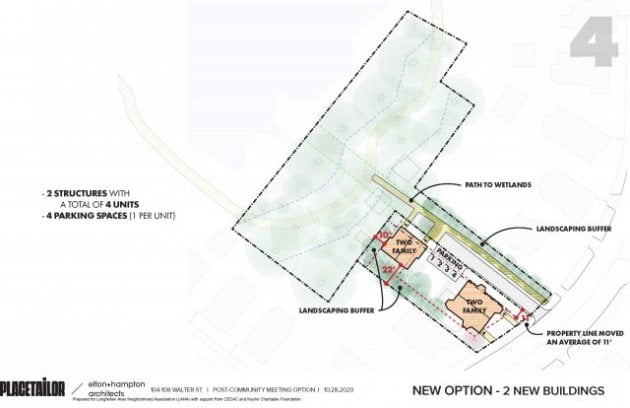
The second part of the community’s vision for the future of these parcels is to create four units of affordable ownership housing at 104 Walter Street. The housing component will advance equity and inclusion in an increasingly expensive neighborhood.
In a parallel project, the city is investing $500,000 in capital improvements elsewhere in the Roslindale Wetlands Urban Wild, such as wetlands crossings, trail upgrades, removing piles of dumped construction debris, and other ecological restoration work. These planned improvements increased the imperative of adding 108 Walter to the conservation area.
In November, the city received a $387,000 grant from the Commonwealth to help pay for the purchase of 104 and 108 Walter, which were offered for sale jointly. The Longfellow Area Neighborhood Association (LANA) received a planning grant and hired architectural firm PlaceTailor Design to work with neighbors during two October workshops. A preferred site plan was developed for affordable home ownership opportunities and open space conservation for climate resiliency. The resulting consensus proposal makes possible the preservation of 108 Walter Street, which is closest to the wetlands boundary and the most ecologically sensitive, and proposes four units of affordable ownership housing at 104 Walter, which has already been developed and now includes a single-family house and a dilapidated barn.
Following the BPDA vote, a closing to effect the purchase is expected before the end of the year, after which the agency will transfer most of the 108 Walter Street parcel to the Boston Conservation Commission for permanent protection and stewardship.
The Roslindale Wetlands Task Force and Longfellow Area Neighborhood Association expressed thanks to the elected officials who supported the project, especially Mayor Marty Walsh, City Councilors Ricardo Arroyo, Andrea Campbell, Annissa Essaibi-George, Matt O’Malley, and Michelle Wu; State Representatives Nika Elugardo and Ed Coppinger; and State Senator Mike Rush. CEDAC (Community Economic Development Assistance Corporation) and the Kuehn Charitable Foundation provided assistance with a planning grant to LANA.
More information about the consensus vision for the property, developed during the two October workshops, is available at www.LongfellowArea.org and www.RoslindaleWetlands.org.