Lt. Governor Announces State Grants for Child Care Centers in East Boston
Last Tuesday afternoon, Lt. Gov. Karyn Polito and Early Education and Care Commissioner Samantha Aigner-Treworgy stopped by the East Boston Social Centers (EBSC) in Central Square for a tour, and to announce $7.5 million in Early Education and Out of School Time Capital Fund (EEOST) capital improvement grants to 36 organizations to renovate childcare facilities that serve primarily low-income families like EBSC.
Polito said the Baker-Polito Administration teamed up with the Children’s Investment Fund (CIF) and its affiliate the Community Economic Development Assistance Corporation (CEDAC) for the $227,000 in grant money towards the Social Centers. EBSC and the other thirty-five recipients all received grants between $100,000 to $250,000 to provide capital funding needed to address health and safety concerns related to COVID-19.
“These awards announced today – which mark the largest total amount awarded since the inception of the EEOST grants – will improve child care programs across the state,” said Polito last week at the Social Centers. “Now more than ever, as families return to workplaces, investments in early education and care settings are vital to provide necessary resources to children and their families through high-quality early childhood education and out-of-school time programs.”
The capital grants will help continue to support major renovation and construction projects at EBSC and improve the quality of learning environments for the over 300 children they serve.
The Social Centers previously received an EEOST grant last July and EBSC Executive Director Justin Pasquariello was excited to show Polito how the previous round of funding helped improve the Social Centers’ facilities. He also thanked the Lieutenant Governor for continuing to support EBSC’s capital improvements with the latest round of funding.
“We at the East Boston Social Centers were honored to host Lt. Gov. Karyn Polito and EEC Commissioner Samantha Aigner-Treworgy for a tour of our early education and school age programs,” said Pasquariello. “We were grateful to show them the high-quality, safe facilities the EEOST grant has funded at the East Boston Social Centers. The Commonwealth’s recognition of the increased cost of providing high-quality, safe care during the COVID pandemic has been essential for our ability to be fully open for early education, school age programs, and full-day in-person remote learning support from July 2020. Their investments in our facilities, commitment to paying parent fees, additional grants, and investments in our workforce are critical as our essential sector continues to meet the needs of children and families across the commonwealth.”
The Early Education and Out of School Time capital improvement grants are financed through the state’s capital budget and provide matching funds that leverage private investment. More than $200 million in public and private investments have been leveraged throughout the life of the grant program. The Baker-Polito Administration’s FY21 Capital Budget Plan included funding for the Early Education and Out of School Time capital improvement grant program.
“Every child deserves the opportunity to learn in high-quality, safe, healthy, and joyous education environments,” said Commissioner Aigner-Treworgy at last week’s event. “Well-designed classrooms and play spaces can greatly enhance early learning and support children to grow and thrive.”
In a statement after the event Gov. Charlie Baker said his administration is committed to supporting childcare providers like the Social Centers who have worked tirelessly throughout the COVID-19 pandemic to care for children and support families returning to work.
“Since the start of this grant program, we’ve invested more than $39.2 million in capital funding at childcare programs that impact the learning experiences of more than 9,000 children in communities across Massachusetts,” he said.
SourceEast Boston Times- Free Press
Baker-Polito Administration Awards $6 Million for Early Education Programs
The Baker-Polito Administration and the Community Economic Development Assistance Corporation (CEDAC) today announced $6 million in grant awards for facility improvements at early education and care programs that serve low-income children. Six agencies were selected to receive an Early Education and Out of School Time (EEOST) capital improvement grant, which will help increase the quality of their early education programs through critical facility repairs and renovations.
Early Education and Care Commissioner Samantha Aigner-Treworgy made the announcement at YMCA Cape Cod in Hyannis, the site of one of the facilities funded by the 2019 grant awards.
“Our administration is pleased to support facility improvements at early education and care programs throughout the Commonwealth to provide families with the resources necessary for success in and out of the classroom,” said Governor Charlie Baker. “Renovating and repairing child care facilities helps achieve the administration’s goal of providing quality early education and care in all Massachusetts communities.”
“Since taking office, we have provided over $25 million in funding to 31 non-profit agencies operating licensed child care programs,” said Lt. Governor Karyn Polito. “These critical investments provide safer environments for children to learn in, while providing educators with modernized facilities.”
“These grants were created to help non-profit providers serving children in low-income communities improve their facilities because we know that building deficiencies impact the quality of teaching and learning in early childhood,” said Education Secretary James Peyser.
The Early Education and Out of School Time capital improvement grants are financed through the state’s capital budget and provide matching funds that leverage private investment. The Baker-Polito Administration’s FY19 Capital Budget Plan included funding for the Early Education and Out of School Time capital improvement grant program.
“Well-designed buildings, classrooms and play spaces help provide high-quality learning environments in which children grow and thrive,” said Early Education and Care Commissioner Samantha Aigner-Treworgy. “The $6 million in grant awards this year — the highest amount since the EEOST Capital Fund inception — will support better program settings for over 700 children across the state.”
“All children deserve to learn in enriching environments and their teachers deserve well-equipped facilities,” said Theresa Jordan, Director of Children’s Facilities Finance, CEDAC Children’s Investment Fund. “The EEOST Capital Fund is creating those environments across the Commonwealth and leveraging additional resources in support of high-quality early childhood education and out-of-school time.”
The following organizations received grants:
Lead Agency
Service Area
Award
Cape Ann YMCA/YMCA of North Shore, Inc.
Gloucester
$1,000,000
Greater Lawrence Community Action Council
Lawrence
$1,000,000
Greater Lowell Family YMCA, Inc.
Lowell
$1,000,000
Horizons for Homeless Children, Inc.
Boston
$1,000,000
YMCA of Cape Cod, Inc.
Cape and Islands
$1,000,000
YWCA of Central Massachusetts
Greater Worcester
$1,000,000
“We are so honored to be selected for this transformational funding since Hyannis demonstrates an incredible need for high quality and affordable child care options,” said YMCA Cape Cod President and CEO, Stacie Peugh. “This new early education center located in the heart of downtown Hyannis will offer a state-of-the-art environment with optimal learning opportunities for children led by loving early childhood professionals. The YMCA Cape Cod is thankful for the investment in our children’s future.”
All of the programs selected to receive a grant award serve publicly-subsidized families, have demonstrated financial need and have secured additional funding to pay for a portion of their project costs. The Department of Early Education and Care partnered with CEDAC’s affiliate, the Children’s Investment Fund, to administer the grants. All of the grantees are non-profit corporations or organizations in which a non-profit corporation has a controlling interest.
###
SourceDepartment of Early Education and Care, Executive Office of Education
Baker-Polito Administration Announces $1.73 Million to Support Energy Efficient Affordable Housing
The Baker-Polito Administration today announced $1.73 million in awards to support energy efficient new construction for affordable housing developments in six cities and towns built to Passive House standards. The grants, awarded to eight affordable housing developments in Cambridge, Gloucester, Hanson, Northampton, Holbrook and Boston totaling 540 high-efficiency units, provide energy savings and improved indoor air quality for low-income households. The announcement was made by state and local officials at the Old Colony Housing Development in South Boston.
“Massachusetts is proud to lead the nation in energy efficiency, which helps to reduce energy use and cut greenhouse gas emissions which in turn promotes cost savings for residents and businesses,” said Governor Charlie Baker. “Our administration is committed to supporting the development of additional affordable housing, and by embracing innovative design to maximize efficiency we can provide quality housing solutions for residents while reducing carbon emissions.”
“Our Administration is committed to helping Massachusetts’ low-income households reduce energy costs while creating better, more affordable housing options,” said Lieutenant Governor Karyn Polito. “Passive House standards offer one of the best options to promote high efficiency housing solutions for families, and better position the Commonwealth to extend energy efficiency benefits of the homes to families in cities and towns across the state.”
The funding was awarded through the Massachusetts Clean Energy Center’s Passive House Design Challenge program, part of the Baker-Polito Administration’s $15 million Affordable Access for Clean and Efficient Energy (AACEE) initiative. The program seeks to demonstrate that multi-family affordable housing can be built to high efficiency Passive House standards in Massachusetts at a low-to-no cost premium.
Passive House is a green building certification that ensures extremely high levels of energy efficiency and the provision of fresh air for ventilation. Multi-family buildings built to the Passive House standard generally use 40% less total energy than energy stretch code-compliant buildings. The annual energy use of 8-12 Passive House multi-family apartments is roughly equivalent to the average existing single-family suburban home in Massachusetts. The Passive House energy efficiency standard ensures new buildings are built with high levels of insulation and air tightness, generous provision of fresh air with heat recovery for ventilation, and better windows than would normally be required.
“Building to energy-efficient Passive House standards is the first step in ensuring buildings are on a path to becoming net-zero,” said Energy and Environmental Affairs Kathleen Theoharides. “To meet Massachusetts’ 2050 greenhouse gas reduction goals, energy efficiency is new construction must continue to be promoted, and it is great to see affordable housing leading the way for the Commonwealth.”
“Passive House buildings are more efficient, durable, healthy, and resilient than typical buildings,” said MassCEC CEO Stephen Pike. “Through these projects, the Commonwealth is supporting better housing for low-income families and reducing greenhouse gas emissions in our most vulnerable neighborhoods.”
“The Passive House Design Challenge program is one of the many innovative ideas in the Commonwealth that contributes to moving us forward in achieving our shared clean energy and emission reduction goals,” said Department of Energy Resources Commissioner Judith Judson. “This program coupled with our new Mass Save incentives for Passive House go a long way towards enabling deep energy efficiency.”
“As we work to build more affordable housing throughout the state to meet our current crisis, it is vital we build high-quality, future-proofed housing that takes current and future energy needs into account,” said Housing and Community Development Undersecretary Janelle Chan. “Today’s awards will advance eight affordable housing developments, which will provide more than 500 units for low and middle-income households. We are thrilled to be supporting housing development that is safe and affordable for families, and is built to Passive House standards, reducing carbon emissions and lowering households’ energy costs.”
The eight developments, four of which have secured low income tax credit financing and three which are applying to the Department of Housing and Community Development (DHCD) for affordable housing tax credits, are:
Homeowner’s Rehab Finch Cambridge– Cambridge ($147,000) – A new 98-unit affordable housing project designed for resiliency to allow for potential flooding and low energy consumption using efficient heat pump heating and cooling technology. Shading features are included to lower cooling demands. The building will also include a 100 KW Solar Photovoltaic array to generate electricity for heating and cooling.
Preservation for Affordable Housing Mattapan Station – Mattapan ($540,000) – An urban-centric housing complex with 135 apartments designed to promote the Neponset River Greenway and bike paths, while reducing energy consumption. The building will use efficient electric heat pump technology for heating and cooling and is exploring innovative heat pump technology to heat hot water.
Beacon Communities Old Colony Phase Three C– South Boston ($120,000) – As part of the third phase of the redevelopment of Old Colony, the project provides affordable housing for vulnerable seniors at extremely low energy use and 55 new apartments. The building will feature much less drafty apartments with at least four times lower air infiltration rates than would be required by code, high levels of ventilation with heat recovery equipment, and attention to creating thermal breaks in the walls and roof to improve energy performance.
NorthShore Community Development Corporation’s Harbor Village – Gloucester ($120,000) – A 30-unit affordable housing construction will include retail spaces, bike storage, and gallery space as well as being in the heart of downtown Gloucester and will feature efficient heat pumps for heating and cooling.
Dakota Partners – Hanson ($192,000) – A new construction housing project for families. When completed, Depot Village, located near an MBTA commuter rail stop, will create 48 new rental units. The building will utilize balanced ventilation with heat recovery, heat pumps for heating and cooling, and reduced heat loss. The project is creating a template for Dakota Partners to use on future developments that will be designed for Passive House construction and certification.
Community Builders North Commons – Northampton ($212,000) – The project will increase insulation levels, air sealing, and ventilation levels to meet Passive House Standards for 53 apartments. It will provide mixed‐income, new construction family rental housing development on the Village Hill campus in Northampton, Massachusetts and will include both affordable and workforce housing units, serving households with a broad range of incomes.
Preservation of Affordable Housing Bartlett Station Lot D – Roxbury ($168,000) – Bartlett Station Lot D includes the construction of 52 senior housing units. Lot D is a part of the master planned Bartlett Station, an 8.6-acre former MBTA bus yard. The building will include shading features, higher levels of air sealing, balanced ventilation with heat recovery, and a central efficient heat pump systems for heating and cooling.
NeighborWorks Southern Mass’s Holbrook Center Senior Housing – Holbrook ($131,200) – A 100% affordable rental housing will cater to seniors aged 65 and over with one-bedroom apartments and common amenities such as a library and fitness center, this housing development will provide support services that aim to accommodate residents’ changing needs as they age. The design will offer seniors more comfort, make for quieter apartments, and less noise from the street and adjacent apartments.
The Passive House Design Challenge awards are complemented by the recent addition of MassSave Passive House incentives for multi-family buildings. Multi-family new construction buildings above four stories, both market rate and affordable, may be eligible for Passive House energy modeling funding and up to $3,000 per unit if they certify to the high-efficiency Passive House standard.
“I applaud the Baker-Polito Administration for their continued work in addressing barriers for low- and moderate-income residents in Massachusetts to access cost-saving, clean energy technologies, including awarding grants for MassCEC’s Passive House Design Challenge program,” said State Representative Thomas A. Golden, Jr. (D-Lowell), Chairman of the Joint Committee on Telecommunications, Utilities, and Energy. “This program has the exciting goal of seeking to demonstrate that Passive House construction can not only provide significant bill savings, air quality improvements, and energy efficiency gains for affordable housing projects, but also that it can be built at a low-to-no-cost premium.”
“We are very encouraged by the grants being awarded by the Massachusetts Clean Energy Center today,” said State Representative Kevin Honan (D-Boston), Chairman of the Joint Committee on Housing. “Massachusetts has been, and will continue to be, a national leader in energy efficiency policies, and these eight new developments built to Passive House standards are an excellent addition to our affordable housing stock. As we continue to focus on housing production issues at the state level, these are the kind of projects and investments we hope to see more of.”
“These state grants will support energy efficient construction projects at affordable housing developments across the Commonwealth, helping low-income households save on energy costs while improving air quality in their homes,” said State Representative David Biele (D-Boston). “I’m proud that the Anne Lynch Homes at Old Colony received a grant to build high-efficiency units, and I thank the Baker-Polito Administration and MassCEC for making these important energy efficiency investments in affordable housing.”
The Baker-Polito Administration has shown a deep commitment to increasing the production of housing across income levels. Since 2015, the administration has invested more than $1 billion in affordable housing, resulting in the production and preservation of more than 17,000 housing units, including 15,000 affordable units. In 2018, Governor Baker signed the largest housing bond bill in Massachusetts history, committing more than $1.8 billion to the future of affordable housing production and preservation. Legislation filed by Governor Baker in February, An Act to Promote Housing Choices, calls for targeted zoning reform to advance new housing production in Massachusetts and support the Administration’s goal to produce 135,000 new housing units by 2025. The Baker-Polito Administration has also advanced the development of more than 11,000 mixed-income housing units through the successful MassWorks Infrastructure Program, reformed the Housing Development Incentive Program, and worked with communities to implement smart-growth development and planning efforts.
SourceMassachusetts Clean Energy Center
WinnCompanies joins with state and city officials to announce plans for $38.3 million mixed-income development in Lowell
WinnCompanies, an award-winning multifamily development and management company, today joined with Massachusetts Lt. Gov. Karyn Polito, state and Lowell city officials to unveil plans for a $38.3 million residential construction project in the Hamilton Canal Innovation District, a collection of 17 parcels master-planned to transform the primary gateway of downtown Lowell.
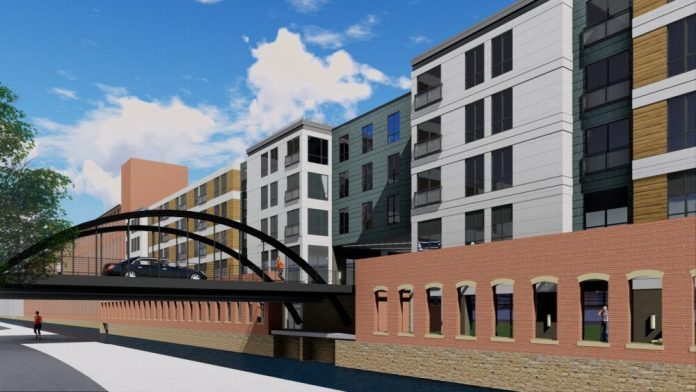
Building on vacant, side-by-side parcels separated by Canal Street, WinnDevelopment will create two five-story buildings with 125 apartments and 5,000 square feet of commercial space. It will be a true mixed income project—54 workforce apartments will rent at 100 percent of Area Median Income (AMI); 39 units will be affordable up to 60 percent of AMI; and, 32 apartments will rent at market rates.
“We’re pleased to be moving ahead with a development featuring a sizable component of workforce housing, which seems appropriate for the city seen as the cradle of the Industrial Revolution in America,” said WinnDevelopment President Larry Curtis. “This project will add a new twist to our long track record of delivering innovative mixed-income, mixed-use communities that contribute to the vitality and the economy of Lowell.”
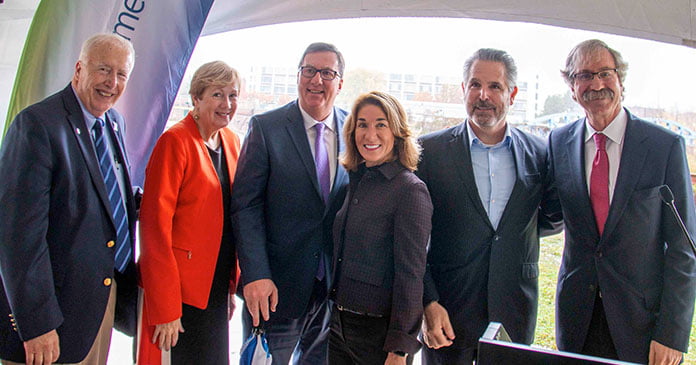
(left to right): Lowell Mayor William Samaras, Lowell City Manager Eileen Donoghue, Massachusetts State Rep. David M. Nangle, Massachusetts Lt. Gov. Karyn Polito, WinnCompanies Executive Vice President Michael O’Brien and WinnDevelopment President Larry Curtis.
The Lowell City Council cleared the way for the project on Tuesday night, unanimously voting to approve Urban Center Housing Tax Increment Financing (UCH-TIF) under a new state program designed to promote multifamily housing in urban centers. Construction is expected to begin in late December 2019 and be completed in December 2021.
“These are fun places to live. There’s a lot going on. There’s a vibe in the downtowns of these old industrial cities because of this collaboration and the willingness of all of you to take the chance, to take the risk, and move forward,” said Lt. Gov. Karyn Polito. “This is a best-of-everything project because you a mixed use project combining commercial and housing together, but it’s also mixed income. To have workforce housing, affordable housing and market rate housing all together is a really great accomplishment. It’s something to the core that WinnCompanies fully embraces.”
Construction will be financed with equity generated by Bank of America’s purchase of federal and state Low-Income Housing Tax Credits; a construction loan from Bank of America; a first mortgage and Workforce Housing funds from MassHousing; financing from the Massachusetts Department of Housing & Community Development under the state’s Affordable Housing Trust Fund, Housing Stabilization Fund and HOME program; financing from the Community Economic Development Assistance Corporation in the form of the Facilities Consolidation Fund and the Community-Based Housing program; Opportunity Zone investment and developer equity from WinnCompanies; and, funds from the Massachusetts Clean Energy Center and MassSave, both dedicated to advancing energy efficiency and clean technology.
The City of Lowell is supporting the project with HOME program funds, the UCH-TIF plan, and infrastructure investments in and around the 51,000-square-foot site.
“The City has made significant investments to put in place the infrastructure needed to support private development in the Hamilton Canal Innovation District. We are pleased that WinnCompanies has put forward a project that will capitalize on these investments and that will help meet the demand for more safe and energy-efficient housing in Lowell in a way that will also stimulate commercial growth in this key area,” said City Manager Eileen Donoghue. “This announcement marks the continuation of a positive partnership between WinnCompanies and the City that has been successful in developing high quality projects that advance our economic development goals.”
WinnDevelopment Project Director Matthew Curtin will lead the development team, which features Keith Construction; ICON Architecture; landscape architect Copley Wolff Design Group; interior designer Wolf in Sheep Design; civil engineer Vanasse Hangen Brustlin, Inc. (VHB); and, structural engineer Odeh Engineers. Deirdre Robinson, a partner at Sullivan & Worcester, serves as legal counsel for the project.
“I am thrilled to see additional private investment in the Hamilton Canal Innovation District. Bringing mixed-use developments to this area is important to ensure that our downtown continues to grow and thrive into the future,” said Lowell Mayor William Samaras.
The development will offer 15 studio apartments, 63 one-bedroom apartments and 47 two-bedroom apartments. The two residential buildings will be linked to each other by an enclosed sky bridge spanning Canal Street, a nod to Lowell’s history when similar connectors joined industrial mill buildings. The sky bridge will also compliment the new signature bridge the city recently built over the lower Pawtucket Canal.
Ambitious Energy Performance Goals
The complex will be designed, built and operated to achieve stringent energy performance goals, including certification through both Energy Star Homes and Enterprise Green Communities.
The environmentally responsible design and construction will feature high-efficiency air source heat pumps for heating and cooling, high performance building envelope details, including robust exterior wall and roof insulation, ENERGY STAR windows, LED lighting, ENERGY STAR appliances, and balanced ventilation with energy recovery for healthy indoor air quality and maximum efficiency.
Final Enterprise Green Communities certification will be achieved post-construction, following rigorous inspections, performance testing and verification provided by Boston based non-profit New Ecology Inc.
Critical incentive funding made available through the Massachusetts Clean Energy Center and MassSave Residential New Construction Program will support added construction costs associated with the project’s HVAC systems and building envelope design, which were designed and selected to reduce the project’s carbon emissions and long-term energy efficiency goals.
Located a half mile from the Lowell Connector with direct access to Route 495 and Route 3, the apartment community will be adjacent to a new 900-space parking garage that is under construction to serve downtown businesses and the new Lowell Justice Center regional court facility scheduled for completion in fall 2020. Residents also will be within walking distance of downtown retail business, a commuter rail line and bus routes served by the Gallagher Intermodal Terminal, as well as downtown retail businesses.
Lowell hosts the single largest concentration of properties owned by WinnCompanies in the United States. In addition, more than 100 company executives and accounting team members work at its regional headquarters in Boott Mills.
A member of the Lowell business community for nearly 25 years, WinnCompanies currently owns and manages seven award-winning residential properties featuring 572 apartments and condominiums, as well as 88,000 square feet of commercial space. The company’s property management arm, WinnResidential, manages an additional 250 apartments in the city.
About WinnCompanies
WinnCompanies is an award-winning national developer and manager of high-impact affordable, middle income and market rate housing communities. Supported by 3,500 team members, the company acquires, develops and manages affordable, senior, mixed-income, market rate, military and mixed use properties. Founded in 1971 and operating in 22 states and the District of Columbia, WinnCompanies is one of the nation’s leading multifamily housing managers with 100,000 units under management. It is the country’s largest manager of affordable housing and the second largest manager of privatized U.S. military housing.
SourceYield PRO Magazine
WinnCo Unveils $38.3 Million Workforce Housing Project in Lowell
WinnCompanies, a multifamily development and management company, joined with Massachusetts Lt. Gov. Karyn Polito, state and Lowell city officials to unveil plans for a $38.3 million residential construction project in the Hamilton Canal Innovation District, a collection of 17 parcels master-planned to transform the primary gateway of downtown Lowell.
Building on vacant, side-by-side parcels separated by Canal Street, WinnDevelopment will create two five-story buildings with 125 apartments and 5,000 square feet of commercial space. It will be a true mixed income project – 54 workforce apartments will rent at 100% of Area Median Income (AMI); 39 units will be affordable up to 60% of AMI; and, 32 apartments will rent at market rates.
“We’re pleased to be moving ahead with a development featuring a sizable component of workforce housing, which seems appropriate for the city seen as the cradle of the Industrial Revolution in America,” said WinnDevelopment President Larry Curtis. “This project will add a new twist to our long track record of delivering innovative mixed-income, mixed-use communities that contribute to the vitality and the economy of Lowell.”
The Lowell City Council cleared the way for the project on Tuesday night, unanimously voting to approve Urban Center Housing Tax Increment Financing (UCH-TIF) under a new state program designed to promote multi-family housing in urban centers. Construction is expected to begin in late December 2019 and be completed in December 2021.
“These are fun places to live. There’s a lot going on. There’s a vibe in the downtowns of these old industrial cities because of this collaboration and the willingness of all of you to take the chance, to take the risk, and move forward,” said Lt. Gov. Karyn Polito. “This is a best-of-everything project because you a mixed use project combining commercial and housing together, but it’s also mixed income. To have workforce housing, affordable housing and market rate housing all together is a really great accomplishment. It’s something to the core that WinnCompanies fully embraces.”
Construction will be financed with equity generated by Bank of America’s purchase of federal and state Low-Income Housing Tax Credits; a construction loan from Bank of America; a first mortgage and Workforce Housing funds from MassHousing; financing from the Massachusetts Department of Housing & Community Development under the state’s Affordable Housing Trust Fund, Housing Stabilization Fund and HOME program; financing from the Community Economic Development Assistance Corporation in the form of the Facilities Consolidation Fund and the Community-Based Housing program; Opportunity Zone investment and developer equity from WinnCompanies; and, funds from the Massachusetts Clean Energy Center and MassSave, both dedicated to advancing energy efficiency and clean technology.
The City of Lowell is supporting the project with HOME program funds, the UCH-TIF plan, and infrastructure investments in and around the 51,000-square-foot site.
“The City has made significant investments to put in place the infrastructure needed to support private development in the Hamilton Canal Innovation District. We are pleased that WinnCompanies has put forward a project that will capitalize on these investments and that will help meet the demand for more safe and energy-efficient housing in Lowell in a way that will also stimulate commercial growth in this key area,” said City Manager Eileen Donoghue. “This announcement marks the continuation of a positive partnership between WinnCompanies and the City that has been successful in developing high quality projects that advance our economic development goals.”
WinnDevelopment Project Director Matthew Curtin will lead the development team, which features Keith Construction; ICON Architecture; landscape architect Copley Wolff Design Group; interior designer Wolf in Sheep Design; civil engineer Vanasse Hangen Brustlin, Inc. (VHB); and, structural engineer Odeh Engineers. Deirdre Robinson, a partner at Sullivan & Worcester, serves as legal counsel for the project.
“I am thrilled to see additional private investment in the Hamilton Canal Innovation District. Bringing mixed-use developments to this area is important to ensure that our downtown continues to grow and thrive into the future,” said Lowell Mayor William Samaras.
The development will offer 15 studio apartments, 63 one-bedroom apartments and 47 two-bedroom apartments. The two residential buildings will be linked to each other by an enclosed sky bridge spanning Canal Street, a nod to Lowell’s history when similar connectors joined industrial mill buildings. The sky bridge will also compliment the new signature bridge the city recently built over the lower Pawtucket Canal.
SourceBoston Real Estate Times
Commonwealth Committed to Early Childhood Education
FUNDING FOR YOUNG CHILDREN
Early Childhood Education an Important Component of Community Development
Reprinted from November 5, 2018
High-quality child care facilities benefit children, their families and society. Facilities with lots of natural light, access to play indoors and outdoors, and space that supports teacher planning and encourages parental involvement are essential to fostering children’s health and well-being, especially for children living in low-income neighborhoods. Over time, policy makers, philanthropists and other public/private financing agencies are increasingly recognizing the importance of early childhood education (ECE) and out-of-school time (OST) facilities to community development.
The most recent – and perhaps most significant – acknowledgement of the role high-quality child care plays in strengthening communities comes from the federal government. In June, the U.S. Department of Treasury’s Community Development Financial Institutions (CDFI) Fund certified the Children’s Investment Fund (CIF), an affiliate of the Community Economic Development Assistance Corporation (CEDAC), as a CDFI. This is important because CDFIs invest in neighborhoods that other financial institutions are unwilling to and expand economic opportunities in those communities by providing organizations with access to financing and technical assistance.
The certification allows CIF to apply for federal funding to offer low-cost lending capital for ECE and OST facility improvements throughout the commonwealth. We were excited to learn in September that the CDFI Fund awarded us a $300,000 financial assistance grant, one of 302 community development financial institutions to receive a total of $202.2 million in awards this year. Those resources will help expand both financial and technical assistance to child care providers from Boston to Pittsfield.
CIF has invested $56 million in support of 565 capital projects that improved learning environments for 30,500 children.
The Children’s Investment Fund is one of a very few organizations across the country with a primary focus on developing child care facilities that has received this certification. We have also become a national leader in integrating child care within community development, in large part because Massachusetts has shown a tremendous amount of vision in this area.
This past spring, Gov. Charlie Baker and state legislators signed the Housing Bond Bill, which reauthorized the Early Education and Out of School Time (EEOST) Capital Fund, a bond program created in 2013 that provides capital funds for child care providers planning to renovate or build new child care facilities. CIF co-manages EEOST with CEDAC and the Massachusetts Department of Early Education and Care (EEC). Baker in August announced the most recent awards through the fund – four providers each received $1 million.
Among the recipients were Holyoke Chicopee Springfield Head Start Inc., which is constructing a high-quality early learning center based on the nationally recognized Educare model to serve 141 infants, toddlers and preschoolers from low-income families within Springfield. The Educare model helps children from birth to age 5 grow up safe, healthy and eager to learn. With more than 20 completed projects across the country, Educare prepares children for success and also helps parents develop skills to champion their child’s education.
Educare Springfield, the first in Massachusetts, is the result of collaboration between city and state partners, the region’s philanthropic community, and Holyoke Chicopee Springfield Head Start, which worked tirelessly to bring Educare to Western Massachusetts.
At a recent groundbreaking ceremony, Lt. Gov. Karyn Polito noted the strong connection between the impact of this new facility and the city’s overall efforts to revitalize this distressed urban neighborhood through public and private investments. It underscored how early education – like housing – is an important component of community development. The 2019 EEOST Capital Fund funding round is now underway.
Since it was established in 1991, CIF has invested $56 million in support of 565 capital projects that improved learning environments for 30,500 children. Our comprehensive technical assistance, training and financing model has strengthened nonprofit community-based child care providers in urban neighborhoods like Dorchester, suburban areas like Beverly and rural towns like Granby. In 2017 alone, more than 3,300 children throughout the commonwealth were served in facilities assisted by CIF. Almost all of these children (93 percent) were from low-income households; 80 percent were children of color; 45 percent were English Language Learners; and 13 percent were children with special needs.
As important as CIF’s role is in supporting child care providers, it has been elevated by certification and funding from the federal government. Funding from the CDFI Fund, EEOST and the philanthropic community give us more opportunities to increase lending to the provider community. As our understanding grows of how early education and care strengthens local communities, it’s good to know that public and private resources are available for smart and impactful investments.
Roger Herzog is the executive director of the Community Economic Development Assistance Corporation. Theresa Jordan is director of Children’s Facilities Finance for the Children’s Investment Fund.
We use cookies to enhance your experience, enable YouTube video playback, and understand how visitors use our website through analytics. We do not use cookies for advertising or cross-site tracking.
Functional
Always active
The technical storage or access is strictly necessary for the legitimate purpose of enabling the use of a specific service explicitly requested by the subscriber or user, or for the sole purpose of carrying out the transmission of a communication over an electronic communications network.
Preferences
The technical storage or access is necessary for the legitimate purpose of storing preferences that are not requested by the subscriber or user.
Statistics
The technical storage or access that is used exclusively for statistical purposes.The technical storage or access that is used exclusively for anonymous statistical purposes. Without a subpoena, voluntary compliance on the part of your Internet Service Provider, or additional records from a third party, information stored or retrieved for this purpose alone cannot usually be used to identify you.
Marketing
The technical storage or access is required to create user profiles to send advertising, or to track the user on a website or across several websites for similar marketing purposes.