Arch Communities and WinnDevelopment Begin Construction on the Adaptive Reuse of the 104-year-old Wells School in Southbridge

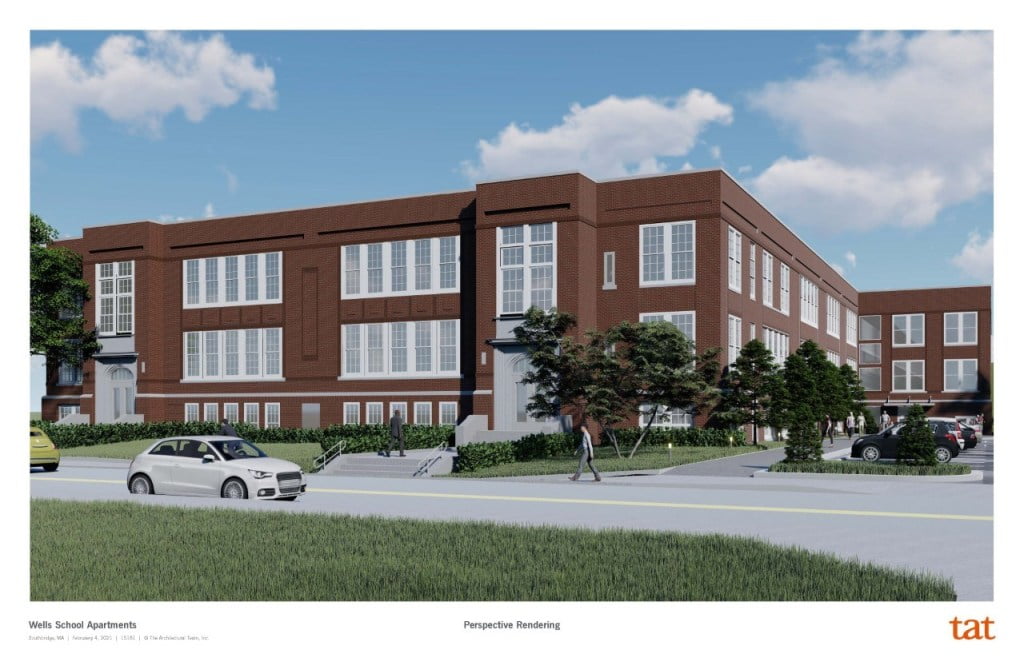
Arch Communities and WinnDevelopment announced that construction is underway on a $25.7 million adaptive reuse project to transform a 104-year-old school building in Southbridge, MA, into 62 apartments for seniors age 55 and older.

Of the 62 apartments, 56 of the units will provide affordable housing at rents set at 60 percent of Area Median Income (AMI), including eight apartments reserved for residents at or below 30 percent of the AMI. Six apartments will be available at market-rate rents. Six apartments will be customized for handicapped and sensory-impaired households.

“This is such a challenging time, particularly for our seniors who have been impacted significantly over the last year, and we’re thrilled to be providing this much needed safe and affordable housing for the Southbridge community,” said Arch Communities Principal Richard Relich. “We’re extremely fortunate to work with our key partners who continue to support our efforts with critical funding including Gov. Baker and Lt. Gov. Polito, Secretary of State William Galvin and the staff at the Massachusetts Historical Commission, as well as our valuable partners at the Massachusetts Department of Housing and Community Development, MassHousing, CEDAC, BlueHub Capital and The Massachusetts Housing Partnership.

“I would also like to our acknowledge our equity partner, Bank of America, who continues to make critical investments in communities across Massachusetts, including at the Wells School Apartments where Bank of America purchased all of the tax credits available and provided construction financing for the project. Without the support from our partners, redeveloping historic properties such as the Wells School into mixed-income housing wouldn’t be possible,” Relich added.

The support of U.S. Rep. Richard Neal, whose district includes Southbridge, along wih State Sen. Ryan Fattman and State Rep. Michael Durant, also helped pave the way for the project’s financing and approval.

“Adaptive reuse projects like the Wells School hold a special place among all of the development work we do,” said WinnDevelopment Executive Vice President Adam Stein. “We’re proud to have the opportunity to restore this historic landmark and return it to service on behalf of the community.”

The Mary E. Wells school was built in 1916 as the first public high school in Southbridge and operated continuously for nearly a century. As the town’s population increased, fueled by the growth of the American Optical Company headquartered down the road, a new high school was built. In 1960s, the Wells building began being used as the town’s junior high school. The building has been vacant since 2012. The three-story school, 90,000-square-foot building was named for the wife of the co-founder and president of the American Optical. Mary E. Wells became the first woman elected to public office in Southbridge when voters chose her to serve on the town’s Board of Education in the 1890s.

“We are excited to have this project come to Southbridge,” said Southbridge Town Manager Michael F. McCall. “Not only does this project breathe new life into a historic school that has been an important fixture in the community over 100 years, it affords our seniors an opportunity to downsize and remain in the community they call home. Additionally, we see the project as the beginning of a revitalization initiative that will spur further economic development and yield economic benefits to our community. ”

Added Southbridge Town Councilor David Adams: “I am excited to see this historical building within our community, that means so much to so many, redeveloped while bringing with it new economic growth and much needed private senior housing,”

The project is utilizing both federal and state historic credits, along with federal and state low-income housing tax credits (LIHTC). The Department of Housing and Community Development (DHCD) is providing the federal and state LIHTC, while the U.S. National Park Service and Massachusetts Historical Commission are providing the federal and state historic credits. In addition to purchasing all tax credits, the Bank of America is providing a construction loan for the project. Additional funding is being provided by The Massachusetts Housing Partnership (MHP) and the Community Economic Development Assistance Corporation (CEDAC).

“The Wells School project will transform a vacant school building into a thriving community for senior residents in the town of Southbridge,” said Miceal Chamberlain, Massachusetts Market President for Bank of America. “Everyone deserves to have safe and affordable housing. We look forward to the opening of this community in the spring of 2022.”

The adaptive reuse effort is expected to be completed by March 2022 with Keith Construction serving as the general contractor and The Architectural Team serving as the architect. The project has been designed to achieve the Enterprise Green Communities certification – the leading U.S. standard for the design, construction, and operation of healthy, energy efficient and environmentally responsible affordable housing. WinnResidential will provide Property Management services to the property.

“We have a long history of supporting WinnDevelopment and Arch Communities, and many of our loans have supported the hard work of turning historic mills or schools into housing,” said MHP Executive Director Clark Ziegler. “These aren’t easy developments to do, but WinnDevelopment and Arch Communities are experienced at making these types of projects come true and we’re pleased to support their partnership in transforming Southbridge’s Mary E. Wells School into mixed-income senior housing that will serve the community for years to come.”

Once completed, the Wells School Apartments will feature a substantial amenity package, including an in-building laundry, fitness & yoga studio, tenant lounge, activity room, movie room, play space, a game room, library and work pods, a wellness suite, storage, and an internal courtyard. The property will include 66 parking spaces, of which four will be accessible. In partnership with WinnResidential, Tri-Valley Elder Services will provide a support services program available to residents living at Wells School Apartments.

Adaptive reuse techniques will preserve the historic features of the building, which was designed by Peabody and Stearns, one of the premier architectural firms in the eastern United States during the late 19th century and early 20th century. WinnDevelopment has completed more than three dozen historic adaptive reuse projects in five states and the District of Columbia. The company has won more awards for transforming vacant schools, mills and other historic buildings into multifamily housing than any other developer in the United States.

Nominated for the National Historic Register in March 2017, the property is located at 80 Marcy Street in downtown Southbridge, a central Massachusetts town along the Connecticut border. Local transportation, services, shopping and amenities are within walking distance from the property. The site is also within close proximity to Harrington Hospital and the public bus route.
SourceBoston Real Estate Times

The Clarion Opens and Includes New Home for Future Chefs

Mayor Martin J. Walsh, developer The Community Builders (TCB) and non-profit Future Chef’s today announced the opening of The Clarion, a mixed-income, mixed-use housing development in Grove Hall. This residence consists of 39 units of rental housing, including 32 income restricted units at a range of income levels and 7 market-rate units. The building includes 5,750 square feet of commercial space on the first floor which is the new home of Future Chefs, a youth development non-profit that uses a work-based learning model to engage teens in paid work to develop culinary and essential life skills, setting youth up for successful careers in any field they choose. The Clarion also meets rigorous energy-efficient goals and is a Leadership in Energy and Environmental Design (LEED) Gold certified building.

Photo credit:  The Community Builders, Inc. 

“I’m excited that this holiday season we will welcome 39 families to their new home at The Clarion, a state-of-the-art building that includes incredible amenities and space reserved  for Future Chefs, which provides crucial life skills to Boston youth,” said Mayor Walsh. “I want to thank The Community Builders,  the Grove Hall community, Future Chefs and all of our partners for working with us to create new affordable and mixed-income housing, as well as opportunities for youth development here in Grove Hall. Together we will continue to work to improve every neighborhood in Boston by making sure all residents and their families have accessible, safe  and affordable housing options.”

“The Clarion and the partnership with Future Chefs is a great expression of The Community Builders’ mission—providing housing for people at a wide range of income levels, enriching a community, and creating opportunities for advancement. We are proud that today The Clarion is fully occupied and a place that 39 households and a very special organization now call home,” said Andy Waxman, Regional Vice President of Real Estate Development at The Community Builders. “I want to thank our partners for all of their work to make this development possible.”

The Clarion has 27 new affordable apartments for households earning at or below 60% of area median income (AMI) or $76,740 for a family of four. Seven of these units are set-aside for households who earn at or below 30% AMI or $38,350 for a family of four. Of the seven, three units are set-aside for persons with disabilities and four are for formerly homeless households directly referred by HomeStart. The Clarion also includes 7 market-rate units and 5 income restricted units at a range of AMIs financed by the City of Boston Department of Neighborhood Development intended for households earning at or below 100% AMI or $119,000 for a family of four.

“We’re thrilled to be working once again with the City of Boston and The Community Builders on cutting edge affordable housing that will help provide opportunities for the city’s youth through the Future Chefs program,” said Clark Ziegler, executive director of Massachusetts Housing Partnership (MHP). “We’ve now financed eight TCB developments and have financed 194 projects and 7,270 apartments in the City of Boston. This development addresses a lot of our priorities and we’re looking forward to financing more homes like this.”

The Clarion includes 15 one-bedroom units, 21 two-bedroom family units, and 3 three-bedroom family units, and a spacious lobby and property management office suite fronting on Blue Hill Avenue. There is on-site resident parking at the back of the building and a landscaped plaza on the corner of Quincy and Blue Hill Avenue. Nola Shea, a new occupant of The Clarion said, “I am really happy to be a resident of the Clarion living complex. The apartments are new, really nice, and comfy; the location is convenient and city friendly…and the staff and management team are awesome!”

Future Chefs formerly operated out of the old Flower Exchange building, but when the Albany Street property was slated for redevelopment in 2018, Future Chefs connected with TCB to make the Clarion the new Future Chefs home base. The interior build out for the 5,750 square feet of ground-floor commercial space creates a new home for Future Chefs.  Future Chefs was founded by Toni Elka in 2008, based on the belief that as a society we have a collective obligation to prepare young people to find employment and lead productive lives.

“Future Chefs is making a monumental shift at a really important time. Our contribution and response to change is on the side of positivity, growth, progress, and togetherness with a focus on youth development and empowerment. I grew up in Roxbury and Dorchester, the new home of Future Chefs – everything coming together makes me so proud to be a part of this wonderful Future Chefs family since its inception!”, said Aquila Kentish. Kentish earned a bachelor’s degree in Hospitality Management on a Future Chefs scholarship and has rejoined Future Chefs as the Culinary Operations Manager.

“We are excited to bring our values into focus in this beautiful new facility. We believe that every young person should be able to imagine a purposeful, joyful life. This collaboration gives Future Chefs a warm and inviting home to create food-centric, youth development magic with our neighbors for years to come,” said Toni Elka, Founder and Executive Director of Future Chefs.

The mix of housing and youth-development brings new beginnings into this site. “We are excited that where once was an empty lot, now sits a beautiful building that provides housing and brings hope to the community. Future Chefs and Commonwealth Kitchen now anchor our culinary district and provide people a clear career path into the culinary arts, entrepreneurship, and a multitude of other endeavors,” said Ed Gaskin, Executive Director of Greater Grove Hall Main Streets.

The Clarion development was made possible by a contribution of $1.5 million from the Department of Neighborhood Development funding and $750,000 in Neighborhood Housing Trust Funds. The Massachusetts Department of Housing and Community Development (DHCD) contributed $1.25 million via CATNHP and HSF funds, $1 million from Massachusetts Affordable Housing Trust Fund, and Community Economic Development Assistance Corporation (CEDAC) provided $450,000 in Community Based Housing (CBH) funds. TD Bank provided the $10.2 million construction loan and Massachusetts Housing Partnership (MHP) is providing permanent funding via a $2.8 million permanent loan. Boston Capital was the tax credit syndicator for $6.2 million in Federal Low-Income Housing Tax Credit equity and $3 million State Low-Income Housing Tax credits. Additionally, The Community Builders provided a $1.35 million sponsor loan.

 ABOUT THE DEPARTMENT OF NEIGHBORHOOD DEVELOPMENT (DND)

The Department of Neighborhood Development is responsible for housing the homeless, developing affordable housing, and ensuring that renters and homeowners can find, maintain, and stay in their homes. As part of the ongoing coronavirus response, the Office of Housing Stability is also conducting tenant’s rights workshops to educate residents about the eviction moratorium and their rights. The Boston Home Center continues to provide down payment assistance to first-time homebuyers and home repairs for seniors and low-income residents. The Supportive Housing Division works with various partners around the city to rapidly house individuals who are experiencing homelessness. For more information, please visit the DND website.

 ABOUT THE COMMUNITY BUILDERS (TCB)      

The Community Builders (TCB) is one of America’s leading nonprofit housing organizations. Our mission is to build and sustain strong communities where all people can thrive. We realize our mission by developing, financing and operating residential communities, neighborhood amenities and resident opportunity programs. Since 1964, we have constructed or preserved hundreds of affordable and mixed-income housing developments and pioneered the Community Life (CL) model for resident success. Today, anchored by offices in Boston, Chicago, Cincinnati, New York and Washington, D.C. we own or manage 13,000 apartment homes in more than 14 states. For more information, please visit: www.tcbinc.org

ABOUT FUTURE CHEFS

Future Chefs prepares teens for success after high school, and a lifetime of economic security. We intervene in the cycle of intergenerational poverty by supporting Boston’s low-income youth to develop job skills while engaged in authentic, productive work in our kitchen, a medium in which teens are engaged, inspired, and challenged. The three-phased program supports teens to (1) explore culinary and job-readiness skills, (2) earn and learn in paid work-based employment while practicing transferable skills, and (3) work their plan for after high school with coaching and support from the staff.

Our new headquarters at the Clarion brings a state-of-the-art production and teaching kitchen and community resource to Roxbury. This new hub will allow Future Chefs to expand our social enterprise program, employ more students, and provide positive youth space and career support services for both teens and their families.

Visit the Future Chefs website for more information.

SourceCity of Boston Department of Neighborhood Development

WinnCompanies joins with state and city officials to announce plans for $38.3 million mixed-income development in Lowell

WinnCompanies, an award-winning multifamily development and management company, today joined with Massachusetts Lt. Gov. Karyn Polito, state and Lowell city officials to unveil plans for a $38.3 million residential construction project in the Hamilton Canal Innovation District, a collection of 17 parcels master-planned to transform the primary gateway of downtown Lowell.

Building on vacant, side-by-side parcels separated by Canal Street, WinnDevelopment will create two five-story buildings with 125 apartments and 5,000 square feet of commercial space. It will be a true mixed income project—54 workforce apartments will rent at 100 percent of Area Median Income (AMI); 39 units will be affordable up to 60 percent of AMI; and, 32 apartments will rent at market rates.

“We’re pleased to be moving ahead with a development featuring a sizable component of workforce housing, which seems appropriate for the city seen as the cradle of the Industrial Revolution in America,” said WinnDevelopment President Larry Curtis. “This project will add a new twist to our long track record of delivering innovative mixed-income, mixed-use communities that contribute to the vitality and the economy of Lowell.”

(left to right): Lowell Mayor William Samaras, Lowell City Manager Eileen Donoghue, Massachusetts State Rep. David M. Nangle, Massachusetts Lt. Gov. Karyn Polito, WinnCompanies Executive Vice President Michael O’Brien and WinnDevelopment President Larry Curtis.

The Lowell City Council cleared the way for the project on Tuesday night, unanimously voting to approve Urban Center Housing Tax Increment Financing (UCH-TIF) under a new state program designed to promote multifamily housing in urban centers. Construction is expected to begin in late December 2019 and be completed in December 2021.

“These are fun places to live. There’s a lot going on. There’s a vibe in the downtowns of these old industrial cities because of this collaboration and the willingness of all of you to take the chance, to take the risk, and move forward,” said Lt. Gov. Karyn Polito. “This is a best-of-everything project because you a mixed use project combining commercial and housing together, but it’s also mixed income. To have workforce housing, affordable housing and market rate housing all together is a really great accomplishment. It’s something to the core that WinnCompanies fully embraces.”

Construction will be financed with equity generated by Bank of America’s purchase of federal and state Low-Income Housing Tax Credits; a construction loan from Bank of America; a first mortgage and Workforce Housing funds from MassHousing; financing from the Massachusetts Department of Housing & Community Development under the state’s Affordable Housing Trust Fund, Housing Stabilization Fund and HOME program; financing from the Community Economic Development Assistance Corporation in the form of the Facilities Consolidation Fund and the Community-Based Housing program; Opportunity Zone investment and developer equity from WinnCompanies; and, funds from the Massachusetts Clean Energy Center and MassSave, both dedicated to advancing energy efficiency and clean technology.

The City of Lowell is supporting the project with HOME program funds, the UCH-TIF plan, and infrastructure investments in and around the 51,000-square-foot site.

“The City has made significant investments to put in place the infrastructure needed to support private development in the Hamilton Canal Innovation District. We are pleased that WinnCompanies has put forward a project that will capitalize on these investments and that will help meet the demand for more safe and energy-efficient housing in Lowell in a way that will also stimulate commercial growth in this key area,” said City Manager Eileen Donoghue. “This announcement marks the continuation of a positive partnership between WinnCompanies and the City that has been successful in developing high quality projects that advance our economic development goals.”

WinnDevelopment Project Director Matthew Curtin will lead the development team, which features Keith Construction; ICON Architecture; landscape architect Copley Wolff Design Group; interior designer Wolf in Sheep Design; civil engineer Vanasse Hangen Brustlin, Inc. (VHB); and, structural engineer Odeh Engineers. Deirdre Robinson, a partner at Sullivan & Worcester, serves as legal counsel for the project.

“I am thrilled to see additional private investment in the Hamilton Canal Innovation District. Bringing mixed-use developments to this area is important to ensure that our downtown continues to grow and thrive into the future,” said Lowell Mayor William Samaras.

The development will offer 15 studio apartments, 63 one-bedroom apartments and 47 two-bedroom apartments. The two residential buildings will be linked to each other by an enclosed sky bridge spanning Canal Street, a nod to Lowell’s history when similar connectors joined industrial mill buildings. The sky bridge will also compliment the new signature bridge the city recently built over the lower Pawtucket Canal.

Ambitious Energy Performance Goals

The complex will be designed, built and operated to achieve stringent energy performance goals, including certification through both Energy Star Homes and Enterprise Green Communities.

The environmentally responsible design and construction will feature high-efficiency air source heat pumps for heating and cooling, high performance building envelope details, including robust exterior wall and roof insulation, ENERGY STAR windows, LED lighting, ENERGY STAR appliances, and balanced ventilation with energy recovery for healthy indoor air quality and maximum efficiency.

Final Enterprise Green Communities certification will be achieved post-construction, following rigorous inspections, performance testing and verification provided by Boston based non-profit New Ecology Inc.

Critical incentive funding made available through the Massachusetts Clean Energy Center and MassSave Residential New Construction Program will support added construction costs associated with the project’s HVAC systems and building envelope design, which were designed and selected to reduce the project’s carbon emissions and long-term energy efficiency goals.

Located a half mile from the Lowell Connector with direct access to Route 495 and Route 3, the apartment community will be adjacent to a new 900-space parking garage that is under construction to serve downtown businesses and the new Lowell Justice Center regional court facility scheduled for completion in fall 2020. Residents also will be within walking distance of downtown retail business, a commuter rail line and bus routes served by the Gallagher Intermodal Terminal, as well as downtown retail businesses.

Lowell hosts the single largest concentration of properties owned by WinnCompanies in the United States. In addition, more than 100 company executives and accounting team members work at its regional headquarters in Boott Mills.

A member of the Lowell business community for nearly 25 years, WinnCompanies currently owns and manages seven award-winning residential properties featuring 572 apartments and condominiums, as well as 88,000 square feet of commercial space. The company’s property management arm, WinnResidential, manages an additional 250 apartments in the city.


About WinnCompanies

WinnCompanies is an award-winning national developer and manager of high-impact affordable, middle income and market rate housing communities. Supported by 3,500 team members, the company acquires, develops and manages affordable, senior, mixed-income, market rate, military and mixed use properties. Founded in 1971 and operating in 22 states and the District of Columbia, WinnCompanies is one of the nation’s leading multifamily housing managers with 100,000 units under management. It is the country’s largest manager of affordable housing and the second largest manager of privatized U.S. military housing.

SourceYield PRO Magazine

Unusual partners are working to build much-needed affordable housing in Chinatown

Could a parking garage lot in the heart of the Theatre District be a guide to the future of Chinatown?

A rare coalition of for-profit and nonprofit developers are betting millions that the answer could be, surprisingly, yes. But that’s getting a little ahead of the story.

The development giant Millennium Partners Boston has joined forces with the Chinatown-based Asian Community Development Corporation to build 168 units of affordable housing on a small lot nestled between the Boch Center, a hotel, and Tufts Medical Center. The project, once completed, figures to bring desperately needed affordable housing to Chinatown, a neighborhood where both housing and land are scarce.

That only hints at its importance to a community facing encroachment by development on all sides and running out of places where its predominantly immigrant, low-income residents can live.

“In Chinatown, where we really have very, very little land left, we want to do as much as possible,” said Angie Liou, executive director of Asian Community Development. “This is really a rare opportunity.”

The piece of land to be developed, known as Parcel 12, is owned by the Boston Planning and Development Agency, and the Chinatown community has eyed it for years as a spot that should be put to much better use. Plans and promises for the parcel have come and gone since at least the 1980s, Liou said. But community groups don’t have the cash to pull off major development projects, and the big developers were otherwise occupied.

Then something unexpected happened. As part of Millennium’s deal to redevelop the decrepit Winthrop Square Garage into a major office and condo tower, the company was required to pay for 1110,000 square feet of affordable housing. Under city policy, developers can — and often do — satisfy their obligation by simply writing a check to the BPDA. But the developers didn’t want to just write a check.

“We’re kind of sick of just paying into the process,” said Joe Larkin, principal of Millennium Partners Boston. “When we looked at all the millions of dollars we’ve paid in the past . . . we’ve become such an appreciator of the city that we — myself and our partners and investors — really wanted to do something more.”

“Something more” quickly became forming a partnership with the Asian CDC and finally making the long-delayed plans to build some affordable housing on Parcel 12 a reality.

“Angie literally identified the site for us,” Larkin said. “We thought in Chinatown we could do something really cool.”

For Millennium — whose projects include the Ritz-Carlton on Avery Street and the Millennium Tower in Downtown Crossing — affordable housing was a new and significantly different arena. Liou is helping to guide the rich folks through the maze of regulations and approvals, while hoping to secure more city and state funding in the process.

The current timetable calls for breaking ground in early 2021, with a two-year construction timetable. As for who will live there, the city will eventually hold a lottery to determine who gets the units. Liou says 4,000 applicants are typical for 100 units of affordable housing — a testament to the need, in Chinatown, and beyond.

Those applicants will face long odds — a realization that gave Larkin pause.

“To tell you how this relationship works, the first thing I thought of was how 100 families are going to have their lives changed. And Angie said me, ‘Yeah, and there’s going to be 3,900 families that are going to be disappointed.’ That was what hit me the hardest, how huge the need is.”

The problem of housing isn’t going to be solved by one project, of course. But any solution will require collaboration and creativity — and this unusual partnership has plenty of both. Two organizations separated by a few blocks — and untold millions in resources — have found common ground. And they’re building on it.

SourceThe Boston Globe