Housing, health care for seniors will rise on site of former Everett church

The site of the former St. Therese church in Everett will soon see new life as a mixed-use development focused on the housing and health care needs of local seniors.

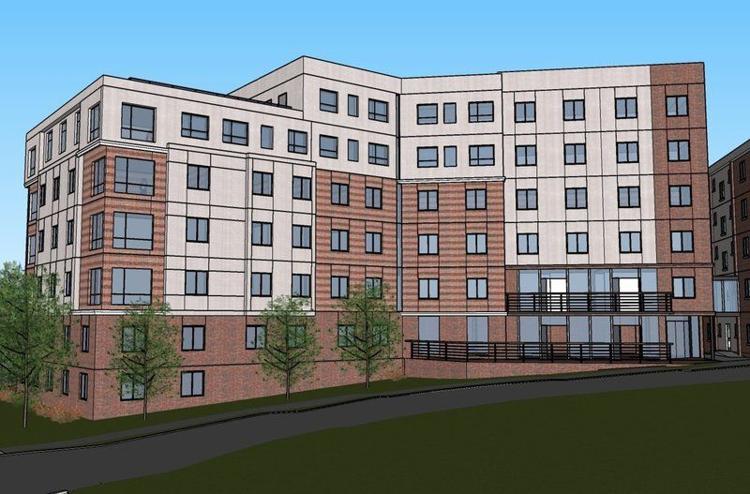
The Neighborhood Developers recently began constructing 77 affordable rental apartments for adults aged 62 and up at Broadway and Gledhill Avenue. The new building will include a ground-floor health care center for the tenants and other seniors that East Boston Neighborhood Health Center will operate through a partnership with TND.

The $33 million project also involves erecting six adjacent three-bedroom townhouses to be sold at affordable prices with no age restrictions, according to Rafael Mares, executive director of Chelsea-based TND.

The project, which has been warmly received by city officials, marks the first undertaken in Everett by the nonprofit, which owns and manages 461 rental apartments in Chelsea and Revere, many of which it developed.

“Everett is a neighboring community to Chelsea and Revere and has similar demographics,” Mares said. “There is a practical need in Everett for affordable housing for seniors so people can age in place in the community. So we felt compelled to offer our help and play whatever role we could in Everett.”

He said TND included a health care center in the project to enhance its goal of creating a place that could fully support people in their older years. Because it serves a similar region, East Boston Neighborhood Health Center was the “perfect partner” in that effort.

“We are excited about this and hope it can be a future model in our region and beyond,” Mares said of combining affordable senior housing and health care on one site.

East Boston Neighborhood Health Center maintains facilities in Boston, Revere, and Winthrop, including four community health centers, and three centers that operate under Program of All-inclusive Care for the Elderly, or PACE, a federal program which provides comprehensive care for older people with complex medical conditions, according to Greg Wilmot, East Boston’s senior vice president and chief operating officer.

The future Everett health center will serve PACE as well as regular primary care patients. But Wilmot said the focus will be employing PACE to provide medical and home health care services to tenants and other seniors that can help them remain independent.

“We know well that when seniors are able to stay in their communities, they are going to have better health outcomes,” he said, “and this partnership is going to give us a great opportunity to do that for the Everett community.”

St. Therese parish closed in 2004. TND purchased most of the site from the Archdiocese of Boston in 2018 after acquiring the remaining portion from another owner in 2017. The project is being financed with the help of federal and state low-income housing tax credits.

The church and other buildings have all been demolished. But Maras said TND is taking care to honor the history of the parish, including naming the development “St. Therese” and installing an interpretive exhibit about the church in a small park that it is renovating.

The rental units must be affordable to people earning up to 60 percent of area median income; with a portion affordable to those earning up to 30 percent of the median. Tenants above the 30 percent median will pay about $1,296 for a one-bedroom, and $1,550 for a two-bedroom. Other rents will be income-based. Townhouse prices will likely range from $235,000-$390,000.

The future apartment building will enjoy such common amenities as a large community room and a fitness center, along with activities that could range from cooking classes to potlucks and holiday celebrations. TND staff will also assist them in accessing services.

The project is set for completion in May 2022.

SourceThe Boston Globe

Under The Radar: Affordable Senior Housing Communities Need Support To Fight COVID-19

MassHousing has closed on $2.8 million in affordable workforce housing financing to The Community Builders for the ongoing construction of the 12-unit 35 Village Hill Road in Northampton. Valley Community Development Corporation is the project co-sponsor.

The new housing, which is being developed on the site of the former Northampton State Hospital, will feature 10 workforce housing apartments for moderate-income households and two deeply affordable units for clients of the Massachusetts Department of Mental Health (DMH).

“MassHousing is pleased to support The Community Builders and Valley Community Development in their transformation of a vacant lot into new homes for working households and residents in need,” said MassHousing Executive Director Chrystal Kornegay. “We’re happy that these new homes will serve working and disabled households for many years into the future.”

“The Community Builders is excited to once again be expanding housing opportunities at Village Hill in Northampton. Our organization is committed to building strong communities where all people can thrive. We are grateful to MassHousing and our other state and local partners who help us make this work possible” said TCB Director of Development Rachana Crowley.

“Valley Community Development is proud to be part of increasing the economic diversity of housing options at Village Hill,” said Valley’s Executive Director Joanne Campbell.

The 12 new apartments will be contained in one building, which will also have first-floor commercial space. Ten of the apartments at 35 Village Hill Road will be workforce housing units affordable to moderate-income households. Six of the workforce housing units will be deed-restricted for households earning at or below 120 percent of the Area Media Income (AMI), and four will be workforce units for households earning at or below 80 percent of AMI. Additionally, two units will be deeply affordable for DMH clients and will be supported by federal Section 8 project-based vouchers. The AMI for Northampton is $76,000 for a household of four.

There will be two studio apartments, six one-bedroom apartments and four two-bedroom apartments. Construction is expected to be completed in September.

MassHousing is providing TCB with $1.4 million in permanent financing, and $1.4 million in workforce housing funding from the Agency’s Workforce Housing Initiative.

In addition to the MassHousing financing, the Massachusetts Department of Housing and Community Development (DHCD) is providing the project-based vouchers and $1.5 million in direct support. The project also received $1.3 million in funding through the Community Scale Housing Initiative (CSHI), a joint initiative of DHCD and MassHousing that funds smaller-scale affordable rental developments.

The Community Economic Development Assistance Corporation (CEDAC) is providing $360,000 in financing, the City of Northampton contributed $200,000 in local Community Preservation Act funding and Citizens Bank is providing $2.5 million in construction financing.

35 Village Hill Road advances the Baker-Polito Administration’s goal of creating up to 1,000 new workforce housing units affordable to middle-income households through MassHousing’s Workforce Housing Initiative. Since the inception of the initiative in 2016, MassHousing has committed or closed workforce housing financing totaling $98.2 million, to 45 projects, located in 21 cities and towns. To date, the Workforce Housing Initiative has advanced the development of 4,030 housing units across a range of incomes, including 1,096 workforce housing units.

The general contractor is Western Builders. The architect is Davis Square Architects and the management agent is TCB.

MassHousing has financed five rental housing communities in Northampton totaling 642 units of housing with an overall original loan amount of $33.4 million and the Agency has also provided home mortgage loans to 427 homebuyers and homeowners with an original purchase principal balance of $31.2 million.

SourceHealth Affairs

Merrivista to add senior housing

Bethany Community Services plans to expand its Merrivista senior housing complex on Water Street with the addition of 62 affordable, age-restricted apartments, with 16 units designated for extremely low-income households.

The project recently received a $200,000 predevelopment loan from the Community Economic Development Assistance Corporation or CEDAC.

Bethany operates Merrivista senior housing at 100 Water St., Phoenix Row apartments at 22 Phoenix Row in Washington Square and Mission Towers at 180 Water St.

Jered Stewart, president and CEO of the nonprofit Bethany Community Services, said all three properties currently have long waiting lists of seniors looking for affordable apartments and that the expansion of Merrivista will help meet a significant need for senior housing.

“CEDAC is providing us with resources that we can’t obtain from traditional lenders,” Stewart said.

He said the proposed 62-unit project will be connected to the existing Merrivista building — a 150-unit affordable senior housing complex — through a sky bridge that will provide residents with access to a library, hair salon, dining room, and additional support services.

The project will also feature a 5,000 square foot health and wellness center operated by Bethany.

Stewart said the health and wellness center will be available to all Merrivista residents.

“This is a great thing for the city,” Mayor James Fiorentini said, noting that almost daily, he hears from senior citizens who ask for his help in finding an affordable place to live. “This is just what we need and whatever the city can do to assist, we’re all for it.”

The Merrivista expansion is estimated to cost between $17 and $20 million. Construction could begin in 2022 or 2023, depending on financing approval, Stewart said.

CEDAC has also committed $200,000 to the North Shore Community Development Corporation (NSCDC), which plans to redevelop two former Catholic schools on either side of downtown Salem, Mass, into mixed-income rental housing, including units for affordable to low- and moderate-income residents.

“CEDAC is proud to support both of these projects, which will provide much-needed affordable housing opportunities to Haverhill and Salem,” said CEDAC’s executive director Roger Herzog. “We are glad to see a variety of housing options that will benefit local residents, including supportive housing for seniors.”

Bethany held a gala fundraising event Oct. 10 at the Bradford Country Club that kicked off its capital campaign for the Merrivista expansion.

More than 160 people attended the event, which featured a silent auction, a meal and live music.

To donate to the Merrivista expansion, visit online at bethanycommunities.org/ways-to-give.

CEDAC is a public-private community development finance institution that provides financial resources and technical expertise for community-based and other non-profit organizations engaged in effective community development in Massachusetts.

CEDAC’s work supports two key building blocks of community development: affordable housing and early care and education. CEDAC is also active in state and national housing preservation policy research and development and is widely recognized as a leader in the non-profit community development industry. For additional information on CEDAC and its current projects, visit cedac.org.

SourceThe Eagle-Tribune

44 New Affordable Housing Units Built In Bourne

Bourne, which has the largest percentage of affordable housing units compared to market-rate homes of any town on the Upper Cape, recently celebrated the construction of another 44 affordable units.

The latest additions are townhouse units in the development known as High Meadow Townhomes in Monument Beach. It is the third and final piece of a development roughly 10 years in the making.

The High Meadow Townhomes development is just off Clay Pond Road. It consists of 44 two- and three-bedroom townhouses for families and seniors. It is one-third of the development that started with the Residences at Canal Bluffs, 28 affordable apartments that opened in 2009. That was followed by Clay Pond Cove, 45 individual, family and senior affordable apartments which opened in 2012.

With the addition of High Meadow Townhomes, Bourne now has 641 units in its inventory of affordable homes. Town Planner Coreen V. Moore said that brings Bourne’s total affordable homes percentage to 7.4. The state has set a goal of 10 percent for Massachusetts cities and towns. Bourne has the highest percentage of affordable units on the Upper Cape and is third behind Orleans and Barnstable across the Cape, she said.

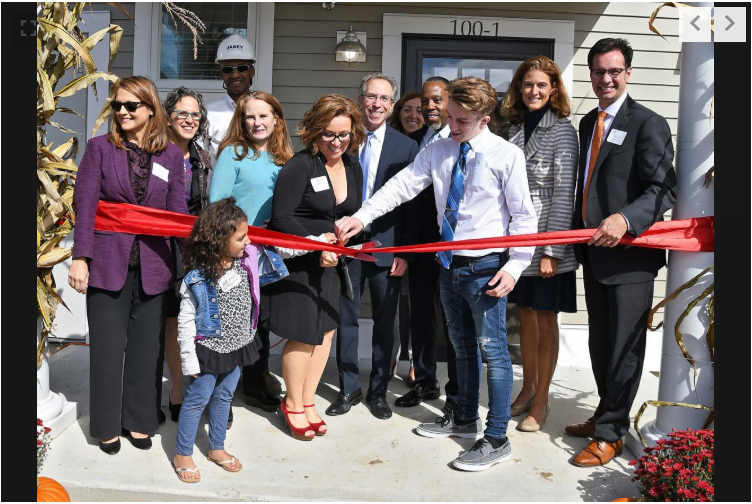
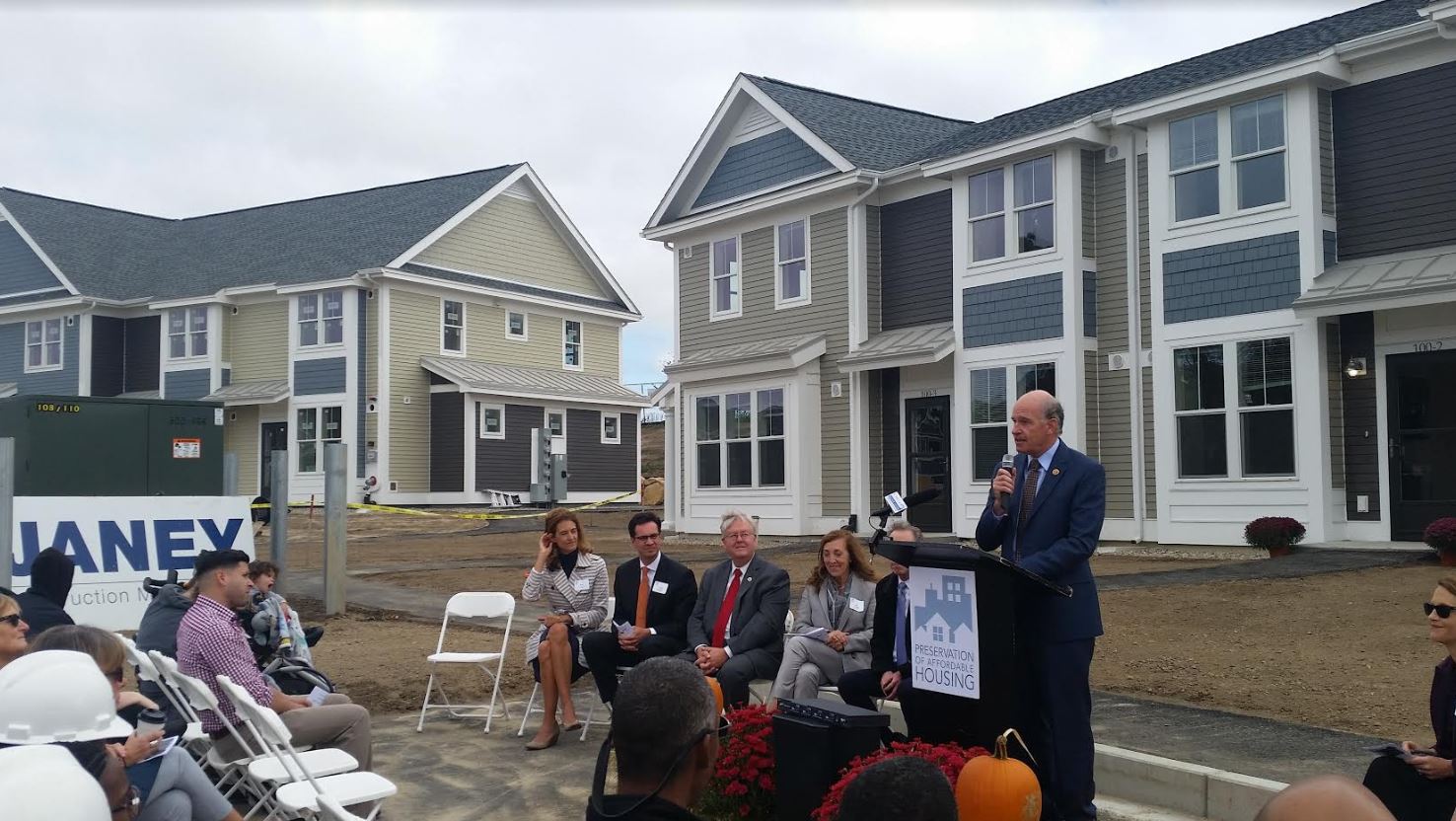
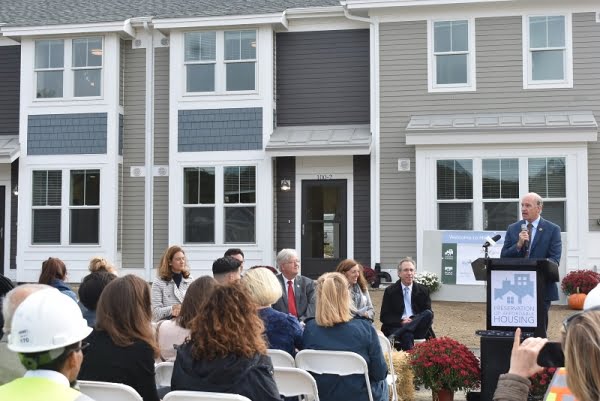
Local and state officials took part in a grand opening, ribbon-cutting ceremony at the development on October 5. Among the attendees were US Congressman William R. Keating (D-MA 9th District), state Senator Viriato M. (Vinny) deMacedo (R-Plymouth), and state Representative Randy Hunt (R-Sandwich).

“There is nothing more important than being able to provide someone with a roof over their head and a safe and a warm place to go that is affordable,” Senator deMacedo said.

Congressman Keating noted the great need on Cape Cod for affordable housing, particularly for younger people who are getting started on their careers.

“There’s a great need for people who fill out a whole demographic pool—younger people, people who are starting families, people that we need to meet the job needs we have in this area and grow our economy forward,” he said.

Groundbreaking on High Meadow Townhomes occurred in July of last year and culminated with the ribbon-cutting ceremony on October 5. The three-phased project was a collaborative effort between Housing Assistance Corporation (HAC) and Preservation of Affordable Housing (POAH).

HAC reported it received more than 200 applications for the 44 units at High Meadow last summer. Tenants are expected to begin moving into their townhomes next month, HAC officials said.

JANEY, Inc. of Boston served as the general contractor for the $14.1 million project. Funding was provided with $7.6 million in low-income housing tax credit from Boston Capital, as well as a $3.3 million loan from MassHousing. Additional funding was provided by Community Economic Development Assistance Corporation (CEDAC), the Department of Housing and Community Development (DHCD), Barnstable County HOME Consortium, Rockland Trust, and MassHousing’s Opportunity Fund.

The Canal Bluffs site was, at one time, slated to be home to a computer technology company, which ultimately decided not to develop the property. Businessman William Zammer of Mashpee bought the land and eventually sold the 19 acres to HAC to develop as rental housing. HAC then partnered with POAH on the project.

The new units have been equipped with EPA-approved Energy Star appliances, including a refrigerator, oven and dishwasher. Each unit has vinyl plank flooring, ample closet space, central air conditioning, and washer/dryer hook-ups. The site also features laundry facilities, out-of-unit storage, and 64 parking spaces, which comes to approximately 1.5 spaces per unit.

During construction of Clay Pond Cove, a wastewater treatment plant was built. It serves all three buildings as well as the abutting retail shopping center, which once housed Grand Union supermarket.

SourceThe Bourne Enterprise

Ribbon Cutting Celebrates Completion of Mixed-Housing Development in Bourne

Congressman Bill Keating (D-MA 9th District) joined local elected officials in Bourne on Friday morning to celebrate the completion of High Meadow Townhomes with a ribbon cutting ceremony.

The apartment homes mark the end of the third and final phase of a mixed-income residential development for the town containing 117 affordable, workforce and market rate apartments.

Keating began his remarks by speaking about how workers had to clear the high density of heavy boulders that previously took up the land the town houses now stand on.

“This is a day to look back, remember the boulders that were there, and remember that we together moved those boulders and created something that will unite us all and bring us closer together,” said Keating. “If we’re going to go forward and try to do everything at the local level, and the state level, and use the resources at the federal level, as well as have non-profits here regionally all working together, municipal leaders all working together, we can take those boulders that look like great challenges. Working together we can move them and move forward for progress to create what’s here now.”

The project’s third phase was made possible by $7.6 million in 9-percent low-income housing tax credit equity from Boston Capital and a mortgage from MassHousing.

“We love this community. It’s a community where my wife Tevis and myself, we live here, we’re neighbors. This is going to make this community stronger and it’s going to make the Cape stronger because there’s a bigger need,” Keating stated. “These 44 town houses and the 117 homes and residences that will be here for people will be a success story that will drive not only drive a more successful Bourne community, but something we need on Cape Cod as well. As we all know, there’s a great need in our region for housing.”

Residents of the first two phases also turned out for the ceremony alongside project supporters and funders. Current Canal Bluffs resident and High Meadow Townhomes lottery applicant Melissa Harris delivered a speech at the event.

Fifth Barnstable State Representative Randy Hunt also spoke at the ribbon cutting, and explained the ever-growing need for housing on Cape Cod.

“We could do this project ten times over in next year on Cape Cod and it would not satisfy the demand that’s here. So, what I’m hoping for is that we can accelerate this some because there is such a huge need,” said Hunt. “We get the fact that it takes a lot of people to make these things happen. We also get the fact that it’s super important that we have housing available on Cape Cod that’s affordable, not only affordable from a traditional sense but also in workforce housing. Some of the units here are going to be rented out in accordance to those rules.”

Other notable speakers included State Senator Vincent deMacedo, State Representative Randy Hunt, Housing Assistance Corporation CEO Alisa Galazzi, Assistant Undersecretary of the Massachusetts Department of Housing and Community Development Susan Terrey, and Director of Housing Development at Community Economic Development Assistance Corporation, Sara Barcan.

SourceCapeCod.com

Completion of High Meadow Townhomes Adds 44 Units of Mixed-Income Housing in Bourne

In July 2017, Congressman William R. Keating (D-MA 9th) joined local and state officials and affordable housing supporters for a groundbreaking ceremony to kick-off the third and final phase of a mixed-income housing project that has brought a total of 117 new units to the town of Bourne in less than a decade.

A little more than a year later, the Congressman returned to Bourne to celebrate the completion of that project, High Meadow Townhomes, a newly-constructed 44-unit building that is a blend of two- and three-bedroom townhomes for families and seniors in a residential community off MacArthur Boulevard.

“These residences will be a success story that will drive not only a more successful Bourne community, but something we need on Cape Cod as well, said Congressman William Keating (D-MA). “There is a great need in our region for housing – for younger people, people who are starting families, [workers] who are needed to fill the jobs in this area and grow our economy forward.”

High Meadow Townhomes represents the final installment of a development that started with the Residences at Canal Bluffs, consisting of 28 affordable apartments completed in 2009, and Clay Pond Cove, consisting of 45 individual, family and senior affordable apartments completed in 2012.

The demand for this type of housing was witnessed this summer when HAC received more than 200 applications for the 44 units at High Meadow. It is expected that tenants will begin moving into their townhomes later this month.

“The completion of High Meadow Townhomes is vitally important to meeting the need for more rental housing on Cape Cod,” said HAC CEO Alisa Galazzi. “With over 200 people applying for these townhomes, it’s apparent there’s a huge demand for this type of housing. I’m proud that our agency was able to partner with POAH to help address this critical need to make a meaningful impact in the lives of these 44 families.”

“This development is the perfect example of what great things can happen when federal and state resources are combined with local support and private investments to create not just buildings, but a real housing community,” said POAH President and CEO Aaron Gornstein.

Long before the project began, the site was intended to be used as an office building for a dot com company that decided not to develop the parcel. Businessman William Zammer of Mashpee purchased the property, eventually agreeing to sell the 19 acres of land to HAC to develop as rental housing.

HAC partnered with POAH to create the phased-in housing to help Bourne address the shortage of rental housing in its community.

The two nonprofits took a thoughtful approach to the environmentally-sensitive nature of the site which is in close proximity to the Phinneys Harbor watershed. During the second phase construction of Clay Pond Cove, a wastewater treatment plant was built that serves all three buildings as well as the abutting retail shopping center which once housed Grand Union supermarket.

POAH Communities, which oversees the management of the Residences at Canal Bluffs and Clay Pond Cove, will serve in a similar capacity for High Meadow Townhomes.

Project Description

JANEY, Inc. of Boston served as the general contractor for the $14.1 million project which was made possible through $7.6 million in 9% low-income housing tax credit from Boston Capital along with a $3.3 million loan from MassHousing and funding from Community Economic Development Assistance Corporation (CEDAC), the Department of Housing and Community Development (DHCD), Barnstable County HOME Consortium, Rockland Trust, and MassHousing’s Opportunity Fund.

High Meadow consists of a mixture of 2- and 3-bedroom townhomes that are equipped with Energy Star appliances including:  refrigerator, oven, and dishwasher.  All units have vinyl plank flooring, ample closet space, central air conditioning, and washer/dryer hook-ups. The site has 64 outdoor parking spaces (approximately 1.5 per unit), on-site laundry, and out-of-unit storage.

SourcePOAH

Affordable senior housing coming to Devens

SHIRLEY — Up to 120 units of affordable housing for senior citizens are coming to Devens.

A $380,000 loan from the Community Economic Development Assistance Corporation will be used to develop Shirley Commons.

The development will take place over two phases, according to CEDAC. The first phase will include 58 units of supportive housing units. Of those, 15 of them will be for seniors who were previously homeless.

“It is encouraging to see non-profit community development organizations from across the Commonwealth recognize the need for quality affordable housing and work with local residents to make these projects a reality,” Executive Director Roger Herzog said in a news release.

Residents will have access to community space and services through CHOICE, Inc.

The Women’s Institute Reality will develop the units.

Shirley Commons is one of three affordable housing developments that will be funded through a $1.63 million loan from CEDAC. The other sites will be in Worcester and Springfield.

Follow Mina on Twitter @mlcorpuz.

Read more: http://www.nashobavalleyvoice.com/ci_31621686/affordable-senior-housing-coming-devens#ixzz55sxTHqjv

SourceNashoba Valley Voice

Church Green housing project would provide affordable senior apartments in Taunton

It won’t happen overnight, but a vacant property in an isolated section of Church Green could eventually feature an apartment building catering to income-eligible senior citizens.

“It’s a good site,” said Carl Nagy-Koechlin, executive director of Housing Solutions for Southeastern Massachusetts — a Kingston-based non-profit agency that develops and manages low- to moderate-income housing projects.

The now-unused L-shaped, single-story building at 68 Church Green, which sits directly behind Old Colony History Museum, in prior decades contained a row of medical offices.

According to Nagy-Koechlin, Housing Solutions Church Green LLC has a purchase-and-sale agreement with property owners Taunton Church Green Realty Trust, the members of which include Russell Martorana, Don Backlund and Richard Harris.

Nagy-Koechlin said his group plans to replace the old and dilapidated structure on the 1.5-acre site with a three-story building including 40 one-bedroom apartments for people at least 63 years of age.

Of the 40 units, he said 24 apartments would be reserved for moderate-income tenants with an income of no more than 60 percent below the area median income (AMI), or a maximum of $37,000.

Low-income elders in Taunton, he said, have an annual income less than 30 percent of AMI, which he says translates to $19,000 or less.

Nagy-Koechlin said judging from similar projects undertaken by Housing Solutions, he expects the majority of residents will be retired, single women or widows.

When asked to explain the higher percentage of women versus men, Nagy-Koechlin said the simple fact is women, on a whole, enjoy longer longevity.

“They outlive men,” he said.

He said the Church Green project is being undertaken in cooperation with Quincy-based non-profit Neighborworks Southern Mass., which, not unlike Taunton’s Pro-Home Inc., provides classes and guidance to first-time home buyers.

The Taunton project, he said, is consistent with the continued lack of affordable opportunities in the Bay State.

“There’s a real shortage of housing on all levels,” said Nagy-Koechlin, noting that Housing Solutions also has had success developing and managing housing for homeless families and group homes for adults with developmental disabilities.

He said the current estimated cost is $13 million to re-develop the site and build the apartment building.

Nagy-Koechlin said the City Council will consider granting a special permit for the project, which he said will include 80 parking spaces — two per unit — as required by city ordinance.

Nagy-Koechlin said he doesn’t expect more than 40 to 50 spaces will be used at any given time by tenants, a number of whom, he said, probably won’t own cars.

During this past week’s Planning Board meeting, a lawyer representing Housing Solutions asked that his client not be required to provide 80 parking spots.

Board member Brian Carr said he recalls the number initially requested being as low as 49, which he said was not realistic.

“There’s no way in hell I was voting for that,” said Carr, whose wife Deborah serves on the Taunton City Council.

Carr said he and other Planning Board members were concerned about a lack of parking spaces for both tenants and visitors to the history museum at 66 Church Green.

By providing an even 80, he said, there would be sufficient “overflow parking” for museum visitors attending special events and presentations on weekends and nights.

Nagy-Koechlin said the non-profit agency is amenable to the idea of providing 80 spaces to accommodate residents as well as people visiting, not just the museum, but First Parish Church, the latter of which lacks any dedicated parking.

The Planning Board made a positive recommendation to the City Council with certain conditions.

They include ensuring that 70 percent of first tenants are Taunton residents; that new PVC sewer pipes be installed in order to access city service; and that an onsite property manager work on premises in his or her office from 9 a.m. to 5 p.m.

The Planning Board also stipulated that a sidewalk be installed on the “access road” — which the museum owns and which includes an easement — that runs from the street to the rear of the museum building; and that a plan be devised so that “excess parking is allocated for use by others.”

The Conservation Commission, in a letter, said it had no concerns regarding the project.

The access road, which provides non-metered parking on one side, separates the museum from the Bethany House adult day-care center and a series of apartment buildings.

Katie MacDonald said she’s in favor of developing more residential housing in and around Taunton’s downtown district.

But as director of Old Colony History Museum at 66 Church Green she wants an assurance it won’t prove to be unsafe to her patrons and visitors.

“Housing is great for the downtown, but only if it makes sense for the existing neighborhood,” MacDonald said, adding that “our members are our number one concern.”

MacDonald said the museum has parking in front for just 11 vehicles.

“I’d like dedicated (parking) spots,” she said.

She also acknowledged that museum guests and visitors in recent years have been using the rear parking area that belongs to the owners of 68 Church Green.

MacDonald said installing new sidewalks “is a great idea” in terms of safety and will make it easier for residents of the apartments to walk downtown during the day.

If the rear property is cleaned up and redesigned, she said, it likely would discourage strangers from parking at night behind her building and diminish the likelihood of vandalism — both to the museum and the vacant, elongated structure behind it.

A small section of the 68 Church Green site has been painted with gang-related graffiti, and one of its windows is boarded up.

Nagy-Koechlin said he expects to break ground on the project “in a couple years.”

But he says that’s not unusual in his line of work.

Nagy-Koechlin said it takes time to line up funding. The main funding source of his group, he said, is the state’s Department of Housing and Community Development.

Other funding sources, he said, will include private donors and foundations as well as corporate donations.

Housing Solutions previously developed Carpenters Glen in East Taunton, an affordable-housing project with 32 units.

Nagy-Koechlin said he’s already met with representatives of the museum and church and has scheduled a 6:30 p.m. “community meeting” this Wednesday at First Parish Church, located at 76 Church Green.

He said “a sliver of the building” sits on land designated as having historic value by the city’s Historic District Commission.

But Nagy-Koechlin said he doesn’t anticipate serious difficulties working with the commission.

He noted that the look of the new building will reflect the historical character of surrounding houses and structures.

He also said it will be built on a solid slab but will remain shorter in stature than Old Colony History Museum.

Nagy-Koechlin noted that not including a basement will eliminate any chance of flooding on the low-lying site. He said one section of the former office building has had its basement flooded.

Nagy-Koechlin said a traffic study, conducted at the behest of the city, was favorable.

“It determined the impact would be very minimal and less than when the doctors’ offices were here,” he said.

The late orthopedic surgeon Dr. C. Nason Burden rented space in the old building for his office.

Jordan Fiore, a museum board member, said he’s all but certain that Burden — who was seeing patients in his office while in his nineties — was the last one to move out of the Church Green building before he relocated to Winthrop Street.

Fiore, who besides sitting on the school committee is a member of the Planning Board, said he recused himself from last week’s vote to avoid a conflict of interest.

Nagy-Koechlin said the city, through its economic and community development office, will likely also contribute to the project, possibly with funds derived from the federal HOME program that assists in the development of affordable housing.

He said Housing Solutions, which also has an office in New Bedford, has a similar mission to that of Boston-based non-profit Neighborhood of Affordable Housing, or NOAH, which is planning to develop 38 market-rate and affordable apartments downtown in the Union Block.

The main difference, he said, is that unlike NOAH, which has a wider reach and scale, Housing Solutions concentrates on Plymouth and Bristol counties and parts of Norfolk County.

http://www.tauntongazette.com/news/20180113/church-green-housing-project-would-provide-affordable-senior-apartments-in-taunton

SourceTaunton Gazette

Ludlow Mill Redeveloped As 75-Unit Mixed-Income Complex

A $19.3 million redevelopment of a 110-year-old historic mill in Ludlow has generated 75 new units of mixed-income senior housing that are already 100 percent leased.

The Residences at Mill 10 contains 63 one-bedroom and 12 two-bedroom apartments for residents ages 55 and older. The complex includes 51 units restricted to households with incomes at or below 60 percent of the area median income (AMI) and 15 set aside for households at or below 30 percent AMI.

Boston-based WinnDevelopment led the project at the 108,163-square-foot building, which is listed on the National Historic Register.

“People began asking to be put on the waiting list for apartments in Mill 10 almost as soon as we began construction, so there is no doubt that the desire for quality housing for seniors in this region is strong,” Larry Curtis, president and managing partner of WinnDevelopment, said in a statement.

The 170-acre former mill complex, formerly the home of the Ludlow Manufacturing and Sales Co., includes more than 60 buildings once used to manufacture rope and twine.

Financing for the project included state and and federal low-income housing tax credits; funding from the housing stabilization fund and HOME fund of the Massachusetts Executive Office of Housing and Community Development; state and federal historic tax credits; tax credit equity from Bank of America; a loan from the Boston Community Loan Fund; money from the Affordable Housing Trust Fund managed by MassHousing; a loan from the town of Ludlow; Facilities Consolidation Fund proceeds from the Community Economic Development Assistance Corporation; a first mortgage from Massachusetts Housing Partnership; project-based subsidies from the U.S. Department of Housing & Urban Development (HUD); and owner equity in the form of a deferred developer fee.

BofA provided construction financing. Quincy-based Dellbrook Construction served as general contractor and The Architectural Team of Chelsea was the architect.

WinnDevelopment also has secured the rights to develop housing at Mill 8, known as the Clock Tower building.

The property is owned by nonprofit Westmass Area Development Corp.

Ludlow Mill Redeveloped As 75-Unit Mixed-Income Complex

SourceBanker & Tradesman

City celebrates completion of Harborlight House renovation

Harborlight House is complete, and Tuesday afternoon was a time to celebrate.

Officials from Harborlight Community Partners and the city, along with residents, gathered at 1 Monument Square to celebrate the end of the 15-month renovation at the home that provides services and support to elderly residents living on limited incomes.

Along with larger rooms, the home also features a large porch, a treatment room where residents can receive health care, a new elevator, plus an overnight room for staff in case of inclement weather.

The completion of the project last month helps the Harborlight House to continue the mission it’s had for more than 50 years — to provide supportive living for seniors in need.

“I think in every respect, it’s as elegant as we hoped it would be,” said Neil Douglas of First Baptist Church, which founded Harborlight House.

The home now has 30 rooms, 28 of which are occupied, according to Beth Brenner, Harborlight House’s property manager. There used to be 35 rooms, but some of the rooms were “really small,” she said.

“A few of the rooms got larger,” she said, adding that most had twin beds.

Andrew DeFranza, Harborlight Community Partners executive director, said the organization is “very excited” to have the renovation complete, noting the home is its oldest property.

“It’s a wonderful and unique way to provide affordable housing and supportive services in a way that helps elders age in a place and avoid long-term care facilities,” he said.

The home is not considered assisted living, DeFranza said, noting his organization no longer has a certification for that. He added that assisted living has become somewhat of a “lifestyle model” whereas Harborlight is more concerned with providing affordable housing for elders that also meets their needs.

“It’s really an affordable housing setting with a service package built on top of it,” he said.

Harborlight House, a combination of two Victorian homes, has housed seniors with limited incomes since 1963, according to the Harborlight website.

First Baptist Church purchased the home and remodeled it, turning it into a home for seniors that offered not only living quarters, but meals and other services.

It was in the 1990s that Harborlight decided it was time to renovate the home the first time.

Funding for this round of renovations came from multiple sources, including the state as well as the city’s Community Preservation Committee.

http://www.salemnews.com/news/local_news/city-celebrates-completion-of-harborlight-house-renovation/article_36332a94-02f0-5bbc-ade2-197ab319fdb5.html

SourceThe Salem News