Construction Underway On $14 Million Educare Preschool

An early childhood education center that will be part of an innovative national network of preschools is under construction in western Massachusetts.

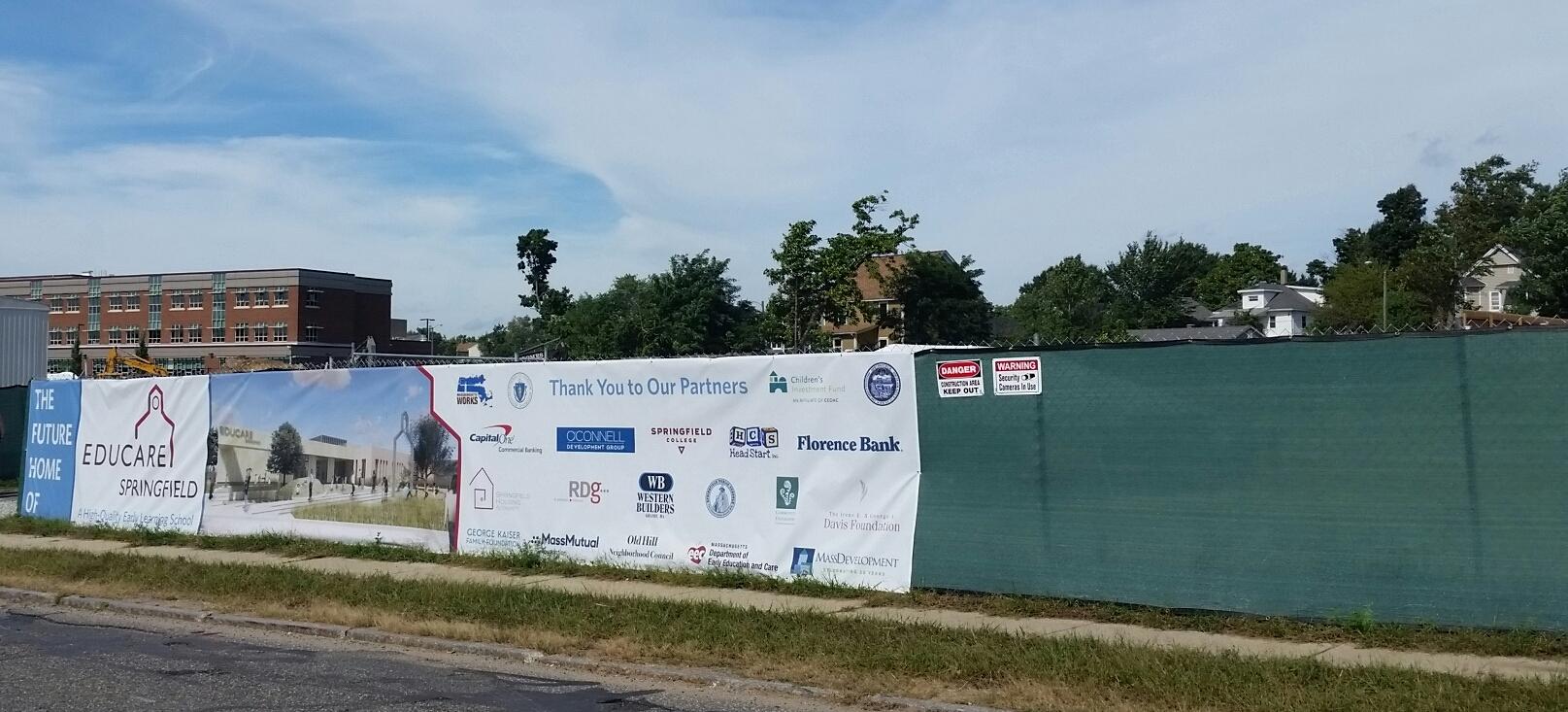
A $14 million state-of-the-art preschool is being developed by the Educare Learning Network in Springfield’s Old Hill neighborhood – one of the poorest urban areas in the country.

It is an ideal location because the goal of Educare, according to executive director Cynthia Jackson, is to “level the playing field” by helping children living in poverty start kindergarten prepared to learn at the same pace as other children.

“Our schools serve as places of innovation and learning,” said Jackson. “This is a learning lab. We don’t have all the answers. We are learning together.”

Among the innovations at Educare is the placement of teachers with the same children from the time they enroll as infants up to age 3.  Parents are required to participate in school activities, home visitations, and regular parent-teacher conferences.

The pre-school program began in Chicago in 2000.  There are now 23 Educare schools in 15 states.  Educare Springfield will be the first in Massachusetts.

“We know the work you will do here in Springfield, Massachusetts will inspire other communities across the country to do what is best and right for our young children and families,” said Jackson.

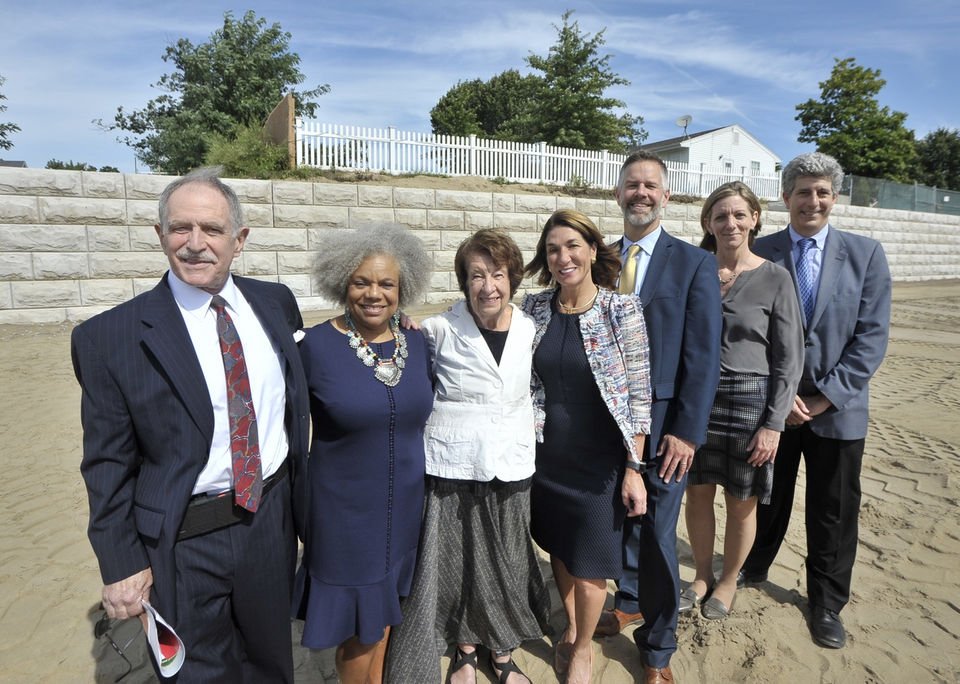
She  spoke at a groundbreaking ceremony Monday that was attended by close to 100 local and state officials, advocates for early childhood education, community leaders, and benefactors.

Tom Weber, Commissioner of the Massachusetts Department of Early Education, said despite the success the state has seen with rising test scores and graduation rates in the last 25 years, it still has one of the largest achievement gaps in the country.

” We have to take risks,” he said. “It is worth taking risks. If the solutions were obvious to us, we would have solved these problems already, so we have to be daring.”

Educare Springfield will be operated by Head Start.  Janis Santos, executive director of the local Head Start program said its one of the most exciting projects in her 45-year career in early education.

“It is just an incredible exciting opportunity here in Springfield and in the state of Massachusetts for our children and families,” said Santos.

The new preschool is scheduled to open in the fall of 2019 with an enrollment of 141 children.

The effort to bring an Educare school to Springfield was spearheaded by the Davis Foundation which put up some of the initial funding and raised money from several sources including $9 million from an anonymous donor.     In addition to the money to build the school, $7 million has been raised for an endowment to support operations.

Springfield College donated the land for the school.

Massachusetts put $1 million towards the construction of the school, and Lt. Gov. Karyn Polito Monday announced a $1 million award from the MassWorks program to build public infrastructure to support the new school.

“This is the way we do business in this Commonwealth,” said Polito. “We work together. We find collaborations and common ground and find the ability to get to ‘Yes’.”

Polito was filling in for Gov. Charlie Baker, who was in Lawrence for a meeting on the recovery efforts after last week’s gas explosions and fires.

The area where the new school is under construction was heavily damaged by a tornado seven years ago.

SourceWAMC

Springfield breaks ground on $14 million Educare early education facility

Local, city and state leaders joined early education advocates, and others Monday to officially break ground on Educare Springfield, a nationally recognized school model that is among just 24 of its kind in the country.

Lt. Gov. Karyn Polito, Springfield Mayor Domenic Sarno and project leaders gathered at a construction site on Hickory Street to celebrate the project’s groundbreaking and reflect on the seven years of work that went in to bringing the nearly $14 million facility to the city.

John Davis, a trustee of The Irene E. & George A. Davis Foundation which helped lead the effort to bring Educare to Springfield, said the new school will provide “an incredible opportunity for Springfield’s youngest citizens.

“Educare Springfield: It’s here,” he said. “This is a clear demonstration that we are investing in the education of the children beginning at birth.”

Polito praised local leaders and partners for their “incredible” work in attracting Educare to Springfield, particularly to a part of the city ravaged by the 2011 tornado.

“What you’re doing is rebuilding this neighborhood. Because these are children who are born here, literally, starting their education here and then being part — eventually, the hope is — of the workforce that will then become employed here in this neighborhood or nearby,” she said. “And then lay their own roots and create the next generation of talent, of leaders — really bringing this city forward to where we all know it could be.”

Polito said it’s “quite an honor” to partner with the city on effort.

Sarno welcomed Educare to Springfield, calling the project a “win-win opportunity” for the city.

“Educare is a significant investment here in the city of Springfield and it’s another public and private partnership, with everybody working together for the same goal for our children,” he said. “Giving them this foundation is going to allow them and their families to be able to avoid poverty, to avoid public safety issues — you just can’t put a price tag on that.”

Mary Walachy, executive director of the Irene E. & George A. Davis Foundation, said while officials had walked away from the project at one point out of cost concerns, they received $9.6 million in funding from an anonymous, out-of-state donor.

The project also received about $3.5 million in New Markets Tax Credits, a $1 million Early Education and Out of School Time grant and a $1 million MassWorks grant for public infrastructure work, as well as private and corporate support, Walachy said.

In addition to money raised for the project, she noted that officials have set aside $7 million for an endowment to support the school’s operating expenses.

“At the end of the day, what matters is what happens in this building. What matters is that we make good on our promise to the children that you were able to see today and their families, and many others who will be in this building,” she said. “This is going to be Head Start on steroids.”

Educare Springfield, which is slated to open in late 2019 on land provided by Springfield College adjacent to Brookings School, will offer local students an early education model that aims to narrow the achievement gap for children living in poverty. It will provide a full-day and full-year program for up to 141 children from birth to age five each year.

The Educare model incorporates embedded and ongoing professional development of teachers, intensive family engagement and high quality teaching practices, as well as uses data to advance student outcomes.

Educare, a national collaboration between the Buffett Early Childhood Fund, Ounce of Prevention Fund and other public-private partnerships across the country, has 23 schools located in 15 states and the District of Columbia.

SourceMassLive

State investing $1 million for Fall River CFC Head Start renovations

The little preschoolers in the Citizens for Citizens’ Head Start program probably won’t notice the new fire suppression system, windows or paint in the building, but their parents can feel good about those safety and aesthetic updates.

CFC was recently awarded a $1 million grant from the state’s Community Economic Development Assistance Corp. It was one of four $1 million capital improvement grants awarded state-wide to child care agencies that serve children from low-income families.

The grants, awarded on behalf of the Baker-Polito administration, are to make critical facility repairs and renovations to improve the environments used by young children.

“This floor will be renovated,” said Pamela Wildnauer, CFC’s Head Start and Early Head Start director, standing on the first level of the former Aldrich School, 295 Harrison St.

The Aldrich School was an elementary school built in 1920. CFC has been using the building since the 1980s for its Head Start program.

“We really haven’t had the funding to do much over the years,” Wildnauer said.

Some 200 children attend CFC Head Start in the Aldrich School building during the school year, just about to get underway after Labor Day. A smaller program runs during the summer.

Wildnauer said the school that has “great bones, great architecture” will be updated with a new electrical system, fire suppression system, fire doors, new flooring, and replacement windows.

“The opportunity presented itself for capital improvement funding,” Wildnauer said.

She said it would allow CFC to offer its families a high quality space for education that is “safe and healthy.”

Once the major repairs — to take place next summer — are finished, Wildnauer is hoping there will be funds left to update the basement for rainy-day activities when the children can’t go outside, for a conference room, and to enclose the kitchen.

The kitchen is used to prepare more than 400 meals each day for the children in Head Start programs at the Aldrich School, as well as CFC’s Robeson Street site, and other smaller sites in the city and in Swansea.

The basement space is also used for free GED classes for parents of Head Start children. Besides class, they receive free transportation, child care and meals.

Repairs were made to the second floor and playground last year with grant funding.

“It’s nice and homey, more comfortable,” said teacher assistant Dawn Mello, working to set up her second-floor classroom.

In the next phase, CFC will seek grant funding for a new heating and air conditioning system. Other repairs needed include a new roof at the Robeson Street building.

The three other child care facilities to receive a $1 million grant are located in Dorchester, Roxbury and Springfield. The grant was awarded by the Department of Early Education & Care through the Early Education & Care & Out of School Time Capital Fund.

“With these grants, we will improve the learning environments of our youngest children, boost the capacity of programs to serve more children and create new jobs,” Gov. Charlie Baker said in a press release. “Renovating and repairing facilities helps achieve our goal of improving the quality of early education and care.”

To learn more about CFC’s Head Start program, visit http://cfcinc.org.

Email Deborah Allard at dallard@heraldnews.com

SourceThe Herald News

Baker-Polito Administration Awards $4 Million for Early Education Programs

The Baker-Polito Administration and the Community Economic Development Assistance Corporation (CEDAC) today announced $4 million in grant awards for facility improvements at early education and care programs that serve low income children.  Four agencies were selected to receive an Early Education and Care and Out of School Time (EEOST) capital improvement grant, which will help increase the quality of their early education programs through critical facility repairs and renovations.

Governor Charlie Baker made the announcement today at the Crispus Attucks Children’s Center in Dorchester, the site of one of the facilities funded by the 2018 grant awards.

“With these grants, we will improve the learning environments of our youngest children, boost the capacity of programs to serve more children and create new jobs,” Governor Charlie Baker said.  “Renovating and repairing facilities helps achieve our goal of improving the quality of early education and care.”

“These capital improvement grants support facility construction and renovations that modernize early education spaces and provide more enriching environments for children,” Lt. Governor Karyn Polito said. “High-quality programs help young children develop healthy learning habits, which is good for the community and for our Commonwealth as a whole.”

“We know that building deficiencies impact the quality of teaching and learning in early childhood and out-of-school time facilities,” Education Secretary James Peyser said. “These grants were created to help non-profit providers serving children living in low-income communities improve their facilities.”

The Early Education and Care and Out of School Time capital improvement grants are financed through the state’s capital budget and provide matching funds that leverage private investment.  The Baker-Polito Administration’s FY18 Capital Budget Plan included $4 million for the Early Education and Out of School Time grant program.  In May, Governor Baker signed An Act Financing the Production and Preservation of Housing for Low and Moderate Income Residents (H.4536), which authorized $45 million for the EEOST Capital Fund.

“The EEOST capital improvement grants provide critical funding for non-profit early education programs to upgrade their facility spaces and provide better physical environments for the children they serve,” Early Education and Care Commissioner Tom Weber said.  “We are pleased to make these awards as this public investment in building construction and renovation of early education programs will benefit children, local communities, and the state for years to come.”

“The EEOST Capital Fund is helping providers create well-designed facilities that support children’s healthy development and learning, and the commitment and effectiveness of educators,” said Theresa Jordan, Director of Children’s Facilities Finance of Children’s Investment Fund. “Over time, this innovative capital resource has the potential to transform the early care and education and out-of-school time landscape for the neediest and most vulnerable children in the Commonwealth.”

The following organizations received grants:

Lead Agency Service Area Award
Citizens for Citizens Fall River $1,000,000
Crispus Attucks Children’s Center Dorchester $1,000,000
Elizabeth Stone House Roxbury $1,000,000
Holyoke-Chicopee-Springfield Head Start Springfield $1,000,000

“All of us at Crispus Attucks Children’s Center are grateful, excited and humbled to be receiving generous and much-needed funding from the Department of Early Education and Care,” said Maritza Juliao, Executive Director of Crispus Attucks Children’s Center.  “For nearly fifty years, Crispus Attucks has been providing quality early childhood education at an affordable price to some of Boston’s most vulnerable children and families.  Our facilities are in critical need of upgrades and improvements so that we may sustain our mission, and this grant will enable us to give our buildings the attention they need so that we as educators can focus our attention on our dearest assets: the children and families we serve.”

All of the programs selected to receive a grant award serve publicly subsidized families, have demonstrated financial need, and have secured additional funding to pay for a portion of their project costs.  The Department of Early Education and Care partnered with CEDAC’s affiliate, the Children’s Investment Fund, to administer the grant awards.  All of the grantees are non-profit corporations or organizations in which a non-profit corporation has a controlling interest.

###

SourceGovernor's Office

YWCA rejoices as expansion set to start Monday in New Bedford

NEW BEDFORD — Jovial voices filled the yard at the YWCA in downtown New Bedford on Friday as supporters gathered to celebrate an expansion 16 years in the making.

“I’m beyond excited,” executive director Gail Fortes said. “It’s almost unbelievable.”

The YWCA Southeastern Massachusetts held a ceremonial groundbreaking for a 6,500-square-foot, two-story addition that will allow the organization to bring its after-school child care and supportive women’s housing — now spread out in other locations — under one roof.

Construction is slated to start Monday at the historic Levi Standish House at 20 S. Sixth St. The work should last about 10 months, Fortes said.

The project will create purpose-built spaces designed to suit the needs of the programs, allow for better coordination of staff time and services, and eliminate the cost of renting space elsewhere, according to YWCA staff and current and former board members.

An earlier plan for a three-story, 12,000-square-foot expansion was pared back to two stories to get the project off the ground. The basement of the original building will be renovated for child-care classrooms to make up for the lost space, Fortes said.

The groundbreaking opened with thank-yous by Fortes, board president Juli Parker and others.

Parker said she felt honored to participate, but she wanted to recognize the work of many previous YWCA leaders.

“There are so many women who came before me to get to this place,” she said.

The child care program, YWkids, will serve 50 children ages 5 to 13. The second floor of the new wing will hold the housing, with eight single bedrooms for low-income women who are employed and/or attending school full time.

Parker said the three-part project started in 2002 with a feasibility study under then-president Dr. Patricia Andrade and the executive director at the time, Yvonne Drayton. That study led to the Under One Roof campaign.

Phase 1 of the campaign included raising $750,000 to address much-needed work on the Levi Standish House. Phase 2, completed in 2006, raised more than $250,000 for additional updates to the existing building, including exterior work.

The new wing is Phase 3. Raising the necessary $4.2 million wasn’t easy, Parker said. It came from numerous sources, and she credited Fortes for her strong grant-writing ability.

Fortes in turn gave credit to state Sen. Mark Montigny and state Rep. Antonio Cabral, both New Bedford Democrats, for securing $1 million that catapulted the YWCA toward getting the building funded.

Referring to the national YWCA slogan, “Eliminating racism. Empowering women,” Montigny said, “Perhaps it should continue, and we should say, ‘loving children and enlightening men,’” because he recalls learning important life lessons at YWCA swim lessons as a boy.

Other speakers at the groundbreaking included Cabral, New Bedford Mayor Jon Mitchell, City Council President Linda Morad, Roger Herzog of the Community Economic Development Assistance Corp., Theresa Jordan of the Children’s Investment Fund, and Susan Terrey of the Massachusetts Department of Housing and Community Development.

On-site child care for the women in residence was a big selling point of the project, Terrey said.

Drayton, the former YWCA director, said she wouldn’t have missed the groundbreaking.

“It’s a big accomplishment to stay in the center of the city and provide the services that will be provided,” she said.

Follow Jennette Barnes on Twitter @jbarnesnews.

SourceSouthCoast Today

Massachusetts’ Financing For Child Care Providers A Model For Other States

Roger Herzog

Roger Herzog

The statistics are troubling. The United States ranks 36th out of 40 developed nations for the percentage of 3- to 5-year-olds enrolled in “pre-primary” or primary school. Enrollment rates vary widely across the U.S.; for example, 59 percent of 3- and 4-year-olds are enrolled in a formal early education and care program in Massachusetts, as compared to 37 percent of 3- and 4-year-olds in Arizona, according to 2013-2015 National KIDS COUNT data. Lack of access to early education and care, especially for families living in low-income communities, is complicated and involves a number of factors. But at least one of those factors is available and appropriate physical space, and that is a problem that Massachusetts has set out to solve.

Theresa Jordan

Theresa Jordan

Massachusetts in 2013 became only the second state to make state bond financing available to improve the quality of early education and out-of-school time facilities – and we were the first to include it in a larger community development bond bill. In the four years since the Early Education and Out of School Time (EEOST) Capital Fund was launched, the Massachusetts Department of Early Education and Care (EEC) has awarded over $15 million to 21 nonprofit early care providers across the commonwealth. As EEOST enters its fifth year, the Legislature is considering a $45 million reauthorization for the next five years as a part of the Housing Bond Bill filed earlier this year.

CEDAC and our affiliate, Children’s Investment Fund, last month laid out the challenges child care providers face in trying to create high-quality learning space – and the success that Massachusetts has achieved because of EEOST – at the annual Opportunity Finance Network (OFN) conference in Washington, DC. OFN is the leading national network of community development financial institutions (CDFIs) investing in opportunities that benefit low-income, low-wealth, and other disinvested communities in the U.S. CDFI representatives from Detroit and San Francisco also presented worthwhile public capital financing opportunities that benefit child care providers.

In lower-income neighborhoods from Boston to Detroit to San Francisco, the difficulties in upgrading child care facilities are similar. Providers need capital to repair and maintain learning sites, to improve and renovate classroom space, and to build and expand facilities. But the barriers to capital are substantial: many providers have low operating margins and little to no reserves. Their ability to generate private donations is limited and their capacity to manage a building process is similarly challenged. As with nonprofit affordable housing developers, providers need financial support in the early stages to get their projects going, and require technical assistance throughout the development process to meet their goals.

A Model In Massachusetts

The United Way of Massachusetts Bay and Merrimack Valley, the Ford Foundation and the Hyams Foundation created the Children’s Investment Fund in 1991 to help providers address these facility challenges. Since then, the fund has provided loans and grants, training and technical assistance to child care providers planning to create high-quality space. Six years ago, CEDAC and the fund recognized the demand for quality child care facilities was far outstripping the supply and that early care providers needed a new source of public capital funding if the commonwealth was going to maintain its educational and economic competitiveness.

While still in its own early stages, the successes of the EEOST Capital Fund are clear. In a competitive process, providers apply for grants up to $1 million to improve or create new facilities. The program is managed by EEC and CEDAC along with the fund. With 21 projects already funded, more than 2,000 children will be impacted, and nearly 450 new child care slots will be created. Eighty-six percent of these children come from low-income families. More than 360 construction jobs and more than 30 educator jobs are being generated. The public financing is leveraging an additional $36 million in private investment. There is strong demand for this capital funding – since 2014, requests from applicants to EEOST totaled $37.8 million with $15 million available for funding.

Programs with results like these are worthy of replication. EEOST is a model that other states can follow if they are willing to make a commitment to funding early education and care. While it won’t solve all of the challenges associated with access to care, it eases the burdens that the state and the providers face when it comes to one significant obstacle – accessible funds for high-quality learning facilities. And it shows that once again, Massachusetts is an innovator when it comes to strengthening communities.

Roger Herzog is the executive director of the Community Economic Development Assistance Corporation. Theresa Jordan is director of Children’s Facilities Finance for Children’s Investment Fund.

Massachusetts’ Financing For Child Care Providers A Model For Other States

SourceBanker & Tradesman

Renovations at 66 Berkeley Street Completed

Ellis is proud to announce that it’s historic building at 66 Berkeley Street opened on June 26, 2017, after significant renovations to the facility. The building has been owned by Ellis since 1924 and now houses education and care programs for children ages two months through 12 years old. The Boston-based nonprofit, which celebrated its 130th anniversary in 2015, serves inner city working families with programs ranging from early education and care to afterschool and summer programs for School-Age youth and a day program for vulnerable adults.

With the renovation of the building, Ellis is able to expand its Early Education Program to support an additional 32 families and provide newly designed space for the 60 children enrolled in its School-Age Program. Announcing the grand opening, CEO Leo Delaney said, “Renovating 66 Berkeley has been an important milestone in Ellis history, capping the close of a three part capital investment in our community space here in Boston’s South End. The leadership of our Board of Directors and the support from Boston’s philanthropic community have been the keys to this project’s success.”

Ellis’ three part capital campaign began with the creation of the Ellis Children’s Park, which turned a vacant lot on Chandler Street into a playground for very young children. In the second phase, Ellis acquired and renovated an abandoned building to create a state of the art Early Education Center. With the close of the campaign and completion of renovations to their historic 66 Berkeley Street building, the agency has created an Ellis campus in the South End. The renovations were made possible through the support of CEDAC and its affiliate, Children’s Investment Fund (CIF), a $800,000 grant from the state’s Early Education and Care and Out-of-School Time (EEOST) Capital Fund, corporate partners, community foundations, and individual donors.

To see full photo galleries of the transformation of 66 Berkeley Street and our grand opening events, please click here.

SourceEllis Memorial Newsletter

Housing Bond Bill Advances Reauthorizations of Community Investment Tax Credit and Early Education and Out-of-School-Time Capital Fund

United Way praised the Joint Committee on Housing for including two key provisions in the Housing Bond Bill that advanced today on Beacon Hill that would strengthen neighborhoods and early education programs.  The Housing Bond Bill, a comprehensive package aimed at helping more individuals and families secure safe, affordable housing, included reauthorizations of two successful programs: the Community Investment Tax Credit and the Early Education and Out of School Time Capital Fund.

“The legislation reported out favorably today by the Joint Committee on Housing recognizes the comprehensive approach needed to ensure neighborhoods and communities thrive,” said Michael K. Durkin, President and CEO at United Way of Massachusetts Bay and Merrimack Valley. “More affordable housing is critical, but communities also need high-quality affordable child care and healthy economies. Reauthorization of the Community Investment Tax Credit and the EEOST Capital Fund are positive steps toward advancing economic and neighborhood development in low-income communities.”

The Early Education and Out of School Time Capital Fund (EEOST) program is a unique source of funding for early education and care and afterschool programs throughout the Commonwealth. It supports major renovation and construction projects for facilities serving low-income children. Since the passage of the Housing Bond Bill in 2013, legislation that included a $45 million bond authorization to create the fund to improve the quality of center-based facilities, the EEOST Capital Fund has distributed over $15 million to help organizations modernize their space and improve the quality of the learning environments for children.

“The Commonwealth needs an improved and expanded supply of facilities to meet the demands of families across the state who are looking for convenient, high quality centers for their children,” said Durkin. “High quality, professional facilities, projects that better utilize existing facilities, and those that add additional space for planning and professional development, will allow the Commonwealth to best compete and retain top tier educators.”

The Housing Bond Bill reported out today also includes reauthorization of the Community Investment Tax Credit, which provides a 50% state tax credit for private donations to support the work of community development corporations across Massachusetts.  Since the program’s inception in 2014, United Way has raised over $4 million from donors to support CDCs across the state through the Community Investment Tax Credit (CITC). Nearly $24 million has been raised to support CDCs statewide.

“Every day, in neighborhoods and cities across the Commonwealth, Community Development Corporations (CDCs) are working hard to spur affordable housing and job creation, incubate small businesses and revitalize neighborhoods,” Durkin said. “CDC’s are an important source of innovation. The CITC Program is helping to greatly accelerate and deepen their work, as well as provide new and sustainable sources of funding.”

The Housing Bond bill will now advance to the House Committee on Bonding.

https://unitedwaymassbay.org/news/housing-bond-bill-advances-reauthorizations-of-community-investment-tax-credit-and-early-education-and-out-of-school-time-capital-fund/

SourceUnited Way of Massachusetts Bay and Merrimack Valley

New Facilities Funding for Early Education Programs in Massachusetts

Massachusetts has just announced the release of $4.1 million in facilities grants. Typically, these funds help early education and after school programs repair, renovate, and expand their buildings. This round of funding will focus on early education and care facilities that serve low-income children.

“Lieutenant Governor Karyn Polito made the announcement at the Worcester Community Action Council’s (WCAC) early education program in Webster, the site of one of the facilities funded by the 2017 grant awards,” according to a press release from the state’s Executive Office of Education.

“Facility improvements like these, coupled with an already announced 6 percent rate increase for early education providers, ensure that more children have access to high-quality environments and staff that will improve their learning experience,” Governor Charlie Baker added.

The five grant recipients are Child Care of the Berkshires, Belchertown Day School, Inc., Action for Boston Community Development, the YWCA of Southeastern Massachusetts, and the previously mentioned Worcester Community Action Council. An estimated 301 children will benefit from this investment.

Worcester’s project is a building conversion. The Telegram and Gazette reports:

“Ever since the roof of a Head Start program in Oxford collapsed under extreme winter conditions in 2015, dozens of Webster children have had to use a Head Start program in Southbridge.” So, the Worcester Community Action Council is using its grant to turn a former senior center into a Head Start facility that’s slated to open in the fall of 2018.

The need for this investment was documented in a 2011 report from the Children’s Investment Fund, part of CEDAC, the Community Economic Development Assistance Corporation. CEDAC also administers the state’s facilities funding grants.

For children, the impact is substantial. As Tom Weber, commissioner of the Department of Early Education and Care, says in the press release, “Thoughtfully designed and developmentally-appropriate environments help children learn and grow successfully.”

“This strategic investment of public resources helps early education and out-of-school time programs leverage private funding to create high-quality learning spaces for children that otherwise might be out of reach.”

https://eyeonearlyeducation.com/2017/09/13/new-facilities-funding-for-early-education-programs-in-massachusetts/

SourceEye on Early Education

Worcester early education center serving at-risk students unveils new playspaces

Rotting wood and rusted bolts at the Rainbow Child Development Center’s old play area have been replaced by brand-new playsets, thanks to the generosity of donors and a six-figure government grant.

Just as important, said officials at the Edward Street-based early education and after-school center, which serves disadvantaged children in the area, the gleaming playground introduced at a ceremony on Friday will enable safer, better playtime for those kids and, in the process, hopefully help close an achievement gap separating them and their more well-off peers.

“We know you have to have healthy, happy children for them to thrive academically,” said the center’s executive director, Joyce Rowell, who explained the Rainbow Center has adopted a range of new programs and activities aimed at instilling healthy living habits in its students and their families. “It’s a whole mindset we’re trying to work on together.”

Unlike many private preschool centers, however, the Rainbow Center cannot rely on its clients to pay for those initiatives. It primarily serves low-income and single-parent families living in some of the area’s poorest neighborhoods, as well as students under the care of the Massachusetts Department of Children and Families, and derives around 85 percent of its funding from the state.

The problem is not unique to the Rainbow Center, according to state officials; a recent study undertaken by the Community Economic Development Assistance Corporation’s Children’s Investment Fund identified “shortcomings at many of the centers” around the state serving similar populations, said Bree Horowitz, senior project manager at the fund.

In response, the state established the Early Education and Out of School Time Capital Fund Program, which has provided millions of dollars over the past three years for infrastructure improvement projects at childcare centers across Massachusetts. The Rainbow Center was among them, applying for and receiving a $200,000 grant last year.

The center put that funding toward its play area project this year, which was still largely paid for through a capital campaign. The total work, costing around $750,000, required a major overhaul of the center’s rear property, including the removal of three utility poles, as well as the replacement of the old playset, which had recently been deemed unsafe for children to use.

On Friday, the center unveiled the new playground, which includes a playset and other activity stations for its younger students, as well as an obstacle course for the older students who enroll in the outside-school-hours program.

“It’s not an ordinary place to play, it’s not an ordinary playground,” primarily because it’s not for ordinary students, said Dr. Marianne Felice, a pediatrician and co-chairwoman of the Rainbow Center’s capital campaign for the project. “It’s not like going out in your backyard (to play) – these children need special kinds of space and special activities to stimulate them.”

That philosophy extends to other areas of the center’s educational model, pointed out Nancy Thibault, its strategic communication and development manager, who said many of the students there “are victims of adverse experiences every day.” Providing them a routine, avoiding the triggers that make them upset – there’s no yelling, Ms. Thibault said – and making them feel safe are all part of the Rainbow Center’s approach.

While it currently serves 250 students in total, 54 of whom are in the preschool program, “we could serve more children if we could fill additional staff (positions),” said Ms. Rowell. But like many early childhood centers, especially those dependent on government funding, the Rainbow Center struggles to attract staff, who only earn $12 to $16 an hour for a job that requires a college degree.

“We put a lot of demands on our early educators – as soon as they reach the benchmarks (necessary for the job), they’re leaving to go into the public (school) systems, where the support and benefits are much higher,” said state Sen. Michael O. Moore, who spoke at Friday’s playground ceremony. “It’s a vicious cycle,” he added, one that ultimately harms students, who are most closely affected by the industry’s high staff turnover rate.

Ms. Thibault said it’s taken a “team effort” from the Rainbow Center and its network of donors to build a robust financial support system for the center’s many initiatives. But when it comes to the central task of running an early childhood center, “the state does need to step up” its support as well, Ms. Rowell said.

According to Thomas Weber, commissioner of the state’s Early Education and Care Department, it has; the state increased its subsidy rate to centers serving at-risk students over the past few years, and is bumping it up 6 percent this year alone, he said. But he acknowledged alleviating the industry’s workforce issues remains “priority 1A for us.”

“We’ve been really working to try to enhance what we’re able to provide through subsidy support,” in addition to the “unprecedented” step of finally providing a capital fund program for the state’s early childhood centers, he said. “We’re making progress.”

http://www.telegram.com/news/20170908/worcester-early-education-center-serving-at-risk-students-unveils-new-playspaces

SourceWorcester Telegram