Landmark Agreement Reached to Preserve Affordable Housing in the South End

Mayor Martin J. Walsh together with LIHC Investment Group, one the nation’s largest investors in affordable housing, the Boston Housing Authority, Mass Alliance of HUD Tenants (MAHT), and Greater Boston Legal Services (GBLS), today announced HUD approval of a creative plan to keep Concord Houses in the South End affordable for at least the next 40 years, with the support of the building’s tenants.

“As we build more affordable housing, it is critical that we do not lose sight of the need to preserve Boston’s inventory of income-restricted housing,” said Mayor Martin J. Walsh. “This agreement marks a positive resolution reached to keep these residents in their homes for decades to come. I thank all the residents for their advocacy, and all partners involved who helped ensure the long-term affordability and viability of the Concord Houses.”

“This agreement is the culmination of a multi-year effort to establish a new HUD program that will protect current and future residents of Concord Houses while providing funds for repairs and upgrades throughout the property,” said Charlie Gendron, Principal, LIHC Investment Group. “We appreciate the support we received from the tenants; Congress, especially the efforts of Sen. Susan Collins; HUD; the City of Boston; BHA; MAHT; and GBLS in our drive to preserve this property for future generations.”

Spanning two buildings located at 705-715 Tremont Street in the heart of the South End, Concord Houses has served as an important source of income-restricted housing in the South End for decades. In 2017, the HUD subsidy provisions governing the property expired, putting it at risk of losing its long-term affordability.

Of the 181 households at Concord Houses, 171-or 95 percent of households-chose to sign a waiver to convert their Enhanced Vouchers (EVs) to a new project-based rental assistance (PBRA) contract to make the plan work. The new HUD contract ensures homes at Concord Houses will be reserved for individuals earning no more than 80 percent area median income (AMI) and is renewable for a total of 40 years.

The agreement also guarantees that current and future tenants pay no more than 30 percent of their income toward rent, which will actually reduce the rent burden for 30 existing households at the property. The remaining ten households will receive rent protections in the form of EVs administered by BHA.

“Preserving units of affordable housing like those at Concord House is a key element of Boston’s housing strategy,” said Roger Herzog, Executive Director of the Community Economic Development Assistance Corporation (CEDAC), which works closely with DND on preservation issues and provided technical assistance in this case. “Congratulations to the City of Boston, the project residents, and LIHC Investment Group, and their partners, for thinking creatively to find a way to keep Concord House affordable for individuals and families in the South End.”

“It’s a dream to secure permanently affordable housing here — not just for ourselves, but other people who will be here long after we’re gone,” said Pauline Durant, 85, a 20-year resident of Concord Houses and member of the Concord Houses Tenants Association. “It’s been a long journey. When tenants stay together and fight, we win!”

“We’re very elated by this victory,” added Adella Quinn, 76, a retiree from Fidelity Investments and 24-year resident of Concord Houses. “We’re losing too many people in the South End who are assets to the neighborhood due to rising rents. We need to come up with more ways like this to keep our community affordable.”

“This is an historic victory,” commented Michael Kane, Director of MAHT, which helped the tenants organize. Since 1983, MAHT has saved more than 12,450 homes like Concord Houses as affordable housing, one building at a time, through tenant organizing. “Saving affordable housing in the heart of the South End will help maintain the neighborhood’s racial and economic diversity well into the future. The 171 tenants who signed up to preserve their apartments are to be commended for making this possible.” Kane also lauded LIHC and the City of Boston for supporting the tenants’ preservation plan and working creatively with Congress and HUD to make it work.

Attorneys for GBLS, Susan Hegel and Ann Jochnick, said they are pleased with the creative and collaborative process, which resulted in preserving much-needed affordable housing in the South End. “It’s a win for current and future tenants, a win for the city and a win for the owner.  We hope that this may serve as a model for future preservation efforts.”

LIHC Investment Group is undertaking a $7 million repair and capital improvement campaign at the property, which includes a new entry system and security cameras; flooring and ceiling replacement; lighting upgrades in the building’s common areas; and exterior work ranging from masonry repair to new fencing and landscaping. Under LIHC’s ownership, apartments in the building have already received new kitchen cabinets, granite countertops and appliances; upgraded bathroom fixtures, tubs, and tiles; and vinyl plank flooring.

About the City of Boston’s Housing Agenda

In 2018, Mayor Martin J. Walsh updated his comprehensive housing strategy, Housing A Changing City: Boston 2030 to increase the City’s overall housing goal from 53,000 to 69,000 new units by 2030, including 15,820 new income-restricted units, to meet Boston’s population growth. In addition, the updated plan also set a goal to preserve 85 percent of Boston’s most at-risk privately-owned affordable units, like those at Concord House. Mayor Walsh’s recently announced housing security legislative package focuses on expanding upon the work that Boston has done to address the region’s affordable housing crisis by proposing new and strengthening current tools to create more ways to leverage Boston’s prosperity and create sustainable wealth opportunities that make Boston a more inclusive and equitable city. The housing security bills proposed for the 2019 Legislature seek to help existing tenants like those at Concord House, particularly the elderly, remain in their homes, and creates additional funding for affordable housing.

About LIHC Investment Group

Based in Portland, Maine, LIHC Investment Group has been active in the Greater Boston housing market for over two decades. In July 2017, the company donated its ownership stake in the Close Building, a 61-unit affordable housing community in Cambridge, ­to the nonprofit Just-A-Start Corporation, which develops, own and maintains affordable housing; provides housing resources and services; and offers education and workforce training for youth and adults in Boston. In August 2017, LIHC and Weston Associates forged an agreement to keep 380 homes at Shore Plaza Apartments in East Boston affordable and have since completed a major capital repair campaign for the property.

SourceMayor's Office

MHP, CEDAC kick off 2nd Worcester CDC series

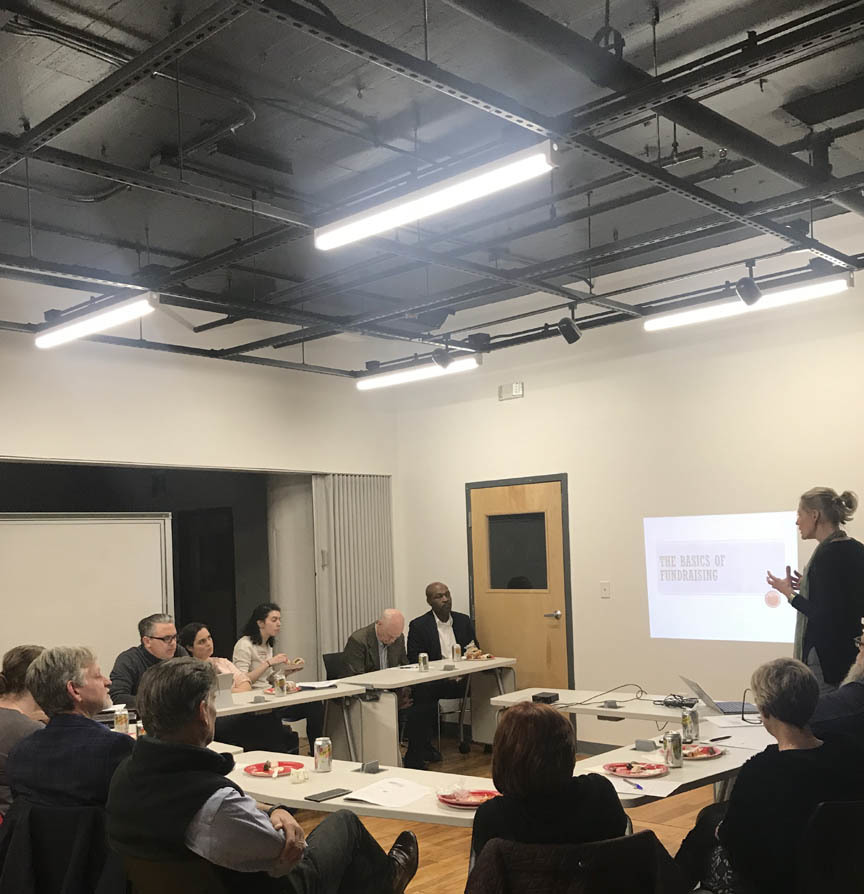
A second series of workshops aimed at helping Worcester’s community development organizations (CDCs) build capacity began this week with a session on fundraising.

Held on January 9 at the Worcester Clean Tech Incubator, the event featured presentations by fundraising consultant Sarah Tanner and John Fitterer of the Massachusetts Association of Community Development Corporations. Fitterer talked about how CDCs have raised funds through the state’s Community Investment Tax Credit Program.

The event was attended by board and/or staff members from the Oak Hill CDC, the East Side CDC, Main South CDC, Worcester Common Ground and Centro Inc.

Sponsored by the Massachusetts Housing Partnership, the Community Economic Development Assistance Corporation (CEDAC) and Clark University, the 2019 training series is planning future sessions on public health and housing, board development and training, collaboration and partnership models and taxes.

In 2018, CEDAC, MHP and Clark hosted two-hour workshops on financial reporting, board development, asset management and collaboration.

The January 9 session on fundraising was preceded by a dinner and networking event hosted by Lionel Romaine of CEDAC, Kate Bosse of MHP and Kathyrn Madden, an urban planner and visiting lecturer at Clark University who has over 25 years of experience helping cities and institutions shape their future development.

The CDC workshop series builds upon CEDAC and MHP’s longstanding support of Worcester CDCs and neighborhoods. MHP efforts include supporting rental development and homeownership efforts of Worcester Common Ground, the Main South CDC and in the Bell Hill-East Side neighborhood in collaboration with the East Side CDC and UMass Memorial Hospital.

In all cases, MHP used its ability to bring in private financing to support community reinvestment through its bank-funded loan pool and its ONE Mortgage Program for low- and moderate-income first-time buyers. MHP has used its bank-funded loan pool to provide $16.9 million in loans and commitments for the financing of 32 rental projects and 521 apartments, 367 of them affordable. MHP’s ONE Mortgage Program has helped 816 low- and-moderate-income households in Worcester purchase their first home, generating $125.6 million in private mortgage financing from participating banks. About 69 percent of those buyers had incomes below 80 percent of area median income.

For more information about this program and MHP’s community assistance work with CDCs, contact Katie Bosse at kbosse@mhp.net or 617-330-9944 x128.

SourceMHP News

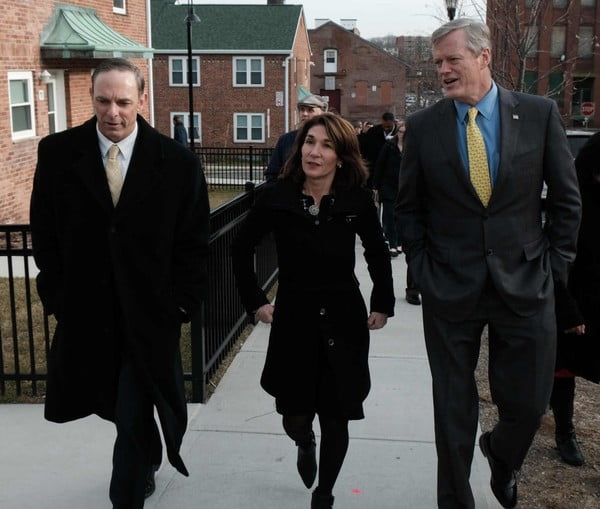
Massachusetts Gov. Charlie Baker, Lt. Gov. Karyn Polito ‘Focus on Housing’ during Holyoke visit

Gov. Charlie Baker and Lt. Gov. Karyn Polito stressed a “Focus on Housing” in Massachusetts during a tour Friday of Lyman Terrace, a 167-unit complex undergoing a $60 million transformation.

Baker and Polito crossed the state a day after the start of their second term in office. Baker and his team made stops in Lee, Springfield, Worcester and the one-hour appearance in Holyoke.

Lyman Terrace, built as Depression era housing in 1939, nearly faced the wrecking ball only a few years back. Tenants, local groups and city government opposed the demolition scheme, favoring a wholesale renovation of the then cramped, below standard apartments.

The Holyoke Housing Authority owns and operates Lyman Terrace, located a short walk from City Hall.

Baker said the state continues to fall short in meeting future housing needs. He visited Lyman Terrace in the summer of 2015. “The road and the journey to get to this point is a long and difficult one,” he said.

The governor said the project experienced “fits and starts,” delays and rejiggering the final vision for Lyman Terrace. “We don’t invest in things we don’t think are going to be successful,” he said.

Baker said his administration examines a project’s worthiness, the team in place and if there is widespread support. “I don’t want to make empty promises. I don’t want us to engage in commitments we can’t deliver on,” he said.

He wants to ensure projects like Lyman Terrace are fully funded and ready to commence.

“This was an important stop for the both of us,” Baker said. “It reflects a lot of key issues and opportunities associated with not only the way we think about housing but the way we think about community building, community development, and partnerships and possibilities.”

Baker called for passage of a new housing bill in the current term. “We in Massachusetts struggle to build housing. We just do,” he said. “Some of it’s the way the game is played. Some of it’s the way the rules are set up. Some of it’s we don’t appreciate the holistic issues that are at play here.”

The governor wants more cooperation in meeting the housing needs for future generations. “If we don’t, the supply we have is never going make it,” he said.

Polito wanted to highlight the impacts housing and economic and community development have on a community. She said the city partnered with state agencies and local nonprofits to make the Lyman Terrace renovations possible.

Matthew A. Mainville, the Holyoke Housing Authority executive director, led Baker, Polito and state housing officials on the tour, which included viewing a pre-renovated unit in need of serious repair and a newly renovated apartment occupied by Sonia Gonzalez, a longtime resident who led the effort to save Lyman Terrace.

Mainville said 88 of the 167 one-and-two bedrooms apartments are reoccupied. The apartments contain new kitchen appliances, wood-laminated floors, washers and dryers, updated bathrooms, energy-efficient windows and more secure doors.

A series of federal and state housing grants and tax credits support the project, including grants from MassWorks. The housing authority obtained an additional $20 million in funding to build a community center at Lyman Terrace.

Mainville said the administration is a model for bipartisan cooperation, which their “federal counterparts could learn from.” He said the Baker-Polito Administration identifies critical issues germane to Massachusetts, such as housing, education, and economic development

“The Baker-Polito Administration understands that without good housing, achieving one’s goals becomes infinitely more difficult,” Mainville said. Without good housing, succeeding in school, living a healthy lifestyle or obtaining gainful employment is nearly impossible.”

In 2018, the Baker Administration pushed and secured a $1.8 billion affordable housing bond, the largest in the commonwealth’s history. The state allocated $600 million for public housing modernization and redevelopment, which included a boost in housing subsidies.

Mainville said Lyman Terrace represents the positive effect such funding has on a community. He said the complex now offers stable housing for residents.

The Holyoke Housing Authority partnered with Community Builders, a Northampton nonprofit, on the Lyman Terrace project.

Housing authority commissioners, state Rep. Aaron Vega, D-Holyoke, and Marcos Marrero, the director of the Holyoke Economic and Planning Department, were in attendance.

SourceMassLive

New housing opens in Hyde Park, Affordable development is first in 20 yrs

It took the Southwest Boston Community Development Corporation more than 20 years to see its 27-unit all-affordable housing building through to completion, so when Mayor Martin Walsh and leadership from the organization cut the ribbon on the development last Thursday, it was a big deal.

The Residences at Fairmount Station is a $12 million four-story building nestled between the Fairmount Station commuter rail stop and Fairmount Avenue, with 24 of its units affordable to families earning 60 percent of the area median income or below. The building contains a mixture of studios, one-, two- and three-bedroom units.

The development faced fierce pushback from Hyde Park residents when it was first proposed during the late 1990s, said SBCDC board member Diana Kelley.

“The community voted it down,” she said.

Then-Mayor Thomas Menino’s administration did not push for the development, which the CDC had originally proposed for another site, but instead steered the project to the Fairmount site, at that time a collection of dilapidated industrial buildings. That move kicked off a nearly-10-year process during which the CDC pieced together the parcel of land from private owners and the MBTA, while at the same time negotiating with neighbors over issues including the size of the building and the amount of parking.

“I don’t know that you can build affordable housing in any neighborhood and not encounter some opposition,” Kelley said. “What’s important is that we were able to get some compromises.”

Among the compromises, plans were altered to include three units available for families earning up to 70 percent of the area median income, up from 60 percent. A playground that abutters felt was too close to the MBTA tracks was moved to the opposite side of the building.

The end result is a building affordable to households earning $21,000 to $58,000, said SBCDC Board President Mimi Turchinetz, addressing elected officials and neighborhood residents gathered for the ribbon cutting Thursday.

“The units are affordable to the majority of residents of Hyde Park,” she noted.

Demand for the units is substantial, with more than 2,700 applications submitted for the 27 available units.

“The need for affordable housing that’s kid-friendly is enormous,” Turchinetz said.

Mayor Martin Walsh said the building fits into the city’s goals to increase the amount of affordable housing available as rents increase in neighborhoods along the Fairmount Line Corridor — the commuter rail line that cuts through Hyde Park, Mattapan, Dorchester and Roxbury, with new stops in many of those neighborhoods.

Walsh administration officials hope the transit line will spur new economic development in the southwestern part of the city.

“We want inclusive development,” Walsh said. “We want transit-oriented development. We want development without displacement.”

Walsh said the new building would also support businesses in the Cleary Square commercial district in Hyde Park.

“You can’t have a thriving business district if you don’t have people there,” he said.

The affordable development was made possible in part by a City of Boston contribution of more than $1.7 million. This contribution enabled the development team to take advantage of more than $2.5 million from the state’s Department of Housing and Community Development. The state also provided an allocation of almost $1.5 million in federal Low-Income Housing Tax Credits that helped raise over $4.7 million in equity from National Equity Fund, the equity investor in the project. Webster Bank provided a construction loan, with MassHousing providing long-term permanent financing. The Community Economic Development Assistance Corporation and the Equitable Transit-Oriented Development Accelerator Fund at LISC Boston provided critical pre-development and acquisition funding to secure the site.

SourceBay State Banner

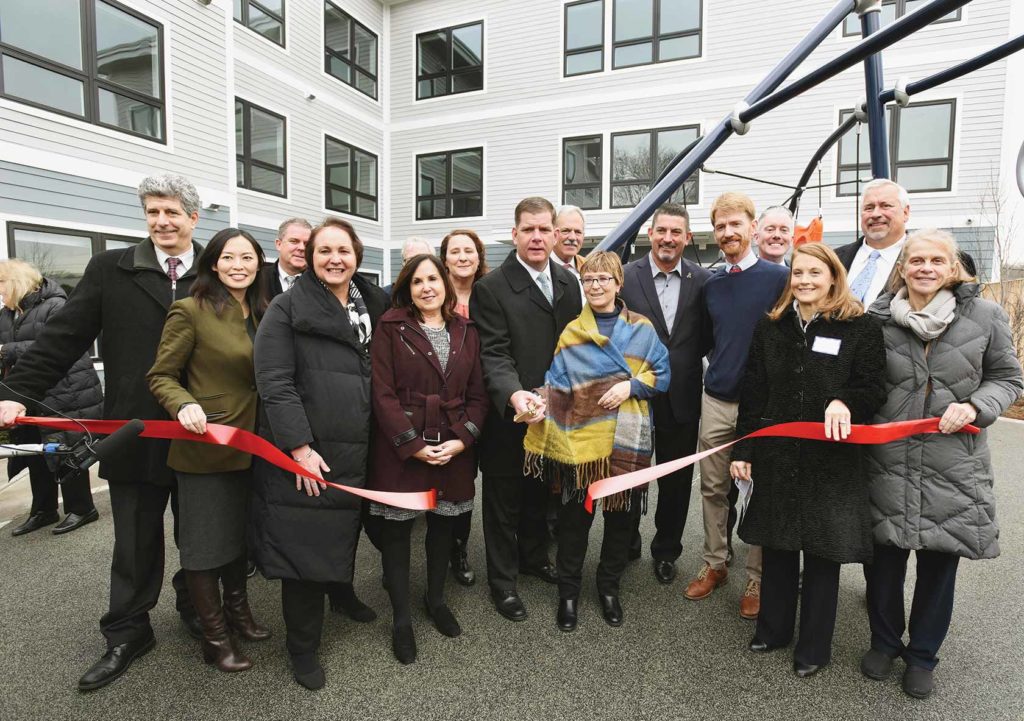
Mayor Walsh, Southwest Boston Community Development Corporation, Traggorth Companies and residents celebrate opening of the Residences at Fairmount Station

Mayor Martin J. Wash today joined Southwest Boston Community Development Corporation, Traggorth Companies, elected officials and residents to celebrate the grand opening of The Residences at Fairmount Station. This once vacant property is now a transit-oriented residential development that offers 27 rental units, including 24 affordable units. The project is part of a larger City effort to prioritize affordable development along the Fairmont Corridor, one of the action areas outlined in Imagine Boston 2030 with the goal of expanding opportunities and reducing disparities for residents in the area.

“Today we celebrate a milestone in our efforts to create more affordable housing by officially opening The Residences at Fairmount Station, which sets the standard for all transit-oriented development in the city,” said Mayor Walsh. “I’m proud that with our partners we were able to create 27 rental homes for Boston’s working families. This new development will continue to keep Hyde Park a strong and vibrant neighborhood for generations to come.”  

The $12 million four-story building features a combination of studio, one-bedroom, two-bedroom, and three-bedroom units. Out of the 27 rental units, 24 are affordable to households at or below 60 percent of Area Median Income (AMI), which is around $51,000 for a two-income household. The remaining three units are designated for households at or below 70 percent AMI, or around $60,000 for a two-income household. The development also offers 6,000 square feet of green space and play space, a public community room, and parking spaces and bike spaces.

“This lot used to be overgrown with weeds and falling down buildings,” said Hyde Park resident Nicole Wiggins. “It is wonderful to see investment in our community that creates affordable housing, playgrounds, and community spaces that will benefit current Hyde Park residents.”

The project is LEED Silver Certified and has many green features for long-term operations, sustainability, and includes several improvements such as new sidewalks, handicap accessible ramps, benches, lighting, bike racks, and a playground. The building was designed by DMS Design, constructed by Delphi Construction, and will be managed by Maloney Properties. Southwest Boston CDC will provide ongoing services to residents.

“We have long advocated for equitable investment along the Fairmount Corridor, and we could not be more thrilled that through community persistence and support from Mayor Walsh, we have succeeded,” said Mimi Turchinetz, board chair of Southwest Boston Community Development Corporation, one of the joint venture partners on the project. “By providing residents with high-quality affordable housing, safe and beautiful play spaces, and access to transit, we make Hyde Park more beautiful while also providing Hyde Park families with much needed stability.”

“It’s been a pleasure working with Southwest Boston CDC to bring a shared vision for equitable transit oriented development to life,” said Dave Traggorth, Principal of Traggorth Companies, the second partner in the joint venture to build the project. “Their tireless advocacy, along with the critical resources from the City of Boston and the Commonwealth, has created beautiful, affordable homes for Hyde Park families. We hope this project sets the standard for the neighborhood, and is just the beginning of an exciting chapter.”

The new development has been made possible in part by a City of Boston contribution of more than $1.7 million. This contribution enabled the development team to take advantage of more than $2.5 million from the Commonwealth’s Department of Housing and Community Development. The State also provided an allocation of almost $1.5 million in federal Low-Income Housing Tax Credits (LIHTC) that helped raise over $4.7 million in equity from National Equity Fund, the equity investor in the project. Webster Bank provided a construction loan with MassHousing providing long-term permanent financing. The Community Economic Development Assistance Corporation (CEDAC) and the Equitable Transit-Oriented Development Accelerator Fund (ETODAF) at LISC Boston provided critical predevelopment and acquisition funding to secure the site.

The Residences at Fairmont Station consist of affordable units to low- and middle-class families and strongly aligns with the City’s housing goals outlined in Housing a Changing City: Boston 2030. Mayor Walsh recently increased the City’s overall housing targets from 53,000 to 69,000 new units by 2030 to meet Boston’s population growth. These updated housing goals build on Mayor Walsh’s commitment to increasing access to home ownership, preventing displacement and promoting fair and equitable housing access.

Since the release of the original Housing a Changing City: Boston 2030 plan in 2014, income-restricted housing stock, designed to increase affordable housing, has grown along with overall new production: nearly 20 percent of housing units are income restricted, and 25 percent of rental units are income restricted. In total, after creating an additional 15,820 units of income-restricted housing, Boston will have nearly 70,000 units of income-restricted housing by 2030.

These income-restricted units will include purchasing 1,000 rental housing units from the speculative market and income-restricting them through an expanded Acquisition Opportunity Program. In addition, the City will soon announce awardees of an affordable housing funding round that includes more than $16 million in city affordable housing funds, and the first large scale awards of Community Preservation Act (CPA) funding for affordable housing development projects.

For more information on the City’s work to create more housing, please visit: Housing A Changing City: Boston 2030.

SourceSampan

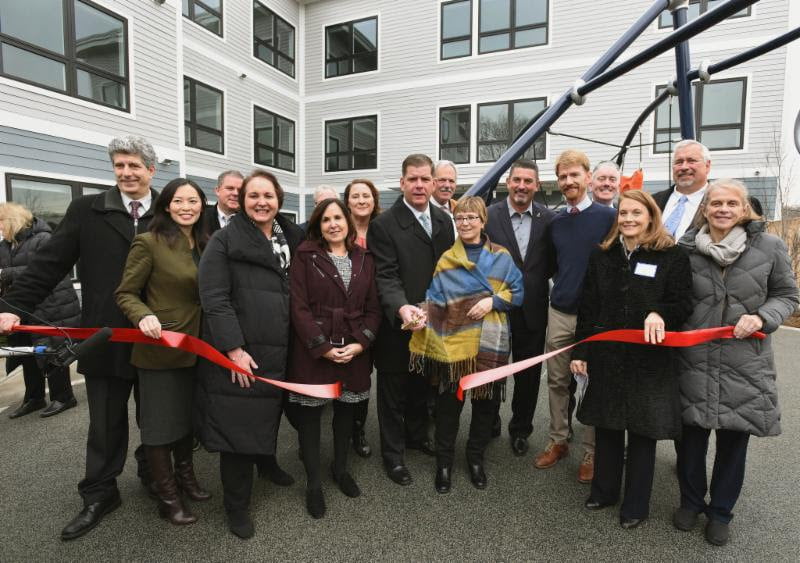
Residences at Fairmount Station Opens With Celebration in Hyde Park

Mayor Martin J. Wash today joined Southwest Boston Community Development Corporation, Traggorth Companies, elected officials and residents to celebrate the grand opening of The Residences at Fairmount Station. This once-vacant property is now a transit-oriented residential development that offers 27 rental units, including 24 affordable units. The project is part of a larger City effort to prioritize affordable development along the Fairmont Corridor, one of the action areas outlined in Imagine Boston 2030 with the goal of expanding opportunities and reducing disparities for residents in the area.

The Residences at Fairmount Station opened

“Today we celebrate a milestone in our efforts to create more affordable housing by officially opening The Residences at Fairmount Station, which sets the standard for all transit-oriented development in the city,” said Mayor Walsh. “I’m proud that with our partners we were able to create 27 rental homes for Boston’s working families. This new development will continue to keep Hyde Park a strong and vibrant neighborhood for generations to come.”

The $12 million four-story building features a combination of studio, one-bedroom, two-bedroom, and three-bedroom units. Out of the 27 rental units, 24 are affordable to households at or below 60 percent of Area Median Income (AMI), which is around $51,000 for a two-income household. The remaining three units are designated for households at or below 70 percent AMI, or around $60,000 for a two-income household. The development also offers 6,000 square feet of green space and play space, a public community room, and parking spaces and bike spaces.

“This lot used to be overgrown with weeds and falling down buildings,” said Hyde Park resident Nicole Wiggins. “It is wonderful to see investment in our community that creates affordable housing, playgrounds, and community spaces that will benefit current Hyde Park residents.”

The project is LEED Silver Certified and has many green features for long-term operations, sustainability, and includes several improvements such as new sidewalks, handicap accessible ramps, benches, lighting, bike racks, and a playground. The building was designed by DMS Design, constructed by Delphi Construction, and will be managed by Maloney Properties. Southwest Boston CDC will provide ongoing services to residents.

“We have long advocated for equitable investment along the Fairmount Corridor, and we could not be more thrilled that through community persistence and support from Mayor Walsh, we have succeeded,” said Mimi Turchinetz, board chair of Southwest Boston Community Development Corporation, one of the joint venture partners on the project. “By providing residents with high-quality affordable housing, safe and beautiful play spaces, and access to transit, we make Hyde Park more beautiful while also providing Hyde Park families with much needed stability.”

“It’s been a pleasure working with Southwest Boston CDC to bring a shared vision for equitable transit oriented development to life,” said Dave Traggorth, Principal of Traggorth Companies, the second partner in the joint venture to build the project. “Their tireless advocacy, along with the critical resources from the City of Boston and the Commonwealth, has created beautiful, affordable homes for Hyde Park families. We hope this project sets the standard for the neighborhood, and is just the beginning of an exciting chapter.”

The new development has been made possible in part by a City of Boston contribution of more than $1.7 million. This contribution enabled the development team to take advantage of more than $2.5 million from the Commonwealth’s Department of Housing and Community Development. The State also provided an allocation of almost $1.5 million in federal Low-Income Housing Tax Credits (LIHTC) that helped raise over $4.7 million in equity from National Equity Fund, the equity investor in the project. Webster Bank provided a construction loan with MassHousing providing long-term permanent financing. The Community Economic Development Assistance Corporation (CEDAC) and the Equitable Transit-Oriented Development Accelerator Fund (ETODAF) at LISC Boston provided critical predevelopment and acquisition funding to secure the site.

The Residences at Fairmont Station consist of affordable units to low- and middle-class families and strongly aligns with the City’s housing goals outlined in Housing a Changing City: Boston 2030. Mayor Walsh recently increased the City’s overall housing targets from 53,000 to 69,000 new units by 2030 to meet Boston’s population growth. These updated housing goals build on Mayor Walsh’s commitment to increasing access to home ownership, preventing displacement and promoting fair and equitable housing access.

Since the release of the original Housing a Changing City: Boston 2030 plan in 2014, income-restricted housing stock, designed to increase affordable housing, has grown along with overall new production: nearly 20 percent of housing units are income restricted, and 25 percent of rental units are income restricted. In total, after creating an additional 15,820 units of income-restricted housing, Boston will have nearly 70,000 units of income-restricted housing by 2030.

These income-restricted units will include purchasing 1,000 rental housing units from the speculative market and income-restricting them through an expanded Acquisition Opportunity Program. In addition, the City will soon announce awardees of an affordable housing funding round that includes more than $16 million in city affordable housing funds, and the first large scale awards of Community Preservation Act (CPA) funding for affordable housing development projects.

For more information on the City’s work to create more housing, please visit: Housing A Changing City: Boston 2030.

ABOUT SOUTHWEST BOSTON COMMUNITY DEVELOPMENT CORPORATION

The Southwest Boston Community Development Corporation (SWBCDC) works to build and sustain a thriving, racially and economically equitable community in Hyde Park and Roslindale. We work to prevent displacement, create and preserve affordable housing, strengthen the commercial base of the neighborhoods, ensure access to good transit and green spaces, and develop local leaders whose voices are not otherwise heard. For more information, please visit swbcdc.org

ABOUT TRAGGORTH COMPANIES

Based in Boston, Traggorth Companies works to execute mid-sized smart growth, urban infill multifamily projects working collaboratively with communities to balance affordability, tenure, historic preservation, and economic development. For more information, please visit traggorthcompanies.com

SourceCity of Boston Neighborhood Development

Quincy Affordable Housing Community Purchased

The Asian Community Development Corp. (ACDC) of Greater Boston has purchased Martensen Village, a 12-unit affordable housing community in Quincy. The Massachusetts Department of Housing and Community Development (DHCD) and MassHousing assisted the company in financing and preserving the affordability of all the units for at least 40 years.

DHCD provided $1.7 million in 13A preservation financing, HOME funds from the city of Quincy, a $561,941 redevelopment loan from the Community Economic Development Assistance Corp. and a $15,970 capitalized 13A payment grant from MassHousing make up the financing for the community.

The funds will be used to make immediate repairs of the community, with a permanent financing transaction also helping future rehabilitation of the property, as well as preserving affordability of the units.

“ACDC is excited about this opportunity to preserve an important affordable housing asset, and this project complements our existing housing and civic engagement work in Quincy. We are grateful for the partnership with DHCD and MassHousing, and we look forward to working with the city of Quincy and CEDAC to complete essential renovations at Martensen Village to ensure the property’s long-term viability,” ACDC Executive Director Angie Liou said in a statement.

SourceBanker & Tradesman

Quincy Housing Community with Expiring Section 13A Mortgage Has Been Acquired to Ensure Continued Affordability for the Residents

The Massachusetts Department of Housing and Community Development (DHCD) and MassHousing have assisted the Asian Community Development Corporation (ACDC) in purchasing and preserving the affordability of Martensen Village, a 12-unit affordable housing community in Quincy. The ACDC purchased Martensen Village through Chapter 40T, a state law that helps prevent housing with expiring affordability restrictions from being sold and converted to market-rate rents. The Section 13A mortgage at Martensen Village was due to mature in March 2019, and the apartments would have been in danger of converting to market rates. This transaction will preserve the affordability of all 12 apartments at Martensen Village for at least 40 years.

“The ACDC acted quickly to acquire Martensen Village, protecting at-risk residents and preserving their tenancy for the long term,” said MassHousing Executive Director Chrystal Kornegay. “MassHousing is committed to meeting the challenges of the state’s expiring Section 13A portfolio, working creatively with our state and local partners to protect elderly and low-income households from unaffordable rent increases.”

“We are proud to partner with MassHousing to support Asian Community Development Corporation’s work to maintain Martensen Village as an affordable housing resource for families in Quincy,” said Housing and Community Development Undersecretary Janelle Chan. “Our hard-working families and residents across the Commonwealth depend on access to housing they can afford and ensuring we maintain the affordability of our current housing stock is a top priority for our agency and the BakerPolito Administration.”

“ACDC is excited about this opportunity to preserve an important affordable housing asset, and this project complements our existing housing and civic engagement work in Quincy. We are grateful for the partnership with DHCD and MassHousing, and we look forward to working with the City of Quincy and CEDAC to complete essential renovations at Martensen Village to ensure the property’s long-term viability,” said ACDC Executive Director Angie Liou.

The Martensen Village transaction involved $1.7 million in 13A preservation financing from DHCD, HOME funds from the City of Quincy, a $561,941 redevelopment loan from the Community Economic Development Assistance Corporation (CEDAC), and a $15,970 capitalized 13A payment grant from MassHousing.

The financing package funds the ACDC’s acquisition and immediate repairs of Martensen Village. A permanent financing transaction, which will allow for the substantial rehabilitation of the property, will follow.

The Commonwealth’s Section 13A program was created by the Massachusetts Legislature in the 1970s to provide low-interest mortgage financing to affordable housing communities. Today, 13A communities serve some of the lowest-income and most vulnerable populations in Massachusetts, including many elderly residents. The mortgages on these 13A housing communities are nearing maturity, and no federal resources are available for their preservation. In response, MassHousing and DHCD have committed a total of $100 million in capital to help protect vulnerable residents and preserve affordable 13A units that otherwise could convert to market rates.

All 12 units at Martensen Village will remain affordable to households earning at or below 80% of the Area Median Income (AMI). The AMI for Quincy is $107,800 for a family of four.

Martensen Village contains 9 three-bedroom and 3 four-bedroom townhouse-style units spread across three low-rise buildings.

MassHousing has financed or administers federal subsidies at 11 rental housing communities in Quincy involving 1,779 units and $58.2 million in financing. The Agency has financed 1,362 home mortgage loans in Quincy, totaling $211.1 million in financing.

About Asian Community Development Corporation

The Asian Community Development Corporation works in underserved and immigrant Asian American communities in the Greater Boston region to create and preserve affordable, sustainable, and healthy neighborhoods. They achieve this by building affordable homes and vibrant spaces, empowering families with asset-building tools, and strengthening communities through resident and youth leadership. For more information, visit www.asiancdc.org.

About DHCD

The Department of Housing and Community Development’s mission is to strengthen cities, towns and neighborhoods to enhance the quality of life of Massachusetts residents. The Department provides leadership, professional assistance and financial resources to promote safe, decent affordable housing opportunities, economic vitality of communities and sound municipal management. For more information about DHCD please visit www.mass.gov/hed/economic/eohed/dhcd/

About MassHousing

MassHousing (The Massachusetts Housing Finance Agency) is an independent, quasi-public agency created in 1966 and charged with providing financing for affordable housing in Massachusetts. The Agency raises capital by selling bonds and lends the proceeds to low- and moderate-income homebuyers and homeowners, and to developers who build or preserve affordable and/or mixedincome rental housing. MassHousing does not use taxpayer dollars to sustain its operations, although it administers some publicly funded programs on behalf of the Commonwealth. Since its inception, MassHousing has provided more than $22.8 billion for affordable housing. For more information, visit the MassHousing website at www.masshousing.com, follow us on Twitter @MassHousing, subscribe to our blog and Like us on Facebook.

###

SourceMassHousing

JPMorgan Chase Commits $100,000 to Develop an Equitable Neighborhood Plan in Upham’s Corner, Boston to Drive Economic Opportunity

JPMorgan Chase & Co. announced a $100,000 planning grant to a Boston-based collaborative team, Pathways Home, to create economic opportunity in Upham’s Corner through an effort to maximize equity as the area undergoes rapid transformation. As part of the firm’s $125 million, five-year Partnerships for Raising Opportunity in Neighborhoods (PRO Neighborhoods) Competition, the Pathways Home team, consisting of Dorchester Bay Economic Development Corporation, Blue Hub Capital (formerly Boston Community Capital), Boston Medical Center, Community Economic Development Assistance Corporation (CEDAC), and the Corporation for Supportive Housing will develop an equitable neighborhood plan for the rapidly changing Upham’s Corner neighborhood of North Dorchester.

With equitable and inclusive economic growth at the heart of the strategy, JPMorgan Chase recognizes the importance of having a plan in place to develop and drive equitable outcomes for families, businesses, and communities. That’s why this year’s PRO Neighborhoods competition included planning grant opportunities for local leaders to identify the greatest needs facing their communities and develop data and community-driven neighborhood plans—14 planning grant winners received $1.8 million this year in addition to the four capital grant winners in Fresno, Milwaukee, New Orleans and Philadelphia.

“We are proud to make an investment that will strategically bring local partners together to push for positive change in Dorchester’s Upham’s Corner,” said Rick MacDonald, New England region manager for JPMorgan Chase Commercial Banking. “This investment will help give organizations the means to put ideas on paper and develop a blueprint of economic growth.”

PRO Neighborhoods provides the necessary capital to local community development financial institutions (CDFIs) to address the drivers of economic opportunity in neighborhoods. These CDFIs work together to pool resources and expand lending activities for building health and education facilities, open retail centers and support community services in area neighborhoods.

The Pathways Home team intends to work with area residents and key neighborhood partners in developing their plan.

“We are thrilled at the opportunity afforded to us and our partners to make a contribution to equitable development and real economic opportunity in Upham’s Corner,” said Perry B. Newman, CEO of Dorchester Bay Economic Development Corporation on behalf of the Pathways Home team. “The area is undergoing an exciting and rapid transformation, and it is essential that local stakeholders and partners work together to ensure that the development of this community is equitable and provides stability as well as an opportunity for all residents. Through an equitable development planning process, we can help to make that a reality.”

Measuring the Impact of PRO Neighborhoods

JPMorgan Chase has hosted five competitions to-date, awarding more than $98 million to 25 groups of collaborating CDFIs in communities across the country – work that’s highlighted in a new progress report by the Joint Center for Housing Studies of Harvard University. Among other highlights, the report found that the winners of the first three competitions leveraged JPMorgan Chase’s nearly $68 million in support to raise an additional $717 million in outside capital, issued over 21,000 loans to low-to-moderate income customers, and created or preserved over 3,000 affordable housing units and 11,000 quality jobs.

Visit www.jchs.harvard.edu to learn more about this work.

About Pathways Home

The Pathways Home Collaborative is committed to equitable and holistic community development in Boston. Dorchester Bay Economic Development Corporation is the convener for the PRO Neighborhoods planning on behalf of the Dorchester Bay Neighborhood Loan Fund (DBNLF). BlueHub Capital will provide flexible, patient financing for a range of projects. Corporation for Supportive Housing will bring experience in collaborations for population-specific housing development. Community Economic Development Assistance Corporation offers strong expertise in state funding and holistically-minded community development. Boston Medical Center can provide direct services, research and finance to act on its belief that housing is a prescription for health.

More information about the organizations in the collaborative can be found at:

Dorchester Bay Economic Development Corporation www.dbedc.org

BlueHub Capital www.bluehubcapital.org

Corporation for Supportive Housing www.csh.org

Community Economic Development Assistance Corporation www.cedac.org

Boston Medical Center www.bmc.org

About JPMorgan Chase

JPMorgan Chase & Co. is a leading global financial services firm with assets of $2.6 trillion and operations worldwide. The firm is a leader in investment banking, financial services for consumers and small businesses, commercial banking, financial transaction processing, asset management, and private equity. A component of the Dow Jones Industrial Average, JPMorgan Chase & Co. serves millions of consumers in the United States and many of the world’s most prominent corporate, institutional, and government clients under its J.P. Morgan and Chase brands. Information about JPMorgan Chase & Co. is available at www.jpmorganchase.com. Follow JPMorgan Chase on Twitter@JPMorgan or @Chase and Facebook.


###

SourceDorchester Bay Economic Development Corporation

44 New Affordable Housing Units Built In Bourne

Bourne, which has the largest percentage of affordable housing units compared to market-rate homes of any town on the Upper Cape, recently celebrated the construction of another 44 affordable units.

The latest additions are townhouse units in the development known as High Meadow Townhomes in Monument Beach. It is the third and final piece of a development roughly 10 years in the making.

The High Meadow Townhomes development is just off Clay Pond Road. It consists of 44 two- and three-bedroom townhouses for families and seniors. It is one-third of the development that started with the Residences at Canal Bluffs, 28 affordable apartments that opened in 2009. That was followed by Clay Pond Cove, 45 individual, family and senior affordable apartments which opened in 2012.

With the addition of High Meadow Townhomes, Bourne now has 641 units in its inventory of affordable homes. Town Planner Coreen V. Moore said that brings Bourne’s total affordable homes percentage to 7.4. The state has set a goal of 10 percent for Massachusetts cities and towns. Bourne has the highest percentage of affordable units on the Upper Cape and is third behind Orleans and Barnstable across the Cape, she said.

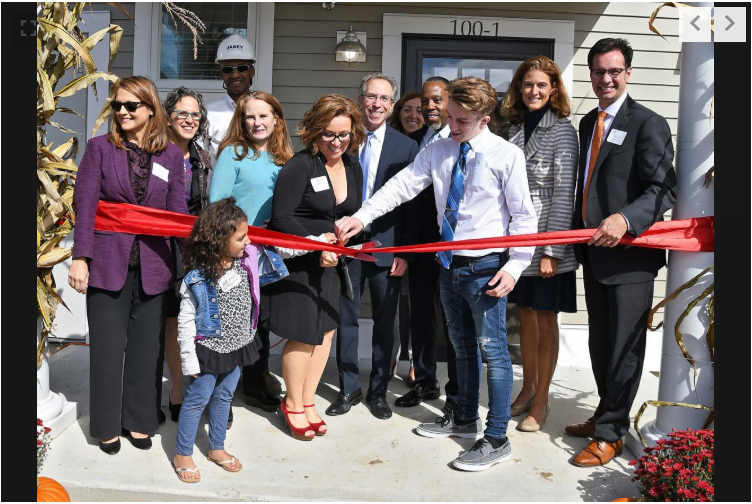
Local and state officials took part in a grand opening, ribbon-cutting ceremony at the development on October 5. Among the attendees were US Congressman William R. Keating (D-MA 9th District), state Senator Viriato M. (Vinny) deMacedo (R-Plymouth), and state Representative Randy Hunt (R-Sandwich).

“There is nothing more important than being able to provide someone with a roof over their head and a safe and a warm place to go that is affordable,” Senator deMacedo said.

Congressman Keating noted the great need on Cape Cod for affordable housing, particularly for younger people who are getting started on their careers.

“There’s a great need for people who fill out a whole demographic pool—younger people, people who are starting families, people that we need to meet the job needs we have in this area and grow our economy forward,” he said.

Groundbreaking on High Meadow Townhomes occurred in July of last year and culminated with the ribbon-cutting ceremony on October 5. The three-phased project was a collaborative effort between Housing Assistance Corporation (HAC) and Preservation of Affordable Housing (POAH).

HAC reported it received more than 200 applications for the 44 units at High Meadow last summer. Tenants are expected to begin moving into their townhomes next month, HAC officials said.

JANEY, Inc. of Boston served as the general contractor for the $14.1 million project. Funding was provided with $7.6 million in low-income housing tax credit from Boston Capital, as well as a $3.3 million loan from MassHousing. Additional funding was provided by Community Economic Development Assistance Corporation (CEDAC), the Department of Housing and Community Development (DHCD), Barnstable County HOME Consortium, Rockland Trust, and MassHousing’s Opportunity Fund.

The Canal Bluffs site was, at one time, slated to be home to a computer technology company, which ultimately decided not to develop the property. Businessman William Zammer of Mashpee bought the land and eventually sold the 19 acres to HAC to develop as rental housing. HAC then partnered with POAH on the project.

The new units have been equipped with EPA-approved Energy Star appliances, including a refrigerator, oven and dishwasher. Each unit has vinyl plank flooring, ample closet space, central air conditioning, and washer/dryer hook-ups. The site also features laundry facilities, out-of-unit storage, and 64 parking spaces, which comes to approximately 1.5 spaces per unit.

During construction of Clay Pond Cove, a wastewater treatment plant was built. It serves all three buildings as well as the abutting retail shopping center, which once housed Grand Union supermarket.

SourceThe Bourne Enterprise