How Cities Are Preserving Affordable Housing

The U.S. needs more affordable housing. A lot more. Between 2001 and 2013 the countrylost 2.4 million rental housing units (both market-rate and subsidized) that were affordable to people making less than 50 percent of area median income. Building more units will help, but preserving existing affordable housing is critical too: It’s generally cheaper than new construction, prevents displacement, takes advantage of existing land use patterns and allows people to remain where they already live. But preservation also presents challenges of its own, often necessitating the blending of multiple federal, state and local funding sources and greater collaboration between developers, policymakers and other stakeholders.


In a bid to better understand how affordable housing preservation happens, the Urban Institute has released a new report and a series of six case studies under the title “Anatomy of a Preservation Deal.” While the report emphasizes that every case is different, it identifies five key lessons for other groups seeking to preserve affordable housing.


First, write the authors, federal subsidies may play a crucial role in funding a project, but they’ll likely be insufficient. Federal subsidies have been flat or declining since 2004. According to the report, between 2004 and 2014 the number of housing vouchers increased from 2.1 million to 2.2 million, but 106,000 public housing units and 146,000 project-based rental assistance units were lost. Another 400,000 units are at risk of losing their affordability because of expiring contracts, and 50,000 are at risk because of deteriorating physical conditions.


Therefore, state and local resources are critical as well. Putnam Square, for example, an affordable rental property in Cambridge, Massachusetts, with 94 units for senior citizens and residents with disabilities, utilized both Low-Income Housing Tax Credits (LIHTC) and Project-Based Rental Assistance (PRBA) funding from the federal government. But the project also received acquisition and predevelopment funding from the state’s Community Economic Development Assistance Corporation and financing through the city of Cambridge and the Cambridge Affordable Housing Trust.


Funding these sorts of projects is a complex endeavor, often involving a host of stakeholders. Funding Putnam Square alone involved 13 agencies and organizations. Hence the second lesson identified in the Urban Institute report relates to developer capacity: “The bigger a project, the more sophisticated the methods needed — and partners involved — to make it successful.” Projects are further complicated by expensive, competitive markets or by the need to preserve historic structures or serve the needs of special populations, like the elderly.

And sophisticated, mission-driven developers are particularly necessary in areas where private capital can’t be attracted. The report cites as an example 4657 West Madison in Chicago. A private local buyer wanted to purchase and renovate the vacant building, but a bank wouldn’t finance it. Community Investment Corporation, a local CDFI did. Now the building provides 10 units that are naturally affordable because of low market rents in the area.


The report also highlights the need for collaborative relationships, which are often led by mission-driven sellers. Putnam Square, for example, had previously been owned by Harvard University, which sold the property to nonprofit developer Homeowner’s Rehab with the explicit desire to keep the units affordable. Harvard continues to fund a resident services program there. A similar relationship ensures the affordability of Billings Forge, a development in Hartford, Connecticut.


Relationships and social goals were key in the two deals above, but the report notes that policy is also key in supporting preservation efforts. Putnam Square was aided by Massachusetts’s 40T expiring use preservation law, which requires affected parties to be notified when affordability restrictions are going to expire, protects against displacement of current residents, and gives the state an opportunity to make or match purchase offers on subsidized properties up for sale.

Both Oregon and Washington, D.C., have Opportunity to Purchase Acts, which require landlords planning to sell their properties to give tenants the chance to buy their homes. In D.C., they have a set period of time to secure financing and negotiate a sale, or to assign their rights to a third party to do so. The latter occurred at the Monseñor Romero Apartments in D.C., purchased by a nonprofit organization.

The final lesson included in the report is the importance of communicating these successes and the policies that made them possible to other interested groups around the country. This can include sharing how financing was structured or how policy frameworks were created — any strategies that helped preserve affordable housing. The report cites the example of the National Preservation Working group, a coalition of affordable housing advocates, developers and other stakeholders who are lobbying for more effective preservation policy. Locally, the Preservation Compact does similar work in the Chicago region.

The report concludes with a lesson that should have been learned from the failures of large-scale public housing. “Initial funds for construction were not enough to ensure stable, secure, and solvent developments in the long term,” write the authors. “Buildings get old. Contracts and rent restrictions expire. Residents and community needs change. Funding for renovations and repair, services, and other features need to come from somewhere. Tax credits and the like can help, but the reality is that affordable housing can be lost for a number of reasons. Preservation requires the continuing efforts of those in the affordable housing field to obtain funding and respond to ever-changing local contexts.”

https://nextcity.org/daily/entry/five-lessons-for-preserving-affordable-housing

 

SourceNext City

Two Community Development Nonprofits Receive $1.3M

Two Community Development Nonprofits Receive $1.3M
August 19, 2016 — The Community Economic Development Assistance Corporation, a public-private community development finance institution that provides financial resources and technical expertise to promote community development in Massachusetts, yesterday announced that it is providing $1,323,100 to two Boston-based nonprofits.

The loan financing will support development of affordable housing in the Boston’s Roxbury neighborhood and improvements to a parent support program in the city’s Dorchester neighborhood.

The Community Economic Development Assistance Corporation (CEDAC) provided $1,200,000 in acquisition financing to Urban Edge in Boston, which helps build affordable housing and diverse communities in Boston and surrounding neighborhoods. The funding will support the purchase and development of a new affordable housing project on Columbus Avenue in Roxbury.

Located just south of Jackson Square, Urban Edge’s Columbus Avenue site will include 38 units of multifamily affordable rental housing and 1,000 square feet of commercial space.

CEDAC has been involved in the redevelopment of Jackson Square since 2006 and provided over $1.5 million in early stage financing for the master planning of the neighborhood and other affordable housing development projects. The new affordable housing project will serve low- and extremely low-income families in the community and continue the trend of growth in the area in- and around Jackson Square.

“We have been extremely proud to support the efforts by the Jackson Square Partners to revitalize the neighborhood in a way that helps current residents,” said CEDAC’s Executive Director Roger Herzog. “The current site is blighted and the neighborhood will greatly benefit from quality housing on that site. It is a pleasure to continue our effective relationship with Urban Edge, which goes beyond the Jackson Square redevelopment and into other nearby neighborhoods in Roxbury and Jamaica Plain.”

CEDAC also provided $123,100 to Family Nurturing Center of Massachusetts (FNC) in Dorchester, which provides support services to families promote skill-building and access to educational, social, and health resources. The funding, made through CEDAC’s affiliate Children’s Investment Fund, will support expansion of FNC’s Bowdoin Street site in Dorchester.

The commitment is in addition to $375,000 previously provided to FNC by the fund for this project. To allow for the expansion of programmatic and administrative space, FNC, which has provided comprehensive family support services to low-income families throughout Boston, is renovating and enlarging its existing Bowdoin Street center to include two additional floors.

“The fund is proud to continue to support mission-focused providers like the Family Nurturing Center of Massachusetts,” said Theresa Jordan, director of Children’s Facilities Finance for the fund. “Supporting children and their families builds strong communities and encourages positive environments for children to learn and grow both in the center and in their homes.”

© 2016 www.massnonprofit.org. All rights reserved.

http://www.massnonprofit.org/news.php?artid=4625&catid=12

SourceMassNonprofit News

State grant to benefit Boston Street affordable housing 2 rooming houses will become units for formerly homeless

State grant to benefit Boston Street affordable housing

2 rooming houses will become units for formerly homeless

By Dustin Luca Staff Writer

Aug 19, 2016

SALEM — Harborlight Community Partners just landed a valuable chunk of change toward its $6.5 million overhaul of two Boston Street properties.

Gov. Charlie Baker’s administration said this week that Boston Street Crossing is one of 26 projects in the state that will receive state grants aimed at developing and preserving affordable rental housing. Andrew DeFranza, executive director of Harborlight, said he didn’t know yet just how much money the project will receive.

The project grew out of a homelessness task force that has been meeting on the North Shore for about a year and a half.

“This is sort of springing from that soil,” DeFranza said. “It’s going to take two existing rooming houses in Salem — 43 Boston St. and 179 Boston St. — and make dramatic physical improvements to those buildings.”

There are currently 37 rooms in the two buildings. Once the project is finished, the buildings will house 26 studio apartments tailored for formerly homeless individuals. All 26 units will be reserved for people making less than 30 percent of the area’s median income.

Lifebridge, the nonprofit that runs the shelter for the homeless in downtown Salem, is a partner in the project.

“They’re going to provide the case management services,” DeFranza said. “We do the development and run the property, but we bring in partners to provide services.”

The state grant is one of several funding sources for the $6.5 million project.

“The (Community Preservation Act) funded it and the city of Salem funded it,” DeFranza said. “It was funded with North Shore Home Consortium funds. It also has a redevelopment loan from CEDAC (the Community Economic Development Assistance Corp.).”

The City Council voted earlier this year to approve $59,000 in funding from CPA funds. The money comes from a small surcharge on property taxes that is dedicated to historic preservation, open space and affordable housing.

This project represents one of the best ways to fight against homelessness, said DeFranza.

“Creating (good quality) affordable housing is the key method for making it possible for those who are homeless to be housed again,” he said. “You have to create housing they can afford with their income levels and have the services that allow them independence.”

The homelessness task force, meanwhile, “created the space to help allow solutions addressing that problem,” he continued. “This is one of the mechanisms to address the problem in the region.”

The Beverly-Salem Mayors Regional Task Force on Homelessness began meeting in December of 2014, bringing together local officials, law enforcement and social service agencies to come up with solutions to the problems of homelessness.


© Copyright 2016 Salem News


http://www.salemnews.com/news/local_news/state-grant-to-benefit-boston-street-affordable-housing/article_f9bbd37a-d9d1-5b57-9094-b5549fba1581.html


SourceThe Salem News

CEDAC Provides $1.3M In Funding To Support Boston Housing And Child Care

CEDAC Provides $1.3M In Funding To Support Boston Housing And Child Care

Aug 19, 2016

The Community Economic Development Assistance Corporation (CEDAC) recently approved acquisition and predevelopment loans totaling over $1.3 million to Urban Edge Housing Corp. and Family Nurturing Center of Massachusetts. CEDAC’s financing will support the development of affordable housing in the Roxbury neighborhood and improvements to a parent support program in the Dorchester neighborhood of Boston.

CEDAC provided $1.2 million in acquisition financing to Urban Edge Housing Development for the purchase and development of a new affordable housing project on Columbus Avenue in Roxbury, which includes 38 units of multifamily affordable rental housing and 1,000 square feet of commercial space. This new affordable housing project, which will be located just blocks from the Jackson Square MBTA station, will serve low- and extremely low-income families in the community and continue the trend of growth in the area in and around Jackson Square.

“We have been extremely proud to support the efforts by the Jackson Square Partners to revitalize the neighborhood in a way that helps current residents,” Roger Herzog, CEDAC’s executive director, said in a statement. “The current site is blighted and the neighborhood will greatly benefit from quality housing on that site. It is a pleasure to continue our effective relationship with Urban Edge, which goes beyond the Jackson Square redevelopment and into other nearby neighborhoods in Roxbury and Jamaica Plain.”

Family Nurturing Center of Massachusetts (FNC) also received $123,100 from CEDAC, through its affiliate Children’s Investment Fund, for the expansion of a Dorchester location. This commitment is in addition to $375,000 previously provided to FNC by the fund for this project. For over two decades, FNC has provided comprehensive family support services to low-income families throughout Boston. To allow for the expansion of programmatic and administrative space, FNC is renovating and enlarging its existing Bowdoin Street center to include two additional floors.

Copyright © 2016 The Warren Group | All Rights Reserved |

http://www.bankerandtradesman.com/2016/08/cedac-provides-1-3m-funding-support-boston-housing-child-care/?utm_source=hs_email&utm_medium=email&utm_content=33169404&_hsenc=p2ANqtz-8wvMIh6gr9gT1JzOkgQ-Nl0z5oLwGNaV6cA3temFg9mGhm13s8ZxClkyMLjH92CdQg_An52pdaVZgaNcNOHnYP-1nrLg&_hsmi=33169404

SourceBanker & Tradesman

Baker Administration Announces Affordable Housing Development Awards

Baker Administration Announces Affordable Housing Development Awards

Aug 16, 2016


The Baker Administration announced awards to fund the development, renovation and preservation of affordable rental housing across the commonwealth on Monday. The money will be used to create or preserve 1,420 housing units.

“These affordable housing awards reflect our administration’s commitment to a stronger, more prosperous and more inclusive commonwealth,” Gov. Charlie Baker said in a statement. “By increasing affordable housing production, and stabilizing working families, low-income senior citizens and homeless families or those at risk, these housing awards will strengthen communities across Massachusetts.”

The announcement was made at48 Boylston St. in Boston, a historic rehabilitation project for formerly homeless residents sponsored by St. Francis House and the Archdiocese of Boston’s Planning Office for Urban Affairs.

The 26 projects awarded will create or preserve 1,420 rental units, including 1,334 affordable units, across 16 Massachusetts communities. The Department of Housing and Community Development is awarding over $31 million in state and federal low-income housing tax credits, which will generate over $218 million in equity for these projects. Additionally, the administration is awarding over $59 million in housing subsidy funds, including federal HOME funds and state capital funds, across the 26 projects.

Projects will serve a wide variety of constituents, including individuals and families transitioning out of homelessness, persons with disabilities and the elderly. Four projects are focused on senior housing, five will provide supportive services to residents and all 26 will include deeply affordable units. The Baker Administration prioritized applications that included a 10 percent allotment for individuals and families who are, or are at risk of becoming, homeless.

In May, the administration unveiled a five-year capital budget plan that includes a $1.1 billion commitment to increasing housing production, an 18 percent funding increase for mixed-income housing production, and affordable housing preservation. In May, the Administration and MassHousing committed $100 million, to support the construction of 1,000 new workforce housing units. Since 2015, the administration has provided funding to create and preserve 2,856 units of affordable housing, including 874 deeply affordable units for at-risk populations.

“St. Francis House is a perfect example of an organization committed to ending homelessness for individuals and families by providing safe and affordable housing and meeting the full needs of their tenants,” Secretary of Health and Human Services Marylou Sudders said in a statement. “These awards will help support vulnerable citizens in the commonwealth.”

The award will include 46 units of affordable housing at the former Boston Young Men’s Christian Union building at 48 Boylston St. The state Department of Housing and Community Development (DHCD) will support the project with federal and state low income housing tax credits that will leverage about $11.8 million in equity and $4 million in subsidies from DHCD.

St. Francis House and the Planning Office for Urban Affairs of the Archdiocese of Boston (POUA) purchased the building in April of this year, and the two entities plan to rehabilitate the historic, but presently vacant, building into affordable housing. The completed development will include units reserved for people who have experienced homelessness and others with very modest incomes. Twenty-six of the units will be reserved for individuals earning less than 30 percent of the area median income.

Copyright © 2016 The Warren Group | All Rights Reserved |

http://www.bankerandtradesman.com/2016/08/baker-administration-announces-affordable-housing-development-awards/?utm_campaign=Daily&utm_source=hs_email&utm_medium=email&utm_content=32993672&_hsenc=p2ANqtz–woMwC9tdw1LL0nM3nVUjpGZiEBsgWYlAEcRRKX6X3ayEg2HKd5ApDSeOlMqj2Htb1gcX8fC21aE0TX-lg-QSNdkdiZw&_hsmi=32993672


SourceBanker & Tradesman

Partnership’s Affordable Housing Numbers Hit Six-Year High

A public-private partnership preserved nearly 4,400 affordable rental housing units in Massachusetts during 2015, the largest number of units preserved in a single year since the Community Economic Development Assistance Corporation began collecting data in 2010.

Data released this week by CEDAC showed state financing helped preserve nearly 5,300 housing units in 38 developments, including more than 840 market rate units. Long-term contract renewals under the federal Section 8 program preserved an additional nearly 2,100 affordable apartments.

CEDAC officials said preservation efforts have been boosted under a six-year-old law known as Chapter 40T, which features public notification provisions for tenants and state and local officials, a right of offer and right of first refusal for the state or its designee to purchase publicly-assisted housing, and tenant protections for projects with affordability restrictions that terminate.

But officials also asserted that Massachusetts is at risk of losing thousands of affordable units over the next few years due to expiring affordability restrictions. A CEDAC database tracks over 1,500 projects with 130,000 housing units that are privately-owned but feature publicly assisted affordable housing.

Community development corporations recently reported record-setting affordable housing efforts that they said are tied to a community investment tax credit implemented in 2014.
And Boston Mayor Martin Walsh in late April declared his support for a surcharge under the Community Preservation Act that he says would cost the average homeowner $28 per year but generate $16.5 million annually for the city, and leverage millions of dollars in state funding that could be spent on affordable housing, historic preservation and open space. Walsh also announced recently that the city is on target to meet its goal of creating 53,000 units of housing by 2030, after permitting 565 units in the first quarter for a total of 17,183 units that have been permitted or created since October 2014.
CEDAC preserved 3,854 affordable units in 2010, 2,246 in 2011, 3,260 in 2013, and 3,278 in 2014. Numbers were not available for 2012.

Gov. Charlie Baker at 11:45 a.m. Monday plans to announce housing production and preservation capital investments at the Housing Opportunity 2016 Conference hosted by Urban Land Institute. The conference will be held at the Boston Marriott Copley Place.

SourceState House News

Stacy Kirkpatrick, 52; caregiver to the neediest

To those who live on the streets, Stacy Kirkpatrick was more than just a nurse practitioner at Boston Health Care for the Homeless — more than a caregiver who brought her healing presence to shelters. “She was my family,” said Larry Adams, who was her patient for many years.
“I was homeless and I was an addict. I was all messed up. I’m the kind of person, I don’t trust nobody,” said Adams, who helped found and chaired the health care agency’s Consumer Advisory Board. He put his faith in Ms. Kirkpatrick, however. “Her word was gospel. Whatever she said, I did. As a matter of fact, the reason I’m here is she saved my life.”
For 17 years Ms. Kirkpatrick ministered to the medical needs of Boston’s neediest — patients who because of wariness, mental illness, or substance abuse sometimes miss appointments and disappear, only to return weeks or months later, their health more fragile.
“Stacy never got emotional about control with patients. She knew how to wait until they were ready. For a clinician, that’s difficult,” said Kathleen Saunders, a nurse practitioner colleague at Boston Health Care for the Homeless for whom Ms. Kirkpatrick was a mentor.
“I think that’s what made her so successful in her care of patients,” Saunders added. “They would always come back. There was never any judgment about why they missed this appointment or that appointment. It was always, ‘I’m so glad to see you today, tell me what’s happening now?’ ”
Ms. Kirkpatrick, whose skill at instilling a sense of family extended from her patients and colleagues to ever-widening circles of friends that reached back to her youth in Texas, died of cancer March 16 in her Medford home. She was 52 and had raised about $60,000 for cancer research and treatment by riding in the Pan-Mass Challenge several times after her initial diagnosis 11 years ago.
“I carried the names of over 90 people who are affected by cancer given to me by donors,” she told the Medford Transcript in August after finishing what turned out to be her final fund-raising ride.
Each year, Ms. Kirkpatrick “would ask friends and families to give her names of people they wanted her to ride for — they might be survivors, someone in treatment, or someone to be remembered,” said Carole Hohl, a work colleague and longtime riding friend. “She would carry those names with her either in her saddlebag or sometimes pinned to her shirt and dedicate her ride to those people.”
And in her heart, family and friends say, Ms. Kirkpatrick carried the names of everyone she befriended — a list that grew endlessly. “She was such an incredibly warm, welcoming, friendly, and funny person that everyone she met ended up becoming a friend, and she maintained those friendships for many, many years,” said Ms. Kirkpatrick’s wife, Karen Shack.
“She pulled together personal friends, work friends, and family from all different parts of her life and connected people with each other, and everyone felt special,” Shack added.
Dr. Jim O’Connell, president of Boston Health Care for the Homeless, said Ms. Kirkpatrick was “one of those rare people who, when they’re around, everything just seems better and when they’re not around, something seems missing. She infused joy into everyone around her. You realized that she had a magical effect on everyone she met.”
Ms. Kirkpatrick grew up in Texas, the only child of Mike Kirkpatrick and the former Leah Lacaze. Her father worked for Southwestern Bell, AT&T, and the engineering school at Southern Methodist University. Her mother worked for Southwestern Bell.
At Berkner High School in Richardson, Texas, Ms. Kirkpatrick played tuba in the orchestra and marching band and continued as a musician at Southern Methodist University, from which she graduated in 1986 with a bachelor’s degree in English.
For several years she worked as a copywriter for The Container Store and in marketing for companies such as Cellular One, moving to Boston to be closer to friends.
A decade out of college, she enrolled at the MGH Institute of Health Professions and received a master’s in nursing in 1999. Clinical rotations during school introduced her to caring for the poor, and the year she graduated she joined the Boston Health Care for the Homeless staff as a nurse practitioner, becoming associate director of clinical operations in 2013.
“There was always something in her that was drawing her to that kind of work,” Shack said. They were introduced through a mutual friend while playing squash and were a couple for 25 years, marrying in 2005.
Ms. Kirkpatrick “had a phenomenal relationship with her patients,” said Dr. Jessie Gaeta, chief medical officer at Boston Health Care for the Homeless. Along with a “keen clinical sense,” Ms. Kirkpatrick brought boundless compassion that made her seek out patients for checkups and updates many times each year at the Long Island shelter and St. Francis House, said Gaeta, who added that “she would lose sleep about people she was worried about for any reason.”
Such devotion might suggest that Ms. Kirkpatrick left little time for life away from work, but that was never the case. “She was a connector across different groups of friends. People would come together through her,” Gaeta said.
Ms. Kirkpatrick retained her Texas-born loyalty to the Dallas Cowboys but adopted the Red Sox as a favorite baseball team and often attended sporting events, ticking off entries on a must-attend list that included the Olympics, the Super Bowl, the World Series, and the Indianapolis 500.
A music aficionado, she also went out to hear live music as often as possible and “always knew what the best new restaurants were in Boston,” Saunders said. “She had a real thirst for culture and experiencing things. She had an endless amount of energy, and I don’t think she took anything for granted.”
Family and friends are planning a private gathering to celebrate the life of Ms. Kirkpatrick, who in addition to Shack leaves her mother, of Fairview, Texas.
On Saturday at 11 a.m., a ribbon-cutting will take place in Jamaica Plain at a 20-bed medical respite facility for the homeless that is being renamed the Stacy Kirkpatrick House. Ms. Kirkpatrick began her Boston Health Care for the Homeless career in 1999 at the building, which was then called the Barbara McInnis House.
In 2005, Ms. Kirkpatrick was diagnosed with breast cancer and treated with surgery, chemotherapy, and radiation. The diagnosis, she told the Medford Transcript, got her interested in the Pan-Mass Challenge, which she first rode in 2008. Diagnosed with ovarian cancer in 2014, she returned to ride again last summer. In the autumn, she learned that the ovarian cancer had recurred.
“We knew each other for over 25 years,” Shack said. “I don’t think I heard her once over the entire time I knew her complain about anything related to her — the pain or anything. That’s a testament to who she was as a person.”
Ms. Kirkpatrick, Shack said, dealt with each diagnosis and treatment with the optimism she brought to all parts of her life.
“She suffered terribly over the past few years, and she never once came to work without smiling,” O’Connell recalled. “She knew how to handle suffering in a way that she turned into joy.”

»
»

SourceThe Boston Globe

Former Agawam Police Academy Will House Vets Following Redevelopment

Citizens Bank’s Community Development Lending Group yesterday announced a $10 million financing package for Soldier On Inc.

Soldier On, a nonprofit that provides social services and transitional and permanent housing for veterans, will use the construction financing to repurpose a former policy academy in Agawam as an affordable housing development for vets.

The former Western Massachusetts Regional Police Academy at 702 South Westfield St. will be turned into the new 51-unit Gordon H. Mansfield Veterans Village.

The design calls for dining facilities and offices in addition to 51 studio apartments. A 56-square-foot, single-story annex will be built and attached to the main building by a covered walkway. Thirteen of the units are reserved for veterans at or below 30 percent AMI, and 38 units for veterans at or below 60 percent AMI.

“We value our partnership with Citizens and appreciate the banking team’s great ideas and timely execution,” Soldier On CFO Bruce Buckley said in a statement. “Citizens’ commitment to affordable housing and military veterans is clear. Their experience with these types of transactions makes a big difference.”

SourceBanker & Tradesman

Warren pledges to push for Lawrence grants

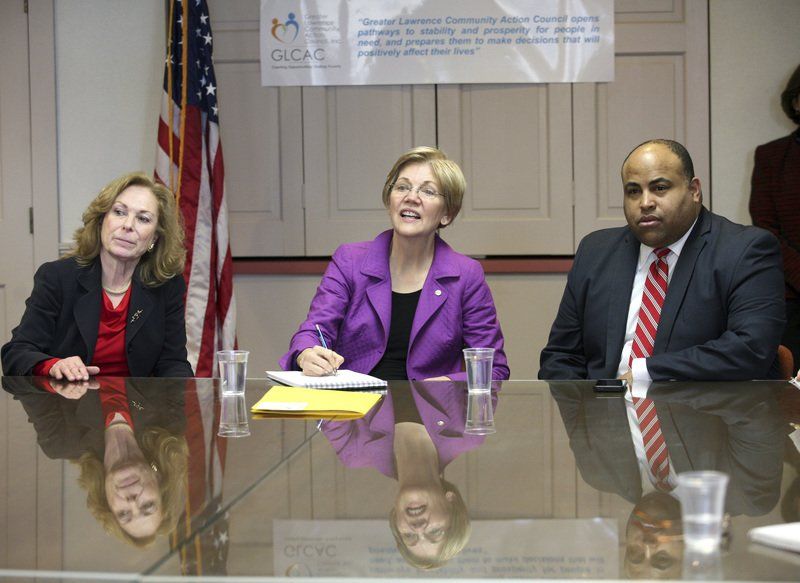
U.S. Sen. Elizabeth Warren met with city leaders Monday to discuss a range of issues, from affordable housing to transportation improvements, praising efforts made in these areas and pledging to advocate for the city at the federal level to help that work continue.
“The federal government wants to be a good partner to the people in Lawrence, and it’s my job to try to make that happen, whenever and wherever I can,” Warren, D-Mass., said.
To start her visit, Warren met with Mayor Daniel Rivera, several city employees and elected officials to hear the city’s plans to apply for Transportation Investment Generating Economic Recovery federal grant funds, known as TIGER money.
She then moved to the Greater Lawrence Community Action Council Inc., where she read to children in the Head Start program and heard about the GLCAC’s efforts to assist residents with everything from visa issues to heating their homes.
Rivera said it was important for the state’s senior senator to come to Lawrence both to celebrate the work that was being done in the city and to understand what still needed to be done to help improve the quality of life and expand opportunities in the city.
“To have such an influential person in the U.S. Senate be our senator, and then to have her come to Lawrence, is the leg up Lawrence really needs,” he said.
Warren called Lawrence a city with “great, great opportunities.”
“I like being in Lawrence because Lawrence is a gateway city in the true meaning of that word,” Warren said. “It is a gateway for people who are building a future, that’s what Lawrence is all about.”
Transportation improvements
Lawrence is seeking TIGER funds for an estimated $10 million in transportation improvements to a 1.6-mile stretch of road through the city’s downtown — from the Five Corners intersection north up Parker Street, across the Merrimack River to Amesbury Street, then to the intersection with Lawrence Street — designed to increase safety and make downtown Lawrence more easily navigable.
“We want to make multimodal transportation access better for everyone, whether that’s pedestrians, bicyclists, motor vehicles,” said Theresa Park, the city’s planning director.
The city is looking to make infrastructure improvements at the Five Corners intersection, from upgrading traffic signal equipment to making sure the roadway complies with the Complete Streets policy for all modes of transportation.
Then, the city is looking to turn Amesbury Street from a one-way roadway into a two-way roadway to help provide more direct access to locations in the city’s downtown. Motorists heading north on Amesbury Street are diverted either left or right after crossing the North Canal, limiting direct access to areas such as the Buckley Parking Garage or Northern Essex Community College, she said.
Plans also call for a roundabout at the intersection of Amesbury and Lawrence streets.
The one-way system “really makes navigation or way-finding within downtown difficult. It forces people to drive out of their way,” Park said.
The improved access and upgraded infrastructure could also help spur job growth, city officials said.
Rivera said the senator offered her perspective on the city’s application – the TIGER program is competitive, and Lawrence was not selected for a grant last year. She helped officials refine the city’s message for that application.
After discussing the grant, Warren, Rivera and elected officials, including state Sen. Barbara L’Italien, D-Andover, and state Reps. Frank Moran and Marcos Devers, D-Lawrence, headed to the GLCAC building for discussions about the organization’s services, its successes, and what resources it needed to help continue serving residents.
“People come here to get their foothold in American society, they come here in the neediest part of their lives, and I think organizations like the GLCAC make that transition easier,” Rivera said.
The GLCAC’s Head Start program was among the successes highlighted to the senator, but there were calls for increased salaries and more support for teachers.
Warren said while “we are not in the position we were in three years ago” when sequestration in Washington resulted in program cuts, including closures of Head Start centers, there was still a fight to be had.
“It is a reminder that what we need to do is we need to be putting more resources, not fewer resources, into Head Start,” she said. “I agree this is the best investment. The nickels we put into children is dollars that will pay off when they’re teenagers.”
Lawrence District F City Councilor Marc Laplante asked the senator whether the city should focus on maintaining and growing its middle class.
“Lawrence shouldn’t just hold onto people it educates, it should attract people,” Warren said. “That’s the kind of community that really is about building a future. A future isn’t just let us give you a start so you can go somewhere else to live a secure life, you can do that right here in Lawrence.”
Linda Soucy, program director for fuel assistance at the GLCAC, spoke of staffing and service issues for her program, which has nearly 12,000 clients. Staffing has been cut nearly in half since she started in 2008, the amount of money clients receive for heating assistance has diminished, and planning issues arise from not having their entire budget released to them at once, she said.
“We have to have the money come in,” Soucy said. “We’re just trying to do our best to make sure people live in safe, warm houses.”
Warren noted it was sometimes a challenge to get those federal funds for heating assistance.
“We don’t do it every time, we don’t win every battle, but I’ll tell you, we will get out there and fight, and fight for what’s right for families in Lawrence,” Warren said.
While each issue was discussed separately, Warren said they are all connected when it comes to advancing quality of life for families in Lawrence and beyond.
“It’s the reminder that all of the pieces work together. If a family doesn’t have housing, then they can’t be secure, they can’t get their children educated, they can’t build any kind of future,” she said.
“But if they get in that housing and can’t keep it heated, then they can’t be safe. If they get in that housing and they keep it heated but they have small children that can’t make it into a Head Start program, then their children will have more difficulty not just immediately, but over the very long run of their years in school and their working years,” she continued.
Given that, Warren said it was hard to prioritize just one issue to focus on in Lawrence.
“It truly is the case that we need to push forward on multiple fronts at once so the pieces can work together,” Warren said, adding, “We know what our families need. The federal government just needs to put the resources in so that we can deliver for our families.”

SourceEagle Tribune

Local veterans group deserves praise for housing effort

Haverhill has always been good to its military veterans.

Organizations such as the AmVets and the VFW provide services to local people who served their country. The Veterans Services Office in the Citizens Center does the same.
There are annual Veterans Day events designed to thank locals who served in World War I up to today’s military conflicts.

Last year’s Santa Parade, attended by thousands of people, had a veterans theme to bring special attention to those who have served our country.

Such events are good for the community’s veterans. It’s nice to get a pat on the back.
But what do they need even more? The essentials of life — food, clothing and shelter. That last one has been hard to come by in recent years, due to rising rents and home sale prices.
State leaders are concerned about the lack of housing for veterans, especially those returning from recent military conflicts.

But in Haverhill, housing for veterans is available thanks to the efforts of a local group. (See story, Page 1.)

The Veterans Northeast Outreach Center began its efforts in the city more than 25 years ago. The group took ownership of a run-down building in the inner-city Acre neighborhood and turned it into apartments for veterans.

Veterans Northeast later took over the old St. Rita’s Church, which was closed in 1998 by the Catholic Archdiocese of Boston. Veterans Northeast created a veterans services center there and now has a variety of veterans housing units in that neighborhood.

Veterans Northeast is also eyeing another property near the downtown for homes for veterans.
Veterans Northeast Executive Director John Ratka said the organization’s plan to buy the former home of Gerson Furniture at 185 Washington St. and convert it to 44 new one-, two- and three-bedroom units of veteran’s housing has received approval of the city’s Zoning Board of Appeals.

While Veterans Northeast is still negotiating the purchase of the building from its current owners, the process of completing a state application to receive grant money for the purchase of the property and construction of the apartments has already begun.

That’s more good news for local veterans looking for housing. Kudos to the Veterans Northeast Outreach Center for its work to develop these much-needed housing units. And thanks to the entire community, from city officials to residents, for supporting our veterans. For all they have given, they deserve it.

SourceThe Haverhill Gazette