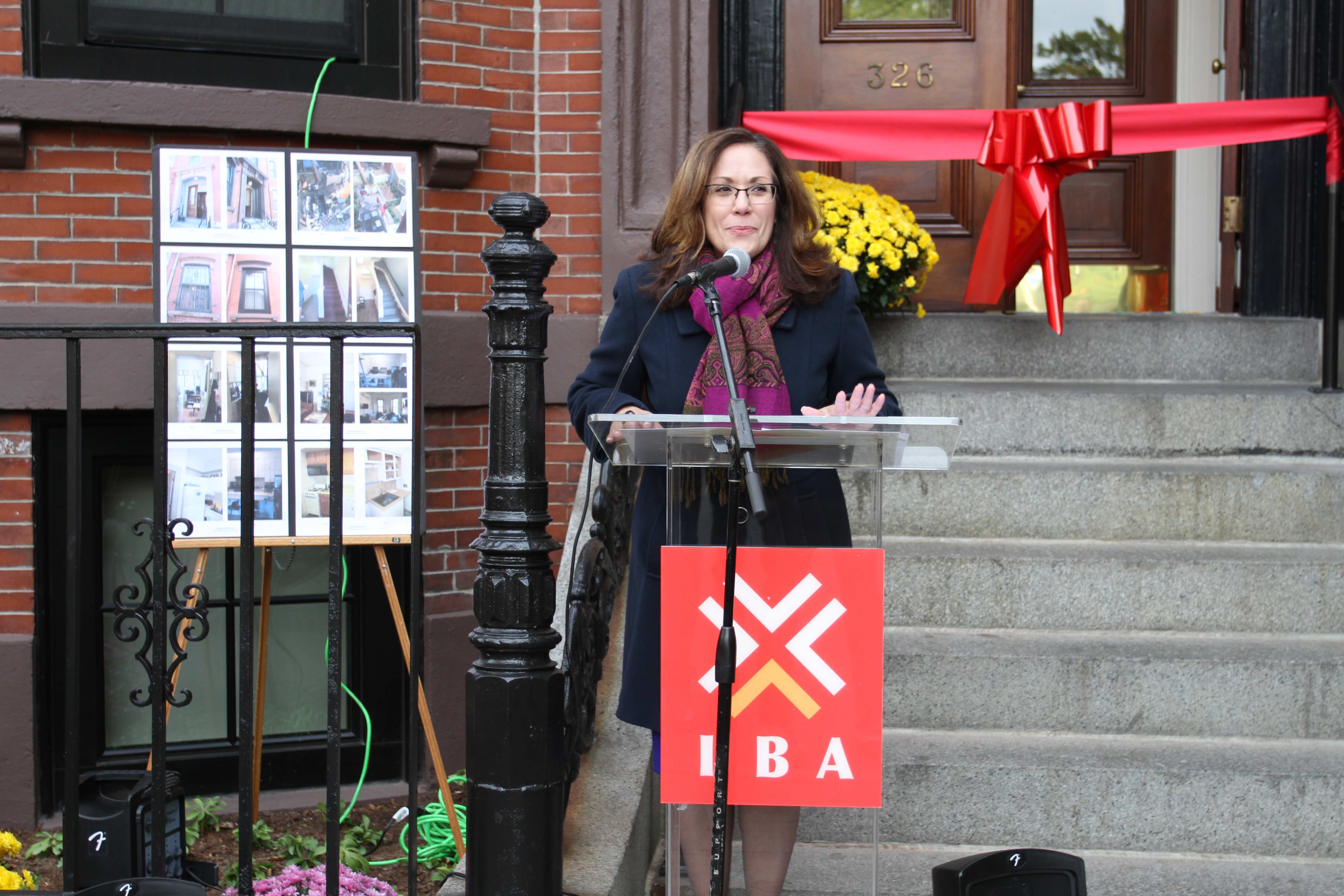
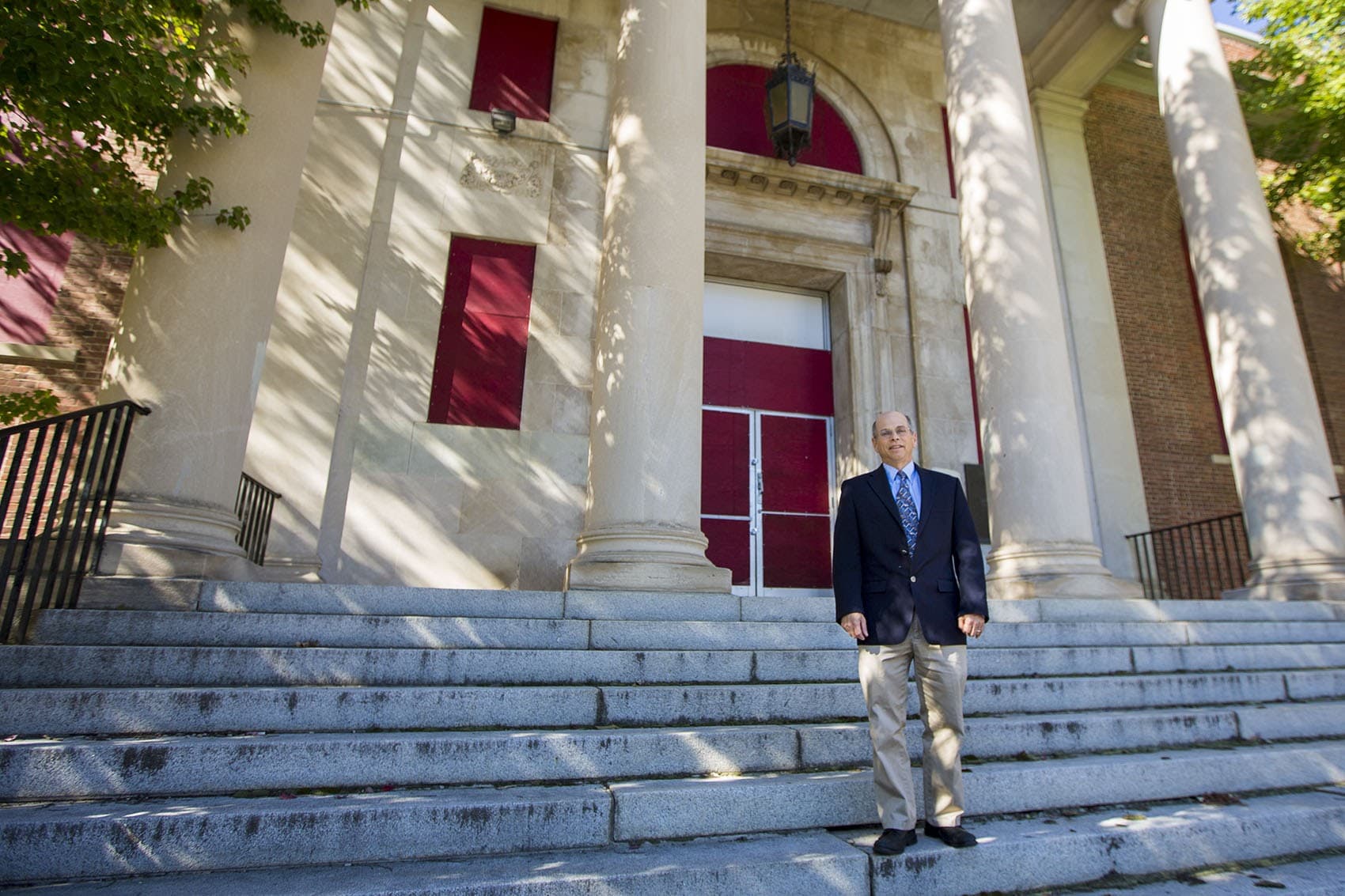
IBA’s Residencia Betances, one of only a few housing facilities in Boston offering supportive services to formerly homeless, Spanish speaking residents, received a makeover recently, and Inquilinos Boricuas en Acción (IBA) CEO Vanessa Calderón-Rosado celebrated the completed renovation on Thursday, October 27 with city and state housing and social service officials. Opened in 1993, Residencia Betances provides 11 single-occupancy units for formerly homeless residents who are clients of the Department of Mental Health, with round-the-clock, bilingual staff on site to assist residents with medication and health-care appointments, social skills symptom management and meal preparation, and to provide social, employment skills and wellness opportunities. “Residencia Betances is such a meaningful part of Boston’s South End, and we are proud to have completed renovations that will enhance the lives of our residents,” said Vanessa Calderón-Rosado. “We are grateful to those that have helped make this project happen, and look forward to continuing with more work aimed at providing affordable housing for those in need.” The renovation, which received funding from the Department of Housing and Community Development’s (DHCD) Housing Preservation Stabilization and Facilities Consolidation program and from the Community Economic Development Assistance Corporation (CEDAC), will provide a more open and client-friendly common area; historic restoration of the brick townhouse’s exterior and upgrades in the residents’ units.
State representative Aaron Michlewitz, undersecretary of Housing and Community Development Chrystal Kornegay, Laila Bernstein, advisor to the Mayor for the Initiative to End Chronic Homelessness and Community Economic Development Assistance Corporation (CEDAC) director of housing development Sara Barcan joined Vanessa Calderón-Rosado for a ribbon cutting, remarks and a luncheon at the Villa Victoria Center for the Arts. In her remarks, Bernstein noted the Mayor’s commitment to ending homelessness and particularly to helping the long-term homeless. She said, “In January 2016, there were 612 chronically homeless individuals and since then we have housed 186 of those individuals. That represents 1,015 years of homelessness because these were the individuals who have been homeless the longest. The proven formula for ending chronic homelessness is permanent, supportive housing.” Similarly, Undersecretary Kornegay said, “This is a really important project and a really important constituency for the governor. As many of you know, when the administration took office, we had 1,500 homeless families in hotels and motels and yesterday, we were down to 230. It’s because of projects like this and investment in them that we are able to keep moving families through difficult and trying times in their lives.”
The project was financed Department of Housing and Community Development (DHCD), and the funds for this project come from DHCD’s funds, and in part by CEDAC. Calderón-Rosado pointed out, “This project was completed on time and within budget and we are very proud of that accomplishment.” She noted that the renovation of the property was conducted without relocation and with the residents in place, making the adherence to budget and timeline all the more noteworthy.
In our constant efforts to improve the lives of our community, we unveiled the new & improved Residencia Betances with a ribbon cutting ceremony at the property last Wednesday. The ceremony marked more than just the completion of renovations to the building, it celebrated the improvements that will help us provide even better care to our 11 residents, who were previously homeless and suffer from mental disabilities. Many community members attended the ribbon cutting and had nothing but praise for all those involved in making this project possible – a project that gives not just a house, but a home to these previously displaced individuals.
“Residencia Betances is such a meaningful part of Boston’s South End, and we are proud to have completed renovations that will enhance the lives of our residents,” said our CEO Vanessa Calderón-Rosado. She also remarked the impressive completion of the project “on time and within budget with our residents in place the entire time.”
Our CEO, Vanessa Calderón-Rosado, introduced guest speakers and thanked all of our partners in this project.
Started in 1993, Residencia Betances is an 11 room, single-occupancy development located on Shawmut Ave in the South End, serving Spanish-speaking residents who are formerly homeless clients of the Department of Mental Health. Our bilingual and bicultural staff works around the clock with the residents to ensure they have access to a range of supportive services that enable them to live successfully and optimize their overall health. These services include symptom management, community skill development, support with medication administration, healthcare appointments, and meal preparation; as well as encourage all residents to partake in social, employment and wellness activities.
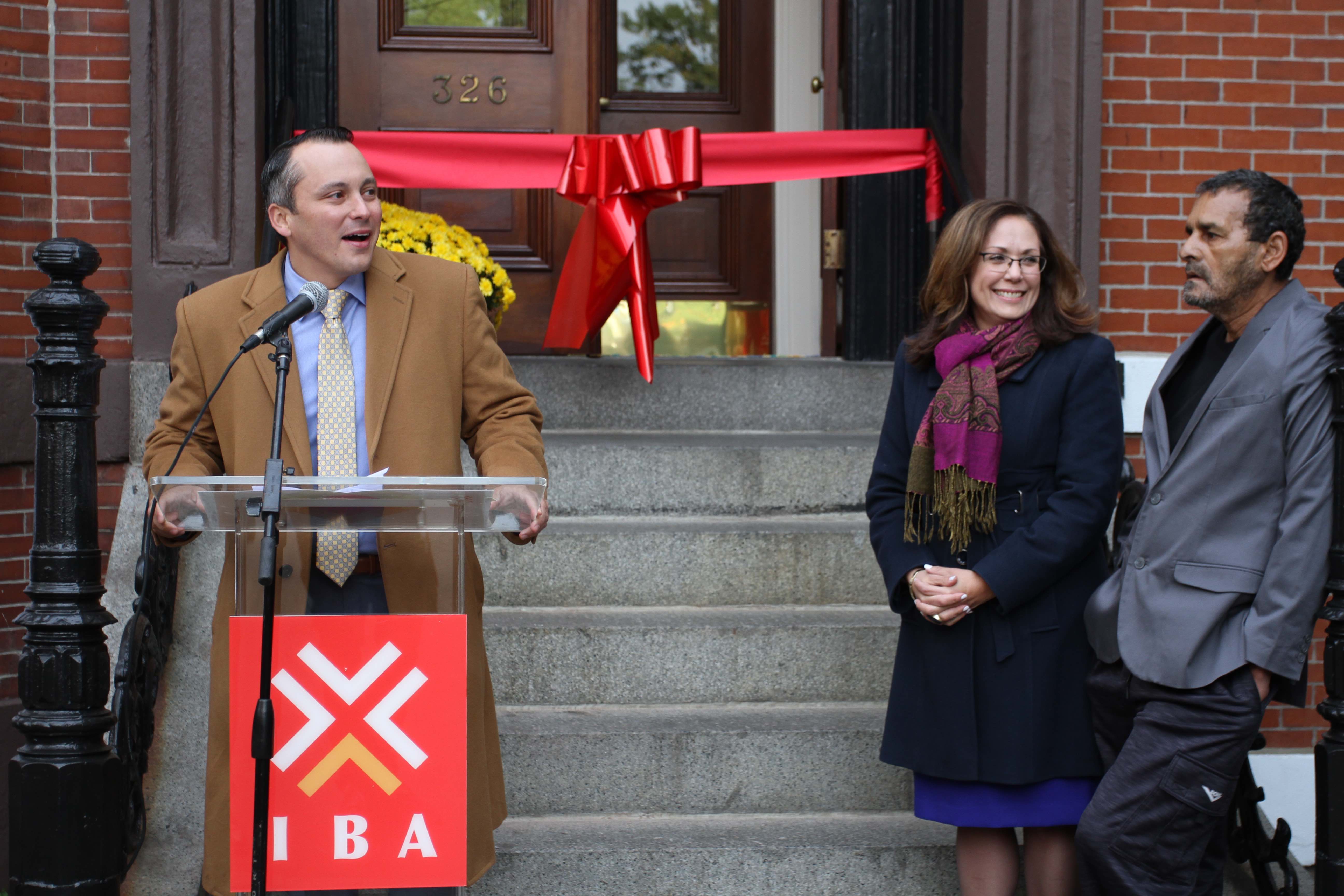
The ceremony was led by our CEO Vanessa, and brought together city and state officials including State Representative Aaron Michlewitz, Undersecretary of Housing and Community Development Chrystal Kornegay, Advisor to the Mayor for the Initiative to End Chronic Homelessness Laila Bernstein, and CEDAC Director of Housing Development Sara Barcan. There were also IBA supporters and community members in attendance, including the residents of the building who were excited to cut the ribbon marking the official completion of renovations to their home.
State Representative, Aaron Michlewitz, spoke during the ceremony.
“We gladly celebrate the completion of such an important property in the South End, carried out by an organization dedicated to bettering the lives of others” said Undersecretary Kornegay. “Our involvement with IBA on this project dates back nearly 20 years, and we are thrilled that we were able to reinvest in housing unlike any other in the area.”
Improvements were made to the residents individual units as well as to the common areas to create a more open and welcoming floor plan for the residents to interact. There were also exterior enhancements made to the historical brownstone so many in attendance not only applauded this major milestone, but joked, “It looks like the rest of the South End!”
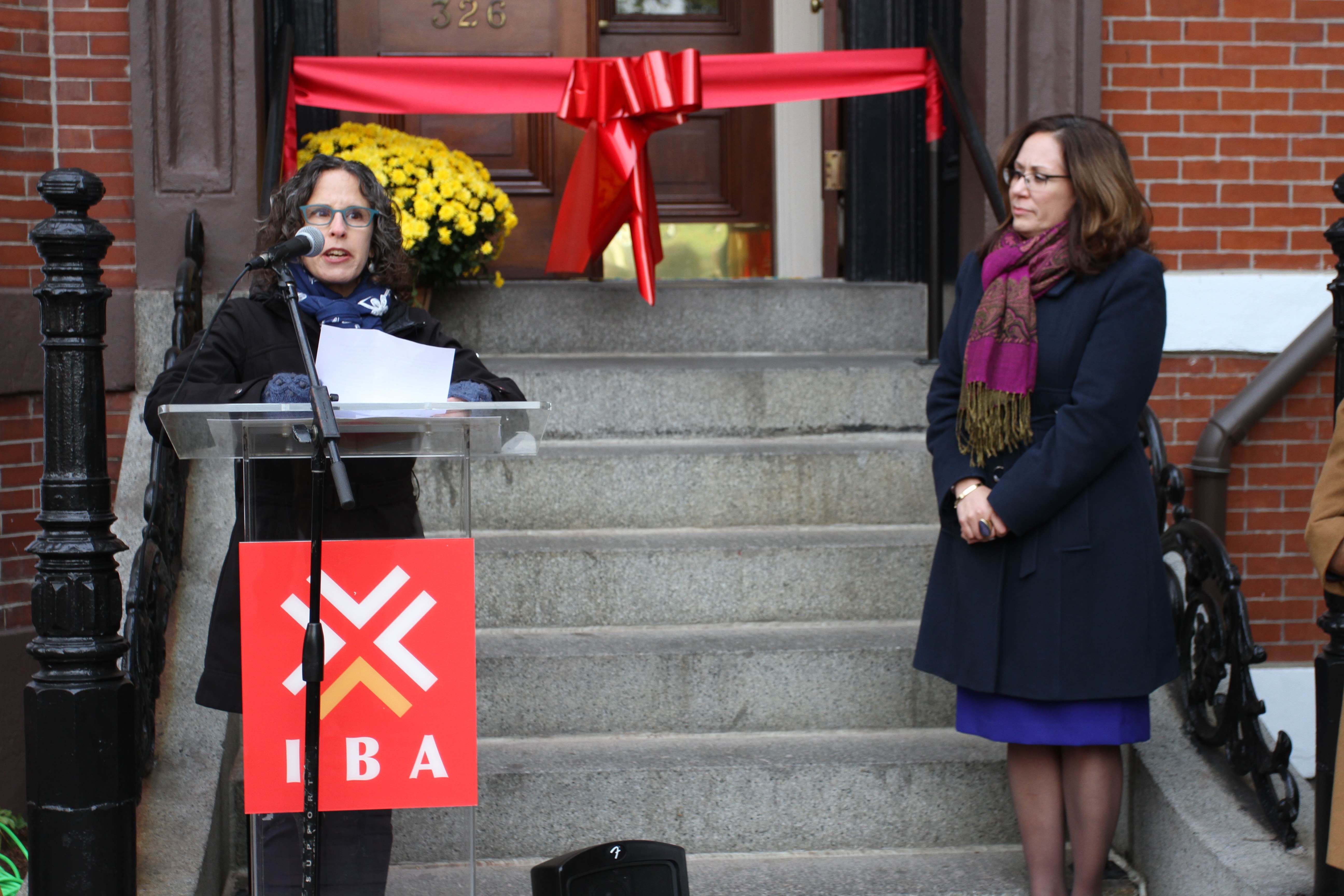
Barcan praised the project, “Our hats are off to IBA for having nourished and sustained this project for almost a quarter of a century – it’s really very impressive.” She continued, “it didn’t take anything away from the stability of the housing and the quality of services being provided [to the residents]. So, we really congratulate them on making this building a national example of what you can do with permanent supportive housing.”
CEDAC’s Director of Housing Development, Sara Barcan, addressed the crowd.
Bernstein spoke on behalf of Mayor Marty Walsh, saying, “The way to end chronic homelessness – long term homelessness – for people with disabilities is through projects like this one…We’re very grateful for IBA’s leadership in developing this project and many others that are part of the solution to stabilize housing for people who are housing insecure and also ending homelessness.”
Vanessa closed the ceremony saying, “We are grateful to those that have helped make this project happen, and look forward to continuing with more work aimed at providing affordable housing for those in need.”
This property offers affordable housing to those that need it most, and provides unparalleled services to enhance the quality of life for our residents and we could not be more ecstatic about it’s completion. To ensure that we can continue projects like this one, please donate here. Remember, any amount helps to make a difference.
Housing nonprofit Inquilinos Boricuas en Acción (IBA) has completed renovations of Residencia Betances, an 11-room single-occupancy building on Shawmut Avenue in Boston’s South End that serves low-income individuals with mental health needs.
IBA recently completed exterior and interior upgrades to the brownstone structures, including creation of open floor plans in common areas and improvements to individual units.
The property was originally developed by IBA in 1993, one of the area’s few properties that provide around-the-clock supportive housing to Spanish-speaking residents who are formerly homeless clients of the Department of Mental Health.
The project was financed by the Department of Housing and Community Development (DHCD) and in part by the Community Economic Development Assistance Corp.
IBA was founded in 1968 by a group of Puerto Rican activists to fight displacement in the South End.
The Community Economic Development Assistance Corporation (CEDAC) was recently awarded $180,000 of funding by the Kuehn Charitable Foundation to establish a new planning grant program to help the non-profit community development sector across Massachusetts. Named for the foundation’s creator Robert H. Kuehn, Jr., the Kuehn Planning Grants will help non-profit corporations in Massachusetts explore the feasibility at the earliest stages of project development. The Kuehn Charitable Foundation was created by the late Robert H. Kuehn, Jr. in the late 1990s and is dedicated to preserving communities around Massachusetts. By supporting affordable housing and historic and open space preservation, the Foundation carries on the legacy of its founder who spent his life developing affordable and historic housing. The primary activity of the foundation is the Kuehn Fellows Program, which provides hands-on experience to its fellows by placing them in positions with vetted nonprofit affordable housing organizations around the Commonwealth. “There are non-profit organizations across the Commonwealth who want to improve their communities by building new affordable housing or economic development space, but are unaware of both the challenges and the funding available to do so,” said Jennifer Gilbert, Director of Kuehn Charitable Foundation. “These grants will help those agencies determine what is feasible. We are partnering with CEDAC because their expertise in this area will allow these organizations to take the steps in turning their vision into a reality.” For more than 35 years, CEDAC has provided early stage capital to non-profit, community-based organizations engaged in effective community development. The Kuehn Planning Grants of up to $15,000 each will be awarded to organizations for costs associated with affordable housing or economic development projects. There will be a preference for projects undertaken by small, community-based organizations, as well as mixed-use and/or mixed-income projects incorporating historic preservation, projects serving low- and moderate-income artists, supportive housing for vulnerable families and individuals, and smaller scale projects. “Throughout our history, CEDAC has provided early-stage financing to community development corporations and other community-based non-profit organizations to help them develop affordable housing and child care facilities,” said CEDAC’s Executive Director Roger Herzog. “But we know that there many more organizations who want to improve their communities by producing or preserving affordable units or commercial space. The Kuehn Planning Grants will allow smaller non-profits to explore opportunities that they might feel are too financially risky otherwise. We’re looking forward to working with these organizations through these grants.” More information on the Kuehn Planning Grants can be found at CEDAC’s Website at www.cedac.org.
SourceCEDAC
Ceaseless Commitment From All Corners Of The Commonwealth
State’s Dedication To Supportive Housing Creation Has Paid Off – But There’s More Work To Do
Massachusetts has done something remarkable – it has produced more than 1,750 new units of supportive housing in just three years. By doing so, it has helped to stabilize the lives of thousands of formerly homeless families and individuals. And by helping these families become more self-sufficient, neighborhoods and communities across the state have been strengthened.
Why is this so remarkable? Because even though Massachusetts has an affordable housing finance system that can be considered the nation’s gold standard, the commonwealth’s nonprofit affordable housing providers still face considerable challenges in producing new units of housing for extremely low-income residents. Supportive housing, in which organizations offer support services and affordable housing, can be even more complex for agencies to create. So it is encouraging to see that the commonwealth not only met but exceeded its goal in developing new units.
How did Massachusetts do it? For one, the state brought all of the major players together to work collaboratively towards a goal. For the past several years, 20 state agencies, from those focused on housing to those providing human services, have worked together in a collaborative effort to improve the way we fund and produce supportive housing. This interagency initiative, chaired by Health and Human Services Secretary Marylou Sudders and Housing and Economic Development Secretary Jay Ash, meant improved communication and coordination, more sharing of information, and a better understanding of best practices.
For another, the commonwealth also experimented with ways of streamlining an often complicated funding process. Nonprofit organizations require different sources of financing to turn the idea of a project into a reality – they need capital dollars to acquire or build affordable housing, operational funding to maintain units and service funding for tenant stabilization and other supports. Piecing together that kind of financing can be a challenge, especially for smaller nonprofits.
But a successful pilot program that allowed affordable housing developers to access these funding streams in a consolidated process proved to be an effective way of developing supportive housing units. CEDAC, which provides early stage capital to nonprofit affordable housing developers, played a role in both efforts. We helped lead the interagency initiative and worked closely with the Department of Housing and Community Development on the pilot program.
An example of the pilot program’s success can be found in the partnership between Lowell’s Coalition for a Better Acre (CBA) and the Veterans Northeast Outreach Center (VNOC), which teamed up to build 27 units of supportive housing near downtown Haverhill. One of the first projects to benefit from the combined funding process, the Welcome Home Vets project now serves 27 veterans households.
More To Be Done
There is additional good news – the governor’s capital budget includes $1.1 billion for affordable housing production and preservation over the next five years, an 8 percent increase in FY17 and 18 percent increase over the life of the plan, and includes an enhancement of resources for supportive housing. And we will see additional funds from the federal government for production of these units. In April, the U.S. Department of Housing and Urban Development (HUD) announced the launch of the National Housing Trust Fund to help states create new housing for extremely low-income individuals. While the fund is modest in its first year – $174 million to be shared among all 50 states – it will still help Massachusetts in its quest to help homeless families and individuals find housing. And it could grow. The initial allocation for Massachusetts from the fund is $3.4 million.
The proof of all of the commonwealth’s efforts to address homelessness is in the numbers – after many years of hard work by providers and policy makers, the numbers of homeless families living in motels has sharply declined. Producing supportive housing units is one of the ways that the commonwealth has pursued to move homeless families out of emergency shelter.
Massachusetts has shown it is possible to address the challenge of homelessness but there is, of course, more work to be done. We remain a state with a high cost of living and one where income inequality is growing. The successful supportive housing initiative has been merged into the state’s Interagency Council on Housing and Homelessness, demonstrating a continued commitment by the state. With critical agencies working together on a common goal, we can continue to find new ways to strengthen communities and stabilize families.
Roger Herzog is the executive director of the Community Economic Development Assistance Corporation (CEDAC).
SourceBanker & Tradesman
MassHousing, DHCD Announce $9.4M In Affordable Housing Trust Fund Financing
MassHousing and the state Department of Housing and Community Development (DHCD) announced $9.4 million in Affordable Housing Trust Fund (AHTF) loan closings today which will help create or rehabilitate and preserve the affordability of 454 affordable rental apartments in seven communities.
“These housing communities receiving financing from the Affordable Housing Trust Fund represent a cross section of residents across Massachusetts who need a quality, affordable home,’’ MassHousing Executive Director Timothy C. Sullivan said in a statement. “This housing will be for senior citizens, working families, lower-income residents and homeless veterans and will provide affordable units in communities like Boston and Cambridge where the markets are hot with high rents.’’
The AHTF provides resources to create or preserve affordable housing throughout the state. Funds are available for rental, homeownership and mixed-use projects as well as housing for the disabled and homeless, but may be applied only to the affordable units. AHTF funds are used primarily to support private housing projects that provide for the acquisition, construction or preservation of affordable housing.
MassHousing and DHCD jointly administer the AHTF. Since its creation in 2001, the AHTF has provided $438.7 million in financing for 507 affordable housing communities involving 25,665 housing units.
For most of these housing communities, DHCD has also provided financing and has also allocated Low-Income Housing Tax Credits, the sale of which has generated financing toward the cost of completing the housing.
From homeless to home: Fall River family moves out of shelter into affordable apartment in Taunton
Courtney Morris no longer has to wonder where she and her children will sleep at night.
Or where they will go to school.
And she now has a safe place to store her things.
“As of 2 p.m. Sept. 26, my family and I signed a lease and we are no longer homeless,” Morris told the dozens of officials who gathered for a ribbon cutting Thursday morning at Carpenter’s Glen affordable housing development in East Taunton.
She uttered those momentous words slowly and in a soft-spoken voice but with deep emotion and conviction.
She wasn’t at the ribbon cutting because it was her job. She was there because it was her life.
After Morris spoke, Carl Nagy-Koechlin, executive director of Housing Solutions for Southeastern Massachusetts, took to the podium.
“I don’t think there are any other questions why we went through this to make this all happen,” Nagy-Koechlin said.
Morris, 31, has been living in a shelter in Fall River with her two daughters, 6 and 13, and her mother, whom she thanked for her support and guidance.
But the four of them will be moving this weekend into an affordable townhouse at Carpenter’s Glen, one of eight units with a section 8 sliding scale rental subsidy.
Up until a few months ago, Morris was scraping by working at K-mart in Fall River until it closed its doors.
At the time, the family of four was squeezed into a one-bedroom apartment in Fall River paying $500 a month. Even after she lost her job, they were still able to swing the rent, just barely, because her mother is on disability, Morris said.
But then Morris complained to the landlord about safety issues and he evicted them with just two days notice, she said. She had no money for first and last month’s rent and a security deposit, so they found themselves in a shelter.
“It was a whirlwind. I lost my job and then my house,” Morris said.
But she didn’t lose hope, she said.
When she first saw her 3-bedroom townhouse at Carpenter’s Glen in June, she had to pinch herself. It was such a far cry from the inner city life her family had been living, she said.
It even has a big grassy backyard, with woods and sky to look out from the kitchen window.
“I can sleep at night without fear,” she said.
She can even dream.
Now that she has secure, affordable housing, she has two main goals, finding gainful employment and continuing her education, which in turn will allow her to offer those same life-changing opportunities to her children, she said.
Morris would like to be a social worker one day, perhaps working with homeless families, she said.
“It’s a beautiful thing when a great need is met,” she said.
Taunton makes dent in housing crisis with renovation of Carpenter’s Glen
Mayor Tom Hoye still remembers driving by Carpenter’s Glen in East Taunton in the 1990s when it was just a bunch of “holes in the ground.”
The property had been foreclosed on and the private developer had halted construction and abandoned the project with just the foundations poured.
Hoye kept wondering what would happen to the place.
He soon found out.
“South Shore Housing came to the rescue and it’s been a godsend to the city,” Hoye said at a ribbon cutting Wednesday to celebrate the completion of a major renovation of Carpenter’s Glen.
Back in the 1990s, South Shore Housing, a non-profit housing organization now known as Housing Solutions, built 32 affordable apartments there, as well as a group residence for Department of Mental Health clients.
The original development also included 70 single-family owner-occupied houses adjacent to the townhouses. A portion of those were also designated as affordable.
But that was a long time ago and about five years ago, it because clear the apartments could use a major overhaul, Housing Solutions Executive Director Carl Nagy-Koechlin said.
The Taunton renovation included new roofs; rebuilt front and back porches; new windows; new exterior siding; energy-saving insulation; new high-efficiency boilers; updated kitchens and bathrooms; and a new playground.
And as part of the project, for the first time, eight of the townhouses were set aside for very low income people, including formerly homeless families, with subsidized, sliding scale rents.
“We really understand deeply how difficult it is for working families to find a place to live in the communities where they’ve grown up and want to remain a part of,” Undersecretary of the State Department of Housing and Community Development Chrystal Koregay said at the ribbon cutting.
The total project cost was $8 million – which includes the cost of the Carpenter’s Glen renovation as well as a simultaneous overhaul to a Housing Solutions development in Wareham.
Nagy-Koechlin said the project got off the ground a couple of years ago with $245,000 in Community Development Block Grant money through the mayor’s office of Economic and Community Development.
Hoye said it was great to see all the hard work pay off on such a worthy project. He said he first met Nagy-Koechlin at a late night City Council meeting as they worked to assure the funding would be in place.
“Let’s continue this journey together,” Hoye said Wednesday.
In addition to the local funding, the project was paid for with state and federal grants, as well as a $3 million mortgage Housing Solutions will repay with rents collected, Nagy-Koechlin said.
State Sen. Marc Pacheco, D. Taunton, said Thursday he remembers working on the initial project in the 1990s when he was assistant to then-mayor Dick Johnson.
“There is a need for affordable housing particularly today when the income gap between the haves and have-nots has never been greater and working class citizens who get up every day and go to work have to struggle to find a place to live,” Pacheco said.
Mark Cook sees that struggle every day.
He is the director of The Matthew Mission at First Parish Church in Taunton, a community outreach center that focuses on helping homeless people, the working poor, veterans, the elderly – anyone in need, he said.
Right now, there are six or seven families with children living out of their cars in Taunton, Cook said.
In one case, the father works full-time and the mother spends her days in the library with their younger child, while the older child is in school, Cook said.
“High rents are doing people in. Working families are becoming homeless families,” said Cook, whose day job is as a disaster captain for the Red Cross.
He can provide families with a warm place to spend the day and vouchers for food and clothing. But he wishes he could do more.
“It makes me feel helpless. When I see them walk away, I feel terrible. The system is definitely broken,” Cook said.
Nagy-Koechlin said Massachusetts has a “Right to Shelter” law that is supposed to guarantee emergency housing be provided to families with children – be it in a shelter or hotel – but too many families fall through the cracks.
Courtney Morris, a single mother of two, will be moving into one of the subsidized units at Carpenter’s Glen this weekend.
Morris, who has been living in a shelter in Fall River, told the officials gathered what secure, affordable housing means to her. Now, she can sleep at night without fear. Now, she can work for a better life for herself and her children.
A place to call home is the foundation on which she can build, she said.
“It’s almost as if she was saying, ‘Now, that I have a place to live, the sky’s the limit’,” Nagy-Koechlin said.
How Mass. ‘Gateway Cities’ Are Crafting New Identities
The hum of textile looms once filled the 19th-century mill buildings throughout downtown Lawrence. Immigrant workers from Ireland and Germany were among some of the first laborers.
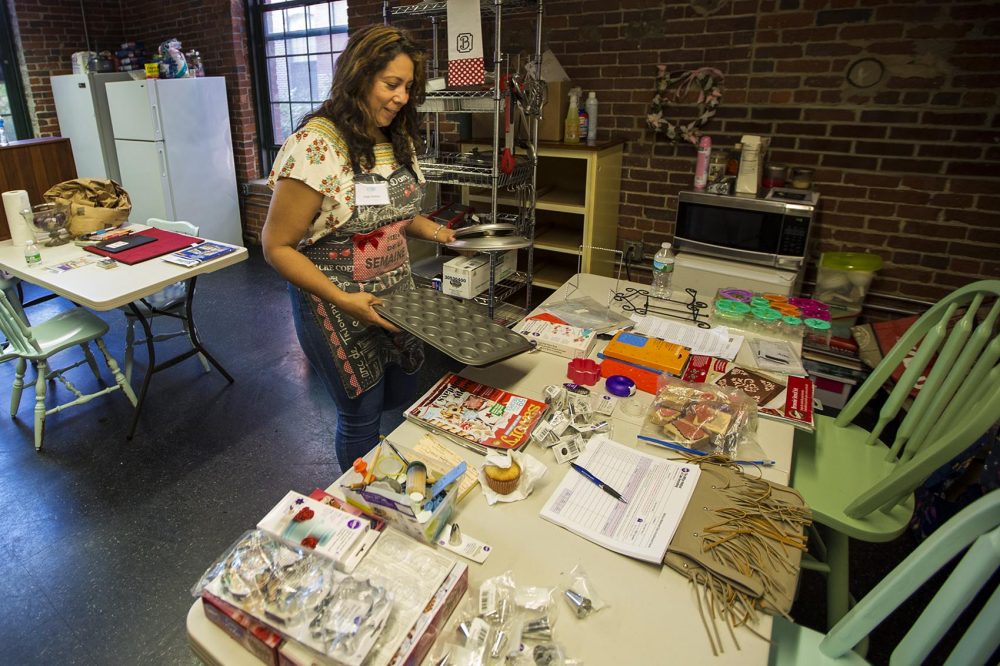
Today, many of the mill buildings in Lawrence are home to refurbished work spaces — buzzing with the sounds of artists, innovators and entrepreneurs like Angie Jimenez, who is arranging pots and pans in the site of her future cooking classroom.
“I’m going to be teaching pies, and cooking lessons — cookies, different cookies for the holidays so people can, you know, make their own and give them as a gift,” she says with a smile.
Jimenez is a graduate of Entrepreneurship for All, a business accelerator program. It’s the first of its kind in the country to offer courses and training in Spanish. It’s no surprise that such a program would launch in Lawrence, where more than 70 percent of the population is Hispanic or Latino.
EParaTodos — that’s EforAll in Spanish — gathers would-be business owners, mentors and staff who collaborate in the program’s shared co-working space.
Entrepreneurs, mentors and staff collaborate in Entrepreneurship for All’s co-working space in Lawrence. (Jesse Costa/WBUR)
CEO David Parker says after two years, graduates of the program have created 150 jobs in Lawrence and nearby Lowell — a key measurement of the program’s success.
“Because manufacturing across the U.S. and certainly here in these cities in Massachusetts has declined,” Parker says, “the immigrant communities still exist, there’s social services to help people, people who speak your language who have built neighborhoods now, except the jobs don’t exist.”
‘Lawrence Is A Place Where People Work’
New England mill towns were once global manufacturing hubs, pumping out cotton, wool and paper products — attracting immigrant workers from around the world.
But, one by one, the mills closed when faced with factors like modernization and global trade.
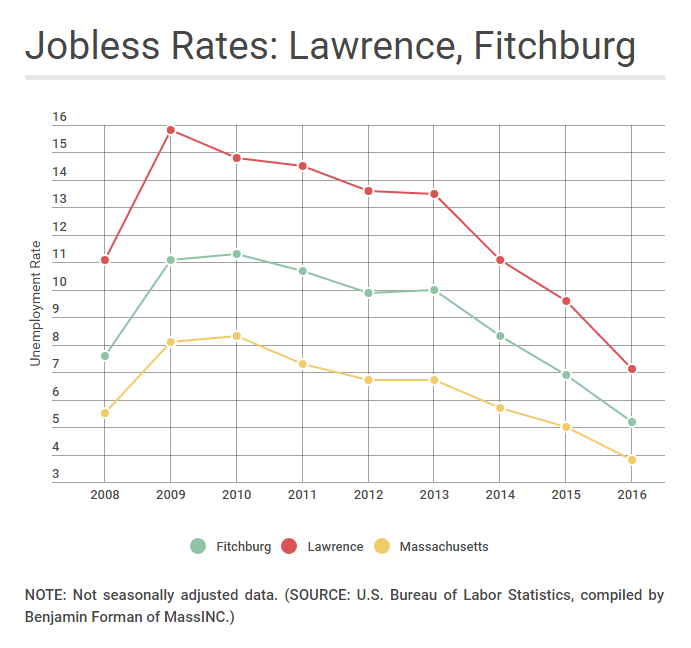
Unemployment in Lawrence is now among the highest in the state, a dubious distinction the city shares with places like Springfield and Holyoke — all former mill towns, now known as “Gateway Cities.”
On paper, it might not be the most flattering title.
State law defines a Gateway City as a mid-sized municipality, where the median household income and rate of bachelor’s degree holdersare both below state averages.
But Lawrence Mayor Daniel Rivera says there’s more to Gateway Cities than those metrics alone.
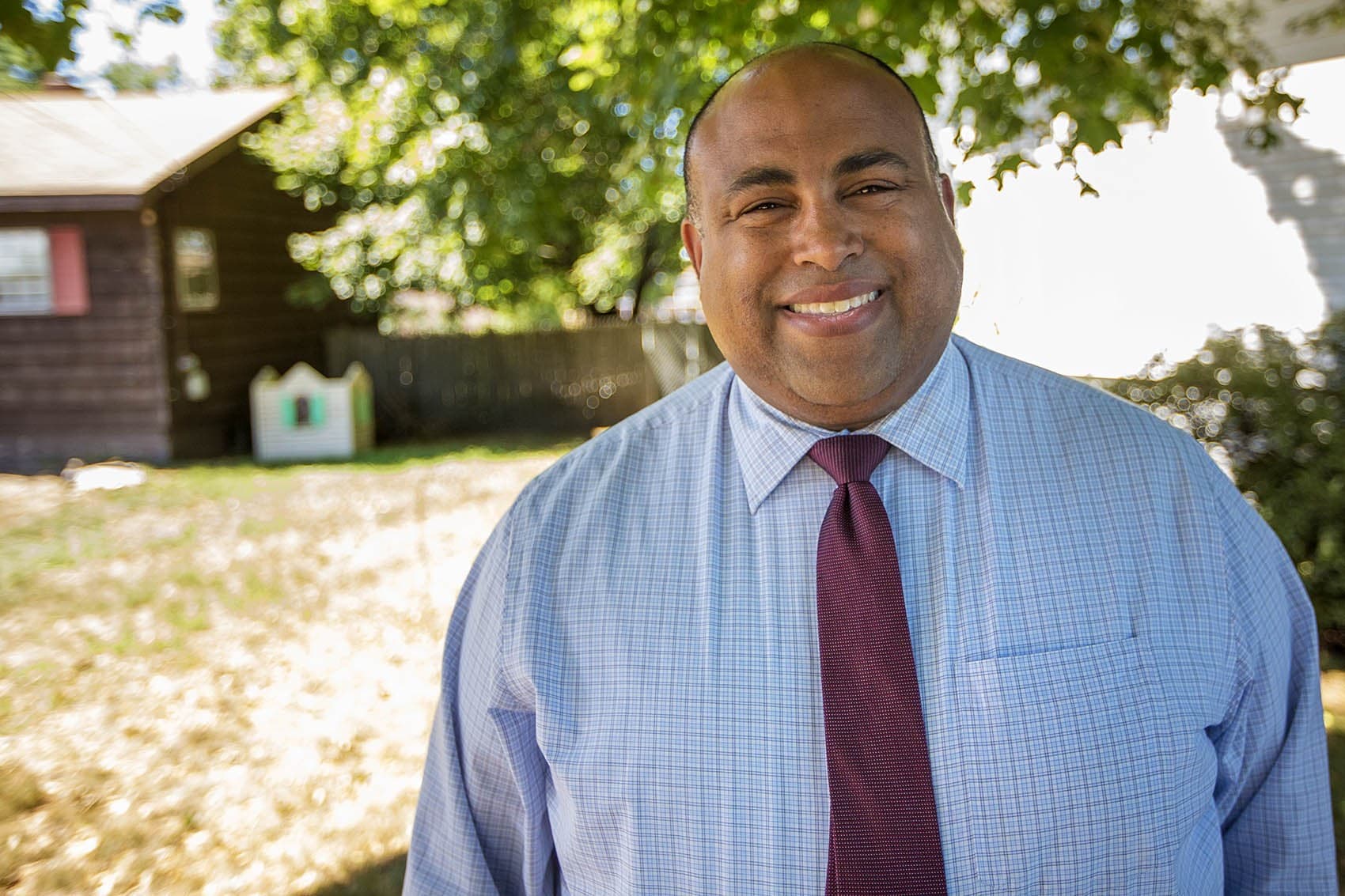
“Lawrence is a place where people work,” he says. “We’ve always been a place where people work.”
Rivera says he’s proud of the city’s immigrant heritage and the work ethic he believes accompanies those roots. He believes that owning that immigrant identity has helped shift the image of the city.
“We’ve already changed the way people talk about Lawrence,” he says. “They used to talk about Lawrence in these whispered tones and, like, not so great intonations and now they’re like, ‘Wow, something good maybe’s happening up there, maybe we should go check it out.’ “
Lawrence Mayor Daniel Rivera (Jesse Costa/WBUR)
Despite ongoing challenges, Rivera says he’s confident Lawrence is poised for progress, and hebelieves the city’s geography plays a role.
“When you think about what’s happening in Boston, and that’s around the boom in housing, they’re just doing great and we’re so excited about that because at some point they’re going to cap out and people are going to come toward our areas,” he says.
That’s the hope in many of the state’s 26 Gateway Cities, some just close enough to see the glow of the red hot market in Boston.
But a recent report findsBoston’s boom remains largely isolated from the rest of the state.
Benjamin Forman is research director at MassINC, a nonpartisan think tank. He’s also co-author of the Gateway Cities report, “Rebuilding Renewal.”
Forman says that while state investment in Gateway Cities is robust, it lacks coordination, which hinders significant impact, especially in places south and west of Boston.
“The biggest story in Massachusetts is the pull of Boston, how everything has been pulled into the orbit of the city,” he says, “and so to that extent the closer you are to that action, the better off you are as a small, mid-sized regional city in our state.”
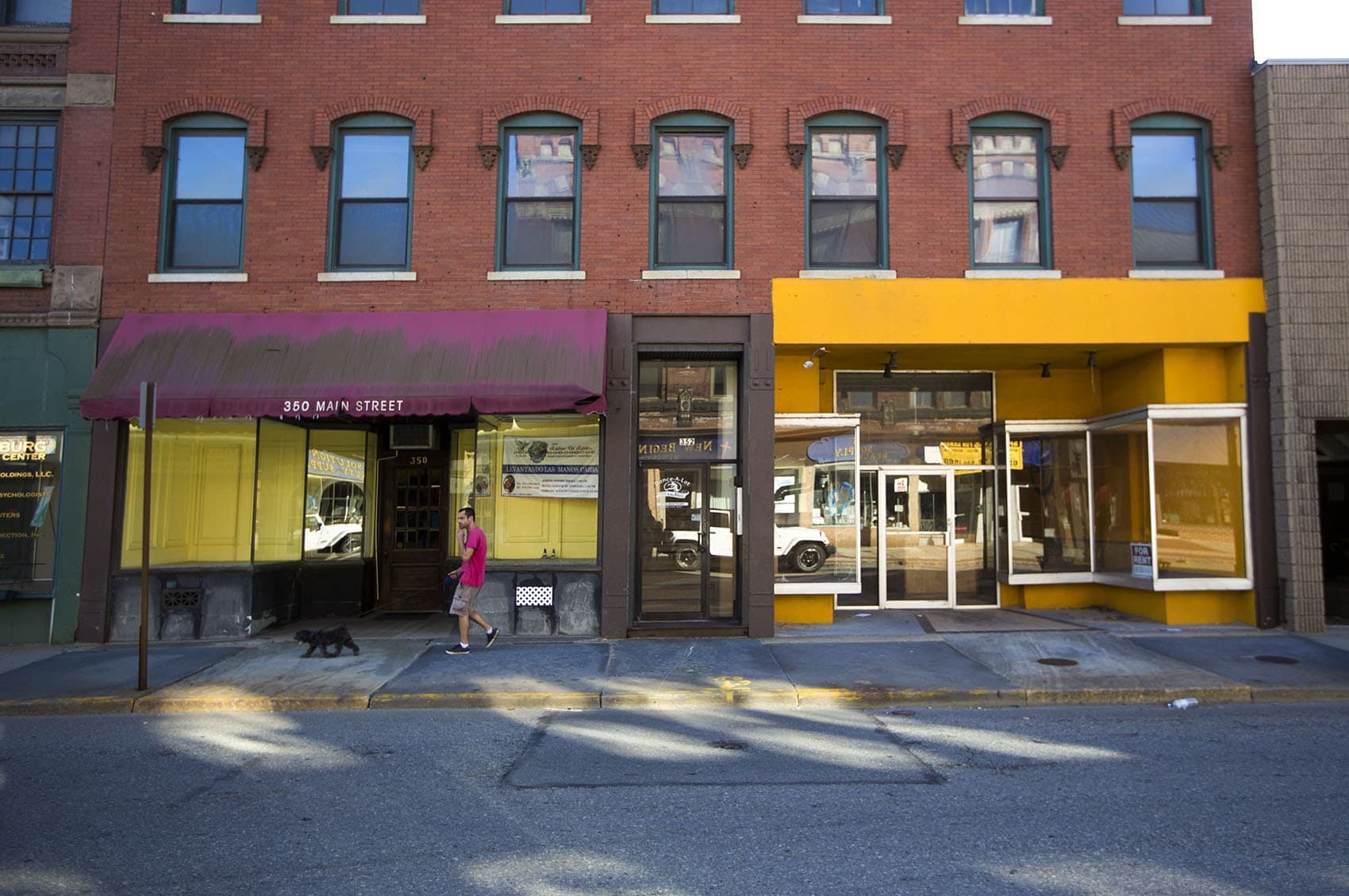
A man walks his dog in front of vacant commercial spaces along Main Street in Fitchburg. (Jesse Costa/WBUR)
Embracing Change In Fitchburg
Forty miles west of Lawrence, another Gateway City is also planning a revival.
And on this day, a group of six nonprofit leaders and city officials are gathered around a table to figure out how to pump a little more vitality into Fitchburg’s downtown.
Mayor Stephen DiNatale, who took office in January, says the city’s weak real estate market has yet to fully recover from the subprime mortgage crisis. Nearly one in five homes in Fitchburg are underwater on their mortgages, according to real estate tracking firm Zillow Inc.
An old housing stock and deteriorating commercial and civic buildings present another challenge — one that the mayor says the city is trying to address through demolition.
Fitchburg Mayor Stephen DiNatale (Jesse Costa/WBUR)
“When I took over, the demolition figure for Fitchburg was about $30,000,” DiNatale says. “This year we’re going to be spending close to a million.”
DiNatale says that increase partially reflects a better system in place to identify blighted properties, as well as a renewed commitment to improving the community.
“That will take care of, in terms of removing some of those areas that bring a neighborhood down,” he says. “I mean the challenge is, more of those buildings than we can deal with, so we’re going to chip away at it every year.”
Fitchburg, once known for its bustling paper mills, is also chipping away at a new identity.
Much of that work falls to NewVue Communities, a local community development corporation.
Walking out onto Main Street, Marc Dohan, NewVue’s executive director, says he sees more than vacant storefronts and sparse sidewalks. He also sees opportunities and success stories.
Pointing just over his shoulder, he shares one such story.
Luis Feliciano cuts the hair of a young boy at the newly opened Brother’s Barber Shop on Main Street in Fitchburg. Feliciano worked with NewVue Communities, a local community development corporation, to open his business. (Jesse Costa/WBUR)
“We have about seven businesses just right in this little section of Main Street that we work with,” he says. “So, Brother’s Barber Shop, Luis started it on his own. He came in for us, got technical assistance. It’s impossible to get your hair cut there now ’cause he has so many people with him.”
Heading north of Main Street, Dohan stops to point out the vacant B.F. Brown School, NewVue’s next big development project, which Dohan says will be renovated into artist apartments.
The old school is just across the street from the Fitchburg Art Museum, an institution that Dohan and others say is integral to Fitchburg’s sense of place.
Marc Dohan, executive director NewVue Communities, stands in front of the vacant B. F. Brown School which NewVue plans to renovate into artist apartments. (Jesse Costa/WBUR)
“One of the things that we think of for Fitchburg, it is one of the cultural hubs of the area. It has the art museum, it has the university, and we want to build on that asset,” Dohan says. “This neighborhood in particular, it’s one of the more diverse neighborhoods in north-central Massachusetts, and that’s another type of culture that we want to take advantage of because people who live here want to celebrate their own culture.”
Dohan says recognizing the importance of change is key to Fitchburg’s success.
“I think all great places, it’s not just the old, it’s not just the new, but it’s welcoming and being able to accept that change as opposed to being afraid of that change,” Dohan says.
Fitchburg and Lawrence are trying to embrace change, recognizing their mill town histories while crafting a vision of their future as Gateway Cities.
And that willingness to change may be one of the most important indicators of success.
WBUR is participating in a national week of conversation, along with other NPR member stations, on economic opportunity. Find more from “A Nation Engaged” here.
Pine Street Inn Opens New Brookline Affordable Housing
Home sweet home is the new reality for 30 people in Brookline, thanks to the efforts of the Pine Street Inn.
It’s part of an effort to build permanent homes for people who had been homeless. And for the people moving in, having their own places is changing their lives.
“I don’t worry about going hungry, sleeping somewhere,” says Joe Joy, one of the new residents.
For Joe, his humble studio apartment means everything.
“I say a prayer in the morning and in the night. I’m like, my God, where would I be right now?” he says.
Joy is one of 30 formerly homeless people who will live on Beals Street in Brookline, a tree-lined residential area just a stone’s throw from JFK’s birthplace.
“It’s a huge, enormous victory and a miracle, and we’re very grateful to the town of Brookline,” says Lyndia Downie the head of the Pine Street Inn.
Friday was the official dedication, celebrating the renovation of two buildings by the Pine St. Inn and its partners. The Inn has developed 900 units of permanent housing like this in Greater Boston.
“Housing is the basis of everything. Housing is where you get up in the morning, where you go to sleep at night, where your community is, where you eat,” says Downie.
As part of the project case managers will work with residents if they need services like health care or job training.
“It feels good to be able to just walk out and go about your business,” says new resident Joe Joy.
Congressman Joe Kennedy was the keynote speaker. He lives just around the corner from the new housing.
“The support that went into making this investment, the hard work that brought it to fruition I think, is a real testament to the power of upward mobility and the promise that housing provides,” says Kennedy.
And for people like Joy, Friday really was the first day of the rest of their lives.
“I try to do the best that I can. It’s a complete turnaround,” he says.
Thanks to projects like Beals Street, the Pine Street Inn now has more permanent housing units than shelter beds.
Of course the Inn couldn’t do it alone. Their partners include the town of Brookline, state agencies, banks and an army of volunteers.
SourceCBS Boston
X
The Work That Happens Early: Reflections from CEDAC’s FY25 Annual Report